Showing posts with label buttons. Show all posts

Sunday, November 15, 2026

Using Buttons for Math and Literacy Work with Children

"Button experiences span all domains – they can be used across the curriculum; for math, for language and literacy, for dramatic play, for art, for construction and block play, and for science as children relate to the properties of the buttons and the materials they are made from." 

 Diane Kashin

Buttons are one of my favourite loose parts. I recall as a child the joy I felt exploring the old tin of buttons my grandmother kept in a drawer in the kitchen. These buttons seemed as old as she was; collected over the years and kept 'just in case'. These buttons became my entertainment for hours. I remember counting and sorting them. The shiny ones usually caught my eye first. Some of them were so unique it was hard to believe they came from an article of clothing my grandmother might have worn. I loved to invent stories about where these buttons originated. Each seemed to have a special story to tell.
 
The collection of buttons are now in my classroom and one of my reliable resources when I want to inspire children to explore. There are so many different ways children can learn using them. Here are some of my favourite activities.
 
Math
Sorting: Have children identify an attribute and group buttons accordingly (e.g., size, shape, colour, number of holes, texture, material).
 
Estimating and Counting: Display buttons in a container and encourage children to make a reasonable guess as to how many there are. Offer a hundreds grid and encourage children to use it to count the collection.
 
Patterning: Children can create different patterns using the buttons. Ask them to identify the core of their pattern.  
 
Measuring: Offer buttons in a sensory bin with different measuring tools (e.g., cups, spoons, bowls). Invite them to measure how many buttons they can use to fill each container. 
 
Graphing: Offer children grid paper. Invite them to sort buttons and line them up on the paper to create a physical graph showing how many of each colour they have. 
 
Literacy

Fine Motor Work: Offer children different templates that show a variety of lines. Invite them to pick up each button using a pincer grasp and place it on the line to create a button design.   
 
Vocabulary Cards: Children can use different vocabulary cards to read and write about buttons. Cards that explore shape, colour, and articles of clothing can be provided along with fun stationary. Invite children to copy the words or use them to create their own 'button books'.  
 
Drawing: Children can draw their own unique pieces of clothing that feature buttons. Provide a button template and ask children to imagine to what that button belongs. 
 
Creative Play
Art: Offer a collection of buttons and frames to children. Invite them to create their own 'loose parts' button pictures inside the frames. Buttons can also be provided at the art center for children to incorporate into their artwork. Challenge them to create something completely of buttons!
 
Building: Include a basket of buttons in the construction area of the classroom. Children can incorporate them into their building, perhaps using them to embellish wooden structures. 
 
Dramatic Arts: A basket of buttons in the drama area can become transformed into anything - perhaps children might use the buttons as 'food' when cooking, or as play money in a store.
 
Need help setting up a button invitation for children? Check out my Buttons Math Templates and Vocabulary Cards on TPT!

Thursday, May 12, 2016

Beautiful Beading

We had some delicate treasures that arrived to the classroom as part of our "Beautiful Stuff" project this week! The children were captivated by the many beautiful beads, buttons, and jewelry that came in the brown paper bags. There is something so rich, so magical about beads and buttons. Perhaps it is because we don't know the story of how they came to be; whose outfit did they fall from, what travels have they had? We love working with them in our classroom. Today we displayed this treasure in baskets at our art area and encouraged the children to explore.
 

They noticed that there were many beautiful colours in the collection; we gave them plates and encouraged them to begin sorting what they saw. Soon the children had designated a colour to themselves and searched the collection for trinkets of that colour. It led to a very rich discussion about how colours have many shades, and depending on how you look at the colour, it might be considered a part of more than one group. For example there was a lively debate about whether a teal button belonged with the green or blue group.
 
Once the children sorted their objects we encouraged them to string them together using clear fishing line. The added challenge of working with such delicate materials is that the children had to persevere with stringing many beads and this helped strengthen their fine motor control.


Once the colour strings were finished we displayed them in our art window so they could be illuminated by the sun. They are a gorgeous, happy addition to this spot!
 

We also liked how this activity promoted mathematical thinking; children were using their knowledge of colour to sort the objects accordingly. They were also measuring to see which string was longer and how many times it could be wrapped around the branch.


"The only difference between an extraordinary life and an ordinary one is the extraordinary pleasures you find in ordinary things."
 
Veronique Vienne

Thursday, March 12, 2015

Pete's Buttons

"Pete the Cat" is always a favourite character of young children! Today we read the book "Pete the Cat and His Four Groovy Buttons". In this story Pete loses his buttons one by one and the reader is challenged to think of how many are left on his shirt each time. It's a great reinforcer of subtraction, complete with subtraction sentences to accompany the pages.

We decided to set up a math invitation based on Pete's buttons - we used ten frames, plastic buttons, wooden numbers, and dry erase markers.


The materials were open-ended and it was interesting to see what the children decided to do when visiting the centre.

Some children found a number, matched the corresponding buttons on the ten frame, and then practised writing the number themselves!


Other children wanted to challenge themselves to think of addition and subtraction sentences and record these under the ten frames.


It's interesting how using appealing manipulatives inspires children to think about math in new and exciting ways!


Friday, February 14, 2014

Sorting Buttons by Colour

Today we placed a large basket of buttons on the math table with colour mats. 


The children were eager to explore the buttons and successfully sort them by colour. 


The children discovered that one colour has many shades. 

Sunday, February 24, 2013

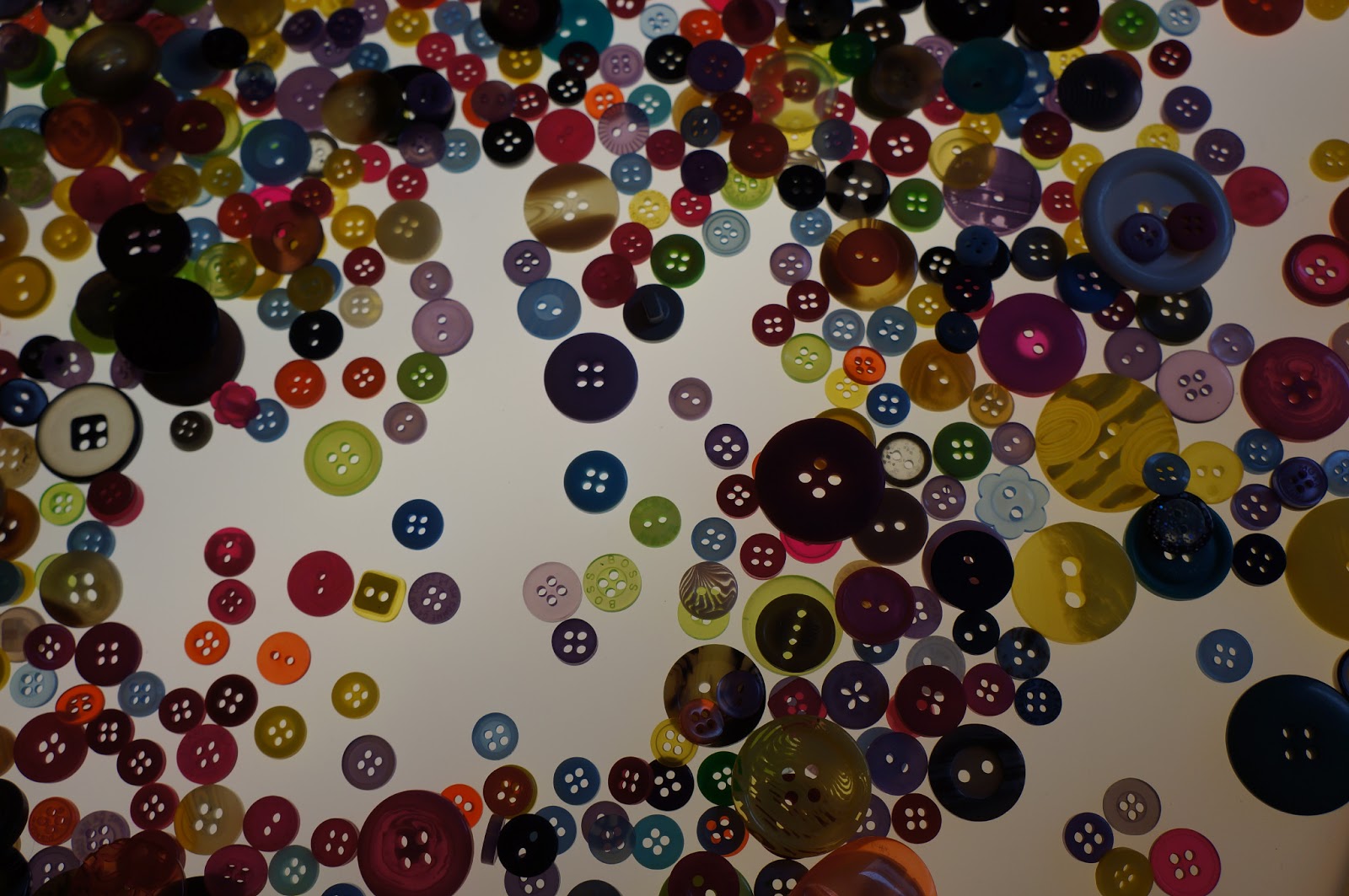
Buttons on the Light Table

Sometimes all it takes for children to become engaged in a task is for it to be located in an unpredictable place. Sorting buttons becomes much more intriguing when done on a light table!


Related Posts Plugin for WordPress, Blogger...