Showing posts with label symmetry. Show all posts

Monday, October 13, 2025

Spider Math

 "Oh look! There's a spider on the school! 

Maybe he's coming to learn too!"

Autumn always brings with it many treasures. Recently my students have been curious about the many creepy crawlies they have been discovering in the yard. Although spiders can be scary for some, they serve a big purpose in our local ecosystem as they eat insects and also are a source of food for others. Exploring them together also helps those who are scared or reluctant learn to see them in a new way. 

I always look for ways to incorporate children's interests into our activities, specifically math. Here five spider math ideas for you to use with your little ones!

1. Which One Doesn't Belong - encourage children to examine and describe these collections of images and articulate which they believe doesn't not belong in the group and their reasoning why.


2. See, Think and Wonder - this thinking routine asks children to carefully examine something and clearly describe what they see, articulate their thinking about the object, and express curiosity through wonderings and questions related to the subject. This picture of an intricate web might be an interesting prompt for discussion.

3. Spider Survey - ask children to record their names on a t-chart that indicates whether or not they like spiders. Calculate and interpret the results of the survey with children. Click the image to access the printable.


4. Spider Subitizing - use this printable with children to explore different ways of representing a number. Write a number on the spider and ask children to brainstorm and record many different ways of showing the number (e.g., tallies, dots, ten frames, word). Click the image to access the printable.


5. Spider Symmetry - use this printable with children to explore the concept of symmetry. Encourage children to draw the missing half of the spider and web as best as they can. Explore symmetry in photos of real life spiders!
Click the image to access the printable.


Thursday, October 14, 2021

Autumn Math Walk

 “I'm so glad I live in a world where there are Octobers.”
L. M. Montgomery, Anne of Green Gables 

What a beautiful time of year it is in Southern Ontario! We have been spending much time outside each school day exploring the changes in our school yard. The children are curious about the world around them and ask many questions about their surroundings and the autumn treasures they find. Many of their wonderings have been mathematical in nature - Why is there a pattern on the sunflower's seed head? What are those holes in the stump and where did it come from? Why is a Daddy Long Legs an arachnid and not a spider?  How do leaves change colours? Why are the clouds moving so fast in the sky?

There is math everywhere. If one looks deeply enough, there is always a mathematical connection in nature. The sunflower seeds follow the Fibonacci Sequence - a numerical pattern meant to help maximize space and fit as many seeds into the head as possible. The perfect little circles in the stump might have been caused by a wood boring insect or bird looking deep into the bark for food. Daddy Long Legs have a different body than spiders even though they have eight legs. Leaves change colour because the amount of sunlight they need to create their own food lessens in cold weather (as the Earth's axis tilts us away from the sun), resulting in a chemical change in the leaves. 

I've been motivated to continue to look for rich mathematical wonderings and opportunities for inquiry each time I'm outside - even on the weekend with my own children. I find it fascinating to see math applied in an authentic, interesting, real world connection. The math in nature is beautiful! Inspired by this mathematical beauty I have written a book called Autumn Math Walk that includes photos and narrative to help readers delve deeply into exploring math in the outside world. I've appreciated the interest in this book and loved seeing the ways educators have used the text in their classrooms. Learning from one another is so inspiring!


I'm so very excited to partner with Pembroke Publishers and offer a free teaching resource to complement my book Autumn Math Walk!

Autumn Math Walk Teacher's Guide is a free resource that can help educators understand the math that exists in the natural world, and use this information to provoke conversation and understand with children as they explore nature. Perhaps children will be inspired to author and illustrate their own Autumn Math Walk book unique to their specific surroundings!

Saturday, October 2, 2021

Pumpkin Math

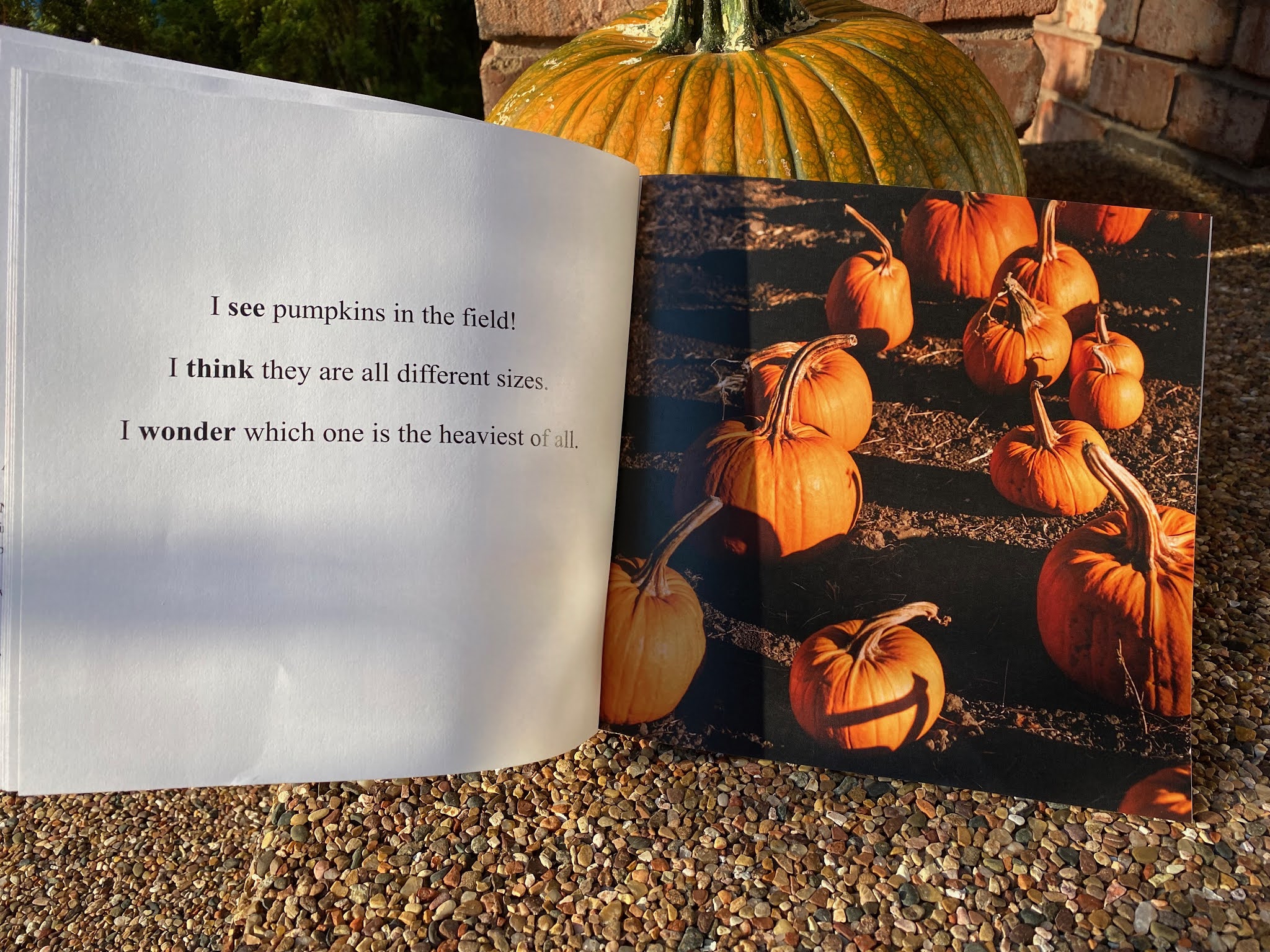
Autumn is such a wonderful time of year! The colours and textures can inspire such rich math conversation! This past weekend we visited a few farm stands in the area and all I saw was math around me! I'm hoping that these photos will be useful as math prompts for 'math talk' conversations with children.

Show children a photo and ask them to share what they 'see, think and wonder' about each photo. The 'see, think, wonder' thinking routine can be used to help children delve more deeply into exploring and articulating what they notice in a specific situation. As children notice and name what they see, they can make connections to their own experiences and ideas, and form questions for further exploration and math research. 

Educators can also ask children specific math questions to guide their thinking. This can be especially helpful if the math concepts in the photos are geared towards an existing exploration the children are having, or if specific curriculum and assessment investigations are needed by the children. Sample math questions are provided below!

How many bumps are on this pumpkin?
 How big around is the stem?
What patterns do you notice?

How are these gourds organized?
What other ways can you sort the objects?
How many do you think are in each bushel? How do you know? 

 
What patterns do you see?
Why is the pumpkin more narrow at the top?
How big around might this be in the largest part?  

How many pumpkins do you estimate are in this box?
How many pumpkins might fit in the box if it was filled to the top?
How much money do you think the farmer should charge for the entire box of pumpkins? Why?

If these pumpkins are $3.50 each, how much would all of these cost? 
Should bigger pumpkins cost more than smaller ones? Why?
Which do you think is the biggest? How do you know?

Which pumpkin would you pick if you only had $2? Why? 
If you had X dollars, how many pumpkins could you buy?
How much money do all these pumpkins cost altogether?
What symmetry do you notice?
What patterns do you see?
How many pumpkins would a full crate hold?
 
Which gourd does not belong? Why?
How could you sort these? What's your sorting rule?
How many gourds do you think are in this bushel?
 
Halloween Math uses the 'see, think, wonder' thinking routine to explore seasonal objects and experiences in a mathematical context and is now available from Amazon!

Monday, August 16, 2021

Embracing Math Talks Outdoors


“The book of nature is written in the language of Mathematics.” 
Galileo

The children were gathered around a zinnia in the garden. Right in the middle was a fuzzy bee covered in pollen. I stood back and listened to their conversation. 

"Wow! Look at those cool wings! They are as big as his body!"

"I like his hairy little legs. He holds onto the flower when he walks."

"Look at all the pollen on him. It covers his entire body!"

"I wonder how much food he all day."

Spending time outdoors in nature is vital for children's mental and physical health and well-being. In our kindergarten program we are usually outside for one or two hours each day. We engage children in a variety of play-based, inquiry-based experiences. Each day we also encourage children to freely explore the yard. I love to step back and observe their play. The observations they make, and the questions that they ask, are filled with rich math potential. Many times we have had a deep math exploration as a result of their observations and wonderings about the natural world.

Many educators are familiar with Sherry Parrish's Number Talks - a strategy where children participate in daily math explorations designed to help them play with numbers. Children are introduced to a problem and asked to visualize what is happening, while using previous math knowledge and experiences to perform a quick calculation. Children are encouraged to share their ideas with one another. As the math conversation occurs children learn from their peers as they explore different ways the math was solved. This daily practice helps build confidence and fluency in math as students reflect upon their ideas, gather feedback from others, and acquire new ways of interpreting and solving math problems.

In the July 2021 issue of Mathematics Teacher: Learning and Teaching PK to 12 Jo Boaler writes about how educators can leverage 'data talks' to help students delve into analyzing and understanding data more fully. Similar to a number talk, data talks encourage children to notice and wonder about different representations they see (e.g., bar graphs, line graphs, collections of objects). Boaler posits that data talks will help children visualize and make sense of the information they notice emerging in different data, helping them to grow as critical consumers of information.

http:// Like number and data talks, educators can embrace the power of math talks outdoors to help children recognize, understand and appreciate the authentic and integrated ways that math exists in nature. 

Math talks outdoors can happen in two ways: 

Preplanned - educators who wish to engage children in an exploration of a specific math concept (e.g., patterning, symmetry) can guide children to an object or experience outside that demonstrates this in real life. Perhaps an educator is hoping to spark an interest in symmetry, or needs additional assessment opportunities for this topic. S/he can guide the class to the garden where they can observe symmetrical flowers and engage in a conversation about what they see, think and wonder. 

Spontaneous - educators carefully observe children's conversations and interactions outdoors. As children notice and wonder about a specific phenomena (e.g., how fast the wind is blowing, the shadow a leaf is creating on the ground), educators scaffold and support the mathematical inquiry. Educators listen to the questions children ask, and help them conduct research into finding an answer. The research into the question or wondering can happen briefly, or extend over time, as additional resources and information are used to deepen the mathematical exploration and understanding. As math ideas emerge, educators can 'notice and name' these in the context for children (e.g., "The distance around a tree stump is called the circumference. We can measure it in many different ways. Let's find the stump with the biggest circumference in our yard.").


Math talks outdoors will inspire children to look at their world through a mathematical lens. Seeing math concepts in authentic contexts will help children understand the relevance math has to their lives and the world around them. Abstract mathematical ideas can become more concrete and easily understood and internalized by children. Some of our richest math inquiries have sparked as a result of the children's curiosity about the world around them. 

Some tips for getting started:
  • Uses the see/think/wonder routine where children are asked to state what they see in a particular situation or object, share what they think about this situation or object, and share a question or wonder they might have. (I see circles forming when the rain drips into the puddle. I think these are happening because the rain is falling from the sky quickly. I wonder why some circles are bigger than others.)
  • Record children's conversations and take photos of their explorations for future reference. These can be brought to a whole group meetings for further discussion, or reviewed at a later date for assessment purposes. 
  • Look for interesting objects and events in your school yard in which to draw children's attention. Use a 'notice and name' strategy where you share your observations and connections with children in order to pique their curiosity and spark an investigation.
  • Connect math concepts and vocabulary when exploring outdoors. Help children see the math in the natural world, and practice using the proper terminology (e.g., The way the tree branches are positioned  is called a fractal pattern.")
  • Bring outdoor math talks inside by using artifacts and photos with children during whole group discussions. Similar to outside experiences, ask children to observe an object (e.g., feather, shell) or photo (e.g., of a child jumping off a stump) and make mathematical observations and connections.
Like number and data talks, the possibilities for learning by regularly incorporating math talks outdoors are limitless. Invite children to share their ideas, connections, and questions with one another, as they appreciate the beauty and joy that math outdoors has to offer.

Friday, August 21, 2020

Inspiring Math Learning Outdoors using Moments and Photos

The world outdoors is filled with amazing math moments. Almost anything you find - whether it is natural or man made - contains an element of math.

From the symmetry we find in flowers or garden wheels...        


...the interesting shapes we can spot in structures and found objects...    


 ...the uniquely formed angles hiding in unexpected places...


 ...to the potential for discovering and playing with numbers.


The world around us uses math in the most interesting of ways.

Many educators are looking ahead to this school year, wondering how to engage children in authentic math moments while decreasing the risks associated with the current pandemic. Many experts recommend holding classes outside. This option is appealing, but some wonder how to take the math learning they traditionally offer in the classroom to the world beyond. How might one fulfill curriculum expectations and assess student learning while being outside?

I suggest looking to the world around you for math inspiration! 

Whether you are a teacher who will be holding your classes outside, or planning to engage children in online learning, using the outdoors to inspire math talks can be an authentic and exciting way for children to delve more deeply into math concepts while seeing their application to real life. 

Teachers can chose specific photos or places in the yard to introduce curriculum concepts needed to be covered (e.g., showing a photo of rain drops in a puddle to introduce the concept of radial symmetry) or ask children to see/think/wonder about a phenomena they notice and planning a mathematical inquiry centred around this (e.g., estimating and then problem solving for how to calculate the number of daisies that have grown in the garden).


There is math potential everywhere!

To help get you started, I have compiled a collection of 75 photos featuring natural and man made objects from the outdoors. You can access these here: Photos to Inspire Math Conversations

Feel free to use them to inspire math conversations in your physical classroom, or during an online math talk. Download them, print them, use them however you'd like to facilitate math learning with your students. Heading outside to explore math might seem daunting at first, but listening to the observations and questions that children have can be a wonderful start to a rich, mathematical inquiry.

I'd love to see the math learning you experience as we head back to school. Don't forget to tweet me @McLennan1977 and share the amazing #foundmath you discover in your explorations outdoors!


Friday, October 13, 2017

Playful Symmetry

"Mathematics is one of the essential emanations of the human spirit - a thing to be valued in and for itself - like art or poetry."  
(Oswald Veblen)

Math has become one of the most engaging and aesthetic experiences in our inquiry-based classroom. The more I experience math pedagogy in practice, the clearer it seems to me that math and the arts are intertwined. I have been inspired to look at all actions in our classroom through a mathematical lens, regardless of which learning domain they appear to belong. Many of our recent endeavors have been inspired by a wonderfully rich book I have been exploring regarding geometric and spatial thinking. In Taking Shape the reader is taken on a journey of understanding regarding the importance of engaging young children in rich spatial reasoning activities and inspired to replicate and evolve many of the activities in the classroom. Many of these also celebrate aesthetics in shape and design, something the arts encourage as well.


The authors advocate for the inclusion of more spatial reasoning in the classroom for many reasons: spatial reasoning and mathematical thinking are intimately linked, spatial reasoning can always be improved regardless of the age or experience level of the students, spatial thinking is an important predictor of achievement in STEM careers, spatial reasoning is currently an under served area of math instruction, and spatial reasoning provides multiple entry points and equitable access to mathematics.

One section in particular, symmetry, stood out to me.  Recently I had noticed symmetry appearing in many of the children's wooden structures made from large and small blocks. I wondered if they had previous experiences with symmetry and felt that it would be an excellent place to begin some intensive spatial reasoning work.

 "In simple terms, two shapes are symmetrical if you can slide, flip, or turn one of them to have it match the other exactly...Symmetry provides an engaging context in which to explore mathematical structures and patterns. Symmetry - in particular, reflection symmetry - is a rich area of spatial reasoning that we can tap into as educators of young children. Symmetry is also important for later mathematics when making efficient mathematical arguments and working with graphs."
(Taking Shape, p. 20)

I have collected 12 of our most engaging activities exploring symmetry and described them below in the hopes it will inspire you to continue to explore symmetry together with children in your classroom or home!

Pattern Blocks on Sticky Paper

For this experience we have added clear, sticky mack tack to an extra easel in the classroom. Engaging math manipulatives like wooden pattern blocks can be non-permanently affixed in different patterns and designs to the mack tack. A line of symmetry can be added to help guide children in their work. When finished, a child simply removes the pieces and the easel is ready for another.


Hole Punchers

Hole punchers are excellent tools for encouraging fine motor work - they are difficult to squeeze and require patience and perseverance on the part of the user. A paper that is folded in different ways and has holes punched in various designs will open to reveal one, or many, lines of symmetry.


Building with Unifix Cubes

Many classrooms have linking cubes or unifix cubes. Our children have been drawn to using them to create small robots and airplanes. Because of their versatile nature, these cubes can be linked on all sides, and children can easily incorporate symmetrical design into their creations.


Working with Sticky Loose Parts

Loose parts offer endless opportunities for exploration of spatial reasoning and design. A recent trip to the Scrap Box in Ann Arbor, Michigan (a recycling centre for art materials) provided us with many foam pieces that had one sticky side. We drew various lines of symmetry on paper (horizontal, vertical, diagonal) and encouraged the children to place the foam pieces symmetrically on the paper. It was interesting to see their designs being built in 2D across the paper, and in 3D upwards off the paper. 


Recycled Game Boards

Recycled wooden game boards are excellent grids to use when encouraging children to consider spatial reasoning and symmetry in their design. The grid design helps children 'picture and place' geometric shapes symmetrically. In this experience we've offered recycled carpet samples to entice children who enjoy tactile experiences into creating interesting mathematical designs.


'Follow the Leader' Game with Foam Pieces 

Taking math outdoors is always fun! In this game, a line of symmetry is created with masking tape on the ground. Large foam shapes (easily cut from Dollar Store art foam) are used as game pieces. One child is the leader and the other the follower. The leader places a shape on his/her side and the follower has to create a symmetrical design by placing the same shape in reflection on the opposite side of the line. The result is an intricate symmetrical design. 


Paper Cutting

Similar to using hole punches, encouraging children to cut shapes onto folded paper results in the creation of interesting symmetrical designs. This is also a fun activity to bring outdoors. 


Paint Droppers

Children love to drop paint onto paper and fold it in half to create interesting colours and designs. In this activity the paper is folded first, indicating the line of symmetry. Children are encouraged to carefully use droppers/pipettes to drip paint onto one side of the paper only. 


The paper is folded on the line of symmetry...


...and is opened to reveal a symmetrical picture! When the primary colours of paint are used the creation of secondary colours is an added bonus!


Finding Lines of Symmetry

Helping children find symmetry in the world around them is an important discovery to instill the idea that math is everywhere. We offered books about symmetry for the children to explore, along with laminated photos of real objects from nature. The children were encouraged to look at the different pictures and then use dry erase markers and rulers to draw the lines of symmetry they saw.  


Pentominoes on Trays

Pentominoes are complex math manipulatives that fit together in interesting ways. In order to challenge children we added a line of symmetry to a tray and encouraged the children to see if they could create a symmetrical design with the pentominoes, while trying to fill the tray at the same time!


Pattern Blocks on Mirrors

Building on mirrors is an interesting way for children to explore symmetry. Whatever is constructed on the mirror will naturally reflect symmetrically with the mirror as the line of symmetry. Children are often amazed to see their creations reflected, which sometimes results in an interesting discussion of 'doubling' in addition to symmetry.   


Symmetrical Letter Guess

Many letters are symmetrical in nature (e.g., A, B, C, D, E, H, I, M, O). In this game children are shown a letter that is folded in half and asked to guess what the letter might be. 


We like to use plastic plates and dry erase markers to make games more interactive and also encourage letter writing. After children observe the folded letter they can write their guess on the plate...


..and then look to see the letter revealed! The line of symmetry is evident as the fold line on the letter.


We will continue to explore symmetry this upcoming week! Stay tuned for more ideas! Feel free to add comments and additional ideas for exploring symmetry in the comments below!
Related Posts Plugin for WordPress, Blogger...