We love to use our light table for art exploration. Today we covered the table with clear plastic and dropped the primary colours of paint on it.
I am a Reggio Emilia inspired Full Day Kindergarten teacher and mother to three young children. This blog is meant as a communication tool for the families of our children and as a learning tool for the many educators who follow us. Please feel free to comment on posts and participate in our collective understanding of emergent curriculum.
Showing posts with label fingerprinting. Show all posts
Monday, January 25, 2016
Thursday, January 15, 2015
Shaving Cream Fun
What better on a cold, snowy day then to have a super messy, super fun shaving cream sensory experience on the art table.
It's even more fun when you add the primary colours of paint to it and experiment with colour mixing.
Thursday, February 6, 2014
Mess-less Fingerpainting
Today we placed mess-less Fingerpainting bags on our light table. We used large ziplock bags (taped closed) with two colours of paint inside.
We hoped that as the children explored them the colours would eventually mix together and create new colours.
Tuesday, June 18, 2013
Outdoor Finger Painting
Today we found another use for our acrylic outdoor easel! I love to encourage the children to finger paint but sometimes it can get so messy. Instead of using a flat paper surface, we dribbled finger paint on our outdoor acrylic easel.
The paint was thick enough to stay on the acrylic, giving Caleb an interesting surface to paint on. Usually finger painting is done on a horizontal surface, and he seemed to appreciate the challenge of experiencing it done vertically instead!
The sunlight shone through the paint and illuminated it, much like when one finger paints on a light table. It reminded us of beautiful stained glass.
Clean up was easy! We just sprayed it with the hose. Don't have an outdoor acrylic easel? What about trying this on windows? (maybe perform a spot check first...just in case!)
Tuesday, January 8, 2013
Contained Finger Painting
Providing opportunities for children to explore materials like paint with their hands/fingers is an important developmental experience. It encourages fine motor strengthening and control, creative expression, and early experiences with mark making. When children are encouraged to make marks with different materials, they develop experience and interest in pre-writing behaviours - realizing that they have the ability to permanently record something tangible that can be observed, discussed, and interpreted by others. This behaviour is an important milestone for children who are learning to write. Early marks will eventually turn into drawings and as children share the 'story' behind each drawing, they will come to understand that these pictures can also be explained in oral and written words. (Schickendanz, J.A. & Collins, M.F. (2013). So much more than the ABCs: The early phases of reading and writing. National Association for the Education of Young Children)
I love to encourage children to draw and finger print in paint but know that many people are reluctant to encourage this due to the extreme messiness that is natural with the activity. In order to contain the paint and still encourage free exploration, we used our portable water table as the canvas for our work.
Caleb selected some complimentary colours of washable paint (anything else will be much harder to clean) to use in the bin.
At first he was interested in using various painting tools to explore the paint.
I encouraged him to use all the space in the bin, including the inside walls.
Of course any kind of paint with young children will often turn to finger painting and because I wasn't worried about the messiness of this activity, I encouraged him to explore painting his hands with the various brushes.
Even though the paint was repeatedly swirled together, the complimentary colours blended into a beautiful shade of aqua green and was still appealing to use.
The paint was cool and felt so smooth and Caleb spent a long time exploring it.


This activity was fun and so easy to do! An easy way to save any pictures or printing done in the paint is to lightly press a piece of large paper against it and make a print of the work. This way children's experiences can still be saved for classroom display or portfolio use.
When we were done we simply washed the bin out in our tub. Any large water/tactile table would work well for including many children at once. Smaller bins could also be placed together on a table top with many different colour combinations.
Tuesday, November 6, 2012
Rainbow Sand
We had some left over coloured sand and I thought it would be neat to explore it on our light table . I covered the table with a clear garbage bag in order to protect the surface from getting scratched and also to make clean up easier.
The rainbow presentation made it immediately appealing to my son, who couldn't wait to get his fingers in it.
As he slowly and carefully swirled his finger, he mixed the colours together. They looked like a 'colour explosion' he observed!
The light from below shone through the sand, illuminating it in places where it wasn't as thickly layered. My son loved the feel of the sand and spent a great deal of time grabbing it and letting it trickle through his fingers.
After a while he decided that he wanted to do some writing in the sand. We practiced the first letter of his name over and over.
We also used other materials to create the letter "c". Here we layered rocks on top of the "c" he had already printed in the sand.
This would be a great tactile experience for anyone wishing to engage children in some small group or individual letter writing/identification work, especially those of you who engage in RTI experiences in your classroom. Children would be motived to participate by the nature of the messy materials, use of the light table, and tactile experience of constructing the letters.
Thursday, October 25, 2012
Surprise Salt Tray Printing
Finger printing in fun materials like salt, sand, paint, flour, and hair gel is a great way to encourage literacy experiences for young, tactile learners. In my experience anything messy is immediately going to be a hit with many children. We have been exploring letter recognition around here lately. I decided to update an old favourite.
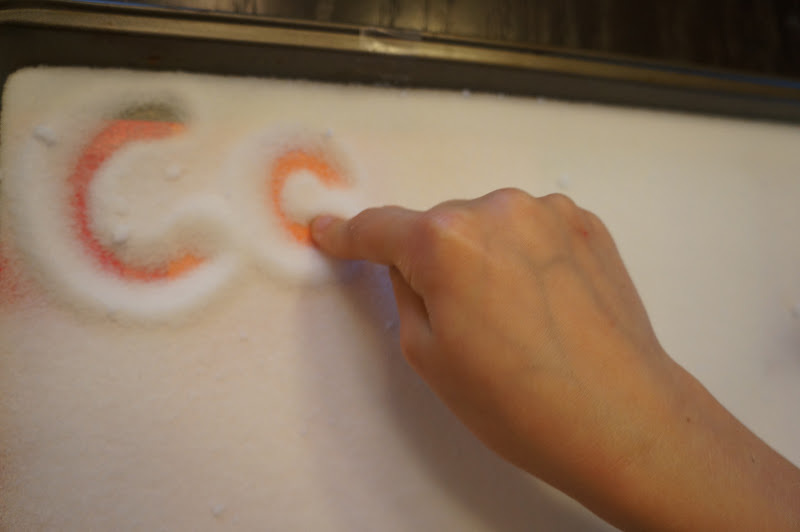
I filled a ridged baking sheet with fine salt (with a surprise taped underneath).
As my children explored the salt, a rainbow background was revealed in their prints (it was simply construction paper taped underneath to resemble the colours of the rainbow). My children were amazed at the rainbow colours that they would be rewarded with upon drawing and fingerprinting in the salt. "It's magic!" exclaimed Cadence as she printed her name.
Both spent lots of time exploring the trays and engaged in many activities including...
...creating random designs
...writing their names
...practising letters
...practising high frequency 'words of the week'
...even writing numbers
Surprise salt trays would be a motivating way to encourage children to practice letter printing, letter recognition, and writing high frequency words for those teachers who are interested in exploratory ways of engaging their children in RTI activities.
Subscribe to:
Posts (Atom)