Showing posts with label manipulatives. Show all posts

Sunday, September 25, 2022

Algebra in Kindergarten? Absolutely!

 "Pure mathematics is, in its way, the poetry of logical ideas."

Albert Einstein

 
When you think about algebra you might have memories of sitting in a high school math class, searching for unknown values in linear and quadratic equations. Those long ago math courses may seem far removed from today's kindergarten classrooms but did you know that it is essential for educators to promote algebraic reasoning in early childhood education?

I devoured the most recent issue of Young Children (Volume 77, Number 3), especially the article Promoting Algebraic Reasoning in the Early Years by Lindsey Perry. 

In her work Perry advocates for algebra in early math programs that explore two main ideas: composition and decomposition of numbers and properties of operations. According to Perry (2022) algebraic reasoning "involves seeing and describing patterns and relationships between quantities that may be unknown...which builds upon students' understanding of patterns and relationships with known quantities and values" (pg. 17). Perry posits that if children can observe and describe number relationships they can begin to symbolically represent relationships between numbers. 

Composition and Decomposition of Numbers

When children compose they understand that a number can be put together using its parts (e.g., 5 plus 5 equals 10). Decomposition is the opposite where a number can be broken apart in different ways (e.g., 10 can be broken into 8 and 2 or 7 and 3). When children compose and decompose numbers they understand how to manipulate numbers in different ways, which helps them become flexible when solving calculations. For example mentally adding 68 + 22 can become easier when children realize that the ones values total 10 and then add this to the tens value (10 + 60 + 20). Adding 68 plus 22 is the same as adding 10 plus 60 plus 20 but the second strategy may be easier to mentally calculate for many people.

Properties of Operations

Properties of operations encourage children to work flexibly with numbers in order to recognize and manipulate their relationships. This helps them simply calculations in order to more efficiently and accurately solve them. For example the order of addends (numbers added together) does not matter in order to arrive at a sum. 

a + b = b + a 

6 + 4 = 4 + a therefore a must be 6.

The commutative property applies to addition and multiplication. The order of numbers can be switched and it does not change the answer of the operation.

2 + 7 = 9 and 7 + 2 = 9

4 x 5 = 20 and 5 x 4 = 20

The inversion property states that all integers have an inverse number that when added equal zero. 

3 + (-3) = 0

Although complicated young children can play with inversion when they become interested in, and work flexibly with equations.

3 + 2 - 2 = 3

So how can early childhood educators encourage children to participate in activities that promote early algebra? Here are some simple activities that can be used regularly to build children's confidence, ability and interest in number sense.

Equation Line


Provide children with a variety of subitizing cards and math symbols (addition sign, subtraction sign, equal sign). Encourage children to arrange the cards in different ways in order to create equivalencies.

 Make 5 (or 10)

Show children a total number of cubes (starting with 5 and then 10 is helpful). Hide the cubes behind your back and remove some. Show children the remaining number of cubes and encourage them to calculate how many are hiding.

Singing Songs with a Five/Ten Frame

When singing popular songs and finger plays with children (e.g., 5 Little Monkeys, 10 in the Bed) add a five or ten frame as a visual and manipulate the number of counters in the frame to match the number being sang. 

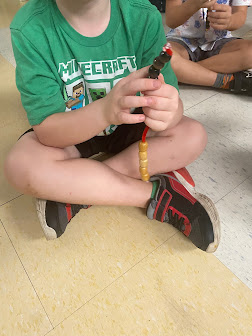
Counting Beads
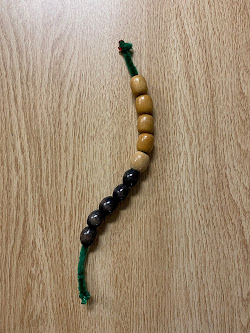
   
A string of counting beads can easily be made using two colours of wooden beads secured on a pipe cleaner. Encourage children to use these when playing number games or engaging in number talks.

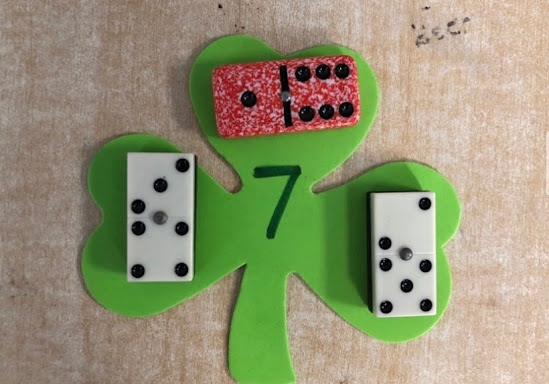
Domino Sort

Provide a mat for children (here a foam shamrock has been used but any shape will work). Write numbers on individual mats. Encourage children to sort dominoes and match their quantities to the mats in order to represent the many different dot arrangements possible for each number.

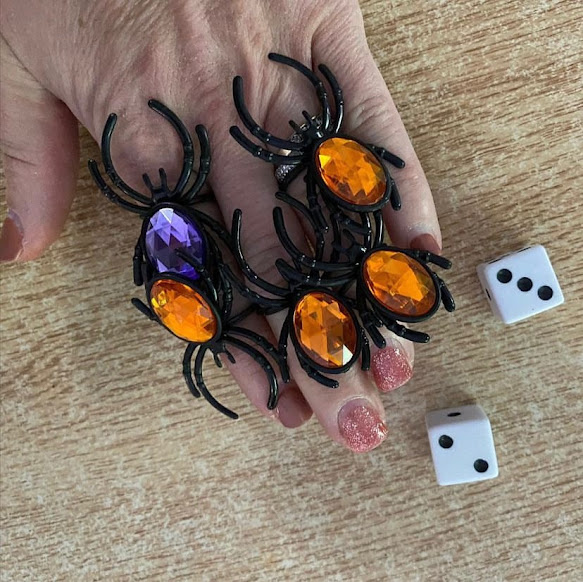
Roll a Ring

 
Seasonal rings are a fun tool to use in math games. Provide children with dice and encourage them to roll and add (or subtract) the numbers. Children can then wear the corresponding number of rings on their fingers. If two players play the game, they can each roll and wear rings and then compare hands to see who has more or less.

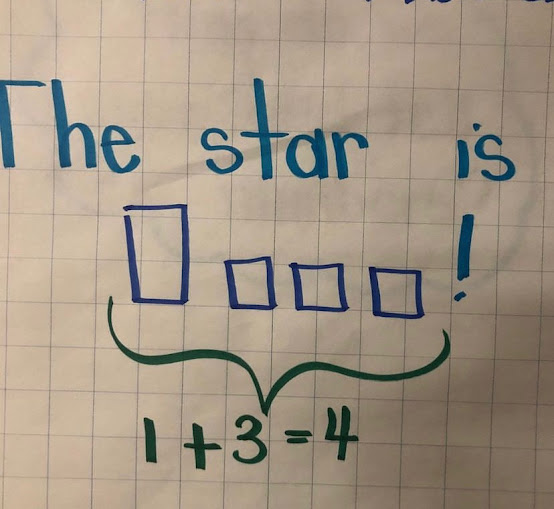
Name Equations

 
We enjoy representing children's names with boxes and encouraging them to think about the number, size and shape of the letters. These boxes are also fun to represent at equations so that children can play with their names and integrate a bit of math into literacy.

Calendar-based Number Talks


Morning message is a great time to encourage a daily number talk. We often represent the date in different ways (e.g., dice faces, dominoes, tallies, frames) and then encourage children to calculate the number by paying careful attention to the representations and operation signs used.

Which One Is Wrong?


Another favourite number talk is 'Which One is Wrong'. Different equations are displayed and children are challenged to explore each one using manipulatives (e.g., cubes, bead strings) to find the incorrect one. 

What other activities do you use to help children with early algebra? Let's connect on social media @McLennan1977!

Sunday, September 16, 2018

Anchor of Five

Anchor of 5

A successful math program for children will have an emphasis on number sense as its foundation. Number sense is a natural part of all other strands (e.g., geometry, patterning, data management). Exploring number relationships help children build fluency, accuracy and confidence. Five frames provide a visual reference to the anchor of 5. Five is a 'friendly number' for children. They associate five with the most natural of math 'manipulatives' that they always have available...fingers on one hand! The number system that we use in Canada encourages an understanding of place value that is dependent on groupings of 10, and understanding groups of 5 will evolve into 10. This is a key foundation for future place value work. Here is a review of some of our math work this week. 
Read alouds
 
We used many engaging, patterned texts during our whole group circle time that focused on groups of 5. In books like 'Five Busy Beavers' a group of 5 beavers slowly decreases to 1 as each beaver leaves the water for other adventures. Children can see the group decrease by 1 each time, and predict what the new number will be. They can subitize the new number as they observe the number of beavers on each page, or follow along and use their fingers to chant along with the text. This book can then be added to a math centre where manipulatives can be provided to further enhance the text and encourage children to play with the numbers 1 through 5.
A Number Station
During free choice time the children had the opportunity to visit a math centre where various manipulatives and tools were made available for children to play with the numbers. A number line, wooden and mirror numbers, five frames, finger tracers, and natural materials were available for children to explore. Students matched, counted, sorted, patterned, and ordered the manipulatives, often composing groups of 5.
Morning Message
Each morning we start our day with a morning message. One of the most important words that children first learn to read and write are their names (their own, and those of their peers). We used our 'star of the day' to model how our names fit into five frames (and sometimes beyond the five frame if the name has more than five letters). This helped us conceptualize the anchor of five and also introduced some concepts of print too (e.g., that words are composed of letters and that letters represent sounds).
Number Line
We brought a number line outdoors with us during our outdoor play time. It was interesting to see how the children created their own games without adult prompting. Some children gathered natural materials and placed them next to the numbers (e.g., 7 stones next to the number 7). Others used the line as a tool in a jumping game, starting at the 0 and seeing who could jump the furthest and reach the biggest number!
How Many are Hiding?
Whole group time is also a great opportunity to introduce meaningful math games that children can then play in small groups or during free choice play time. To help children compose to the anchor of five, we used a group of five unifix cubes. Children are first shown the five in a line. The player then hides some cubes behind his/her back and shows the group the remaining cubes. The group has to calculate how many cubes are hidden, encouraging them to subitize and compose to the anchor of 5. They indicate the missing quantity by holding their fingers up to the player who then reveals the missing quantity.


Fingerplays

We love to sing each day. Our children loved the fingerplay "Five Little Monkeys Swinging in a Tree". To enrich the experience with meaningful math, we added a magnetic five frame to the song. As the children sang along and used their fingers to decompose the number 5 to 1, we removed counters from the frame as they count. During play time many children enjoyed leading their peers in a singing of the song!


Pentomino Challenge
Pentominoes are a wonderful math manipulative that encourage spatial reasoning and use an anchor of five as each unique piece is created using five small squares. A challenge that encouraged perseverance and spatial logic this week involved challenging the children to fill a standard cookie tray with pieces, leaving no gaps in the puzzle. 


We love learning from others! Share your favourite math activities that encourage an exploration of the anchor of 5 in the comments below!

Thursday, March 12, 2015

Pete's Buttons

"Pete the Cat" is always a favourite character of young children! Today we read the book "Pete the Cat and His Four Groovy Buttons". In this story Pete loses his buttons one by one and the reader is challenged to think of how many are left on his shirt each time. It's a great reinforcer of subtraction, complete with subtraction sentences to accompany the pages.

We decided to set up a math invitation based on Pete's buttons - we used ten frames, plastic buttons, wooden numbers, and dry erase markers.


The materials were open-ended and it was interesting to see what the children decided to do when visiting the centre.

Some children found a number, matched the corresponding buttons on the ten frame, and then practised writing the number themselves!


Other children wanted to challenge themselves to think of addition and subtraction sentences and record these under the ten frames.


It's interesting how using appealing manipulatives inspires children to think about math in new and exciting ways!


Wednesday, December 10, 2014

How Many Presents?

Today we displayed some mini presents and encouraged the children to practice counting how many there were by using the tools we've been exploring in the classroom: a hundreds chart and some ten frames.
 

The children knew they needed to start at the number 1 on the chart and add the presents one at a time in order so that they had an accurate number. We discussed what would happen if they randomly placed the presents on the chart.


The children also used the ten frames. They knew they had to fill one ten frame up before moving onto a new one.
 

Once the children had an accurate count, they were encouraged to record the number on a piece of paper at the centre. Some children counted the presents using both tools before recording their number in order to ensure their answer was correct.


Tuesday, December 9, 2014

Math Tools

With over 300 food items for our can drive, we are preparing the children for calculating a large amount of objects by using math tools in many situations this week. We presented a counting problem to our children during circle. After displaying some plastic food, the children suggested using a hundreds chart to help organize and accurately count the number in the collection.
 
They carefully placed each object on the hundreds chart...


...and were able to tell with every piece what number we were at.


When the chart was filled the children realized we had over a hundred items! We lined them up next to the chart to come up with a final count.


On a different day we asked the children to again help us count a large quantity of little vehicles. Our rule was we couldn't count them and couldn't use a hundreds chart. One child knew that 10 ten frames was the same as a hundreds chart, so we placed them on these instead.


We are going to continue to challenge our children by using large numbers. 10 frames and hundreds charts can be easily found online and printed. Why don't you consider counting some collections at your house using these strategies?
Related Posts Plugin for WordPress, Blogger...