Showing posts with label drawing. Show all posts

Thursday, March 28, 2024

Five Free Printables to Use with Tree Math

 "Trees are poems that the earth writes upon the sky."

-Khalil Gibran

During outdoor play children are drawn to the trees in the school yard. They love to feel bark with their hands and wrap their arms around the trunk. They collect artifacts for exploration including sticks and leaves and search for insects in the bark's crevices. Trees offer so many rich opportunities for wonder and discovery as children notice how they change with the weather and seasons.


To help supplement my book Tree Math (available from Amazon and Indigo) here are five easy, free printables that can be used to support children's work in nature!

1. My Favourite Tree

Encourage children to spend time in nature and observe the tree they like best. Ask them to consider what it is they appreciate about this tree? Children can then sketch the tree on this page and compare their tree with others.

2. My Tree and the Four Seasons

Over time children can observe the same tree and draw what they notice changing during the four seasons. This page can be kept over time and added to as the months change. Children can also draw on it at one sitting and hypothesize what the tree might look like in each season, especially after conducting research about how trees adapt to the weather.

3. Tree Circumference

Children can use a variety of materials to measure how big around a tree's trunk is (e.g., measuring tape, hand spans, links) and record it on this tracking page. Drawing a picture can help explain their math thinking.

4. Tree Bark Patterns

Exploring the texture of bark appeals to many children who enjoy sensory experiences. Children can use magnifying glasses to examine the patterns in bark up close, or place a paper on top of the bark and use crayons to create a rubbing. Children can then describe what they see and compare their rubbings to others. 

5. A Tree is a Home

Encourage children to explore many trees in the school yard and neighbourhood. Ask children to observe what living things they observe on and in the trees (e.g., birds, insects, mould) and record their observations on the tracking paper. They can hypothesize how the tree might be a home for many living things at the same time.

Thursday, November 30, 2023

Virtual Bird Count

“There is an unreasonable joy to be had from the observation of small birds going about their bright, oblivious business.”
 Grant Hutchison

 
Colder weather and light snow this week have inspired new observations during outdoor play and exploration. The children have noticed birds hiding in the trees. It's been fun to watch them flit from branch to branch, observe their tracks in the snow and identify their different calls. I hoped to continue with these observations indoors. I introduced Cornell's live bird cam and invited children to spend time observing the animals that visited the different feeders. The children were enthralled with the quick, happy little birds as they flew in and out of the frame and gobbled up the seed.

The next day I asked children to predict which birds they thought might be at the feeders. We spent time drawing our guesses on a graphic organizer. I wanted to capitalize on the children's interest in the birds and integrate math and literacy into the experience. I also displayed posters from our library that had illustrations of common North American birds to be used as reference.


As the children observed the feeders they tracked what they saw on their charts. After ten minutes of watching we calculated and shared our results. Blue jays appeared the most!


This is an easy to implement activity that brings the outdoors inside! Click here for a free printable Bird Count tracking sheet children can use to record birds.

Saturday, October 23, 2021

Uncovering Math Using Observational Drawing

 "When we as teachers are purposeful about bringing nature into our classrooms, we create opportunities for curiosity, questioning, observation, collecting and analyzing information."

(Nenia & Clucas Walter, pg. 8)

I recently read the article 'Exploring Nature Indoors with Observational Drawing and Scientific Thinking' by Kendra Nenia and Melissa Clucas Walter in the Fall 2021issue of Teaching Young Children. In it the authors discuss the many literacy benefits for children who carefully observe and draw objects from nature. As I was reading I was also considering the rich mathematical wonderings and connections that observational drawing can offer children. 

Observational drawing is when children draw what they see. If they are observing and exploring a natural object they are creating a realistic portrayal of the object in a drawn format. Children can sketch black and white representations using only pencil or marker, or draw their outlines first and then add colourful details after. 


As children explore ask them to consider what they see. Use varied questions to prompt a deeper exploration of the object including:

  • What shape is this object?
  • What size is this object?
  • What textures do they feel when they handle the object?
  • How heavy/light is the object?
  • Are there any patterns on the object?
  • What colours can be seen on the object?
  • Does sunlight or artificial light affect the object? 
  • Are there any shadows created on the object when it's placed in the light?
  • What contours can be observed? 
  • Of what does this object remind you?

Ask children to consider how they can draw the object in order to highlight their observations and ensure they are represented. What other drawing tools can be used to help in this artistic representation (e.g., pastels, watercolours)? What math is uncovered in this process? Engaging in supportive discussions with children throughout the drawing can help them to 'notice and name' the math they see. Educators can enhance this mathematical understanding by scaffolding the conversation and highlighting additional math concepts (e.g., proportional reasoning, perspective, reflections, symmetry) and encouraging children to include these in their drawings.

Once a child is satisfied with his or her drawing, encourage the child to represent the object in another way using a different artistic medium such as clay, Plasticine or wire.

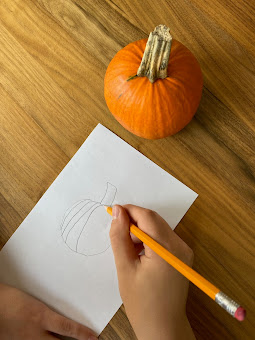
When we tried observational drawing we first examined and drew a small pumpkin.

               
We also explored dried hydrangeas from the garden.


As children draw, ask them to look back and forth between their drawing and the object to ensure they are including any interesting nuances that will help give character to their artwork. Remind children that there is no right or wrong way to create art, and that repeated practice over time (even with the same object) helps us to refine our skills. Observational drawing should not be rushed. Encourage children who might become fatigued or frustrated to take a break from their work - they can tuck their object and drawing away and return to it when they feel inspired again.  
 
The interest in observational drawing in our classroom continued as the children became curious about some different leaves that had been collected and donated to our science table. Notice how the children became comfortable drawing the object using pencil first, and then added additional colourful details to show the shapes, lines, and patterns they saw.


Once children are satisfied with their drawings encourage them to share these with their peers. Children can reflect upon their experience - How did their mistakes help them to learn and improve their work? What did they enjoy about the experience? What might they do differently next time? How might children like to display their work? Sometimes children enjoy gifting their art to others, or displaying it in a public space like the school library. These drawings can be added near the shelf where books about nature are housed. Perhaps children will be inspired to create a documentation display to share the process of their observational drawing, and the final pieces, with others in the school or community. 
 
Observational drawing is an incredibly rich artistic experience that is infused with science, literacy and math. As each season brings new treasures, it can be revisited over and over throughout the school year.

Friday, October 9, 2020

A Playground for Mr. Big Legs - STEM in the Outdoor Classroom

"Look! Look at this spider! His legs are so long! Let's call him Mr. Big Legs!"

The children found an interesting spider in the garden one day. Curious, they gently picked it up and let it climb up and down their arms. It was so graceful in its movements that even reluctant children came for a closer look.

"He's so cute! Why was he in the garden?"

"Maybe that's where he lives."

"How do you know he's a boy?" 

"The garden is so boring for him - nothing is growing right now."

"I know! Let's build him a playground!"


Curious about the children's ideas and how I could use their interest in spiders to enrich our outdoor space, I took photos and mentally planned for how we might proceed next. I considered what curriculum expectations might be met, and anticipated the math that might emerge. Such a simple and quick interaction with nature sparked a rich mathematical inquiry in our outdoor classroom that lasted for several days.  

Our first step was to conduct some research. What did children already know about spiders? What did they wonder about Mr. Big Legs specifically? How might they design a playground that he would like? What could they use to help them acquire more information?

We read a number of texts together to gather information that might help enrich their understandings of what exactly a spider was and needed in order to survive. We organized our ideas on a large chart paper and referenced this over the course of our inquiry.


While exploring our school yard for more spiders, we noticed a really interesting tunnelled web just outside our window. The location was the perfect place to set up a 'spider observation window' where children could safely check on the spider during play time and carefully watch it in its habitat. Not only did this give children an additional opportunity to research, it provided children who weren't comfortable holding a spider a safe way to observe one up close without needing to handle it. (We wondered if the spider had eaten two others, or if this particular one shed its skin.)


The more the children learned about spiders, the more determined they were in their quest to create a playground for Mr. Big Legs. They designed spaces for him - a garden, house, slide, swing, and bridge - by drawing blueprints on their clipboards. They considered the size, shape, and materials needed for each creation.


During the next outdoor play time, the children brought their drawings outside and referred to them as they worked in the garden. Some children enhanced their drawings and others started anew. They looked to the materials available outdoors, and planned for how to build using only natural materials found in our space. 


Their work was stunning; the level of thought put into creating the tiny structures was incredible. Children considered measurement and proportional reasoning as they built to scale. Here are some of their creations:

A bed - notice how the sticks point upwards in a circular direction and there are leaves to cushion the center. "The leaves will be so comfortable for him! It will be a soft place to sleep, and the sticks will keep other bugs away."


A swing - notice how this child has balanced the top section of the swing onto two sticks. Later on he would add a long, slender leaf in the middle for Mr. Big Legs to swing on. "I hope that he can balance because this isn't very stable right now."

An obstacle course - notice how Mr. Big Legs will have to climb through the structure, along the stick, hop on top of each of the stones and land on the leaf. The child who build this sequenced the steps in her course and articulated exactly what the spider would need to accomplish along the way while playing here. "This would be so much fun to play on - do you think he will know where to start and where to finish?"

 
A bedroom - this child created a circular structure so that Mr. Big Legs could weave a web near his playground using the rocks as anchors. She knew that many spiders used webs as a home and place to catch prey, and wanted to be sure he had this in his new area. "Spider webs are circles, so I put the rocks in a circle."


A garden - this child dragged his fingers in the dirt to make rows for Mr. Big Legs to use when planting rows of vegetables. "They need to be evenly spaced, because they need room to grow. That's what my dad does in our garden."


A slide - this child placed two sticks together on a slope resting in the corner of the garden. "I wonder if he will know to lift his legs. If he doesn't then he won't go down as fast because they are long and will bump against the slide."


A bridge - this child broke twigs so that they were approximately the right fit to be placed in the narrow hole in the garden. "I couldn't find any sticks that fit, so I broke them. I think Mr. Big Legs needs a bridge in case this hole is too deep for him. If it rains maybe he can pretend it's his pool.

Towards the end of the week the children found another Mr. Big Legs climbing on the brick wall. They eagerly picked him up and placed him in the garden so he could explore everything they had created. Proud of their work, they pointed out each structure and explained to him how he could use the equipment.

"This is your slide and here's your swing. You can play on those!"

"I made you a garden in case you don't catch any bugs in your web."

"And when you get tired, here's a bed for you to sleep on!"

I couldn't help but smile at their enthusiasm. I was amazed that something as simple as finding a spider in our yard could inspire such authentic STEM learning.

Wednesday, September 21, 2016

Mirror Writing

We always love to have engaging literacy activities available for the children to explore. Motivating them to draw and write is fun when we use exciting materials like mirrors and dry erase markers. The markers wipe off so easily and the reflection and unique surface (and experience) of writing on a mirror is very interesting for young learners.

It was interesting to see what the children drew. Many noticed their reflection and drew that. Others practised printing their name.


We noticed counting happening too as the children drew their own five and ten frames!


Others drew interesting designs! Whatever it was that was drawn, the conversation around the table was lively as many children squeezed in to share the fun tools!


Related Posts Plugin for WordPress, Blogger...