Thursday, May 3, 2018

Playing with Shape

I had the great pleasure of hearing Dr. Nathalie Sinclair (@geometry4yl) speak at the recent ETFO Kindergarten Conference in Toronto on April 14, 2018. Her engaging presentation involved discussing how educators can create opportunities for children to explore geometry in integrated and playful ways.
As many of you know early years mathematics is an absolute passion of mine. Exploring what role math has in an emergent program, and what attuned educators can do to introduce and support children's evolving understandings, drives my everyday pursuits in the classroom. I tend to look at everything we do through a mathematical lens and am always interested in learning how we can delve even more deeply into our classroom understandings and interactions regarding math. It is for these reasons that I found Dr. Sinclair's presentation so fascinating.

"Play is exactly what mathematicians do.”

In her work Dr. Sinclair discusses how math relates naturally to play - both encourage children to step outside of reality, create order and beauty in the immediate world, are bound within time and space, and are governed by a set of rules. Dr. Sinclair reminds us that play is not aimless or spontaneous but a highly constructed reality that guides children in layered roles and representations. It is rehearsal for reality where children can experiment with different situations, problem-solve within the parameters of the play, and then try out different solutions to the problems within a supportive and safe learning environment. 

Something that I found particularly interesting in the presentation was Dr. Sinclair's discussion of shape learning in early years classrooms. She shared that often children identify with only the 'prototypical representation' of a shape and assume all other shapes by that name look the same.  Consider the typical representation of a triangle on many of the pre-made, purchased learning materials teachers might use in the classroom. Many look this this little guy - a smiling, upwards standing equilateral triangle. Over time many children assume that this is what all triangles look like, and when faced with variations aren't sure what shape to classify them as.
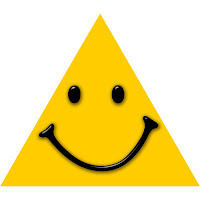
 Image result for triangle with a happy face
 Dr. Sinclair invited the audience to reflect upon what geometric models we were using in our practice and consider a number of alternative activities to help children play with shapes in order to better understand their interesting properties and build understanding when variance occurs. 

When I returned to my classroom I decided to conduct a small experiment in order to determine my students' thoughts regarding triangles. I created a survey using our morning 'sign in' that asked children to sign their name under the shapes they felt were triangles. Even though three of the four were triangles, most children chose only the typical equilateral triangle. I also noticed that the children assumed only one shape could be a triangle, so when they decided on the equilateral, they stopped examining the other shapes. They assumed that there was only one right answer.
 
I brought the survey to our whole group morning meeting time where we were able to explore the question together. I invited the children to share why they chose their shape and explain their thinking. Most children stated that the felt their triangle of choice was the right one because it had "three sides", "three corners", "straight sides", and "looked like a triangle". When we explored each of the shapes on the survey most children appeared surprised that there were also two other triangles that fulfilled their criteria. To extend on this thinking I decided to use a read aloud to help us explore shapes further. Linking literacy to math is a great way to make abstract ideas more tangible to children while hooking them emotionally within a story.
 In Marilyn Burns' 'The Greedy Triangle" children are introduced to a triangle who continues to change its shape after meeting with a shapeshifter until it is no longer a triangle but a circle. It was interesting to note the children's observations of the shapes in the story, especially the triangle, as Burns portrays many variations and they were quick to notice that these differed from the ones depicted on our initial sign in survey.

To compliment the text I then invited the children to play a shape sorting game with me. Using various shapes cut from construction paper, the children had to sort each based on whether or not they felt it was a triangle. It was interesting to listen to their descriptions of the shapes as they determined which grouping to place them within. At the conclusion of the activity we had a large collection of different triangles and the children determined that was made a triangle was a shape with "three sides and three corners" regardless of size.
Moving forward we will continue to explore geometry in our classroom in new and exciting ways. Some ideas for you to try with your students can include:

Using read alouds to inspire shape art - books like Perfect Square and Scribble can be read to children and then added to the art centre with various materials and tools to inspire creative exploration and manipulation of shape.
         Image result for The Perfect Square            
       

Playing with shapes using technology - the website Geometry for Young Learners from Simon Fraser University allows users to manipulate shapes in many different ways directly on the website using a sketchpad. No need to download any programs. https://www.sfu.ca/geometry4yl.html

Creating shapes kinesthetically - children can use their bodies to create different shapes, especially in the outdoor classroom or gym!


Print making with found shapes - children can be invited to search the classroom for various shapes and use these to create prints with paint.

   
Locating shapes in the school and beyond - children can go on a shape hunt, record what they find on a tally chart or take photos with the class iPad, and then print out the photos and outline what they see on the print itself. 


What other shape activities and games have you tried with children? Leave your ideas in the comments section below!

Friday, April 13, 2018

Coding Stories and Games

We are pleased to have presented our workshop  Creating Coding Stories and Games at the 2018 ETFO Kindergarten Conference!


Here is our presentation for those interested in what we shared.


Friday, October 13, 2017

Playful Symmetry

"Mathematics is one of the essential emanations of the human spirit - a thing to be valued in and for itself - like art or poetry."  
(Oswald Veblen)

Math has become one of the most engaging and aesthetic experiences in our inquiry-based classroom. The more I experience math pedagogy in practice, the clearer it seems to me that math and the arts are intertwined. I have been inspired to look at all actions in our classroom through a mathematical lens, regardless of which learning domain they appear to belong. Many of our recent endeavors have been inspired by a wonderfully rich book I have been exploring regarding geometric and spatial thinking. In Taking Shape the reader is taken on a journey of understanding regarding the importance of engaging young children in rich spatial reasoning activities and inspired to replicate and evolve many of the activities in the classroom. Many of these also celebrate aesthetics in shape and design, something the arts encourage as well.


The authors advocate for the inclusion of more spatial reasoning in the classroom for many reasons: spatial reasoning and mathematical thinking are intimately linked, spatial reasoning can always be improved regardless of the age or experience level of the students, spatial thinking is an important predictor of achievement in STEM careers, spatial reasoning is currently an under served area of math instruction, and spatial reasoning provides multiple entry points and equitable access to mathematics.

One section in particular, symmetry, stood out to me.  Recently I had noticed symmetry appearing in many of the children's wooden structures made from large and small blocks. I wondered if they had previous experiences with symmetry and felt that it would be an excellent place to begin some intensive spatial reasoning work.

 "In simple terms, two shapes are symmetrical if you can slide, flip, or turn one of them to have it match the other exactly...Symmetry provides an engaging context in which to explore mathematical structures and patterns. Symmetry - in particular, reflection symmetry - is a rich area of spatial reasoning that we can tap into as educators of young children. Symmetry is also important for later mathematics when making efficient mathematical arguments and working with graphs."
(Taking Shape, p. 20)

I have collected 12 of our most engaging activities exploring symmetry and described them below in the hopes it will inspire you to continue to explore symmetry together with children in your classroom or home!

Pattern Blocks on Sticky Paper

For this experience we have added clear, sticky mack tack to an extra easel in the classroom. Engaging math manipulatives like wooden pattern blocks can be non-permanently affixed in different patterns and designs to the mack tack. A line of symmetry can be added to help guide children in their work. When finished, a child simply removes the pieces and the easel is ready for another.


Hole Punchers

Hole punchers are excellent tools for encouraging fine motor work - they are difficult to squeeze and require patience and perseverance on the part of the user. A paper that is folded in different ways and has holes punched in various designs will open to reveal one, or many, lines of symmetry.


Building with Unifix Cubes

Many classrooms have linking cubes or unifix cubes. Our children have been drawn to using them to create small robots and airplanes. Because of their versatile nature, these cubes can be linked on all sides, and children can easily incorporate symmetrical design into their creations.


Working with Sticky Loose Parts

Loose parts offer endless opportunities for exploration of spatial reasoning and design. A recent trip to the Scrap Box in Ann Arbor, Michigan (a recycling centre for art materials) provided us with many foam pieces that had one sticky side. We drew various lines of symmetry on paper (horizontal, vertical, diagonal) and encouraged the children to place the foam pieces symmetrically on the paper. It was interesting to see their designs being built in 2D across the paper, and in 3D upwards off the paper. 


Recycled Game Boards

Recycled wooden game boards are excellent grids to use when encouraging children to consider spatial reasoning and symmetry in their design. The grid design helps children 'picture and place' geometric shapes symmetrically. In this experience we've offered recycled carpet samples to entice children who enjoy tactile experiences into creating interesting mathematical designs.


'Follow the Leader' Game with Foam Pieces 

Taking math outdoors is always fun! In this game, a line of symmetry is created with masking tape on the ground. Large foam shapes (easily cut from Dollar Store art foam) are used as game pieces. One child is the leader and the other the follower. The leader places a shape on his/her side and the follower has to create a symmetrical design by placing the same shape in reflection on the opposite side of the line. The result is an intricate symmetrical design. 


Paper Cutting

Similar to using hole punches, encouraging children to cut shapes onto folded paper results in the creation of interesting symmetrical designs. This is also a fun activity to bring outdoors. 


Paint Droppers

Children love to drop paint onto paper and fold it in half to create interesting colours and designs. In this activity the paper is folded first, indicating the line of symmetry. Children are encouraged to carefully use droppers/pipettes to drip paint onto one side of the paper only. 


The paper is folded on the line of symmetry...


...and is opened to reveal a symmetrical picture! When the primary colours of paint are used the creation of secondary colours is an added bonus!


Finding Lines of Symmetry

Helping children find symmetry in the world around them is an important discovery to instill the idea that math is everywhere. We offered books about symmetry for the children to explore, along with laminated photos of real objects from nature. The children were encouraged to look at the different pictures and then use dry erase markers and rulers to draw the lines of symmetry they saw.  


Pentominoes on Trays

Pentominoes are complex math manipulatives that fit together in interesting ways. In order to challenge children we added a line of symmetry to a tray and encouraged the children to see if they could create a symmetrical design with the pentominoes, while trying to fill the tray at the same time!


Pattern Blocks on Mirrors

Building on mirrors is an interesting way for children to explore symmetry. Whatever is constructed on the mirror will naturally reflect symmetrically with the mirror as the line of symmetry. Children are often amazed to see their creations reflected, which sometimes results in an interesting discussion of 'doubling' in addition to symmetry.   


Symmetrical Letter Guess

Many letters are symmetrical in nature (e.g., A, B, C, D, E, H, I, M, O). In this game children are shown a letter that is folded in half and asked to guess what the letter might be. 


We like to use plastic plates and dry erase markers to make games more interactive and also encourage letter writing. After children observe the folded letter they can write their guess on the plate...


..and then look to see the letter revealed! The line of symmetry is evident as the fold line on the letter.


We will continue to explore symmetry this upcoming week! Stay tuned for more ideas! Feel free to add comments and additional ideas for exploring symmetry in the comments below!

Sunday, September 17, 2017

New Beginnings...

“Come to the edge," he said.
"We can't, we're afraid!" they responded.
"Come to the edge," he said.
"We can't, We will fall!" they responded.
"Come to the edge," he said.
And so they came.
And he pushed them.
And they flew.” 

Guillaume Apollinaire

I am a creature of habit; I love routine and predictability. So when I was offered a chance to move to a school much closer to my home, during this past 'reorganization week', I hesitated to take the chance to move because I was fearful of change and the unknown.
 
However after being at my current school for many years and burdening my young children with early mornings, hours at latchkey and long commutes, I took a breath and accepted a kindergarten position at a school thirteen minutes from home.

On Friday, after saying goodbye to the families I have cherished working with for many years, I packed up my belongings (yes in a 27 foot UHaul!) and moved to my new classroom.


Being in a new space was interesting. I was nervous and excited at the same time. I'm sure that as I get to know my new children and surroundings we will work together to evolve our space. But for now I have the 'footprint' of the room established for our new start this week.  

Here's a sneak peek:


I look forward to seeing what new learning awaits me! Change is often the catalyst we need to expand our own thoughts and actions as we have the opportunity to collaborate with new people who have diverse interests, experiences and ideas. I am excited for the opportunity!

Saturday, September 9, 2017

Printable Activities to Support Open-Ended Mathematics

I continue to be inspired by the rich math learning I have been offered in my recent professional development. Research shows that early math experiences are key to a child's future math success - both in their confidence and math abilities. We know that having a strong partnership between home and school can enhance this mathematical mindset in the early years.

This year I will be pleased to continue to send home math 'take home bags' to our children, beginning towards the end of September. Each of these bags is numbered. On Fridays your child will bring a new math bag home to explore with you. In each bag are activities that are designed to refine math concepts from the Ontario Kindergarten Curriculum, with a special emphasis on number sense and numeration, specifically subitizing and composing/decomposing numbers. Please send the bag back to school by the following Wednesday so that we can send a new bag home with your child.


Inside each bag will be an instruction card and any applicable materials you will need to play the game together.


I am excited to see how the children's math mindset and abilities are influenced by these activities. We will continue to focus on math rich tasks at school as well. Any feedback regarding these bags is greatly appreciated.

If you would like a sneak peek at some of the activities, or are a fellow educator interested in printing a set of these activities for use in your classroom, please click this link: Family Math Bags
Related Posts Plugin for WordPress, Blogger...