Wednesday, November 30, 2022

The Many Benefits of Mud Play

"We can't blame children for occupying themselves with Facebook rather than playing in the mud. Our society doesn't put a priority on connecting with nature. In fact too often we tell them it's dirty and dangerous."     

David Suzuki

 
Mud play is an incredibly rich learning activity that many children enjoy. Although it can make some educators and families squeamish due to the potential mess, playing with dirt and mud offer so many learning benefits for children. Spending time outdoors exploring many natural elements helps children recognize that there is no such thing as bad surroundings or weather. There is beauty and wonder to be found in every aspect of nature. Sometimes in early childhood education we need to help our families and school community understand the authentic learning that can happen when children play with sensory materials like water and mud outdoors. Demonstrating the meaningful math and literacy connections that emerge in this type of play can build support for outdoor exploration and learning. Sharing this through regular communication including documentation can be incredibly helpful in cultivating positive partnerships and support for messy play outdoors.

There are many benefits for children playing in the mud: 

1. Playing with natural materials like mud and water help children build a relationship with nature. Fresh air and exploration of natural elements encourage creativity and exploration. Children are often drawn to messy sensory materials and enjoy the freedom that mud play provides. As children spend time in nature they will appreciate its beauty and wonder, hopefully encouraging them to grow into eco-warriors who will work to sustain and protect the natural environment. 

2. Mud play encourages problem-solving and innovation. When children work together to create mud cakes and other delicacies in the outdoor kitchen they use their imagination to transform the materials into dramatic play props. It's amazing to watch children as they explain their recipes, adding bits of dirt and weeds to a pot and stirring an imaginary stew or soup. Flower petals and grass become the decorations for a fancy cake.

3. Children explore many math concepts authentically through mud play. As children scoop and pour water and dirt using a variety of tools (e.g., spoons, cups, bowls, muffin tins) they quantify their work. They use math language to describe what they are doing (e.g., The cup is heavy with mud. My bowl is half full.). Educators who play alongside children can 'think aloud' and help mathematize what they see happening and advance the play. 

4. Mud play bolsters children's oral communication. As children work together in their play they describe their actions to one another. They share their thinking as they engage in imaginative and dramatic play, expressing their thoughts orally. Children work together cooperatively in play situations and these incorporate subject specific vocabulary and directions. Children can also use rich language to describe what they see and feel (e.g., The mud is sticky/gooey/crumbly/caked.)

5. Playing with dirt and mud strengthens children's fine and gross motor skills. The consistency of mud can be a challenging medium for children to use. When it is thin and runny it is quick to scoop and pour. As it hardens and thickens it becomes heavy and awkward. Children use their hand and arm muscles to manipulate it in different ways. Thicker mud can be formed using the hands in a fashion similar to clay or play dough, working fine motor muscles.

6. Mud play appeals to sensory learners and can be a calming and enjoyable activity for many. Sunlight, fresh air and exploring the elements help children connect to their surroundings and encourage big body exploration that is not always available indoors. Many children may be discouraged from playing in the mud at home and the act of doing so at school may be freeing for them. It is also a familiar activity that can be soothing for children who are still adjusting to the school setting.

7. Research shows that playing in the dirt can strengthen children's health and immunity. Exposure to microorganisms in the earth can strengthen our immune response and help our bodies adapt more efficiently to our surroundings.

Looking for a book to read with children to support their work with mud? You might be interested in my new book Muddy Math: See, Think and Wonder available now through Amazon!


Thursday, November 10, 2022

Enjoying Books Longer

 "Books are a uniquely portable magic."

Stephen King

As an educator I have dozens of favourite books. I love sharing a wonderful text with children during whole group meetings. It's enchanting to become lost in the story with them, and discover parts of the text that I might not have noticed before. Children are careful observers! They point out aspects of books that I have missed even though the books are worn and well loved...small details in the illustrations, joyful narrative, and connections to the world around us. With each reading the book becomes more special and I feel a deeper understanding of what the author and illustrator might have been trying to convey in their telling of the story. 

Because I have so many favourite books I used to treat them like fast food - rushing through text after text and not usually spending more than a day on each. However I have realized that reading books with children is like enjoying a five course meal - better slowly savoured and attuned to the overall experience. This year my goal was to read one book for at least a week - usually one reading per day. I was worried that the children might become bored but after a few months of using this strategy I have noticed the opposite happen. Children are extremely engaged and our conversations about the story tend to deepen each day. I feel like we are learning so much more. Each reading I tend to focus on a different element of the book - listening comprehension, careful attention to the illustrations, a review of new and interesting vocabulary, connections to other books we have read and questions the children might have that need further attention. We have also looked for other versions of the stories (e.g., animated videos, poems, songs) and compared these to the original. Children have been eager to retell the stories in the drama center and sensory tables, and families have been reviewing and reading versions of the texts at home too. Overall it's been an incredibly positive experience. 

I've also noticed that:

~with each subsequent reading children become more familiar with the story and confident sharing their ideas in our discussions

~over the course of the week the children's interest in the characters and understanding of the plot seems to deepen and grow

~children ask richer questions and make more significant connections as they gather more information from the book with each new reading

~as familiarity with new vocabulary grows children appear more comfortable using the words in other learning opportunities

~many children thrive with comfortable routines and hearing a story over and over is reassuring to them, especially first thing in the morning

~with each reading we are able to explore concepts of print more fully (e.g., speech bubbles, the shape and size of fonts)

~we have noticed that the front and back covers and end pages also offer opportunities to make connections and ask questions

~enjoying the text together with children is a bonding moment as we enjoy a special book together

~ often the books lead to some pretty interesting inquiries that extend beyond whole group that the children enjoy researching further

~this approach gives me more time to differentiate experiences related to the text to meet the needs of learners

~children often notice and wonder about math and science questions that are teased from the book with each discussion

I'm excited to continue with this reading strategy and see how far we travel!

Sunday, October 23, 2022

Mother Nature as Mathematician: Learning Outdoors without Commercial Materials

“In every walk with nature, one receives far more than he seeks.”

John Muir


In our program we spend at least one hour outside each day exploring our play yard and interacting with nature rain or shine (excluding dangerous weather). Although we are fortunate to have an ample collection of materials to use, there are many days that we bring nothing extra outdoors with us. We ask children to interact with the world around them and spend time immersed in nature. Challenged to create play opportunities using only natural elements encourages children to pay close attention to what the world offers and they often wonder about objects and phenomena that they might not otherwise have noticed (e.g., the strength of the wind, an interesting insect, the size of leaves). It's also a great way to encourage children to become resourceful and use their imaginations. In land-based learning knowledge is shared and a respect for nature is encouraged.

 
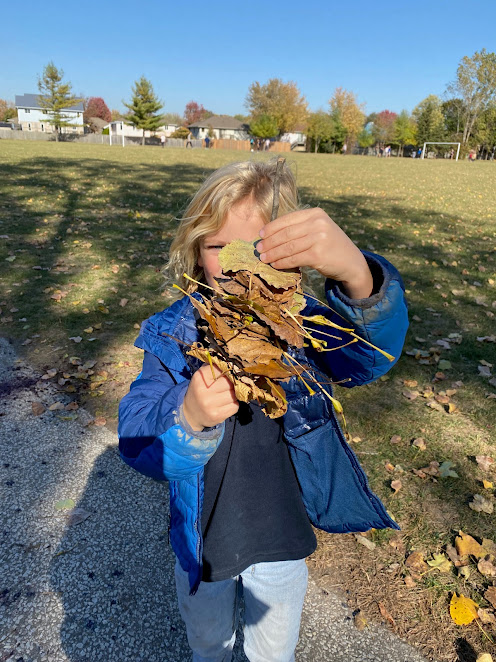
Curious about the size and colours of leaves, the children were encouraged to gather a leaf collection on a stick. This helped them practice fine motor skills and they were eager to quantify the leaves they collected.
 
Much of what the children discover is mathematical. Mother Nature tends to be a beautiful mathematician offering a variety of sizes, shapes and patterns in natural objects. Children are curious as they describe, classify and sort what they find into collections. How many times have you found an assortment of rocks in a child's pocket? Being outdoors without toys also facilitates amazing risky play and children are eager to quantify their achievements (e.g., how fast/high/far can my body move compared to my friend's?). Risky play is an amazing way to encourage math learning in kids (see this post for more information). 
 
I'm often asked by others how children become so attuned with their surroundings and invested in their work in the natural world. I believe that it is because we spend so much time outdoors that children are so immersed and excited. As educators we act as play partners with the children and explore together. We use a 'notice and wonder' thinking routine where we think aloud about something we are curious about (e.g., "I see the leaves swirling in a circle on the pavement. I wonder what is causing them to move that way.") and model for children how we might go about exploring this further (e.g., "I think I'm going to record what I see using my device so I can watch the leaves moving again and think about why this is happening."). I also really enjoy standing away from children and just listening to their observations and theories about the world around them. The things they notice, and the questions they ask, provoke some of the deepest math learning experienced in our program. Children are deeply invested in their work. 
 
Since children become so aware of their surroundings, they are often quick to notice changes. The landscape evolves as the weather and seasons shift and these patterns offer many mathematical learning opportunities. Knowing the land so well also means that children become invested in caring for it and understanding how and why we need to be sustainable learners. 

The children were proud of their abilities to balance on a wiggly log. They decided to count as they stood on it, and see if they could beat their 'time' with each subsequent try.

 After finding a pair of ladybugs in the grass the children created a 'home' for them using natural loose parts. Interesting discussion occurred regarding what the ladybugs would need in their home, and what size would be best for each feature (e.g., bed, kitchen).

 The children enjoyed picking dandelions one spring day. We challenged them to see who could find the longest and shortest stems. Without measuring tools the children had to figure out how to fairly measure each stem. 

Although we are lucky to have a lovely, large play yard to use, exploring nature can happen anywhere. Even a puddle has the potential to spark children's imaginations and facilitate rich discovery and discussion. If your space is limited, consider going on nature walks around the community in which your school is located. Perhaps a trail or garden can be visited nearby. Field trips are also a fun option (e.g., orchard, farm). Bringing natural objects into the classroom is another way to help children connect with nature (e.g., pumpkins, sticks, acorns) and continue their explorations after outdoor time has ended.
 The children marvelled at the circumference of the large trees located near our school. We asked them how they might measure and compare the trunks in order to find the largest one.

 After making snowballs on a winter day the children thought it would be fun to see how many they could stack inside angled branches of a tree.

 
Prints in the snow always spark rich conversation about who (or what) might have visited the yard. 

 
Dew drops on a web discovered early one morning led to fascinating theories about how strong a web must be. 

 
Finding fossilized rocks and identifying shapes and patterns leads to some great imaginative thinking about what might have lived within the rock long ago.
 
Some tips for getting started:
  • Learn more about your local habitat so that you can facilitate discussions with children regarding interesting objects and events that occur in your area (e.g., native plants, migration patterns).
  • Go on guided walks to help children practice using their senses to observe the world around them. Scavenger hunts focused on the senses can be fun and spark inquiries (e.g., listening walks, bird hunts).
  • Start collections of objects found outdoors that can be displayed in classroom (e.g., feathers, seeds, dried flowers).
  • Provide challenges for children that will help them interact with natural materials (e.g., Can you build a house for the ladybug? Can you find and order ten sticks from largest to smallest?).
  • Use tech to support your work outdoors. There are many great apps that can help you identify leaves and insects. Posting ideas and questions on social media can facilitate discussions with others from different areas.
  • Take photos and videos of children's work outdoors and share this for reflection during a consolidation circle. Use the discussion to help spark future work outdoors (e.g., Today we found many flower patterns in the garden. I wonder if there are patterns on other living things in our yard.).  
It's rare that we don't visit the outdoor space. On the days when it is too stormy or cold to head out, we often find children watching the outside world through the windows. In a time when children may suffer from a Vitamin N(ature) deficit, spending unstructured time outdoors without the distraction of toys or teacher-prepared materials may spark a deep love of nature and facilitate rich math learning that would not be possible otherwise.

Sunday, September 25, 2022

Algebra in Kindergarten? Absolutely!

 "Pure mathematics is, in its way, the poetry of logical ideas."

Albert Einstein

 
When you think about algebra you might have memories of sitting in a high school math class, searching for unknown values in linear and quadratic equations. Those long ago math courses may seem far removed from today's kindergarten classrooms but did you know that it is essential for educators to promote algebraic reasoning in early childhood education?

I devoured the most recent issue of Young Children (Volume 77, Number 3), especially the article Promoting Algebraic Reasoning in the Early Years by Lindsey Perry. 

In her work Perry advocates for algebra in early math programs that explore two main ideas: composition and decomposition of numbers and properties of operations. According to Perry (2022) algebraic reasoning "involves seeing and describing patterns and relationships between quantities that may be unknown...which builds upon students' understanding of patterns and relationships with known quantities and values" (pg. 17). Perry posits that if children can observe and describe number relationships they can begin to symbolically represent relationships between numbers. 

Composition and Decomposition of Numbers

When children compose they understand that a number can be put together using its parts (e.g., 5 plus 5 equals 10). Decomposition is the opposite where a number can be broken apart in different ways (e.g., 10 can be broken into 8 and 2 or 7 and 3). When children compose and decompose numbers they understand how to manipulate numbers in different ways, which helps them become flexible when solving calculations. For example mentally adding 68 + 22 can become easier when children realize that the ones values total 10 and then add this to the tens value (10 + 60 + 20). Adding 68 plus 22 is the same as adding 10 plus 60 plus 20 but the second strategy may be easier to mentally calculate for many people.

Properties of Operations

Properties of operations encourage children to work flexibly with numbers in order to recognize and manipulate their relationships. This helps them simply calculations in order to more efficiently and accurately solve them. For example the order of addends (numbers added together) does not matter in order to arrive at a sum. 

a + b = b + a 

6 + 4 = 4 + a therefore a must be 6.

The commutative property applies to addition and multiplication. The order of numbers can be switched and it does not change the answer of the operation.

2 + 7 = 9 and 7 + 2 = 9

4 x 5 = 20 and 5 x 4 = 20

The inversion property states that all integers have an inverse number that when added equal zero. 

3 + (-3) = 0

Although complicated young children can play with inversion when they become interested in, and work flexibly with equations.

3 + 2 - 2 = 3

So how can early childhood educators encourage children to participate in activities that promote early algebra? Here are some simple activities that can be used regularly to build children's confidence, ability and interest in number sense.

Equation Line


Provide children with a variety of subitizing cards and math symbols (addition sign, subtraction sign, equal sign). Encourage children to arrange the cards in different ways in order to create equivalencies.

 Make 5 (or 10)

Show children a total number of cubes (starting with 5 and then 10 is helpful). Hide the cubes behind your back and remove some. Show children the remaining number of cubes and encourage them to calculate how many are hiding.

Singing Songs with a Five/Ten Frame

When singing popular songs and finger plays with children (e.g., 5 Little Monkeys, 10 in the Bed) add a five or ten frame as a visual and manipulate the number of counters in the frame to match the number being sang. 

Counting Beads

   
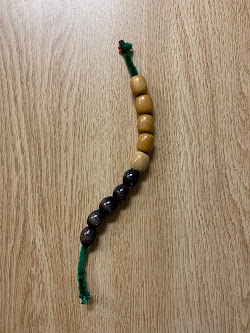
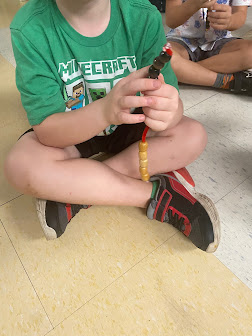
A string of counting beads can easily be made using two colours of wooden beads secured on a pipe cleaner. Encourage children to use these when playing number games or engaging in number talks.

Domino Sort

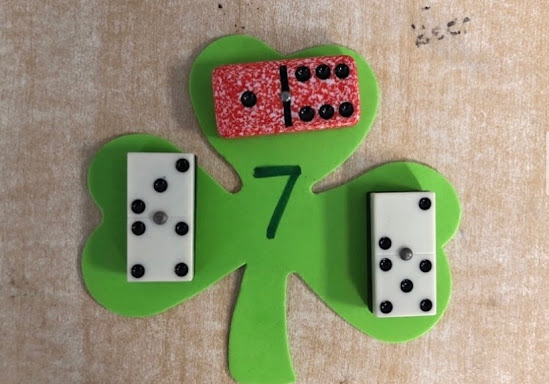
Provide a mat for children (here a foam shamrock has been used but any shape will work). Write numbers on individual mats. Encourage children to sort dominoes and match their quantities to the mats in order to represent the many different dot arrangements possible for each number.

Roll a Ring

 
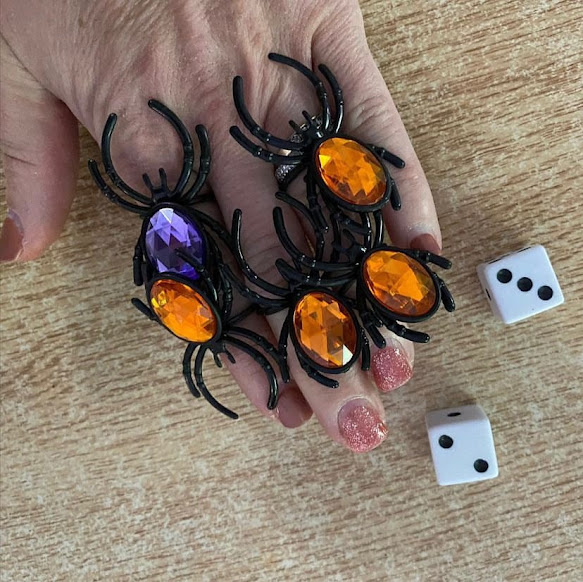
Seasonal rings are a fun tool to use in math games. Provide children with dice and encourage them to roll and add (or subtract) the numbers. Children can then wear the corresponding number of rings on their fingers. If two players play the game, they can each roll and wear rings and then compare hands to see who has more or less.

Name Equations

 
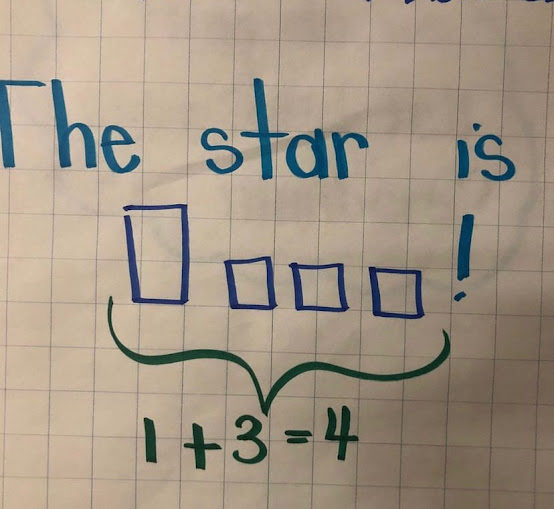
We enjoy representing children's names with boxes and encouraging them to think about the number, size and shape of the letters. These boxes are also fun to represent at equations so that children can play with their names and integrate a bit of math into literacy.

Calendar-based Number Talks


Morning message is a great time to encourage a daily number talk. We often represent the date in different ways (e.g., dice faces, dominoes, tallies, frames) and then encourage children to calculate the number by paying careful attention to the representations and operation signs used.

Which One Is Wrong?


Another favourite number talk is 'Which One is Wrong'. Different equations are displayed and children are challenged to explore each one using manipulatives (e.g., cubes, bead strings) to find the incorrect one. 

What other activities do you use to help children with early algebra? Let's connect on social media @McLennan1977!

Friday, September 2, 2022

Creating a Sensory Wall for Children

In our classroom we have a discovery area where children are invited to explore materials that focus specifically on the senses. We enjoy including resources that support exploration of light and colour (e.g., light table, sensory jars). Many loose parts are also in this area (e.g., stones, shells). The materials are stored on a small wooden shelf so they are easily accessible for children.

The shelf floats in the middle of the room as an anchor for the space. The back was covered in blue felt. We wanted to maximize all areas of this space and because there are many children with sensory needs in the class we decided to turn the felt area into a sensory wall.

The first step was to measure the space and plan out how the materials would fit together. I found this easiest to do on a flat working space. This way I could piece the material together like a puzzle and ensure they were diverse and interesting to explore.

Once I was satisfied with the way it looked I attached each piece to the felt wall using hot glue. I know that over time as children explore the pieces may fall off, but I am hopeful that I will be able to quickly and easily reattach them. I love how the sensory wall is low enough for all children to access. They will be able to sit and explore, or touch it while they walk by. The materials also match the colour scheme and decor in this calming space and do not stand out.

I found myself enjoying the materials and know that the children will too!

Related Posts Plugin for WordPress, Blogger...