Showing posts with label computational thinking. Show all posts

Saturday, October 2, 2021

Pumpkin Math

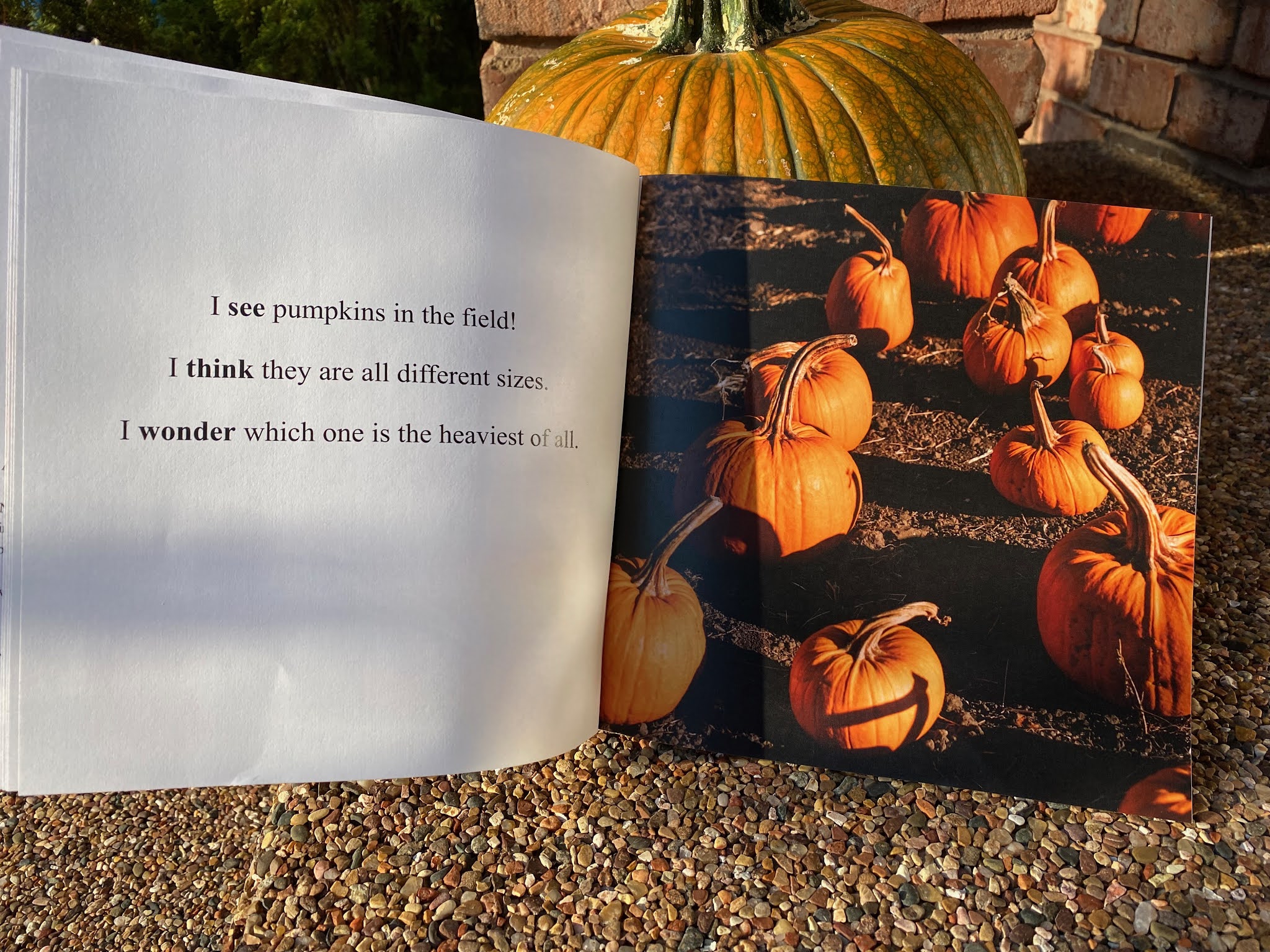
Autumn is such a wonderful time of year! The colours and textures can inspire such rich math conversation! This past weekend we visited a few farm stands in the area and all I saw was math around me! I'm hoping that these photos will be useful as math prompts for 'math talk' conversations with children.

Show children a photo and ask them to share what they 'see, think and wonder' about each photo. The 'see, think, wonder' thinking routine can be used to help children delve more deeply into exploring and articulating what they notice in a specific situation. As children notice and name what they see, they can make connections to their own experiences and ideas, and form questions for further exploration and math research. 

Educators can also ask children specific math questions to guide their thinking. This can be especially helpful if the math concepts in the photos are geared towards an existing exploration the children are having, or if specific curriculum and assessment investigations are needed by the children. Sample math questions are provided below!

How many bumps are on this pumpkin?
 How big around is the stem?
What patterns do you notice?

How are these gourds organized?
What other ways can you sort the objects?
How many do you think are in each bushel? How do you know? 

 
What patterns do you see?
Why is the pumpkin more narrow at the top?
How big around might this be in the largest part?  

How many pumpkins do you estimate are in this box?
How many pumpkins might fit in the box if it was filled to the top?
How much money do you think the farmer should charge for the entire box of pumpkins? Why?

If these pumpkins are $3.50 each, how much would all of these cost? 
Should bigger pumpkins cost more than smaller ones? Why?
Which do you think is the biggest? How do you know?

Which pumpkin would you pick if you only had $2? Why? 
If you had X dollars, how many pumpkins could you buy?
How much money do all these pumpkins cost altogether?
What symmetry do you notice?
What patterns do you see?
How many pumpkins would a full crate hold?
 
Which gourd does not belong? Why?
How could you sort these? What's your sorting rule?
How many gourds do you think are in this bushel?
 
Halloween Math uses the 'see, think, wonder' thinking routine to explore seasonal objects and experiences in a mathematical context and is now available from Amazon!

Tuesday, November 26, 2019

Encouraging Computational Thinking In Kindergarten

Young children are capable of engaging in rich computational thinking activities in the classroom. In emergent programs, the questions and wonderings children have about the world around them can easily be embedded into unplugged coding activities. Activities that incorporate computational thinking are often misinterpreted as 'more screen time' for young children, when in fact, all of the activities I use in my classroom to encourage computational thinking are screen-free without the need for computers or tablets.


Computational thinking is a foundation of computer science, and intricately related to many of the big math ideas and practices found in early childhood curriculum. It involves many concepts and approaches.

There are many different elements of computational thinking including:
  • using logic to predict and analyze when engaging in problem-solving
  • making judgments when faced with problems in order to evaluate what is happening and consider how to move forward
  • creating and following algorithms (or steps of action) in order to move through the problem solving process
  • using patterns in his/her work to find and use similarities efficiently 
  • deconstructing larger problems or actions into smaller, more manageable parts
  • filtering out information that isn't directly related to the problem or an efficient way of solving it

The computational thinker:
  •  tinkers with loose parts and other open-ended materials
  • designs innovative projects and follows through on creating them in some capacity
  • debugs by finding errors in his/her work and correcting them in order to move a project forward
  • perseveres and continues with projects even when they are challenging
  • collaborates with others as part of a team for the betterment of a project 
'Hour of Code' is December 9 to the 15 this year. Hour of Code originally started as a project to inspire people everywhere to spend one hour coding, in order to show that anyone, anywhere can code. It has become a world wide celebration of computational thinking and coding, and many global classrooms participate. 

Looking to engage children with computational thinking in your classroom? Here are some ideas to get you started. 

1. Use a read aloud to introduce the concept to children. Computational thinking can seem abstract, especially out of context. The book 'Think Like a Coder' introduces computational thinking to everyday activities that children experience including cooking, building, and even exploring the outdoors.
2. Look for everyday activities that naturally engage children in inquiry, problem solving, and computational thinking. Building with wooden blocks is a great start! Help children articulate the steps they took to build their structure, and ask them how they problem solved when difficulties arose with their creation (e.g., how they fixed a tower that kept falling over).

3. Provide STEM challenges to children. Ask them to use specific materials to achieve a certain goal, and encourage them to articulate the steps and criteria they used in order to be successful. In this photo a child turns a geoboard into a marble run maze. 


4. Introduce the idea of coding using arrow coding cards and positional language. Children can easily explore pathways by creating them using different building materials (e.g., blocks, legos, magnetic tiles) and then exploring direction of movement.


 5. Transfer coding into algorithms by helping children create and follow specific sequences of actions. Here children create and follow an 'exercise code' where they must look at each line of code in the script, and follow the movements precisely.


Computational thinking is a versatile, foundational approach to learning that helps engage children in rich mathematical activities. As Hour of Code approaches be sure to check out my twitter and instagram @McLennan1977 for more ideas on how to bring computational thinking and coding to your early years and primary classroom. 

Let's connect! Have a great idea to share? Leave it below in the comment section or tweet me and use the hashtags #kindercoding #joyfulmath #HourofCode and #MTBoS!
Related Posts Plugin for WordPress, Blogger...