Showing posts with label hundreds grid. Show all posts

Sunday, October 26, 2025

Spider Catapults


Spiders continue to be a popular topic of exploration in our classroom! To infuse this interest with math and fine motor work we introduced clothespin catapults to the children this week. Wooden catapults are easily made by securing a clothespin to a steady base (like a wooden block) with an elastic. 

They require concentration and perseverance for children to operate. As children become more confident using them they are able to use strategy to aim the catapult in a specific direction or apply pressure to further or reduce the launch power. 

Small plastic spiders (ours were from the local dollar store in the Halloween section) are light and perfect for playing with. We offer 'webs' made from wrapping a shallow basket with yarn. Children are encouraged to fire the spiders into the webs.


Once children master launching the spider into the web additional math tools can be offered to enhance the experience. A five or ten frame or hundreds chart are easy tools for children to use when tracking how many spiders they have landed in the webs.   


Additional targets can be provided for children to play with (e.g., alphabet chart, number chart, printable web with points). The possibilities are endless! 

Sunday, December 3, 2023

Ten Easy Holiday Math Activities

The holidays are such a lovely time of year to spend with children! However the last few weeks before the winter break can be hectic. Here are ten easy to assemble activities that can infuse playtime with math by capturing the magic of the season! Many of the seasonal loose parts included in these photos were found at the local dollar store. Enjoy!

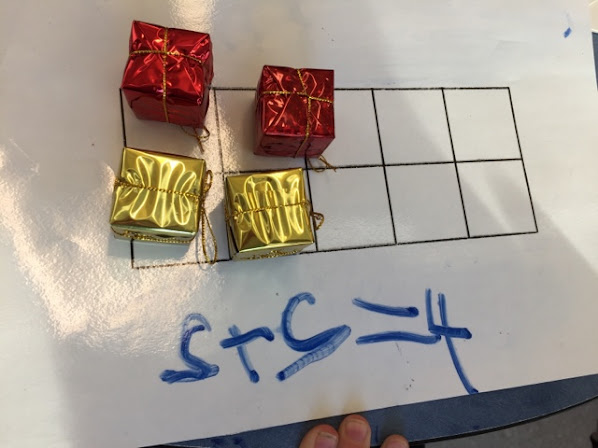
1. Count the Presents - offer children mini presents (or other seasonal trinkets including bells or ornaments) and number cards. Encourage children to match the corresponding number of objects to the cards. Children can also place presents on a laminated ten frame and write a corresponding addition or subtraction sentence using a dry erase marker.


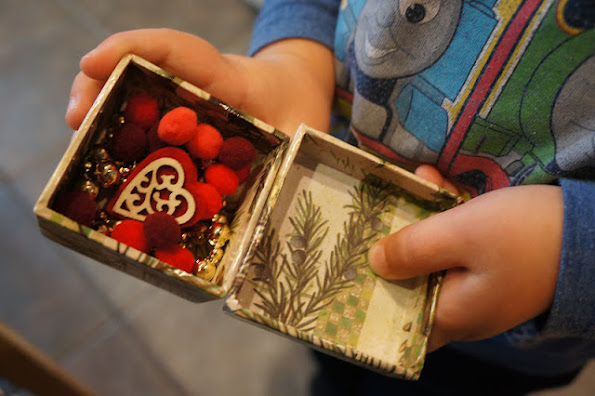
2.  Holiday Sensory Bin with Mini Boxes - fill a sensory bin with seasonal trinkets and treasures. Add mini present boxes and encourage children to fill the boxes with different objects. Children can then use a hundreds grid to count how many objects fit in each box!


3. Catapult the Gingerbread Man to Safety - help mini Gingerbread Men land to safety over the river by firing them using catapults made from clothespins attached to blocks using elastics. This activity works fine motor muscles too!


4. Cookie Cutter Bell Count - display a collection of bells in a tray with a variety of seasonal cookie cutters. Challenge children to fill one cutter with bells and use a hundreds grid to count how many it holds. Which cutter holds the most? Least?


5. What's Inside the Presents? - fill different holiday boxes with loose parts. Encourage children to shake one at a time and estimate how many objects might be inside. They can then open the box and spill the objects out. Each object can be placed on a number grid and counted.

6. Fill a Tree with Trinkets - children can explore the concepts of area and perimeter by filling or outlining wooden trees (or other seasonal place mats or shapes) with a variety of bead strings, ribbons or small objects.

7. String a Pattern - secure a number of green pipe cleaners to a sturdy cardstock or cardboard base in the form of a tree. Encourage children to string beads to 'decorate' the tree using different patterns. Children can also count how many beads they use for each section.
 

8. How Many Elastics? - children can wrap a number of elastics around cookie cutters until they are filled. Encourage children to count how many times they wrap each elastic. For an added fine motor challenge have children remove the elastics one at a time.


9. Gingerbread House STEM Challenge - provide children with magnet shapes and challenge them to build an intricate gingerbread house. Ask them to search the room for various loose parts that will attach to the magnets and 'decorate' the house (e.g., here the staples in mini bows attract to the magnets).

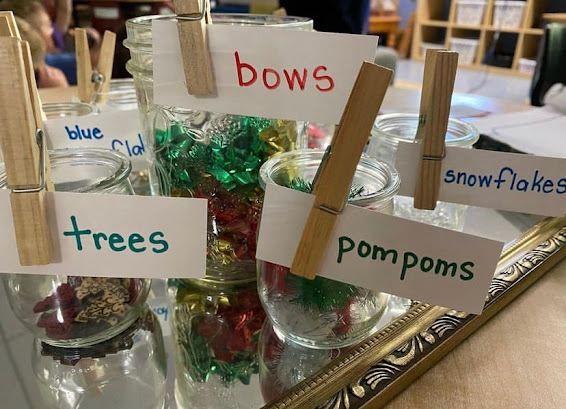
10. Holiday Guessing Jars - fill glass jars with seasonal loose parts. Encourage children to estimate how many objects are in each jar. The objects can then be shaken out and counted using math tools such as number grids and ten frames.


Looking for a book to support holiday math learning? Check out my book Holiday Math! 


Wednesday, May 9, 2018

Flipped Hundred Chart

Helping children conceptualize numbers and find meaningful ways to think about their relationships is a goal in our kindergarten classroom. We encourage problem solving and working with number strategies in daily number talks, and are always on the lookout for interesting ways to compliment the rich math learning opportunities we are observing in the children's play.

Recently I became a member of the National Council of Teachers of Math (NCTM https://www.nctm.org/). A highlight of membership is that I have access to the journal Teaching Children Mathematics, which is filled with research-based articles outlining interesting and developmentally appropriate practice for the early years. In the December 2017 (24, 3) issue there is a fascinating article by Jennifer M. Bay-Williams and Graham Fletcher called A Bottom-Up Hundred Chart? In this piece the authors challenge educators to consider the potential for enriching children's learning if the popular math tool is flipped upside down.


Bay-Williams and Fletcher share that a flipped hundred chart makes sense because when children use the chart to solve equations, the language they use to describe direction on the chart matches their understanding of the operation - if adding the number appears to get taller, bigger and greater as physically modeled when children track the addition sentence by moving up on the chart and if subtracting the number appears to shrink, moving downwards and getting smaller by descending the chart (e.g., if a child is solving 13 + 12 s/he would first point to the thirteen, move upward one space and then to the right two). The authors also suggest a number of different activities for exploring the chart including cutting one into a 'number puzzle', encouraging children to find mystery numbers, and assigning children a number and challenging them to find all the number's 'neighbours'. These activities are great ways for children to physically and mentally manipulate the chart, helping them to become more comfortable working with the numbers.

After reflecting upon our math program I have created five additional activities that I believe will continue to challenge children and encourage them to strengthen their understanding and confidence working with the numbers 1 - 100.

Guess my number!

Display a flipped hundred chart and mentally think of a number that the children will have to guess. Give children one clue at a time to help guide them to your number (e.g., my number is less than 50, my number doesn't have a 6 in it, my number is odd). The children can consider the clues and cross out the numbers that don't follow the clues. With additional clues more numbers will be crossed off the chart until children guess the correct one. Reverse roles and invite the children to think of a number and give the clues to you!


Pentomino Trace

Our children love to manipulate pentominoes - using them to fill frames and trays and solving intricate puzzles. Children can also be encouraged to use them as tracers, matching them to the chart and outlining the numbers contained within. Once a collection of numbers has been traced, encourage children to find something that all numbers have in common (e.g., they each have a 4 in them; they are all greater than 36). Tip - ensure your flipped hundred chart is printed to the same size as your pentomino set to ensure an accurate match.


Dry Erase Number Write

Our children love to write with dry erase markers. Create a variety of 'missing number' flipped charts, laminate, and invite the children to practise filling in the missing numbers.


Flipped Hundred Chart Coding

We spend a lot of time coding in our classroom and see potential for incorporating coding directions and spatial reasoning into exploring the flipped hundred chart. Display the chart and determine a starting number. Provide children with a series of verbal or written coding directions as they move from the starting number and reach the end number. Once the final number is determined encourage children to create an statement or equation that describes the relationship between the two numbers.

Start at 3.
Move up 4.
Move right 5.
The number is 48!

 What do you know about 3 and 48? (48 - 3 = 45, 3 + 45 = 48, 3 + 5 + 40 = 48)


Roll, Subtract and Race!

Use an enlarged copy of the flipped hundred chart as a board game. Two (or more players) can use recycled board game pieces and place them on the starting point 100 spot. Each player takes a turn rolling one die and moving their player backwards on the chart (or 2 to make the game more difficult). Students can be encouraged to think in equations (If I start at 100 and roll 5, 100 - 5 places me on the 95 spot). First player to move off the board into the 0 spot wins!


What other ways can children learn with the flipped hundred chart? 
Feel free to share other ideas in the comment section below or tweet #flipped100schart!

Thursday, May 19, 2016

Race to 100 Outdoors

The children drew their own hundred grid today using chalk. This was a complex task that required much problem solving and communication among children.

Figuring out how to draw the correct number of squares, writing the numbers in each square, and rolling the dice in order to calculate how many spaces to move all require complex math thinking across many domains.


The children used items from nature to mark their places and took turnings rolling and then moving along the grid. 


Outdoor play time is perfect for infusing a math challenge into our learning!
Related Posts Plugin for WordPress, Blogger...