Showing posts with label patterning. Show all posts

Tuesday, August 11, 2026

Multiplicative Thinking in the Early Years


Even though multiplication can be an abstract concept for many, the foundation for it can be nurtured in the early years. Multiplicative thinking for young children involves moving beyond counting when calculating quantity and beginning to think about groups, units, relationships, and patterns between numbers. There are many ways we can help build the foundation of multiplicative thinking early on.

Doubling

Doubling helps children see a number as a unit that can be doubled. For example, children can begin to recognize that 5 and 5 make 10, or that 6 and 6 make 12, without needing to count each object.

We can look for opportunities to use doubling throughout the day. If there are 4 children at one table, we might ask, “How many children would there be if we had another table with the same number of children?” Or, if we have 5 blocks, we could ask, “What would happen if we had another group of 5?”

Doubling also becomes a useful strategy for working with numbers that are close to a double. For example, a child might use 5 + 5 to help figure out 5 + 6. These kinds of connections help children begin to use what they already know to think about new quantities.

Unitizing

Unitizing is an important part of developing multiplicative thinking. It helps children understand that a group of objects can be thought of as one unit that can then be counted or repeated.

For example, instead of seeing 10 counters as 10 individual objects, children might see them as 1 group of 10. They are beginning to think about the structure of the quantity rather than just counting each object.

We can encourage unitizing by having children make equal groups with everyday classroom materials. We might ask:

  • “Can you make groups of 3?”
  • “How many groups did you make?”
  • “How many are in each group?”
  • “How many are there altogether?”
  • “How did you figure it out?”

The goal is not simply for children to get the answer. We want them to start noticing that the same quantity can be organized and thought about in different ways.

Skip Counting

Skip counting by 2s, 5s, and 10s is an early way of helping children think about units and develop multiplicative thinking.

However, skip counting becomes more meaningful when children understand what they are actually counting. For example, counting 2, 4, 6, 8, 10 can represent counting groups of 2 rather than simply memorizing a sequence of numbers.

If each child gets 2 cubes, we might ask, “How many cubes will we need for 5 children?” Children can make groups of 2 and count them: 2, 4, 6, 8, 10.

This gives a purpose to skip counting and helps children connect the numbers they are saying to the groups they are seeing.

Repeated Addition


Repeated addition helps children make a connection between addition and multiplication. When children see 3 groups of 4, they might represent this as:

4 + 4 + 4

This is a useful way for children to begin thinking about equal groups. Multiplicative thinking involves noticing the groups and the relationship between the groups and the quantity in each group.

Educators can encourage this by asking open ended questions including:

  • “How many groups do you see?”
  • “How many are in each group?”
  • “How could you count these?”
  • “Could you count them without counting every object?”
  • “What do you notice about the groups?”

These questions encourage children to think about the structure of the quantity and look for more efficient ways to determine how many there are.

Arrays


Arrays are another great way to help children visualize equal groups. Arranging objects in rows and columns helps children see equal groups and provides a visual representation that can later support their understanding of multiplication.

For example, 12 counters could be arranged in 3 rows of 4 or 4 rows of 3. Children can explore both arrangements and notice that the total stays the same even though the arrangement has changed.

Finding arrays in the world around us is an interesting way to “notice and wonder” about multiplication. We can find arrays in many places:

  • windows on a building
  • seats arranged in rows
  • tiles on a floor
  • eggs in a carton
  • buttons on clothing
  • objects arranged on a shelf

Look for Multiplicative Thinking in Everyday Situations

Multiplicative thinking can be developed through everyday classroom experiences. When children are sharing materials, setting tables, building with blocks, organizing collections, or lining up, there are many opportunities to think about equal groups. Educators can notice these moments of learning and facilitate thinking through responsive questioning. For example:

“There are 4 children at each table. How many children could sit at 3 tables?”

Or:

“We need 2 crayons for each student. How many crayons will we need for 6 students?”

Or:

“Here are 20 counters. Can you organize them into equal groups? How many different ways can you find?”

These questions encourage children to think about how quantities are related, rather than simply finding an answer.

Building the Foundation

Developing multiplicative thinking in young children is about providing experiences that help children see groups, units, and relationships.

When children double, make equal groups, skip count, organize arrays, and look for patterns, they are building ideas that will support their later understanding of multiplication and division. Responsive educators can use their observations of children's actions to help highlight this and invite them into the learning opportunities. 

Thursday, October 14, 2021

Autumn Math Walk

 “I'm so glad I live in a world where there are Octobers.”
― L. M. Montgomery, Anne of Green Gables 

What a beautiful time of year it is in Southern Ontario! We have been spending much time outside each school day exploring the changes in our school yard. The children are curious about the world around them and ask many questions about their surroundings and the autumn treasures they find. Many of their wonderings have been mathematical in nature - Why is there a pattern on the sunflower's seed head? What are those holes in the stump and where did it come from? Why is a Daddy Long Legs an arachnid and not a spider?  How do leaves change colours? Why are the clouds moving so fast in the sky?

There is math everywhere. If one looks deeply enough, there is always a mathematical connection in nature. The sunflower seeds follow the Fibonacci Sequence - a numerical pattern meant to help maximize space and fit as many seeds into the head as possible. The perfect little circles in the stump might have been caused by a wood boring insect or bird looking deep into the bark for food. Daddy Long Legs have a different body than spiders even though they have eight legs. Leaves change colour because the amount of sunlight they need to create their own food lessens in cold weather (as the Earth's axis tilts us away from the sun), resulting in a chemical change in the leaves. 

I've been motivated to continue to look for rich mathematical wonderings and opportunities for inquiry each time I'm outside - even on the weekend with my own children. I find it fascinating to see math applied in an authentic, interesting, real world connection. The math in nature is beautiful! Inspired by this mathematical beauty I have written a book called Autumn Math Walk that includes photos and narrative to help readers delve deeply into exploring math in the outside world. I've appreciated the interest in this book and loved seeing the ways educators have used the text in their classrooms. Learning from one another is so inspiring!


I'm so very excited to partner with Pembroke Publishers and offer a free teaching resource to complement my book Autumn Math Walk!

Autumn Math Walk Teacher's Guide is a free resource that can help educators understand the math that exists in the natural world, and use this information to provoke conversation and understand with children as they explore nature. Perhaps children will be inspired to author and illustrate their own Autumn Math Walk book unique to their specific surroundings!

Saturday, October 2, 2021

Pumpkin Math

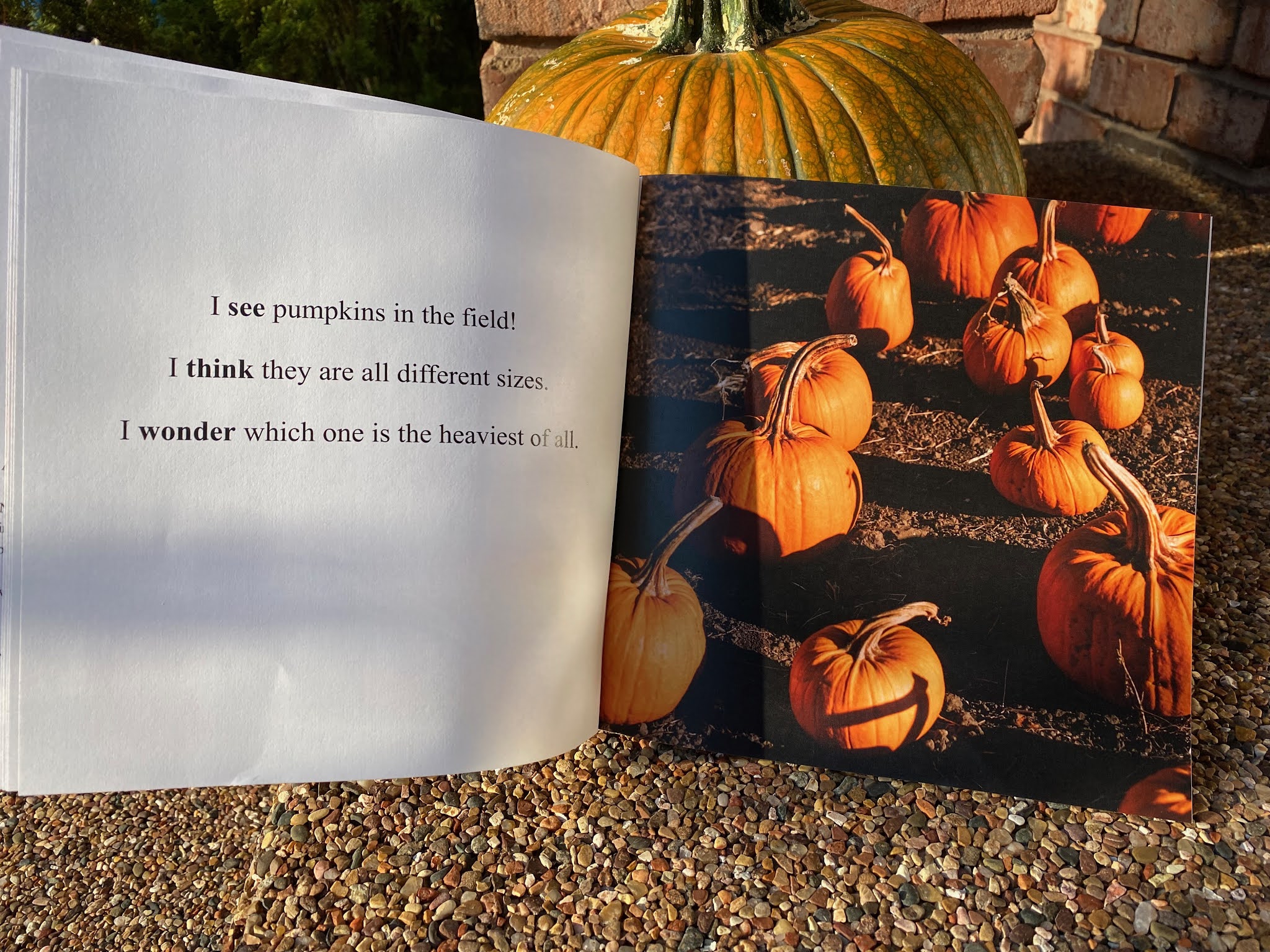
Autumn is such a wonderful time of year! The colours and textures can inspire such rich math conversation! This past weekend we visited a few farm stands in the area and all I saw was math around me! I'm hoping that these photos will be useful as math prompts for 'math talk' conversations with children.

Show children a photo and ask them to share what they 'see, think and wonder' about each photo. The 'see, think, wonder' thinking routine can be used to help children delve more deeply into exploring and articulating what they notice in a specific situation. As children notice and name what they see, they can make connections to their own experiences and ideas, and form questions for further exploration and math research. 

Educators can also ask children specific math questions to guide their thinking. This can be especially helpful if the math concepts in the photos are geared towards an existing exploration the children are having, or if specific curriculum and assessment investigations are needed by the children. Sample math questions are provided below!

How many bumps are on this pumpkin?
 How big around is the stem?
What patterns do you notice?

How are these gourds organized?
What other ways can you sort the objects?
How many do you think are in each bushel? How do you know? 

 
What patterns do you see?
Why is the pumpkin more narrow at the top?
How big around might this be in the largest part?  

How many pumpkins do you estimate are in this box?
How many pumpkins might fit in the box if it was filled to the top?
How much money do you think the farmer should charge for the entire box of pumpkins? Why?

If these pumpkins are $3.50 each, how much would all of these cost? 
Should bigger pumpkins cost more than smaller ones? Why?
Which do you think is the biggest? How do you know?

Which pumpkin would you pick if you only had $2? Why? 
If you had X dollars, how many pumpkins could you buy?
How much money do all these pumpkins cost altogether?
What symmetry do you notice?
What patterns do you see?
How many pumpkins would a full crate hold?
 
Which gourd does not belong? Why?
How could you sort these? What's your sorting rule?
How many gourds do you think are in this bushel?
 
Halloween Math uses the 'see, think, wonder' thinking routine to explore seasonal objects and experiences in a mathematical context and is now available from Amazon!

Saturday, August 14, 2021

Small World Play and Math

 "Old things are better than new things, because they've got stories in them."

Kami Garcia

What is hiding in your cupboards and closets? For 20 years now I have kept an old, beautiful china set from my grandmother high up on my shelves. I can honestly say that I haven't used it once; life with busy children doesn't lend itself to tea parties and fancy dinners. Each time I opened the particular cupboard in which these beautiful objects were stored, I'd feel a sense of guilt. They were treasured by my Nana and used for special gatherings. Now they collected dust.

As I look ahead to the next school year, I am eager to bring beautiful, inspiring materials back into our classroom. Covid has meant that many children have been home with their families, isolated from the world. I anticipate a higher than normal level of anxiety and stress as we return to school, even if we are eager and ready for this new chapter. Having beautiful, interesting materials in the classroom space can often welcome children and pique their curiosity, helping them transition into the space and overcome their feelings of anxiety.

Last week I cleaned the kitchen and as I handled the china, I wondered if it could be integrated into the classroom as play props. Not only would that give the bowls and cups a sense purpose, they would beautify our space. I liked the idea of being able to enjoy them on a regular basis; each time I look at them they remind me of my grandmother and I love feeling her presence in my life.

I had been eager to use a small teacup set (found at Value Village) in some way. I knew that the children loved small world play, and that imaginative mini playscapes held potential for rich math learning. I decided to turn my china into a tea garden. In each piece I placed small stones at the bottom for drainage. I planted succulents in the potting soil because of their hardiness and ease of care. 

     
I anticipate placing these materials on a low shelf in the classroom. They will be a semi-permanent fixture there. They will beautify our space when not in use, and be accessible enough that children can access them without needing to move them around the classroom. I have always felt comfortable integrating fragile materials into our space. My experience has been that when children feel empowered as learners, they care deeply for the materials and handle them gently. I'm also prepared for the possibility of accidents. The children are capable and careful when something breaks and I am willing to trade this risk with the reward of using these materials.

I am purposely not adding character props to this learning invitation. I would rather see how children integrate other materials we have into their play (e.g., mini animals, wooden clothespin dolls), or create their own fairies and other figures at the art center. I also see potential for creating a similar invitation outdoors in some way (e.g., fairy door in a stump). As I observe the children I will take note of their ideas and interests, and help to scaffold and support the math learning as it emerges. Some math ideas I think might present include:

  • a discussion of proportional reasoning as children explore the size of the small world and create additional play props
  • an observation of pattern as children see, think and wonder about what they find on the china
  • practice with one to one correspondence as children set the table for a tea party and create additional props to support their storytelling (e.g., plates, forks, food)
  • STEAM as children create their own figures to integrate in this play (e.g., dolls, fairies) or create their own mini worlds (e.g., dollhouses from boxes)
  • observations of shape and size as teacups are compared to one another
  • connections with capacity as children consider how much liquid might fit into the cups, or create their own tea parties while playing in the mud kitchen or water table

I'm sure as children explore the materials additional ideas will emerge. I can't wait to see what they discover! I'm eager to search my closets for other materials to upcycle and bring into our learning space!

Saturday, September 9, 2017

Printable Activities to Support Open-Ended Mathematics

I continue to be inspired by the rich math learning I have been offered in my recent professional development. Research shows that early math experiences are key to a child's future math success - both in their confidence and math abilities. We know that having a strong partnership between home and school can enhance this mathematical mindset in the early years.

This year I will be pleased to continue to send home math 'take home bags' to our children, beginning towards the end of September. Each of these bags is numbered. On Fridays your child will bring a new math bag home to explore with you. In each bag are activities that are designed to refine math concepts from the Ontario Kindergarten Curriculum, with a special emphasis on number sense and numeration, specifically subitizing and composing/decomposing numbers. Please send the bag back to school by the following Wednesday so that we can send a new bag home with your child.


Inside each bag will be an instruction card and any applicable materials you will need to play the game together.


I am excited to see how the children's math mindset and abilities are influenced by these activities. We will continue to focus on math rich tasks at school as well. Any feedback regarding these bags is greatly appreciated.

If you would like a sneak peek at some of the activities, or are a fellow educator interested in printing a set of these activities for use in your classroom, please click this link: Family Math Bags

Tuesday, April 26, 2016

Complex Patterning Problems in Kindergarten

We have done a lot of work this year in conjunction with our school improvement plan regarding helping improve children's attitudes and achievement in math. Part of encouraging a mathematical mindset has involved communicating the message to children that we believe in them and know they are capable of amazing mathematical work.

Recently we have introduced some interesting math problems to children and it's really encouraged some deep reflection on my part as an educator, especially when considering the types of questions I offer to children and how I support and scaffold authentic problem-solving and mathematical work in our classroom.

Take this problem for example. Previously I would have provided this type of patterning prompt during whole group time (probably in our morning message) to children and encouraged them to identify and continue the pattern in each example. I might have then provided the round stickers to children and invited them to create their own simple and complex patterns. When I think about this type of activity, it's satisfying what I was hoping to do (which is explore and create patterns) but I am not really sure that it's as challenging and open-ended as it could have been. 


After reading Jo Boaler's work on mathematical mindset I've been revisiting the types of problems and math situations we introduce to children. Yesterday I asked the children to consider what they notice about the following figures. 

We spent the first day discussing what we noticed and today we really delved deeply into the problem. We discussed with children what a robust math task is, and how we can spend a lot of time slowly and deeply thinking about a problem. We don't have to think of the answer right away, and we might all see and think something different about the problem. If you examine the children's responses today, you'll notice that they include patterning, measurement, number concepts, and addition in their observations of the growing figures. Some children also considered what was happening if they looked at the figure to the right first, and went right to left. They observed that meant the size and pattern was decreasing instead of increasing. Our conversation was so interesting and we are inspired to revisit this again tomorrow, hopefully using real blocks to actually build a model of this problem. By observing, discussing, writing and representing the problem we are differentiating the math and providing multiple entry points for children into the problem. We are on the same path towards deep math understanding and it's an incredibly exciting place to be!


We like to share what we do in our classroom using social media and often tweet about our learning. It was very exciting to get a response from another kindergarten class who is planning on exploring the same problem we did. We are hoping to tweet back and forth with this class so we can share what we observed about the math figures and learn what they notice. We can work together to collaboratively understand the math situation on a deeper level and use technology to help us communicate! Math is about collaboration, not competition!


Wednesday, March 23, 2016

Inspired by Nature

Inspired by nature we are representing our understanding of the changing of the seasons through art. 


Some patterning emerged in our work! Math and art go so well together!

Tuesday, December 15, 2015

Holiday Beading

We invited children to practise fine motor skills and perseverance by creating with holiday beads. We saw many little fingers at work, carefully crafting mini wreaths and pretty patterned bracelets.


Related Posts Plugin for WordPress, Blogger...