Showing posts with label sorting. Show all posts

Sunday, April 13, 2025

STEAM in the Garden - Constructing Insect Houses using Natural Loose Parts

"Look deep into nature and then you will understand everything better."

Albert Einstein

The children were gathered around a large landscaping rock, working together to arrange twigs and flowers they had picked from the ground nearby.

"I think that this side should be the living room and the bedroom can be over here," Jack gestured as he spoke. "The living room will be next to the bedroom and the ladybug can crawl across by using this little bridge."

"So what are these little sticks here for?" Mary pointed to a little row of twigs placed next to each other.

"Oh, those are going to be the bed." Olive answered.

"But that's way too big to be a ladybug's bed," Mary responded.

"Oh," Olive pondered. "I didn't think about that.
 
"That's okay," Mary smiled. "We'll just find more than one ladybug and then the bed will be the perfect size for them to share." 

Spring was in the air and the children were excited to discover that many little creatures were venturing out into the warm sun. Ladybugs, rolly pollies, and ants were abundant and this sparked the children's imaginations. Eager to 'help' the insects the children set to work building little houses for them. They searched the yard to gather materials they felt would be best suited to this task. 
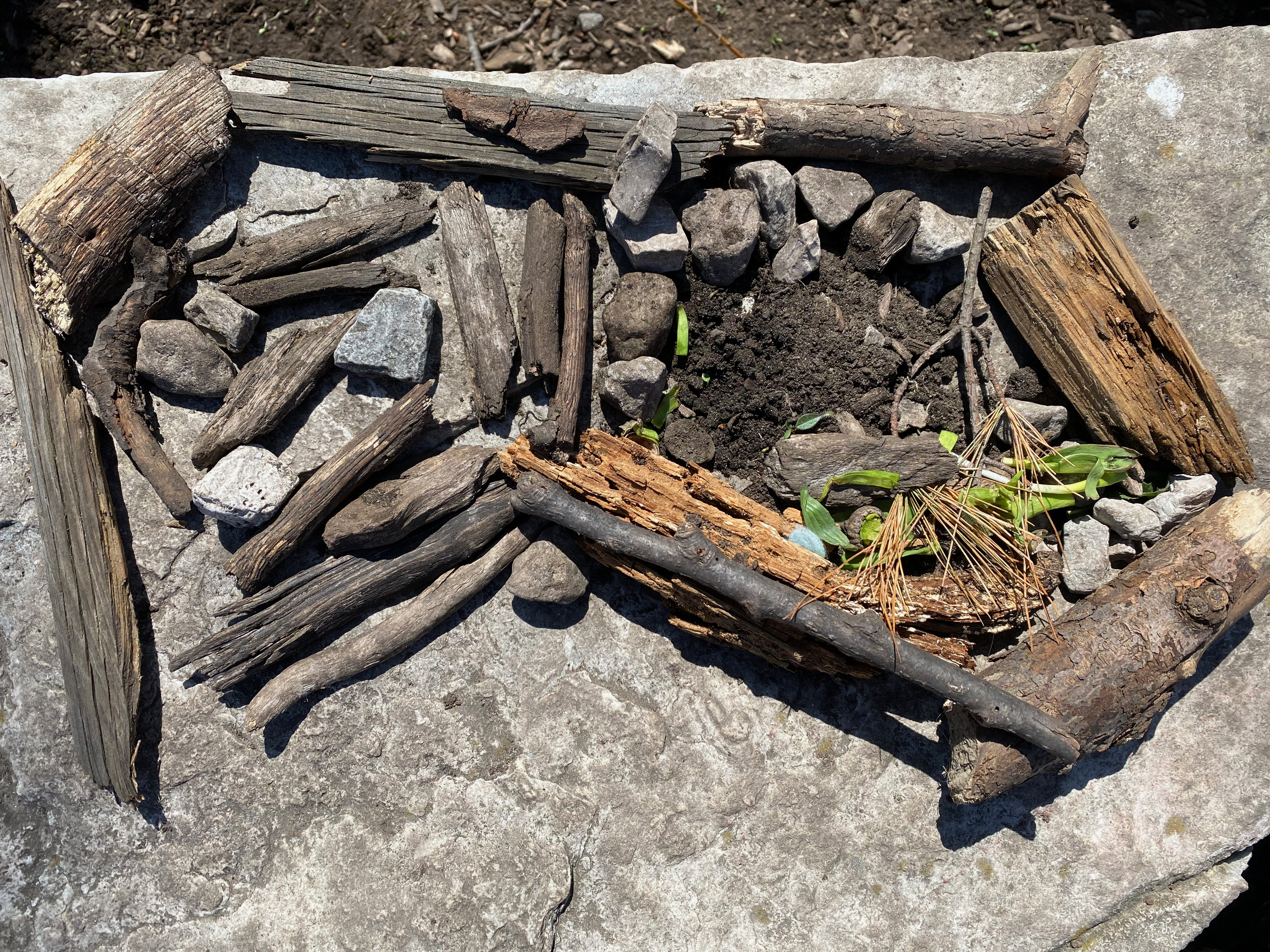
Each day the children would return to the mini houses and continue their work, focused on creating the most aesthetic and functional space for whatever creature they had found that day.  
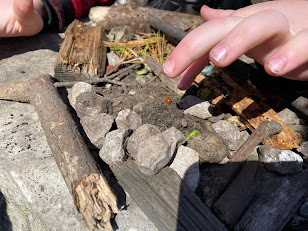
   There are four steps to the design process for young children. When I reflect upon the children's garden engineering of the habitats I observed these steps in action:

Identifying a Problem - the children felt the insects needed a home
Imagining and Planning - children brainstormed that natural loose parts could be used to design and construct a habitat and engaged in conversations about what this might look like
Creating - children spent time over many days creating different homes for different living creatures
Improving - children revisited their creations each day and revised their plans when necessary
after they noticed new things about the insects or had engaged in conversations with peers
  
What might seem like a playful activity outdoors has the potential for much rich learning using an engineering mindset. When children create habitats outdoors they are participating in rich math exploration in action including:
 
-discussing, designing, and refining a plan
-classifying and sorting materials by common characteristics
-considering proportion as they build for specific insects
-using spatial reasoning and design as they manipulate materials
-thinking about measurement as they incorporate area and perimeter into their 'house' or discuss the attributes of materials (e.g., the heaviness of rocks, the length of sticks)
-counting materials gathered and used in the design process
-naming colours and shapes that emerge in their work
-using positional language to describe their creations
-thinking about balance and stability as they assemble materials 
-incorporating patterns or symmetry as they create aesthetic structures
 
It's amazing to notice and name the rich math learning that emerges in children's self-directed play outdoors. Taking photos and videos of the work, engaging in discussions with kids about their play, and reflecting upon the experiences can help educators make this rich learning visible to others! Sometimes nature is the most effective math teacher of all!

Tuesday, January 21, 2025

Exploring Different Fonts of Numbers

Sorting numbers that are presented using different fonts is an effective way to help children understand that numbers can look many different ways. This activity requires children to sort and glue numbers onto a chart. A basket of cut numbers was offered to children along with a template/chart and glue sticks. Children were challenged to find as many of each different number as they could.

Want to try the activity with your students? Click here to get free printable font pages and the template. Happy sorting!


Tuesday, March 5, 2024

Easy St. Patrick's Day Math Ideas

St. Patrick's Day is a fun holiday that helps jump start the spring season! Here are a few easy to plan math activities for children!

1. Shamrock Subitizing- Write different numerals in the center of each shamrock and encourage children to place dominoes with the corresponding number of pips in each leaf.

 
2. Estimation/Counting Jars - Fill jars with a variety of different seasonal loose parts. Encourage children to estimate how many objects are in each jar. They can then use a variety of math tools (e.g., number grid, ten frame, hundreds chart) to count the total objects. These can then be recorded on a paper for comparison.

3. Rainbow Numbers - Provide children with a variety of numbers and encourage them to explore these in different ways (e.g., sorting by colour, ordering, create number combinations).
4. Colour and Coin Sorting - Recycled marker caps can become 'pieces' of the rainbow. Add fun play coins and seasonal pots to the tray and encourage children to sort, count, and pattern with the loose parts.
5. Roll and Record - Here is a fun template that can be used by children to support many math explorations! Children can roll and subitize a die and colour in the corresponding number of shamrocks. Two children can each roll and colour in shamrocks using their own colour and try to get 4 in a row. Children can colour the shamrocks in using different colours to create patterns. The possibilities for this template are endless!

Get the free printable here: Shamrock Printable

 
6. Which One Doesn't Belong? -  Show children pictures of different shamrocks and ask them to articulate which picture does not belong. 
Get the free printable here: WODB Shamrocks
7. Gold Coin Count - Add dice, coins, number lines and writing materials to this game board and encourage children to create and play their own treasure games!
Get the free printable here: Gold Coin Count
8. Find the Gold Coding - Draw the path needed to get from home to the pot of gold! Use arrows to display direction of movement.
Get the free printable here: Gold Coding Mat 


Thursday, November 30, 2023

Virtual Bird Count

“There is an unreasonable joy to be had from the observation of small birds going about their bright, oblivious business.”
 Grant Hutchison

 
Colder weather and light snow this week have inspired new observations during outdoor play and exploration. The children have noticed birds hiding in the trees. It's been fun to watch them flit from branch to branch, observe their tracks in the snow and identify their different calls. I hoped to continue with these observations indoors. I introduced Cornell's live bird cam and invited children to spend time observing the animals that visited the different feeders. The children were enthralled with the quick, happy little birds as they flew in and out of the frame and gobbled up the seed.

The next day I asked children to predict which birds they thought might be at the feeders. We spent time drawing our guesses on a graphic organizer. I wanted to capitalize on the children's interest in the birds and integrate math and literacy into the experience. I also displayed posters from our library that had illustrations of common North American birds to be used as reference.


As the children observed the feeders they tracked what they saw on their charts. After ten minutes of watching we calculated and shared our results. Blue jays appeared the most!


This is an easy to implement activity that brings the outdoors inside! Click here for a free printable Bird Count tracking sheet children can use to record birds.

Saturday, September 9, 2023

Creating a Space that Cultivates Math Learning


As we head back into the school year many educators are working thoughtfully to create environments that are rich with math possibility. In Reggio Emilia the environment exists as the 'third teacher' inspiring, supporting, and extending children's learning in rich and complex ways. I have been contacted by many educators asking for advice on how to best set up their classroom and routines in order to create as many opportunities for authentic math as possible. This has inspired today's blog post - how to cultivate a math rich learning space for children at the beginning of another school year. When I reflect upon my own math pedagogy and practice, these are what I think stand out as mathematically meaningful for the educators, children and families that share our space. Although this list isn't all inclusive, I thought it might spark some ideas to support and inspire as we enjoy the first weeks of school and start back in our classroom with open eyes, minds and hearts this month.

1. Make math a part of every space in the classroom and child's school world. In the classroom are there math tools and materials available for use beyond a 'math center or math shelf'? Do children see how math relates to every subject in the space (e.g., how materials are sorted and stored on the toy shelf, how measurement is used when children decide on a size of paper to use for their project)? Can they translate math tools and ideas into other spaces in their immediate school world (e.g., see how math relates to their walks in the hallway or work in the gym)?

2. Ground and build math concepts into known objects for children. When introducing, extending or innovating a math idea is it organic and natural to the child's explorations and world? For example, it is more natural to engage children in an exploration of measurement if they measure things in their immediate world using the stick they are playing with, instead of using a standardized ruler (e.g., "Can you find something the same length as your stick in the yard?", "What is taller than your body?").


3. Use available math moments with children. In our classroom we have a large block of uninterrupted play each day. It's sometimes challenging to manage children, materials and activities during center time. However I try to engage with children as much as possible in the activities, and take on the role of 'play partner' together with them. When I am actively playing I am able to closely observe what they are saying and doing, helping me to identify and extend the rich math learning that is organically occurring (e.g., helping children to recognize why their tower keeps falling, using math terms when they equally share the play dough, introducing math terms as they discuss how many cars are in their parking lot).

4. Become a math role-model for children, families, and colleagues. Even if math isn't your favourite subject, how do you discuss it within your school and classroom? Are you excited by new activities and resources? Do you demonstrate a growth mindset? When mathematical situations arise with children that you aren't sure of, can you use these opportunities to showcase positive thinking and problem-solving? Share your new math learning with others - suggest articles and books you're reading and post these throughout your classroom to enhance documentation displays.
5. Find the math in everything. Many educators plan forward by choosing curriculum and programming expectations and then building activities to fulfill these. Try back-mapping activities from time to time; embrace child-centered, organic experiences and then deconstruct them in order to identify the rich math concepts and curriculum expectations that they utilize. You'll be surprised to find that math happens in almost every experience children have in the classroom.

6. Try looking at life through a mathematical lens. When planning invitations for learning in your classroom, see what math you can sneak in as well. Changing one or two elements of the experience might be enough to engage children in rich math. It reminds me of how I used to sneak veggies into my children's meals - a little can go a long way!
7. Collaborate mathematically with colleagues. Share new ideas and resources informally. It's easy and effective to create math invitations and activities and share these within your school or division. If every educator plans one or two activities and these are shared, children will benefit from many rich and interesting games and activities without the burden of planning and preparation it would take one educator to accomplish the same.

8. Record and celebrate your math moments. Help children, families, and colleagues recognize that math happens everywhere in the classroom by creating a documentation display with photos, anecdotal observations and connections to curriculum. This bulletin board can be built over the course of the school year as artifacts of learning are continually added by staff and students. Keep sticky notes nearby and invite observers to record their own ideas and share them by posting the notes within the documentation.

9. Engage families in joyful math with children outside of school. Consider ways that you can promote and extend math for children after school. Encouraging families to play math games and activities together with their children will not only provide children with additional meaningful math moments, but it may help older family members reconcile their fear or dislike of math. In our classroom we send home 'family math bags' once a week. These are filled with math invitations and materials so that children and their families can play games inspired by our classroom work.

10. Build your collection of math stories, songs and games. Children love to sing, dance and play games. Ask colleagues to share their favourite games and activities, and use these to help with transitions and other 'math moments' throughout the day. Quite often the words in songs can easily be improvised to match something happening in your classroom, and many rich storybooks have mathematical elements and problems embedded within them that can inspire children.

Saturday, October 2, 2021

Pumpkin Math

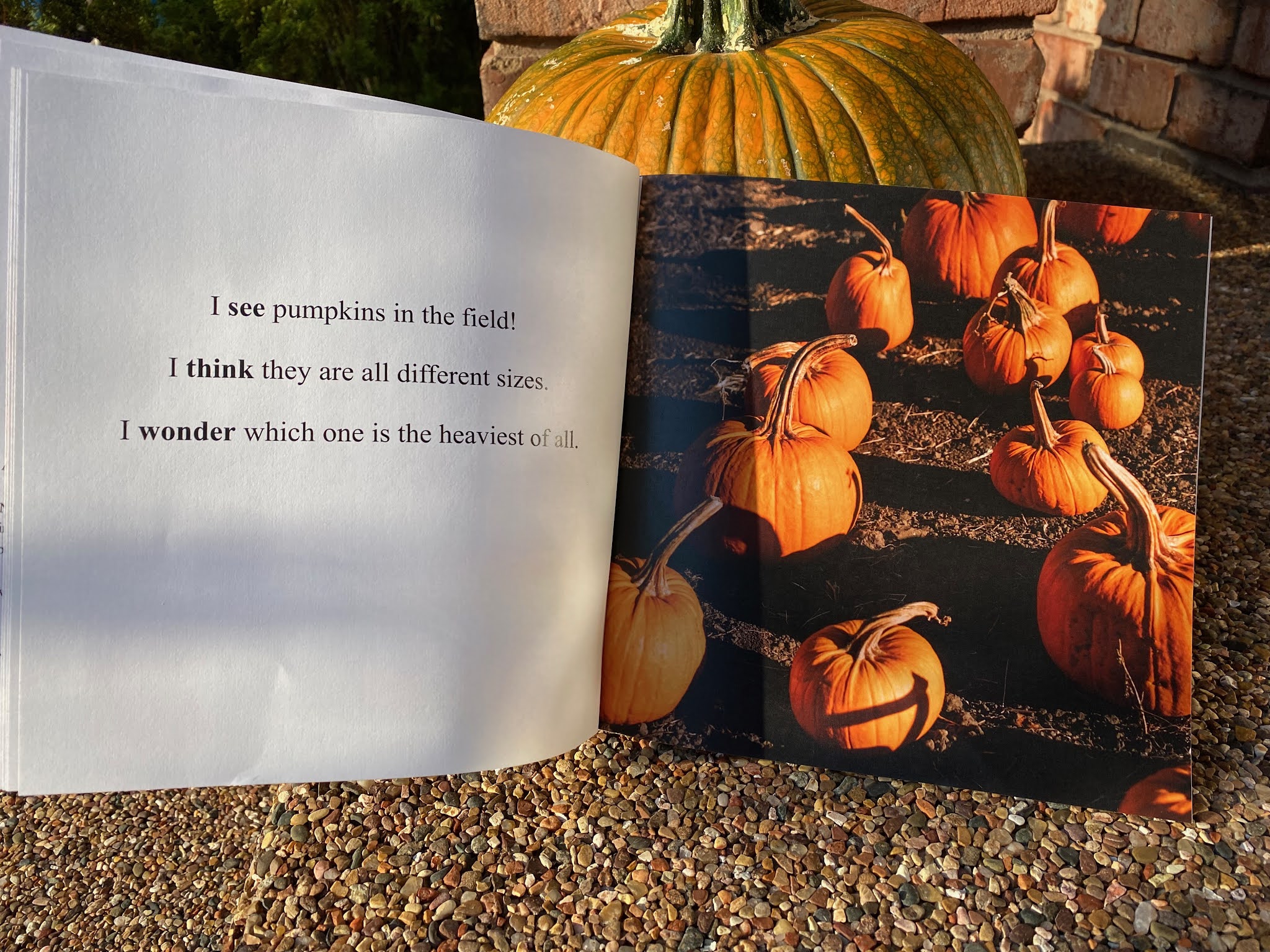
Autumn is such a wonderful time of year! The colours and textures can inspire such rich math conversation! This past weekend we visited a few farm stands in the area and all I saw was math around me! I'm hoping that these photos will be useful as math prompts for 'math talk' conversations with children.

Show children a photo and ask them to share what they 'see, think and wonder' about each photo. The 'see, think, wonder' thinking routine can be used to help children delve more deeply into exploring and articulating what they notice in a specific situation. As children notice and name what they see, they can make connections to their own experiences and ideas, and form questions for further exploration and math research. 

Educators can also ask children specific math questions to guide their thinking. This can be especially helpful if the math concepts in the photos are geared towards an existing exploration the children are having, or if specific curriculum and assessment investigations are needed by the children. Sample math questions are provided below!

How many bumps are on this pumpkin?
 How big around is the stem?
What patterns do you notice?

How are these gourds organized?
What other ways can you sort the objects?
How many do you think are in each bushel? How do you know? 

 
What patterns do you see?
Why is the pumpkin more narrow at the top?
How big around might this be in the largest part?  

How many pumpkins do you estimate are in this box?
How many pumpkins might fit in the box if it was filled to the top?
How much money do you think the farmer should charge for the entire box of pumpkins? Why?

If these pumpkins are $3.50 each, how much would all of these cost? 
Should bigger pumpkins cost more than smaller ones? Why?
Which do you think is the biggest? How do you know?

Which pumpkin would you pick if you only had $2? Why? 
If you had X dollars, how many pumpkins could you buy?
How much money do all these pumpkins cost altogether?
What symmetry do you notice?
What patterns do you see?
How many pumpkins would a full crate hold?
 
Which gourd does not belong? Why?
How could you sort these? What's your sorting rule?
How many gourds do you think are in this bushel?
 
Halloween Math uses the 'see, think, wonder' thinking routine to explore seasonal objects and experiences in a mathematical context and is now available from Amazon!

Wednesday, October 28, 2020

Which One Doesn't Belong? Using Autumn Treasures to Inspire Math Talk

 The children were gathered for whole group. I displayed a collection of pumpkins and asked them a question - which one does not belong?

"I think this one doesn't belong. It's got the thickest stem. If you look at the others their stems are thinner. One pumpkin doesn't even have a stem."
 
"No, that one is green. All the other colours are normal pumpkin colours but that one isn't. Green is a dark colour and I don't even think pumpkins are supposed to be green."
 
"What if we make two piles - green and non-green?"
 
"What about this one? It's got the longest stem. That's different from the others. The stem is even longer than my hand if I put them next to each other."
 
"Yeah, but this one doesn't even have stem. That makes it different from the others. I wonder how it grew without a stem!"
 
"I know! This little one is different. It's the smallest. If I put the pumpkins in order by size this one would be on the end. It's teeny-tiny!"
 
"No. This is the one that is different. It's the only one with bumps."
 
Math talks can be incredible powerful experiences for young children; as they engage in interesting and meaningful conversations they uncover problems of importance (e.g., which pumpkin does not belong), engage in a problem-solving approach (e.g., using their senses to explore the pumpkins in depth and making connections between previous experiences and current explorations), and discover a variety of solutions (e.g., justifying why their chosen pumpkin does not belong using descriptive language). This builds confidence and agency in their work as mathematicians. They build theories about the world around them as they support their ideas with observations, draw upon previous experiences, listen to and consider the opinions of their peers, and revise their thinking as needed. Open ended math talks give children time and space to notice and wonder about something they find interesting and meaningful about the world around them. I purposely chose pumpkins for this math talk because the children have been quite excited about Halloween, and curious about the autumn artifacts we have placed around our classroom and outdoor space (e.g., leaves, gourds, decorative corn).

According to Antonia Cameron (2020) in addition to helping educators fulfill curriculum and assessment obligations, thinking routines included in regular math talks can be used to:
  • develop specific content ideas
  • meet different standards
  • develop playful mindsets in children
  • practice problem-solving models
  • facilitate communication skills  
Children are natural researchers who engage playfully with the world around them. They are driven to answer questions that promote a curious and wondrous mindset. They test their theories and revise their understandings through conversation and experience. Math talks can become powerful learning routines that empower children and build community over time. Children can share their ideas, justify their thinking, consider the ideas of their peers and whether or not they agree with them, and use this information to advance their mathematical understandings.
 
West and Cameron (2013) suggest a number of reflective points for educators to consider when designing mathematical thinking routines including:
  • what is the purpose of the math talk?
  • what big mathematical ideas are you hoping to embed within the conversation?
  • what are the needs of children and is the talk differentiated enough to include all?
  • what directions do you anticipate the conversation taking?
  • what assessment opportunities will the math talk provide?

A starting point for any math conversation is to provide a tangible artifact for children to explore (e.g., a pumpkin, piece of artwork, collection of loose parts) and ask them to notice and name what they see. Once they articulate their observations about characteristics of the object (e.g., shape, size, colour, texture, smell) they can make connections between these and the world around them (e.g., other objects, experiences, texts). Perhaps questions emerge in the conversation and children can wonder about some element of the object or conversation. This can lead to a research query to explore further. 

Giving children freedom to play with problems empowers them as mathematical learners. They grow their individual and collective mindset as they trust their abilities and engage in productive struggle. They question the world around them and delve deeply into complex wonderings and questions. This provides educators with rich opportunities to infuse complex math ideas into authentic moments of learning; building the big math ideas and spiralling curriculum as needed. Making time for regular math talk in the classroom celebrates children's thinking and empowers them as the amazing mathematicians they are! 
 
Cameron, A. (2020). Early childhood math routines: Empowering young minds to think. 
    Portsmouth, NH: Stenhouse Publishers.
 
West, L., & Cameron, A. (2013). Agents of change: How content coaching transforms 
    teaching and learning. Portsmouth, NH: Heinemann.

Saturday, April 8, 2017

Math Learning - and a Touch of Science - in the Outdoor World

With spring in full bloom many kindergarten children are spending time exploring the outdoors! There is so much opportunity for rich math learning hidden among the natural treasures in any play space! If you'd like to learn about the potential for math in the outdoor world, check out my newest article:

Math Learning - and a Touch of Science - in the Outdoor World


Thursday, May 12, 2016

Beautiful Beading

We had some delicate treasures that arrived to the classroom as part of our "Beautiful Stuff" project this week! The children were captivated by the many beautiful beads, buttons, and jewelry that came in the brown paper bags. There is something so rich, so magical about beads and buttons. Perhaps it is because we don't know the story of how they came to be; whose outfit did they fall from, what travels have they had? We love working with them in our classroom. Today we displayed this treasure in baskets at our art area and encouraged the children to explore.
 

They noticed that there were many beautiful colours in the collection; we gave them plates and encouraged them to begin sorting what they saw. Soon the children had designated a colour to themselves and searched the collection for trinkets of that colour. It led to a very rich discussion about how colours have many shades, and depending on how you look at the colour, it might be considered a part of more than one group. For example there was a lively debate about whether a teal button belonged with the green or blue group.
 
Once the children sorted their objects we encouraged them to string them together using clear fishing line. The added challenge of working with such delicate materials is that the children had to persevere with stringing many beads and this helped strengthen their fine motor control.


Once the colour strings were finished we displayed them in our art window so they could be illuminated by the sun. They are a gorgeous, happy addition to this spot!
 

We also liked how this activity promoted mathematical thinking; children were using their knowledge of colour to sort the objects accordingly. They were also measuring to see which string was longer and how many times it could be wrapped around the branch.


"The only difference between an extraordinary life and an ordinary one is the extraordinary pleasures you find in ordinary things."
 
Veronique Vienne
Related Posts Plugin for WordPress, Blogger...