“Every morning you have two choices: continue to sleep with your dreams, or wake up and chase them.”
I am a Reggio Emilia inspired Full Day Kindergarten teacher and mother to three young children. This blog is meant as a communication tool for the families of our children and as a learning tool for the many educators who follow us. Please feel free to comment on posts and participate in our collective understanding of emergent curriculum.
Sunday, July 24, 2022
A Writer's Dream Come True
Saturday, October 2, 2021
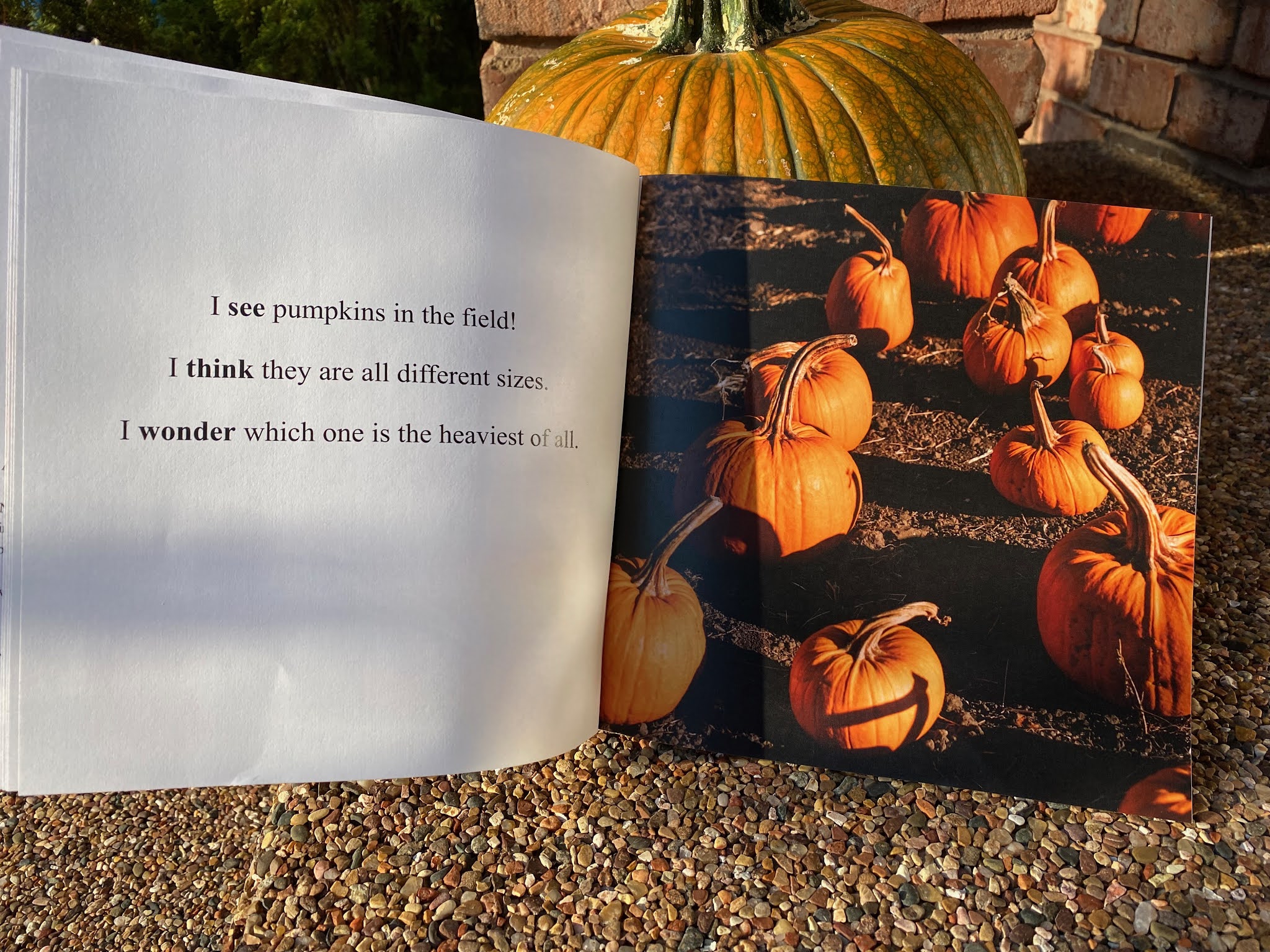
Pumpkin Math
Autumn is such a wonderful time of year! The colours and textures can inspire such rich math conversation! This past weekend we visited a few farm stands in the area and all I saw was math around me! I'm hoping that these photos will be useful as math prompts for 'math talk' conversations with children.
Show children a photo and ask them to share what they 'see, think and wonder' about each photo. The 'see, think, wonder' thinking routine can be used to help children delve more deeply into exploring and articulating what they notice in a specific situation. As children notice and name what they see, they can make connections to their own experiences and ideas, and form questions for further exploration and math research.
Educators can also ask children specific math questions to guide their thinking. This can be especially helpful if the math concepts in the photos are geared towards an existing exploration the children are having, or if specific curriculum and assessment investigations are needed by the children. Sample math questions are provided below!
Friday, August 27, 2021
Joyful Math Trailer!
In Deanna Pecaski McLennan’s kindergarten classroom, math isn’t limited
to a specific block of time. It’s built into the environment and
inseparable from everything her young students do. All of the math is
infused with a sense of exploration, wonder, and joy.
Deanna’s book, Joyful Math,
is about creating invitations for young children to engage with math
ideas through art, literacy, and outdoor play. She focuses on building
spaces in early childhood classrooms where children see themselves as
mathematical thinkers with valuable ideas from the very start.
Joyful Math is filled with a range of tools and models, including:
- stories, vignettes, and photos illustrating how to develop a classroom environment that fosters curiosity and wonder for mathematics
- practical tips for inviting students to engage in mathematical play throughout the day
- examples of ways to document children’s experiences to make math learning visible to parents and the greater community
Supported by her experiences exploring math with young children, Deanna’s methods will inspire educators to be curious about math, take risks, try different approaches, observe carefully, and collaborate with children as co-learners.
Get a copy here!
Stenhouse Publishers (United States)
Barnes & Noble (United States)
Pembroke Publishers (Canada)
Amazon (United States and Canada)
Saturday, August 14, 2021
Small World Play and Math
"Old things are better than new things, because they've got stories in them."
Kami Garcia
What is hiding in your cupboards and closets? For 20 years now I have kept an old, beautiful china set from my grandmother high up on my shelves. I can honestly say that I haven't used it once; life with busy children doesn't lend itself to tea parties and fancy dinners. Each time I opened the particular cupboard in which these beautiful objects were stored, I'd feel a sense of guilt. They were treasured by my Nana and used for special gatherings. Now they collected dust.
As I look ahead to the next school year, I am eager to bring beautiful, inspiring materials back into our classroom. Covid has meant that many children have been home with their families, isolated from the world. I anticipate a higher than normal level of anxiety and stress as we return to school, even if we are eager and ready for this new chapter. Having beautiful, interesting materials in the classroom space can often welcome children and pique their curiosity, helping them transition into the space and overcome their feelings of anxiety.
Last week I cleaned the kitchen and as I handled the china, I wondered if it could be integrated into the classroom as play props. Not only would that give the bowls and cups a sense purpose, they would beautify our space. I liked the idea of being able to enjoy them on a regular basis; each time I look at them they remind me of my grandmother and I love feeling her presence in my life.
I had been eager to use a small teacup set (found at Value Village) in some way. I knew that the children loved small world play, and that imaginative mini playscapes held potential for rich math learning. I decided to turn my china into a tea garden. In each piece I placed small stones at the bottom for drainage. I planted succulents in the potting soil because of their hardiness and ease of care.
I am purposely not adding character props to this learning invitation. I would rather see how children integrate other materials we have into their play (e.g., mini animals, wooden clothespin dolls), or create their own fairies and other figures at the art center. I also see potential for creating a similar invitation outdoors in some way (e.g., fairy door in a stump). As I observe the children I will take note of their ideas and interests, and help to scaffold and support the math learning as it emerges. Some math ideas I think might present include:
- a discussion of proportional reasoning as children explore the size of the small world and create additional play props
- an observation of pattern as children see, think and wonder about what they find on the china
- practice with one to one correspondence as children set the table for a tea party and create additional props to support their storytelling (e.g., plates, forks, food)
- STEAM as children create their own figures to integrate in this play (e.g., dolls, fairies) or create their own mini worlds (e.g., dollhouses from boxes)
- observations of shape and size as teacups are compared to one another
- connections with capacity as children consider how much liquid might fit into the cups, or create their own tea parties while playing in the mud kitchen or water table
I'm sure as children explore the materials additional ideas will emerge. I can't wait to see what they discover! I'm eager to search my closets for other materials to upcycle and bring into our learning space!
Friday, October 9, 2020
A Playground for Mr. Big Legs - STEM in the Outdoor Classroom
"Look! Look at this spider! His legs are so long! Let's call him Mr. Big Legs!"
The children found an interesting spider in the garden one day. Curious, they gently picked it up and let it climb up and down their arms. It was so graceful in its movements that even reluctant children came for a closer look.
"He's so cute! Why was he in the garden?"
"Maybe that's where he lives."
"How do you know he's a boy?"
"The garden is so boring for him - nothing is growing right now."
"I know! Let's build him a playground!"
Curious about the children's ideas and how I could use their interest in spiders to enrich our outdoor space, I took photos and mentally planned for how we might proceed next. I considered what curriculum expectations might be met, and anticipated the math that might emerge. Such a simple and quick interaction with nature sparked a rich mathematical inquiry in our outdoor classroom that lasted for several days.
Our first step was to conduct some research. What did children already know about spiders? What did they wonder about Mr. Big Legs specifically? How might they design a playground that he would like? What could they use to help them acquire more information?
We read a number of texts together to gather information that might help enrich their understandings of what exactly a spider was and needed in order to survive. We organized our ideas on a large chart paper and referenced this over the course of our inquiry.

While exploring our school yard for more spiders, we noticed a really interesting tunnelled web just outside our window. The location was the perfect place to set up a 'spider observation window' where children could safely check on the spider during play time and carefully watch it in its habitat. Not only did this give children an additional opportunity to research, it provided children who weren't comfortable holding a spider a safe way to observe one up close without needing to handle it. (We wondered if the spider had eaten two others, or if this particular one shed its skin.)
Their work was stunning; the level of thought put into creating the tiny structures was incredible. Children considered measurement and proportional reasoning as they built to scale. Here are some of their creations:
A bed - notice how the sticks point upwards in a circular direction and there are leaves to cushion the center. "The leaves will be so comfortable for him! It will be a soft place to sleep, and the sticks will keep other bugs away."
A swing - notice how this child has balanced the top section of the swing onto two sticks. Later on he would add a long, slender leaf in the middle for Mr. Big Legs to swing on. "I hope that he can balance because this isn't very stable right now."
A garden - this child dragged his fingers in the dirt to make rows for Mr. Big Legs to use when planting rows of vegetables. "They need to be evenly spaced, because they need room to grow. That's what my dad does in our garden."
A slide - this child placed two sticks together on a slope resting in the corner of the garden. "I wonder if he will know to lift his legs. If he doesn't then he won't go down as fast because they are long and will bump against the slide."
A bridge - this child broke twigs so that they were approximately the right fit to be placed in the narrow hole in the garden. "I couldn't find any sticks that fit, so I broke them. I think Mr. Big Legs needs a bridge in case this hole is too deep for him. If it rains maybe he can pretend it's his pool.
Towards the end of the week the children found another Mr. Big Legs climbing on the brick wall. They eagerly picked him up and placed him in the garden so he could explore everything they had created. Proud of their work, they pointed out each structure and explained to him how he could use the equipment.
"This is your slide and here's your swing. You can play on those!"
"I made you a garden in case you don't catch any bugs in your web."
"And when you get tired, here's a bed for you to sleep on!"
I couldn't help but smile at their enthusiasm. I was amazed that something as simple as finding a spider in our yard could inspire such authentic STEM learning.
Tuesday, November 26, 2019
Encouraging Computational Thinking In Kindergarten
Computational thinking is a foundation of computer science, and intricately related to many of the big math ideas and practices found in early childhood curriculum. It involves many concepts and approaches.
There are many different elements of computational thinking including:
- using logic to predict and analyze when engaging in problem-solving
- making judgments when faced with problems in order to evaluate what is happening and consider how to move forward
- creating and following algorithms (or steps of action) in order to move through the problem solving process
- using patterns in his/her work to find and use similarities efficiently
- deconstructing larger problems or actions into smaller, more manageable parts
- filtering out information that isn't directly related to the problem or an efficient way of solving it
The computational thinker:
- tinkers with loose parts and other open-ended materials
- designs innovative projects and follows through on creating them in some capacity
- debugs by finding errors in his/her work and correcting them in order to move a project forward
- perseveres and continues with projects even when they are challenging
- collaborates with others as part of a team for the betterment of a project
Looking to engage children with computational thinking in your classroom? Here are some ideas to get you started.
1. Use a read aloud to introduce the concept to children. Computational thinking can seem abstract, especially out of context. The book 'Think Like a Coder' introduces computational thinking to everyday activities that children experience including cooking, building, and even exploring the outdoors.
2. Look for everyday activities that naturally engage children in inquiry, problem solving, and computational thinking. Building with wooden blocks is a great start! Help children articulate the steps they took to build their structure, and ask them how they problem solved when difficulties arose with their creation (e.g., how they fixed a tower that kept falling over).
3. Provide STEM challenges to children. Ask them to use specific materials to achieve a certain goal, and encourage them to articulate the steps and criteria they used in order to be successful. In this photo a child turns a geoboard into a marble run maze.
4. Introduce the idea of coding using arrow coding cards and positional language. Children can easily explore pathways by creating them using different building materials (e.g., blocks, legos, magnetic tiles) and then exploring direction of movement.
5. Transfer coding into algorithms by helping children create and follow specific sequences of actions. Here children create and follow an 'exercise code' where they must look at each line of code in the script, and follow the movements precisely.
Computational thinking is a versatile, foundational approach to learning that helps engage children in rich mathematical activities. As Hour of Code approaches be sure to check out my twitter and instagram @McLennan1977 for more ideas on how to bring computational thinking and coding to your early years and primary classroom.
Let's connect! Have a great idea to share? Leave it below in the comment section or tweet me and use the hashtags #kindercoding #joyfulmath #HourofCode and #MTBoS!
Thursday, May 10, 2018
Printable Pentominoes
that encourage playful explorations with shape in a variety of ways. One of our favourite tools are
versatile pentominoes.
different pentominoes in one set. You can purchase pentominoes from educational resource stores, or
print paper copies on card stock and laminate for children’s use here:https://bit.ly/2wtFt0d
Pentominoes: