Showing posts with label reading. Show all posts

Sunday, September 20, 2026

Sprinking Literacy Around the Classroom

In our classroom I look for opportunities to add literacy prompts in different spaces. After noticing that children spent a lot of time observing the aquarium, I hoped to capitalize on this interest and transform it into a richer experience. Next to the tank I added vocabulary cards, writing tools, and a clipboard with fishy outlines.

Children were encouraged to observe the fish in the tank and draw what they saw, or decorate the fish outline however they liked. Some recalled the book The Rainbow Fish and created that character using the template. Others were interested in the vocabulary cards and spent time reading them and then copying the print onto their fish papers. 
 
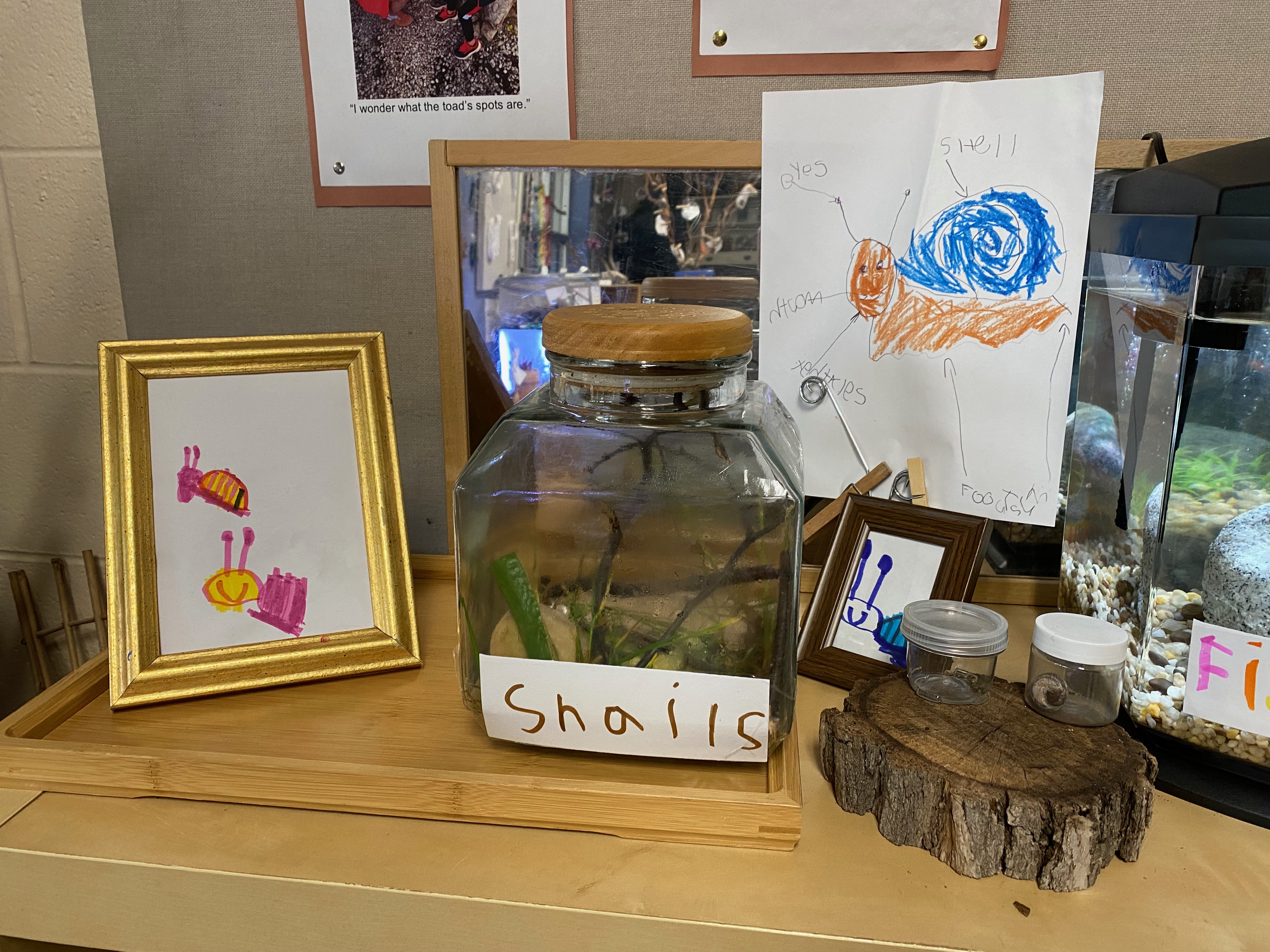
To reignite interest, I am adding papers with snail outlines this week as there are also brightly coloured water snails in our tank. As the days pass I will observe our classroom and see where else kids gravitate and add prompts and tools to those areas to further the literacy experiences. 
 
Click here for free downloadable copies of the vocabulary and templates to add to your own aquarium area.  

Sunday, February 2, 2025

Introducing Children to Strong Characters Using Diverse Texts

"Simply put, a book is both a mirror and a window. It can reflect the reality of a child’s life, allowing them to see the story of someone who looks like them, thinks like them, or lives like them. It can also help a child understand what it’s like for those who live different realities, whether that is a different racial background, religion, socio-economic status, or another facet of identity."

As an educator I have always tried to include diverse texts in my classroom. Whether they are provided freely and permanently to children in the cozy reading area or explored during whole and small group learning, I feel it is so important to help children learn about the amazing diversity in our world. I have spent my entire career collecting texts that help represent the diversity of the children in my care and introducing them to the beauty of humanity beyond their current life experience. I want children to feel seen, represented and appreciated in our learning space.  

A favourite character of mine is Peter featured in books by Ezra Jack Keats. Peter is a typical little boy - spending time exploring nature, connecting with his dog Willie, and feeling the changes that happen in his family when a new sibling is born. I appreciate the artwork created by Keats in the Peter books. They are a staple in my classroom.

This winter I was inspired to research Keats more deeply. I knew he authored The Snowy Day in 1962 but was surprised to learn that Peter is considered to be one of the most consequential children's book characters. Keats felt it was unfair for children to read books that only featured white characters so he created more diverse stories. How did I not know this? Peter is one of the first Black protagonists in a children's story that won the Caldecott award.

Looking back on past readings of The Snowy Day and Peter's Chair, I felt I may have glossed over Peter's Blackness, focusing instead on the plot of the book and its beautiful illustrations. I wonder how many of my students recognized Peter as Black, and made personal connections with him through the beauty of the text. This time I aimed to accomplish more. Before reading the story I introduced Peter to the children as one of the first Black characters in a book. We talked about representation and how before The Snowy Day Black characters were not prominent in books. We discussed how unfair that was and how important Keat's work would have been at that time. This was perfect timing because the children had just learned about the work of Alma Thomas in a previous exploration of concentric art work. During our research we learned Thomas could not attend school because she was Black, and was one of the first Black female artists to have her art displayed in a gallery. Exploring Peter consecutively with Alma Thomas helped give children context when thinking about social issues and racial discrimination. This made our 'text to self' connections to Keat's books richer and more attainable for children. 

I also intended to help children feel more connected to Peter. We used class discussions to think about him. How old did we think Peter might be? How were we alike? What might we say and do if Peter were a member of our class?


My teaching partner and I offered children STEM challenges to help design a new chair for Peter...

          
...and we explored the setting and actions he experienced using the language of art. The intent was for children to continue to think deeply about Peter as a character and feel connected to him beyond our initial explorations of the text.
         
As we continue to explore books that Keats wrote featuring Peter and his family, I am hopeful that children will think more deeply about him as a character and recognize that despite our differences we are really the same children at heart, and that all people have a right to feel seen, heard and represented in our classrooms and world. Digging into diverse texts, understanding their histories and connecting with strong characters is a step in the right direction.

Friday, January 17, 2025

Fairy Tale Inspired STEAM Invitations in the Kindergarten Classroom

"I can help the goats escape that silly, old troll. All I need to do is just make a bridge that is so low to the water there is no room for the troll to hide below. That's the problem with the one in the story. There was enough room for the troll to hide. My bridge won't do that."


Young children are naturally curious about the world around them as they marvel and wonder about what they experience in their daily lives. According to Let's Talk Science this means that every moment has the potential for learning because children desire a deeper understanding of the world around them. STEAM learning in the early years is especially important because it helps prepare children with skills and knowledge for an unknown future. Let's Talk Science explains that STEAM activities can:

  • Foster natural curiosity and creativity 
  • Encourage independent and collaborative learning 
  • Improve work habits and grades 
  • Promote confidence in learning and ‘science identity’ 
  • Promote language learning 
  • Improve social-emotional skills 
  • Build decision-making, problem-solving and critical thinking skills 
  • Support inclusion and reduces gender disparity

In our classroom I have found that children are usually very motivated to help solve problems that appear in books we have read aloud and explored together as a class. In particular fairy tales that have likeable characters that need help evading a villain seem to elicit the most excitement and enthusiasm from kids. Sometimes STEAM invitations that are inspired by fairy tales naturally occur as a result of the children reading and discussing the text together in large or small groups. Other times I will invite children to engage in helping solve a problem by asking a question in our whole group meetings and inviting their ideas, or setting up an invitation for learning based upon the text.

One of the most popular invitations was based on the story of the Three Billy Goats Gruff. After reading the book I asked children to think about whether they could help the goats by building them a new bridge. On a table I created a quick playscape replicating the river by using green place mats for grass and blue paper for water. I offered baskets of different wooden loose parts for them to explore. I also added three toy goats and a troll that could be used as character props to help inspire children to retell the story after building the bridge.


During play time children worked collaboratively to build a number of interesting bridges. It was fascinating to discuss the attributes of each, and listen to the children's rationale for how the goats could evade the troll by using the bridge's features (e.g., close to the water, troll traps, fencing). 


Looking for some STEAM inspired invitations for other fairy tales? Here are some easy ideas to get you started:

The Gingerbread Man:

  • build the Gingerbread Man a boat to use when crossing the river to avoid the fox
  • design a fox-proof water suit the Gingerbread Man can wear when swimming across the river
  • create a trap the bakers and animals can use to trick and capture the Gingerbread Man

Goldilocks and the Three Bears:

  • build Baby Bear a new chair that will not break no matter how much weight is placed upon it
  • design and draw a security system that will alert the three bears next time someone enters their house
  • sketch a disguise for Goldilocks so the three bears will not recognize her

The Three Little Pigs:

  • draw three new wolf-proof houses for the Little Pigs
  • build a wind machine for the wolf that will work on a brick house
  • build the setting of the story using various materials (e.g., wooden sticks, tape, play dough) that can be used to retell the story when toy pigs are added

Little Red Riding Hood:

  • design an invisibility cloak for Little Red
  • build a strong basket for Little Red that can hold many small objects without breaking (e.g., pennies, cubes, marbles)
  • create a transportation system to move the basket of food from Little Red's to Grandmother's house

Jack and the Beanstalk: 

  • build a beanstalk using tubes and card stock as tall as you can without it collapsing
  • design, create and test a parachute that Jack can use to escape from the castle in the sky
  • create a structure that the hen's golden egg can be dropped into that will keep it safe

Monday, January 13, 2025

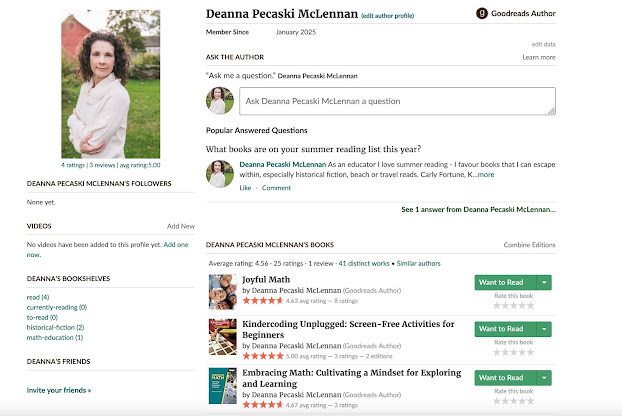
Goodreads!

Like many educators I am a avid reader who devours historical fiction. This is nothing like a good book that pulls you in and helps you forget the cold, snowy January weather of Ontario. While researching my next read I stumbled upon the Goodreads website. Where has this been my whole life? I was fascinated to quickly and easily find many titles to add to my reading list. I was also deeply surprised to find many of the books I have authored on the site - not just their titles but ratings too! This inspired me to create an author page in order to help me connect with readers in a new and fresh way. If you are on Goodreads come find me! Even better I would love a review of my books if you have read or purchased them. Come ask me a question or suggest your favourite book to read! I'm excited to connect with you in a new way!

Deanna's Goodreads Page

Friday, July 26, 2024

Book Review

"Exploring trees outdoors is an enjoyable experience that children love to do! Swinging from a branch, exploring leaves and bark, and observing gnarled roots are all favourite activities that also integrate rich learning. Heading outside to explore the yard uses children's excitement and enthusiasm for sensory and nature experiences to inspire rich mathematical and scientific inquiries about what they are seeing and experiencing."


I was excited to see a review of my book Tree Math in the MAMT Spring Journal! You can access the review here!

Sunday, April 7, 2024

Quick and Easy Resources for Littles to Help Explain and Explore the Solar Eclipse!

The solar eclipse of 2024 is an exciting event for children! Here are some resources I quickly put together to help educators and families explore the eclipse and use it to inspire a few activities!

Here is a great picture book to help explain what an eclipse is:

Here is a video that delves into the science behind the eclipse:


Here's a neat time lapsed video of an eclipse:

And here are three quick and easy math resources to use that capture children's excitement about the entire experience!

1. Roll, Subitize and Cover the Suns!

2. Which One Doesn't Belong?

3. See, Think and Wonder

Friday, March 29, 2024

20 Free Alphabet Activities to Use with Children

I have spent time reviewing many of the resources and materials I have created over the years. Over the next few weeks I would like to share some on this blog.

Learning the names and sounds of upper- and lower-case alphabet letters take time, patience and practice.

Many families are eager for 'take home' activities to help their children practice literacy skills at home. Educators are also looking for easy to gather and implement small group work for children to use at school. In this file I have shared 20 alphabet activities that can be printed and shared with families or used with children during the day. Print all, or take what you think will be a best fit for your little ones!

You can access the file here: 20 Instant Alphabet Activities

Sunday, March 3, 2024

Alphabet Mats for Letter Recognition

Recently we have been working with different fonts to help children recognize that the same letter can look many ways. These letter templates are easy to use in matching games. Get a copy here!

Alphabet Mats 


Friday, September 1, 2023

A Classroom Tour for September


For many years now I have been greatly inspired by the Reggio Emilia approach to early childhood education and have sought any source of information that I could get my hands on! When FDK was first introduced in Ontario I was thrilled to see that many of Reggio's beliefs were interwoven in the document and honouring children's interests through play, inquiry and documentation were highlighted. As educators who follow a standardized curriculum we have great flexibility in our interpretation and implementation of the expectations and this makes our role exciting and dynamic.

I believe in having a fluid, evolved space that continues to change to better reflect the needs of the children and support heightened understandings of explorations and inquiries as well as enhanced abilities in the various domains of learning. We want to support the whole child in developmentally appropriate experiences and integrate learning materials from centres in diverse and unconventional ways.  

Some of the Reggio principles that have guided my work include:
  • children are capable of constructing their own learning
  • children form an understanding of themselves and their place in the world through their interactions with others
  • children are communicators
  • the environment is the third teacher
  • the adults in the room are mentors and guides
  • there is an emphasis and importance on documenting children's thoughts and experiences
  • there are hundreds of languages of children and these are used to explore and communicate ideas and experiences
This is the door leading to our classroom. I post information around the door to assure visitors to the space that I believe in an inclusive environment where all children are respected. Building relationships with families and helping them learn about and support growth mindset is a big part of creating a safe and supportive space for learning. Something about which I've had a lot of positive feedback is our 'wish wreath'. Each September we ask families to write their hopes, wishes, dreams, etc. for their children's kindergarten experiences on paper ribbons. We weave each of these onto a grapevine wreath and display it on our door. We want it to be a symbol of our partnership and collaboration with families for the year ahead. We also include a photo of our teaching team and visitors to the room can access our class blog by scanning the QR code on the door.


Above each child's cubby is a recent photo and painted self-portrait. These change a few times each year (usually a new photo and self-portrait per term) to help show their growth. We like including a real photo to celebrate each child and love how the children use the language of art to represent their perception of self. 
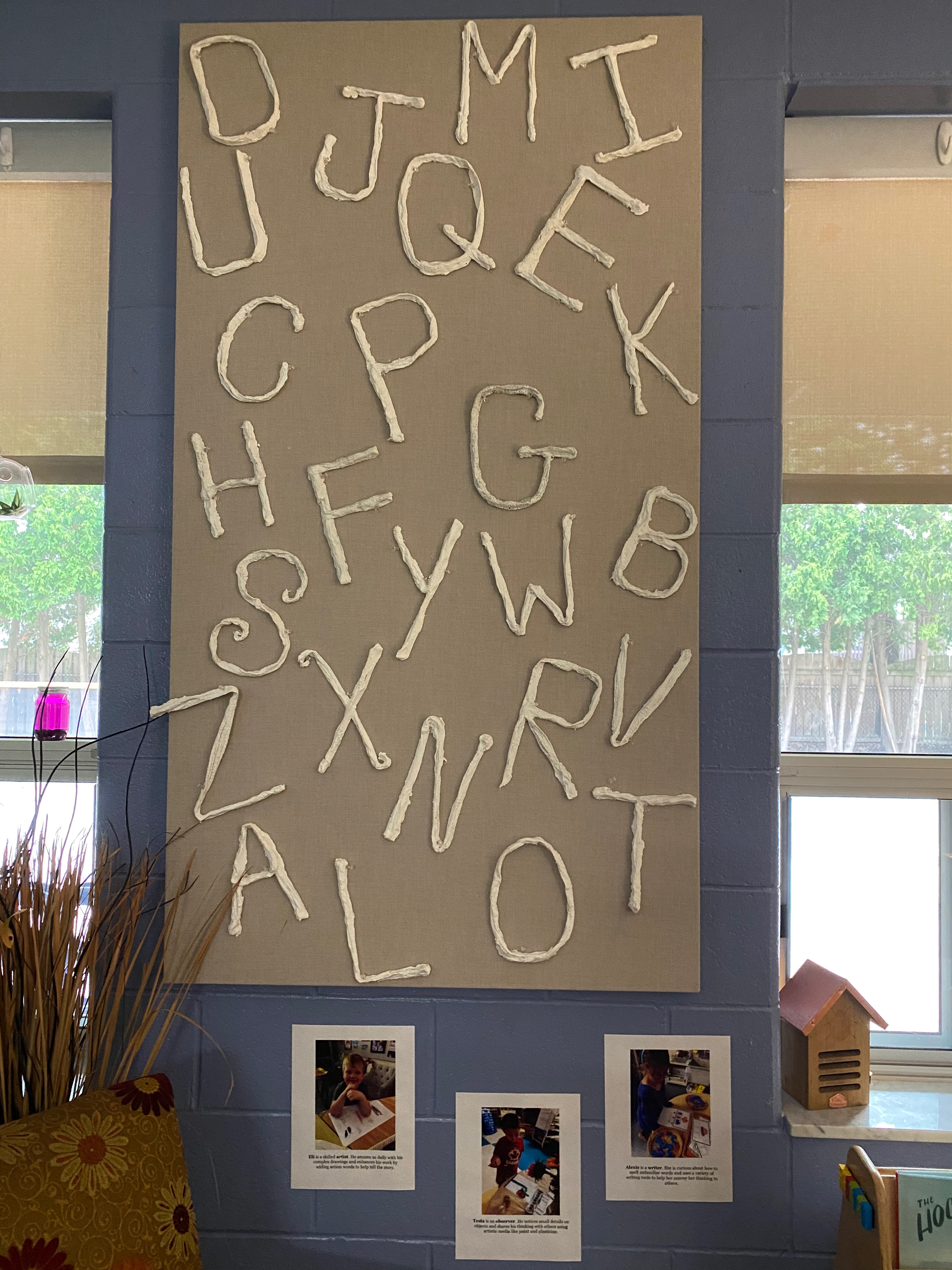
Our quiet literacy area has a collection of books and writing materials to explore. It's a comfortable area for children who want a quiet space to read or draw and the sofa and chairs are a great way to calm oneself if a child is tired or needs a break. The whimsical light invites children to stay for a while and read a book or chat with a friend. We ask families to send in photos that are hung by the sofa as a sign of connection and comfort. The light table and weaving wall encourage creativity and fine motor development which will help children with writing readiness. An upcycled photo display holds seasonal vocabulary cards that can be manipulated by children. The wooden shelf holds diverse and inclusive books so all children can see themselves reflected in classroom resources.


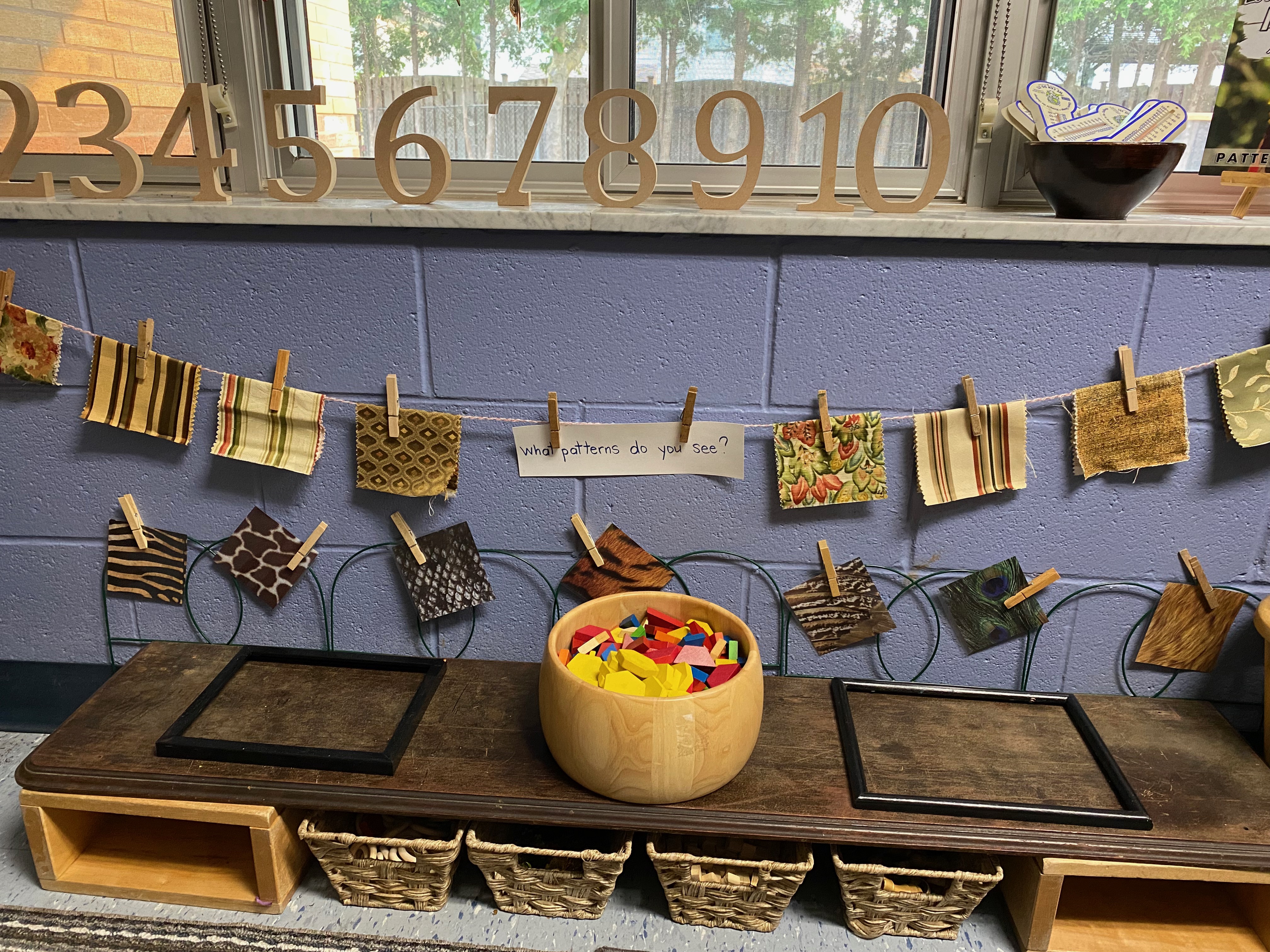
Our math area has many things available for children. We include mentor texts, learning props, and documentation to showcase and support our program.


Our drama centre changes based on the interests and requests of the children. At the beginning of the year it is set up as a little 'house' to provide comfort and familiarity to children.  We include many real objects for the children to use in their imaginative play; real objects communicate the message to children that they are capable of using these tools and make the context for the imaginary play very real and meaningful. Donations from families and the local community also helps represent the diversity of our population and encourages children to see themselves and their peers reflected in the space. Literacy is interwoven throughout as children can talk on the phone, write on the chalk boards, or follow a recipe when cooking. A variety of scarves encourages children to dress up and create their own costumes and clothing. A large basket of fabric flowers can be turned into different arrangements for the table or inspire other dramatic play (e.g., a flower shop, a farmer's market).


Our building area is the heart of our room and the most popular place to be. Children integrate materials from all around the classroom into their play here. We love the big body play the wooden blocks encourage. Small loose parts (e.g., tile squares, corks, wooden spools) are also included in this area for children to combine with wooden blocks. Pillow are available for incorporation in the creations and photos of local structures are displayed for inspiration.


My favourite center in the classroom is the science area. We are fortunate to have a very large wall of windows on one side of the space. The shelf near the window houses materials that are specific to ongoing inquiries. Loose parts play are a big part of our program as we embrace all things STEAM and love our makerspace. We use many natural and found materials here and always welcome donations from our families. The science area also houses many building materials and the children can freely use these around the room in any area to support their play. Often treasures found outdoors (e.g., pinecones, feathers) and the changing of the seasons inspire inquiries. Invitations for further exploration are sometimes set up on the table in this area. A sensory table integrates imaginative play regarding current interests, here insects and their natural habitat. Children can swap out materials for other small world play (e.g., dinosaurs, fabric flowers).


The art studio is located in a sunny area of the classroom. You can see that colours and colour mixing are ongoing interests and there is much art that supports this. The materials are aesthetically arranged to be accessible for children and also decorate the space. Materials are organized by colour for ease of accessibility and also to embed math and sorting into the centre.


We are often asked by other educators about how we encourage the children to engage in regular reading and writing in a child-driven space. On the back of our bookshelf are writing clipboards, one per child. We ask children to self-select a piece of writing that they are proud of and display it on their clipboard. These are then brought to a sharing circle where children can discuss their work with others. It's a quick and easy way for us to see which children have (and haven't) engaged in regular writing so we know how to better support their needs. This clipboards can also be brought on nature walks in the yard or community as needed.
Thank you for visiting us! We love feedback and to learn about your classroom and program. Please share in the comment section below or connect with us on Twitter @McLennan1977.
Related Posts Plugin for WordPress, Blogger...