Showing posts with label learning. Show all posts

Sunday, October 4, 2026

Welcome to our Reggio Emilia Inspired Classroom

Every material, space, and invitation tells a child: You are capable. You are curious. Your ideas matter.
For many years now I have been greatly inspired by the Reggio Emilia approach to early childhood education and have sought any source of information that I could get my hands on! When FDK was first introduced in Ontario many years ago I was thrilled to see that many of Reggio's beliefs were interwoven in the document and honouring children's interests through play, inquiry and documentation were highlighted. As educators who follow a standardized curriculum we have great flexibility in our interpretation and implementation of the expectations and this makes our role exciting and dynamic.

I believe in having a fluid, evolved space that continues to change to better reflect the needs of the children and support heightened understandings of explorations and inquiries as well as enhanced abilities in the various domains of learning. We want to support the whole child in developmentally appropriate experiences and integrate learning materials from centres in diverse and unconventional ways.  

Some of the Reggio principles that have guided our work include:
  • children are capable of constructing their own learning
  • children form an understanding of themselves and their place in the world through their interactions with others
  • children are communicators
  • the environment is the third teacher
  • the adults in the room are mentors and guides
  • there is an emphasis and importance on documenting children's thoughts and experiences
  • there are hundreds of languages of children and these are used to explore and communicate ideas and experiences

Our classroom door welcomes every learner and celebrates the diversity of our student population. Our classroom is a safe space for all.

A sensory wall welcomes children to the space along with a photo of staff and books to inspire those who visit. 

A light up sensory table is also near the door and offers children an opportunity to explore different materials in a fun way. The trellis behind holds photos and vocabulary cards related to the materials being explored to encourage literacy behaviours. 

Above each child's cubby is a recent photo and painted self-portrait. These change a few times each year (usually a new photo and self-portrait per term) to help show their growth. We like including a real photo to celebrate each child and love how the children use the language of art to represent their perception of self.  

 
Our families are also represented on a photo wall located on one of our bulletin boards. We request family photos at the beginning of the year and these are displayed together to help us recognize and celebrate the diversity that exists in our student population and help children feel represented in the space.
Our quiet reading corner has a collection of books and trinkets and treasures to explore. It's a comfortable area for children who want a quiet space to read or rest. The shelf contains a collection of books that explore diversity and invite children to explore new and familiar families and traditions. This helps children feel reflected in the learning space and also helps them learn about other ways of being. Comfortable seating, cozy pillows and a whimsical light invite children to stay for a while and read a book or chat with a friend.  
Our math shelf has many things available for children. We include mentor texts, learning props, and documentation to showcase and support our program. Math organizers including number lines and ten frames are also available. Children are encouraged to explore these materials during play time, and having them housed together makes it easier when we need activities to support small group learning.
Our drama centre changes based on the interests and requests of the children. Currently it is set up as a little 'house'.  We include many real objects and antiques for the children to use in their imaginative play; real objects communicate the message to children that they are capable of using these tools and make the context for the imaginary play very real and meaningful. Antiques make the space interesting while children learn to care for delicate objects.
This is our writing area. We like to have a beautiful, inspiring space for the children to use when they want to draw pictures or write with their friends. Books are available to browse for writing inspiration. A variety of writing tools including markers, pencils, crayons and coloured pencils are arranged by colour in jars. Baskets of different kinds of paper including index cards, mini books, stationary and colouring pages are arranged on the shelves for easy student access. Alphabet charts and vocabulary cards are also provided to support student writing. 
A survey is posted for children to practice reading and writing their names. At the beginning of the year it is educator created and as the year progresses children take over this responsibility. 
 
We are fortunate to have a very large wall of windows on one side of the space and this is where we house our science and art areas. The view outdoors often inspires children as they observe nature and enjoy watching the wildlife outdoors. 
 
An aquarium and plants provide opportunities for children to care for living things. 
A mini table offers a chance for children to explore objects or a concept in depth. Here it is presenting colours using a puzzle, matching cards, vocabulary and a read aloud. Later in the year it will change to reflect different seasons and interests the children have. 
Two sensory tables invite children to explore objects. The first is a large collection of natural shells collected over time. The round table changes with children's interests and usually holds sensory materials that can be manipulated including beans, pasta, sand and water. 
This shelf houses baskets of different materials to encourage play, building and exploration including mini animals, rocks, sticks, wooden frame corners and dinosaurs. Children can use these materials in the red imaginary play table to create habitats for small world play. 
A light panel encourages a different kind of play and exploration as different materials are rotated throughout the year (e.g., alphabet, shapes, leaves, flowers).
Natural objects are housed on this shelf for further exploration including shells, nests, feathers, fossils, jars with different natural loose parts, and animal cards. These are available for student observation and exploration. 
Baskets of science tools are stored here for use as needed including shovels, rakes, magnifying glasses and tweezers. 
The art studio is located in a sunny window of the classroom. The materials are aesthetically arranged to be accessible for children and also decorate the space. 
Materials are usually sorted and arranged by colour or type to help make the space aesthetic and functional. 
A table in the middle provided a space for children to work. Sometimes an educator provided invitation is prepared to help children practice using tools or specific artistic skills. Other times it is left open for student inspired work. 
Thank you for visiting us! We love feedback and to learn about your classroom and program. Please share in the comment section below or connect with us on Twitter @McLennan1977.

Sunday, April 20, 2025

Bringing Math to Life: Sparking Joy and Curiosity through Play

On April 16, 2025 I had the pleasure of presenting my workshop Bringing Math to Life: Sparking Joy and Curiosity through Play for Early Childhood Investigation Webinars! With over 3000 registrants it was my largest audience to date! I absolutely love inviting educators into my kindergarten classroom and sharing the rich math learning that children experience through play and inquiry! Connecting with others drives my practice and inspires me greatly! A big thank you to all who attended! A copy of the presentation slides are available and can be found at this link.

The presentation was recorded and is available for viewing if you are interested in revisiting the information I shared, or did not have a chance to view it live. You can access it here:


Friday, May 6, 2016

Math in Inquiry-Based Learning Facebook Group

My blog posts this week around robust math tasks in an inquiry-based learning environment have been read by a large audience who have emailed and tweeted me many questions. I've created a Facebook group that I'm hoping we can use to create a community of learners regarding how to engage children in rich, authentic math tasks in an emergent, inquiry-based program. If you're interested in joining, please visit Math in Inquiry-Based Learning and join the Facebook group!


Thursday, May 5, 2016

Exploring Math in an Inquiry-Based Kindergarten Program


Math has become a great interest for me due to a school wide focus on improving children’s interest in and attitude towards math. I was introduced to the work of Sherry Parrish regarding ‘number talks’ and felt it was a strategy that could easily be implemented into a play-based, inquiry-based FDK program. I have been fascinated by Jo Boaler's work on Mathematical Mindset. After learning about and implementing a focus on number talks and making math meaningful and engaging for children, I noticed huge gains in children’s computation and fluency as well as the time they spent during free play working with math tools and strategies. This was incredibly motivating for me.

Positive Growth Mindset

As a child I disliked math. I felt I wasn’t ‘smart enough’. My reading and current practice with number talks and growth mindset has shown me it’s not about how ‘smart’ you are, but how hard you work and persist with any given activity. Just as important are teachers' mindsets towards math and math learning. We need to truly believe that any child can succeed at math and create a supportive environment where they feel free to take risks and aren't afraid to make mistakes. Low floor high ceiling tasks will provide entry points for all learners and ensure we are able to differentiate to high degrees when needed for those children who are learning at different rates and require a different challenge (see an example here). I want to help children change their mindsets towards math and discover that there are many different ways to analyze, interpret, and solve a math problem. Math can be an enjoyable activity and is hugely relevant to our lives. I also wanted to continue to positively change my own mindset towards math as an educator and parent. To see some of the extensive work we have done on growth mindset please visit other entries tagged with this label.


Our Program

Children’s early learning experiences have a profound effect on their development. Early interactions directly affect the way connections are made within the brain. To give each child the best start possible our kindergarten program provides a variety of learning opportunities and experiences that challenge and engage children while building confidence - providing foundations in cognitive, physical, emotional, and social development. In our kindergarten class, we want each and every child to enjoy coming to school and to see learning as fun, exciting, and meaningful. We explore lots of teacher-guided and child-initiated opportunities that appeal to each child’s learning style. We want to help develop life long learners! Reaching each child’s potential while supporting learning development is the main goal of our kindergarten program.


Gradual Release of Responsibility in a Playful Math Environment


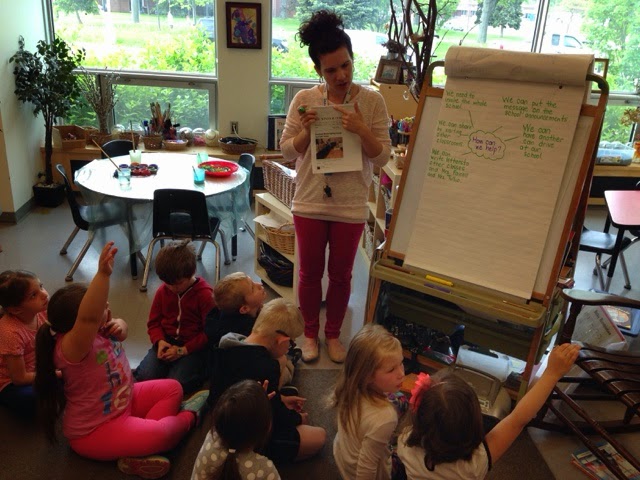
The goal in a playful environment is for children to be comfortable and confident applying mathematical strategies in authentic problem-solving situations. An educator helps children become successful by first introducing the ‘big ideas’ of math in a whole group situation and then providing numerous opportunities for children to practise using the tools, terminology and strategies in authentic contexts during small group time and the open play block. For example, during circle time the educator might introduce a ten frame, demonstrate how to use it for various purposes (e.g., subitizing, counting, recording, adding) and then encourage children to independently use the ten frame in small group activities and play.

Here is a sample math lesson where children are considering what they observe and wonder in a growing shape pattern:


Authentic Math in an Inquiry Model


In emergent programs educators aim to embed rich math resources and opportunities throughout the room and not just in a defined ‘math centre’ in order to encourage organic exploration. The children are investigating and finding solutions to questions or problems generated in the social interactions they have during playtime. Teachers can bring these inquiry-based topics and authentic queries to the whole group for extensive discussion, specifically highlighting math and computation when applicable. Because children are highly invested in solving these problems they will be more likely to work together to brainstorm various strategies for arriving at solutions that meet the needs of many learners.

Finding the balance in emergent practices also means that the teacher carefully selects developmentally appropriate activities that capture children’s interests while still fulfilling curriculum expectations. Interesting materials can be placed in the classroom and the teacher can ask questions or suggest challenges to entice children into exploring these further. An emergent kindergarten program creates natural opportunities for purposeful computation by:
  • providing children the freedom to explore self-directed areas of interest 
  • introducing interesting and challenging materials for children to use independently and with teacher guidance
  • emphasizing a child-centered problem-solving approach when difficulties arise
  • using organic materials and loose parts in place of commercial products
  • honouring children’s questions and providing guidance when needed
 

Documentation 

Young children show their understanding by doing, showing, and telling. They come school with a wide variety of experiences, interests, strengths, and needs. We will observe, listen, and ask questions in order to assess the achievement of each child. This information will then be used to determine instruction so the diverse needs of each child are met.

Observation is the most important assessment strategy that we use in the classroom. Since students spend much of the day interacting with others in various learning centers, we will spend a lot of our time observing children in action and recording these observations.

In our classroom we will create a portfolio for each child – it will contain pieces of “work” from throughout the year. This includes samples of writing, drawn pictures, photos of the child engaged in the classroom, recorded notes from observations of them in action, recordings of student/teacher conferences, and pieces of artwork. Portfolios can be viewed by parents anytime, and will be shared during parent-teacher conferences at report card time. Portfolios are also sent home on a regular basis and parent feedback is encouraged through the use of a parent observation sheet. See a copy of our reflective prompts page to families here.

Environment as the Third Teacher

We start the beginning of the school year with empty walls. Working together we slowly create documentation displays that reflect our questions and explorations using artifacts of learning (e.g., photos, artwork). Effective documentation “draws others into the experience - evidence or artifacts that describe a situation, tell a story, and help the viewer to understand the purpose of the action” (Seize, p. 88). As the year progresses our walls honour learning by sharing the children’s journey helping them to feel valued, respected, and encouraged to take greater risks in their work with others. This work then inspires the children to reflect upon what they have done to help consolidate learning and use this as a reference or inspiration for future explorations.

Seitz, H. (2008). The power of documentation in the early childhood classroom. Young Children, March: 88 - 93.

Saturday, April 16, 2016

Innovate 2016

"What we learn with pleasure we never forget."
Alfred Mercier

It's amazing how a few days outside of one's normal routine and surroundings can inspire deep learning. I had the amazing opportunity this weekend to meet with my fellow ETFO Additional Qualifications instructors in Toronto for the annual ETFO AQ Innovate conference. For those of you who may not know, Additional Qualification courses are taken by certified teachers who are hoping to become more specialized in an area. I have proudly taught the Kindergarten Part 2 for many years now.


One of the many great things about being an AQ instructor is that I meet superb educators from around our province each semester; they bring their experiences and enthusiasm into our course and I am able to virtually 'see' their practice through the discussions we have together. I have always said that the best form of professional development I have had is my experience as an AQ instructor. I am able to learn more deeply about my own kindergarten practice as I support other individuals in their pursuit of becoming even better teachers. It's an honour and a privilege and one that I take very seriously. Because we each look at the Ontario Full Day Kindergarten program through our own lens and apply it in our own context, there are many unique ways of 'doing' and 'being' in the classroom and I am able to take the ideas brought to our course and use these to evolve my practice every day. This directly benefits the children. When I learn, they learn too!

Those of you who know me, know that I absolutely love Toronto. When I'm in the city I feel free. I feel alive. So it's no surprise then that I was already in a state of 'readiness to learn'. The many guest speakers and presentations I attended supported my work as an AQ instructor, but also motivated me to continue to be the best educator I can be each day. Like ripples in the pond when a stone is thrown, our work as educators touches the lives of many more than we'll ever know. 


The workshop that I believe will have the most transformative effect on me as both an educator and mother was presented by Alec Courosa (@courosa). Alec shared how we can create a new culture of learning for students using the power of technology and social media. He shared both humourous and emotional examples of how we can better connect with students and harness the power of collective exploration and expression. I left his workshop resolute to include more opportunities in my home life for my children to critically explore the potential of technology as both a learning tool, and one that they might use as a form of personal expression. Although we use technology on a regular basis in my kindergarten classroom, I have been challenged to consider how to take these ideas even further and engage the children on deeper, more sophisticated levels, particularly how we might use technology to share our math work with an even wider audience using more diversified media.


So on Monday I will be back in the classroom, reinvigorated to explore and enjoy the remaining few months of school with the children. Like the Mercier quote above, I cannot wait to begin and see where this next chapter in my practice takes me. I am hopeful that my enthusiasm will inspire the children and they, too, will be filled with excitement and wonder at the endless possibilities that await!

Monday, August 23, 2010

Importance of Play

Play equals learning.  As children learn how to play, they learn how to learn. Here are some frequently asked questions about Kindergarten:

  • Why are they playing all day?
  • When will my child do seat work?
  • What are they learning?
As adults, we learn the most complicated of skills through experience. While one can read books about driving a car or parenting a child, there is no substitute for the actual experience. The same is true of young children. They learn through doing the active experiences provided to them in Kindergarten.

Active, enjoyable play is the basis of our Kindergarten program. We are trained to support and facilitate learning through play. Our kindergarten classroom is designed to promote developmentally appropriate, curriculum-based activities that are interesting and fun for our students. The skills children must have to participate in play are the cornerstones of successful learners. Through play children learn to negotiate, to share, to communicate needs and wants, and to join a group and get along with others. Children learn to focus, to concentrate, to test and use trial and error, and to stay focused on a task.

Research shows that children who develop strong play skills at an early age have future academic success in school. You can be confident that you child is indeed learning through play in our classroom!
Related Posts Plugin for WordPress, Blogger...