Showing posts with label spring. Show all posts

Sunday, April 13, 2025

STEAM in the Garden - Constructing Insect Houses using Natural Loose Parts

"Look deep into nature and then you will understand everything better."

Albert Einstein

The children were gathered around a large landscaping rock, working together to arrange twigs and flowers they had picked from the ground nearby.

"I think that this side should be the living room and the bedroom can be over here," Jack gestured as he spoke. "The living room will be next to the bedroom and the ladybug can crawl across by using this little bridge."

"So what are these little sticks here for?" Mary pointed to a little row of twigs placed next to each other.

"Oh, those are going to be the bed." Olive answered.

"But that's way too big to be a ladybug's bed," Mary responded.

"Oh," Olive pondered. "I didn't think about that.
 
"That's okay," Mary smiled. "We'll just find more than one ladybug and then the bed will be the perfect size for them to share." 

Spring was in the air and the children were excited to discover that many little creatures were venturing out into the warm sun. Ladybugs, rolly pollies, and ants were abundant and this sparked the children's imaginations. Eager to 'help' the insects the children set to work building little houses for them. They searched the yard to gather materials they felt would be best suited to this task. 
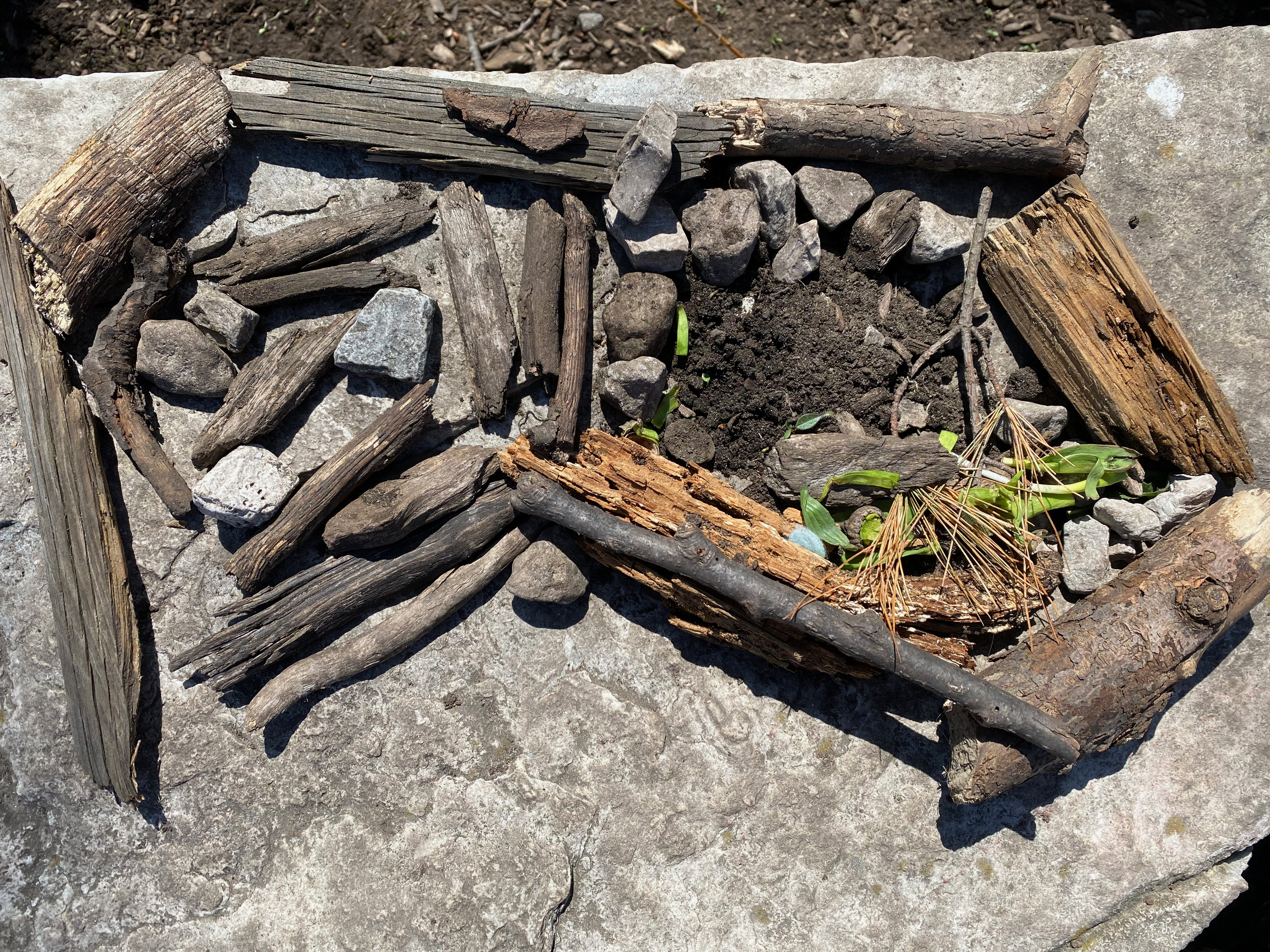
Each day the children would return to the mini houses and continue their work, focused on creating the most aesthetic and functional space for whatever creature they had found that day.  
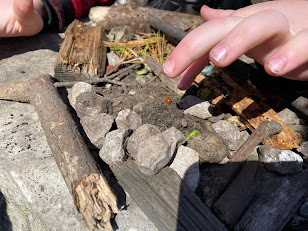
   There are four steps to the design process for young children. When I reflect upon the children's garden engineering of the habitats I observed these steps in action:

Identifying a Problem - the children felt the insects needed a home
Imagining and Planning - children brainstormed that natural loose parts could be used to design and construct a habitat and engaged in conversations about what this might look like
Creating - children spent time over many days creating different homes for different living creatures
Improving - children revisited their creations each day and revised their plans when necessary
after they noticed new things about the insects or had engaged in conversations with peers
  
What might seem like a playful activity outdoors has the potential for much rich learning using an engineering mindset. When children create habitats outdoors they are participating in rich math exploration in action including:
 
-discussing, designing, and refining a plan
-classifying and sorting materials by common characteristics
-considering proportion as they build for specific insects
-using spatial reasoning and design as they manipulate materials
-thinking about measurement as they incorporate area and perimeter into their 'house' or discuss the attributes of materials (e.g., the heaviness of rocks, the length of sticks)
-counting materials gathered and used in the design process
-naming colours and shapes that emerge in their work
-using positional language to describe their creations
-thinking about balance and stability as they assemble materials 
-incorporating patterns or symmetry as they create aesthetic structures
 
It's amazing to notice and name the rich math learning that emerges in children's self-directed play outdoors. Taking photos and videos of the work, engaging in discussions with kids about their play, and reflecting upon the experiences can help educators make this rich learning visible to others! Sometimes nature is the most effective math teacher of all!

Sunday, March 30, 2025

Geometric Chalk Art in the Outdoor Classroom

Have masking tape and sidewalk chalk? Then you can invite children to create amazing geometric artwork outdoors in just a few steps! 

Create the outline of the art by placing tape on the ground in different designs. I personally like creating a large square or rectangle and then using various shapes to fill the area inside. 

Invite children to colour each section using a different colour of chalk. 

Remove the tape to reveal the gorgeous design!
Experiment with different designs...

...and encourage children to to use the art when inventing and playing their own games!

Sunday, November 10, 2024

Facilitating Math Talks with Young Children - Printables to Support the Math Talk Books

Math talks are a great way to engage children in open-ended explorations that invite them to think critically and creatively about a concept. Math talks are like number talks, yet include any area of math that an educator would like children to explore. An effective math prompt to facilitate a rich math discussion will be layered; it should be open-ended with multiple entry points for engagement. Even children as young as kindergarten are capable of participating in complex math conversations. In our classroom I aim to invite children into a math talk at least once a day; I sometimes use the numerical date on our morning message as the spark for exploration. Other times an interesting photo or collection of loose parts will be engaging and incite children into further exploration. I try to vary the invitations I provide in order to diversify the math we discuss and to reach as many learning interests as possible. 

In our program we have a morning circle time. This circle is our first whole group gathering time for the day and helps set a positive atmosphere in our classroom. It is also a time to celebrate being together, and share news from our homes. We often use it as an opportunity to read a story and discuss any new and exciting activities or additions to our classroom space about which the children should know in order to be successful for the day. 

When I first started teaching kindergarten many years ago it was expected that the morning circle would begin with 'calendar time' where children would put a sticky number on a large grid to depict the day and there would be an extensive discussion about the calendar (e.g., day of the week, month, year). However over the years I realized that this was a very teacher-directed task and not as meaningful a use of our time. After reading Sherry Parrish's work on number talks I was inspired to use our morning message as an anchor for math talks. Wanting to still introduce the date to students, the numerical representation of the date became the foundation for our number talks most days. Sometimes I would use other prompts depending on the events and interests emerging in our classroom. If you would like to read more about number talks in kindergarten, you can access an article I wrote for the Journal of Teaching and Learning here: Joyful Number Talks in Kindergarten. 
 

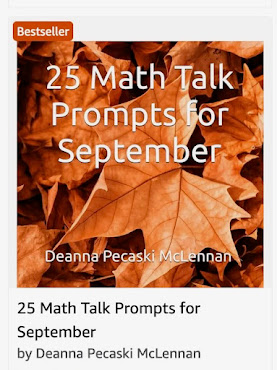
Over the years I have shared my math talks on social media and have been asked repeatedly to create a guide to support educators who wish to engage their students in math talks. This inspired my collection of monthly math talk books. Each book contain 25 prompts to engage children in regular conversations in the classroom. The prompts do not need to be followed in order. In order to help educators I have also created free downloadable PDFs that can be printed and used with students. 


Click on the book's image to be linked to where it can be purchased. 


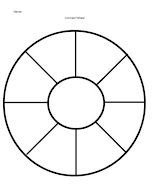
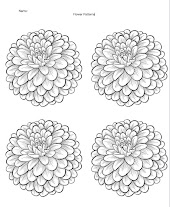
Click on the printable to be linked to where it can be printed.

Printables that can be used to support this book:


Printables that can be used to support this book:


Printables that can be used to support this book:


Friday, July 26, 2024

Book Review

"Exploring trees outdoors is an enjoyable experience that children love to do! Swinging from a branch, exploring leaves and bark, and observing gnarled roots are all favourite activities that also integrate rich learning. Heading outside to explore the yard uses children's excitement and enthusiasm for sensory and nature experiences to inspire rich mathematical and scientific inquiries about what they are seeing and experiencing."


I was excited to see a review of my book Tree Math in the MAMT Spring Journal! You can access the review here!

Thursday, March 28, 2024

Five Free Printables to Use with Tree Math

 "Trees are poems that the earth writes upon the sky."

-Khalil Gibran

During outdoor play children are drawn to the trees in the school yard. They love to feel bark with their hands and wrap their arms around the trunk. They collect artifacts for exploration including sticks and leaves and search for insects in the bark's crevices. Trees offer so many rich opportunities for wonder and discovery as children notice how they change with the weather and seasons.


To help supplement my book Tree Math (available from Amazon and Indigo) here are five easy, free printables that can be used to support children's work in nature!

1. My Favourite Tree

Encourage children to spend time in nature and observe the tree they like best. Ask them to consider what it is they appreciate about this tree? Children can then sketch the tree on this page and compare their tree with others.

2. My Tree and the Four Seasons

Over time children can observe the same tree and draw what they notice changing during the four seasons. This page can be kept over time and added to as the months change. Children can also draw on it at one sitting and hypothesize what the tree might look like in each season, especially after conducting research about how trees adapt to the weather.

3. Tree Circumference

Children can use a variety of materials to measure how big around a tree's trunk is (e.g., measuring tape, hand spans, links) and record it on this tracking page. Drawing a picture can help explain their math thinking.

4. Tree Bark Patterns

Exploring the texture of bark appeals to many children who enjoy sensory experiences. Children can use magnifying glasses to examine the patterns in bark up close, or place a paper on top of the bark and use crayons to create a rubbing. Children can then describe what they see and compare their rubbings to others. 

5. A Tree is a Home

Encourage children to explore many trees in the school yard and neighbourhood. Ask children to observe what living things they observe on and in the trees (e.g., birds, insects, mould) and record their observations on the tracking paper. They can hypothesize how the tree might be a home for many living things at the same time.

Tuesday, March 5, 2024

Easy St. Patrick's Day Math Ideas

St. Patrick's Day is a fun holiday that helps jump start the spring season! Here are a few easy to plan math activities for children!

1. Shamrock Subitizing- Write different numerals in the center of each shamrock and encourage children to place dominoes with the corresponding number of pips in each leaf.

 
2. Estimation/Counting Jars - Fill jars with a variety of different seasonal loose parts. Encourage children to estimate how many objects are in each jar. They can then use a variety of math tools (e.g., number grid, ten frame, hundreds chart) to count the total objects. These can then be recorded on a paper for comparison.

3. Rainbow Numbers - Provide children with a variety of numbers and encourage them to explore these in different ways (e.g., sorting by colour, ordering, create number combinations).
4. Colour and Coin Sorting - Recycled marker caps can become 'pieces' of the rainbow. Add fun play coins and seasonal pots to the tray and encourage children to sort, count, and pattern with the loose parts.
5. Roll and Record - Here is a fun template that can be used by children to support many math explorations! Children can roll and subitize a die and colour in the corresponding number of shamrocks. Two children can each roll and colour in shamrocks using their own colour and try to get 4 in a row. Children can colour the shamrocks in using different colours to create patterns. The possibilities for this template are endless!

Get the free printable here: Shamrock Printable

 
6. Which One Doesn't Belong? -  Show children pictures of different shamrocks and ask them to articulate which picture does not belong. 
Get the free printable here: WODB Shamrocks
7. Gold Coin Count - Add dice, coins, number lines and writing materials to this game board and encourage children to create and play their own treasure games!
Get the free printable here: Gold Coin Count
8. Find the Gold Coding - Draw the path needed to get from home to the pot of gold! Use arrows to display direction of movement.
Get the free printable here: Gold Coding Mat 


Sunday, June 4, 2023

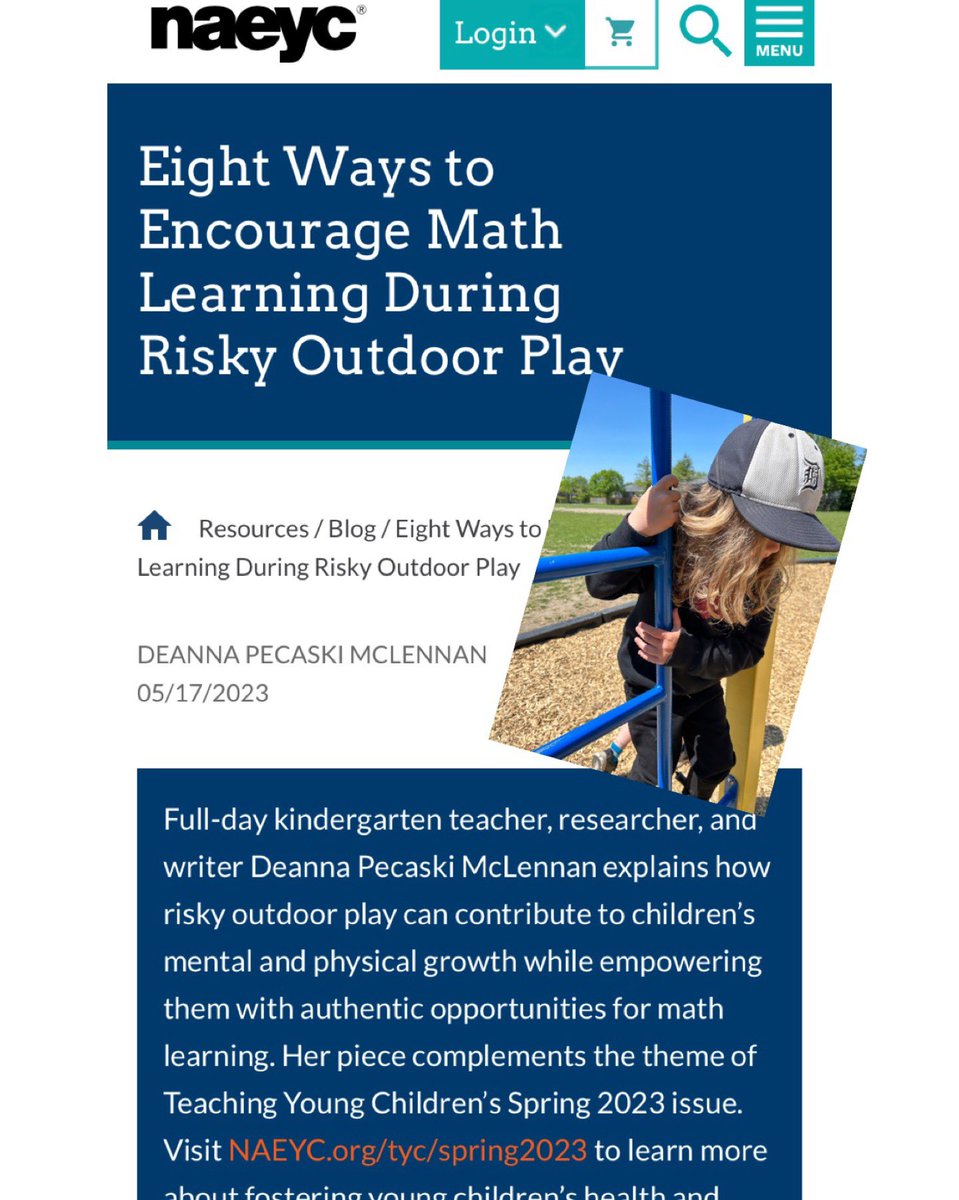
Eight Way to Encourage Math Learning During Risky Outdoor Play

This month I have a blog post featured on the National Association for the Education of Young Children's (NAEYC) website regarding how to engage children in math learning during risky, outdoor play. You can read the article here: Eight Ways to Encourage Math Learning During Risky Outdoor Play.

Image

Sunday, April 16, 2023

Using Outdoor Discoveries to Inspire Rich Math Talks

"It's the little details that are vital. Little things make big things happen."
John Wooden

Now that spring is emerging muddy conditions are common in our school yard. Although some educators shy away from messy spots, I find they are often one of the best places to notice and name rich, authentic math.

One morning the children were exploring the yard and noticed interesting tracks on the path. They took their time observing the different prints they found. They wondered who had been visiting the space and how the markings were made. They noticed that the prints appeared to be dried in the dirt and preserved in the thick mud. 


The tracks that fascinated us the most were those made by animals. Our school is located near a wooded trail and our yard is frequented after hours by coyotes, deer, geese, wild turkeys and dogs. The children compared the different tracks and used their prior knowledge to try and identify the animals. We also used a handy animal tracks identifier to help us as the difference between some tracks is minimal.
 
               
The children were also very curious about the shoe/boot tracks that they found alongside the animal tracks. Within each we noticed intricate shape and line details that differentiated them from one another. We identified many shapes including circles, diamonds, hexagons and squares. There were also many different lines in each - straight, wavy, and zigzag.


We wondered if our footwear matched any of the tracks. The children examined each other's feet to see if they could find a match between their shoes and any of the tracks. This inspired rich observation and discussion as small details were noted and comparisons were made. 
 
In order to capitalize on this interest I printed large photos of a shoe and animal print and brought them to our whole group discussion. I asked the children to consider what was the same and different about each print. I also used the thinking routine 'see, think, and wonder' to facilitate math talk and help the children mathematize the photos. 
We also brought this interest in prints to our art center where children were invited to paint our spare classroom boots and stamp them to see what kinds of prints they made. 
Once the tread prints were dry the children brought them to our whole group gathering time and we continued to observe and discuss the shapes and lines we saw in each. The children grouped the prints according to similarities and also compared the size of the marking to their feet in order to see which was the bigger foot. 
 
As spring weather continues to bring rain, the children's interest in tracks endures. The children are now curious about how long an entire track path is, how deep the prints are in the mud and how much space is in between each print. They wonder about how far and fast the person or animal might have been travelling and use these clues to help them hypothesize the speed and distance. Each time a discovery is made in the yard I carefully document the findings using photos and videos so we can bring the information back to our whole group conversations and build our collective knowledge about tracks. 

Our next step will be to record ourselves making tracks in the mud using digital tools. We will use the different recording options on our smart device including time lapse photography and slow motion recording. These will be interesting to watch and will hopefully help us understand more clearly how the distance, pressure and speed of movement will affect the way a print is made in mud. Stay tuned! 

Looking for a resource to support mud play? Check out my book Muddy Math available on Amazon!

Related Posts Plugin for WordPress, Blogger...