Showing posts with label structures. Show all posts

Sunday, April 13, 2025

STEAM in the Garden - Constructing Insect Houses using Natural Loose Parts

"Look deep into nature and then you will understand everything better."

Albert Einstein

The children were gathered around a large landscaping rock, working together to arrange twigs and flowers they had picked from the ground nearby.

"I think that this side should be the living room and the bedroom can be over here," Jack gestured as he spoke. "The living room will be next to the bedroom and the ladybug can crawl across by using this little bridge."

"So what are these little sticks here for?" Mary pointed to a little row of twigs placed next to each other.

"Oh, those are going to be the bed." Olive answered.

"But that's way too big to be a ladybug's bed," Mary responded.

"Oh," Olive pondered. "I didn't think about that.
 
"That's okay," Mary smiled. "We'll just find more than one ladybug and then the bed will be the perfect size for them to share." 

Spring was in the air and the children were excited to discover that many little creatures were venturing out into the warm sun. Ladybugs, rolly pollies, and ants were abundant and this sparked the children's imaginations. Eager to 'help' the insects the children set to work building little houses for them. They searched the yard to gather materials they felt would be best suited to this task. 
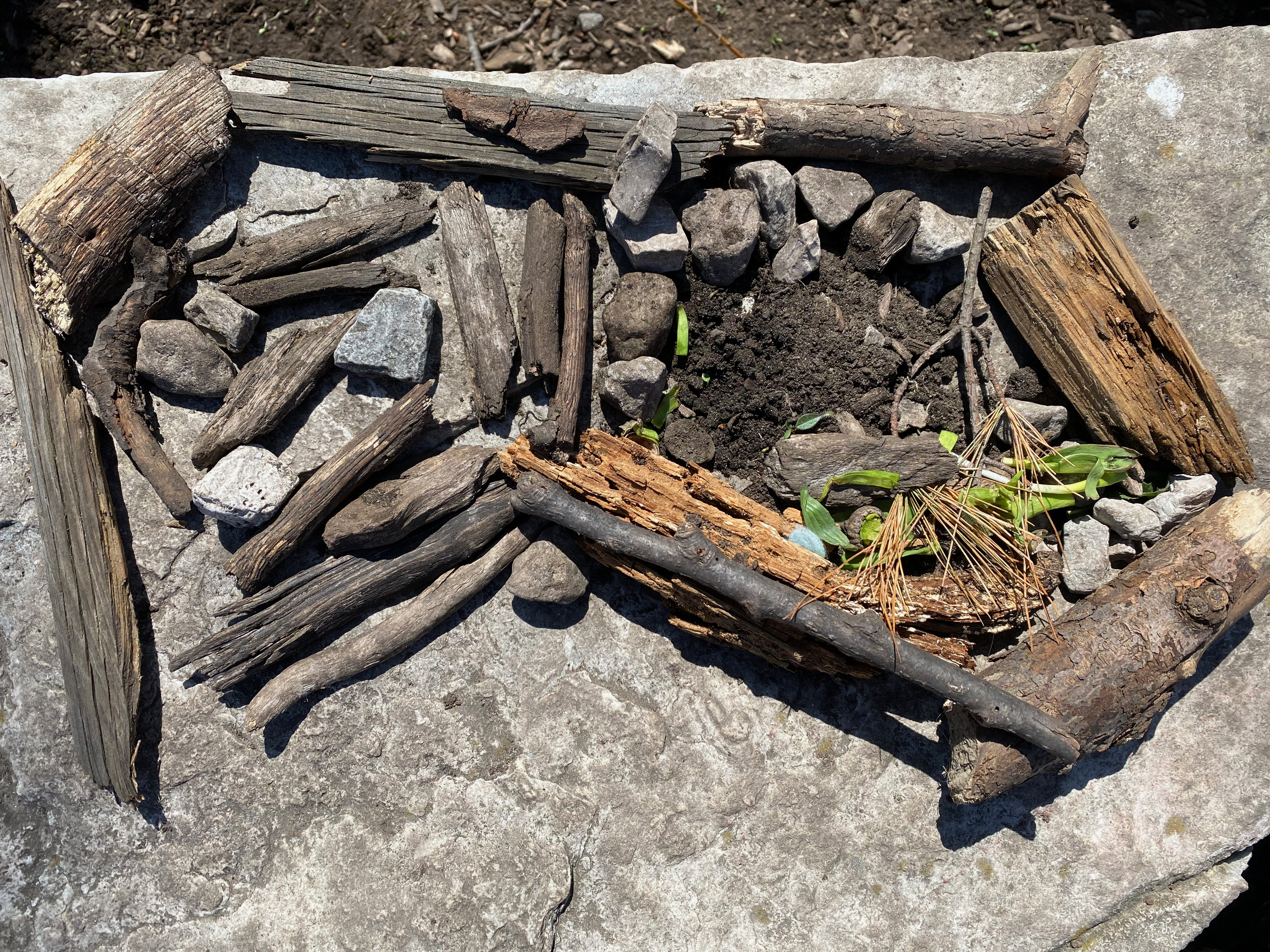
Each day the children would return to the mini houses and continue their work, focused on creating the most aesthetic and functional space for whatever creature they had found that day.  
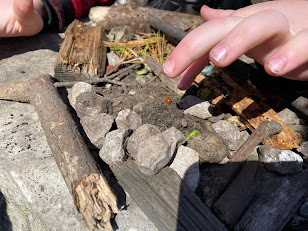
   There are four steps to the design process for young children. When I reflect upon the children's garden engineering of the habitats I observed these steps in action:

Identifying a Problem - the children felt the insects needed a home
Imagining and Planning - children brainstormed that natural loose parts could be used to design and construct a habitat and engaged in conversations about what this might look like
Creating - children spent time over many days creating different homes for different living creatures
Improving - children revisited their creations each day and revised their plans when necessary
after they noticed new things about the insects or had engaged in conversations with peers
  
What might seem like a playful activity outdoors has the potential for much rich learning using an engineering mindset. When children create habitats outdoors they are participating in rich math exploration in action including:
 
-discussing, designing, and refining a plan
-classifying and sorting materials by common characteristics
-considering proportion as they build for specific insects
-using spatial reasoning and design as they manipulate materials
-thinking about measurement as they incorporate area and perimeter into their 'house' or discuss the attributes of materials (e.g., the heaviness of rocks, the length of sticks)
-counting materials gathered and used in the design process
-naming colours and shapes that emerge in their work
-using positional language to describe their creations
-thinking about balance and stability as they assemble materials 
-incorporating patterns or symmetry as they create aesthetic structures
 
It's amazing to notice and name the rich math learning that emerges in children's self-directed play outdoors. Taking photos and videos of the work, engaging in discussions with kids about their play, and reflecting upon the experiences can help educators make this rich learning visible to others! Sometimes nature is the most effective math teacher of all!

Wednesday, October 29, 2014

Shaving Cream Building

Adding shaving cream to foam blocks is a great sensory experience that encourages children to explore. Children notice that the cream can be used as a mortar to hold the blocks together in interesting ways. 


Monday, November 19, 2012

Mirror Building

I have been reading a lot lately regarding the use of mirrors to enhance exploration and creativity in Reggio Emilia inspired activities and I was eager to try this with my children. We just rediscovered some wooden blocks and I set them up next to a flat mirror on our living room floor.


My children were a little apprehensive at first to try this activity. I encouraged them to be gentle with the mirror and ensured that I was close by to supervise - I knew my daughter would understand the fragile nature of the mirror but wasn't so sure my three-year-old son would.

The children instantly noticed their reflections on the smooth working surface.


It was hard to tell where the real structure ended and the reflected one began...


In addition to a neat mini-lesson on reflective surfaces, this activity allowed me to discuss the differences between 2D and 3D shapes and introduce some terminology (e.g., cube, triangular prism). It was also interesting to see my children problem solve how to stack the blocks so they did not fall as their towers got taller. You'll notice the 'sidewalks' my son created that joined the structures together. He had a wonderful imaginative story for why the inhabitants of the structures needed to be able to visit each other.


For a great article on how block play encourages numeracy, visit Block Play, Math and Literacy.

Tuesday, December 6, 2011

Creating with Cardboard

Mrs. Bombardier invited the children to explore an assortment of recycled cardboard at the art table. It was so interesting to see how they worked with the material and what they created.


Many children created parking garages and car ports for use at our building center.


There was lots of great math talk as the children explored how to make the structures stable and how to ensure that the supports were of equal lengths so the structures were level.


Working with the thick cardboard proved to be a challenging fine motor task for the children too! Great for strengthening hand strength!


It was wonderful to see the children helping each other out and co-creating structures together!


At the end of play time we encouraged the children who created at the art table to share their recycled structures with the rest of the class. What a great way to encourage creativity, cooperation, and recycling! Why don't you try this at home with your children over the holidays?

Friday, November 11, 2011

Shaving Cream Structures

The children engaged in one of our favourite activities today! Building structures using shaving cream! The shaving cream acts as a very strong mortar, holding the blocks together enabling the children to build taller, more unique structures than if they were just stacking the blocks on top of one another. This activity also appeals to children because of the sensory nature of the shaving cream. It's just so much fun to play with and smells so good! It's also very easy to wash out of the children's clothing and off the blocks. 


So much fun!
Related Posts Plugin for WordPress, Blogger...