Wednesday, February 23, 2011
Interactive Ten Frame Game
Click here for an amazing, interactive ten frame game that you can play with your child to help support their numeracy skills at home!


More Secret Spies
Our children were incredibly engaged with one another while at the dramatic arts "Spy Headquarters" again today. Their level of imagination and storytelling was just fantastic and inspiring to observe. The children engaged in rich communication with one another and they cooperatively worked through their imaginative play, using specialized spy vocabulary to add to the experience.
In order to engage children in writing, we put out our secret message activity where children used white crayons and water colour paint to decode messages they wrote to one another.


We rearranged our furniture so that the headquarters has a regular door and a secret entrance for the children to enter and exit through.


A secret code keypad has been added to help motivate the children with exploring numbers - sharing the secret code with one another and finding and pressing the corresponding numerals in order to gain entry to the headquarters.


 \
\
In the afternoon we thought it would be fun to engage the children in a little classroom mystery by placing footprints from the window and back door and leading them to an empty book shelf. The books were missing!


Did your child come home with a blue finger? We invited interested children to place a fingerprint on a large piece of paper. We're hoping to explore the science of fingerprints in the next few days by examining the unique differences in our own.

In order to engage children in writing, we put out our secret message activity where children used white crayons and water colour paint to decode messages they wrote to one another.


We rearranged our furniture so that the headquarters has a regular door and a secret entrance for the children to enter and exit through.


A secret code keypad has been added to help motivate the children with exploring numbers - sharing the secret code with one another and finding and pressing the corresponding numerals in order to gain entry to the headquarters.


Miss Rahman helped the children to make a secret spy phone so that outsiders could call into the spy headquarters for help.


 \
\


The children bought into the adventure and spent the afternoon playtime searching for clues as to where the missing books went.


Locks and Keys
In order to help our children strengthen their fine motor skills we placed a number of little locks and keys out at a table today. The keys and locks were mixed together and the children had to experiment with matching a key to its rightful lock through trial and error. This activity took much patience and persistence on the part of our children as it was time consuming to try key after key in the same little lock. Many children were intrigued with the idea and spent a considerable amount of time engaged in the activity.


Some Ontario Curriculum Expectations this activity fulfilled include:


Some Ontario Curriculum Expectations this activity fulfilled include:
2.2 demonstrate persistence while engaged in activities that require the use of both large and small muscles (e.g., tossing and catching beanbags, skipping, lacing, drawing)
4.1 begin to demonstrate control of small muscles in activities at a variety of learning centres (e.g., sand, water, visual arts centres) and when using a variety of materials or equipment (e.g., using salt trays, stringing beads, painting with paintbrushes, drawing, cutting paper, using a keyboard, using a mouse, writing with a crayon or pencil)
4.2 demonstrate spatial awareness by doing activities that require the use of small muscles
Tuesday, February 22, 2011
Wear Pink and Stand Up Against Bullying
Our students are encouraged to wear pink tomorrow as a school-wide symbol of standing up to bullying. To read more, click on this article from the Windsor Star.
Setting up our Spy Headquarters
The children were so excited to set up the spy headquarters today! They helped to quickly clear out the chocolate factory and before I even had a chance to help them set up the space, had begun to use some of the neat items we had for the new center. We can't wait to add more math and literacy activities to this play area in order to advance the learning taking place!
Checking out some of our neat gadgets.

Filling out their spy badges, complete with a code name and fingerprint.


Helping to set up the center.

Trying on some of our secret disguises.

More spy stuff - binoculars and spy bags.


Dressed up and on the hunt for clues.


Back at the headquarters working the phone.

Checking out some of our neat gadgets.

Filling out their spy badges, complete with a code name and fingerprint.


Helping to set up the center.

Trying on some of our secret disguises.

More spy stuff - binoculars and spy bags.


Dressed up and on the hunt for clues.


Back at the headquarters working the phone.

Sunday, February 20, 2011
Secret Spy Stuff
Some of our children have taken a great interest in pretending they are spies in our classroom. This was the result of some very interesting, dark sunglasses being added to our science center. We are hoping to follow this area of interest in our children and embed some math and language into their play. If you have any of the following items that you would be willing to donate or that we could borrow, we'd be most appreciative. We are looking for:
- wrist watches
- walkie talkie type boxes
- small note pads
- gadget-y type items that the children could pretend are spy inventions
- locks and keys
- anything else you think is spy-worthy
- old cameras
Thank you for your support of our children and program! We appreciate it!
Thursday, February 17, 2011
Mustard Seeds on a Sponge
Miss Rahman led the children in an interesting experiment this week. They placed mustard seeds on wet sponges and left them under a layer of plastic wrap for a few days. When the children returned to school today, they were amazed to see that many of the seeds had sprouted - complete with a mini root system and a pair of little green leaves.


When we asked the children how the seeds could sprout without being planted in soil, they had some interesting explanations.
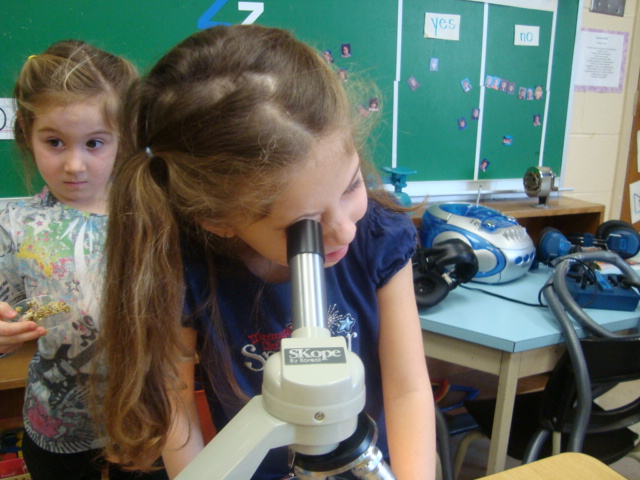
Wanting the explore the seeds/sprouts further, we placed them on our science table along with petri dishes, tweezers, and a high powered microscope. The children spent time teasing the sprouts apart and examining them in great depth. They noticed the seeds had a distinct smell coming from them.


Ontario Curriculum Expectations this activity fulfilled includes:


When we asked the children how the seeds could sprout without being planted in soil, they had some interesting explanations.
Wanting the explore the seeds/sprouts further, we placed them on our science table along with petri dishes, tweezers, and a high powered microscope. The children spent time teasing the sprouts apart and examining them in great depth. They noticed the seeds had a distinct smell coming from them.


Ontario Curriculum Expectations this activity fulfilled includes:
1.3 express their thoughts (e.g., on a science discovery, on something they have made) and share experiences (e.g., experiences at home,
cultural experiences)
2.3 demonstrate self-motivation, initiative, and confidence in their approach to learning by selecting and completing learning tasks (e.g., choose learning centres independently, try something new, persevere with tasks)
1.1 ask questions about and describe some natural occurrences, using their own observations and representations (e.g., drawings, writing)
2.2 make predictions and observations before and during investigations
2.4 communicate results and findings from individual and group investigations (e.g., explain and/or show how they made their structure; state simple conclusions from an experiment; record ideas using pictures, numbers, labels)
Tuesday, February 15, 2011
Adding Music to a Story
Today we read one of our favourite books together, "Mortimer" by Robert Munsch. Because this was a very familiar text for the children, we added the element of music to help enhance some of the parts of the story, especially those where Mortimer made a lot of noise! The children had a blast!
Later on in the day we explored the idea of music helping to tell a story a little more deeply. The children worked in pairs to draw whatever came to mind as they listened to a piece of classical music. Once a child had a turn, they then explained their drawing to their partner. Roles reversed and then the other child had a turn drawing. (Thanks to Mrs. Bombardier for a great idea!)
Later on in the day we explored the idea of music helping to tell a story a little more deeply. The children worked in pairs to draw whatever came to mind as they listened to a piece of classical music. Once a child had a turn, they then explained their drawing to their partner. Roles reversed and then the other child had a turn drawing. (Thanks to Mrs. Bombardier for a great idea!)
Monday, February 14, 2011
Friday, February 11, 2011


Subscribe to:
Posts (Atom)
