Thursday, March 24, 2011


9-1-1 Quack!
We read a wonderful story called "9-1-1 Quack" with the children. This text tells the real story of a mother duck whose 8 ducklings fall into a sewer grate. The duck's frantic quacking leads a police officer to discover the fallen ducklings and help get them out of the grate. Our children have been fascinated with the text and we decided to encourage them to engage in a dramatic retell using props from around the classroom.


We weren't sure what to use in the classroom to make a grate. This child decided to try and use the unifix cubes. He used mathematical reasoning to determine what size to make the space in the grate - it had to be small enough for the mother to cross over, but too big for the ducklings.

These girls are setting up the road that the ducks walked down. The blue basket represents the pond they were headed towards before falling in the grate.

Characters from the story are gathered from around the classroom.

The grate is put into place. The mother duck is represented by the large yellow triangular prism and all 8 of the ducklings are the small cubes.

The girls decide that the park is where the ducks start their adventure. They create a swing using the straws and balls, the loose green straws placed horizontally represent the grass, plastic trees and a park structure also enhance the setting.

The grate with the ramp the police officer used is ready and in place. The tow trucks are also on stand by.

Retelling the story together.


Here is the retell:
Later on the materials were used by other children who enhanced their understanding of the text by extending the story. Here the boys pretend that instead of following their mother the ducklings play on the swing, preventing them from falling into the grate.


These girls are consulting the text to see what characters and materials are needed to recreate the setting and plot from the story at the retell center.

We weren't sure what to use in the classroom to make a grate. This child decided to try and use the unifix cubes. He used mathematical reasoning to determine what size to make the space in the grate - it had to be small enough for the mother to cross over, but too big for the ducklings.

These girls are setting up the road that the ducks walked down. The blue basket represents the pond they were headed towards before falling in the grate.

Characters from the story are gathered from around the classroom.

The grate is put into place. The mother duck is represented by the large yellow triangular prism and all 8 of the ducklings are the small cubes.
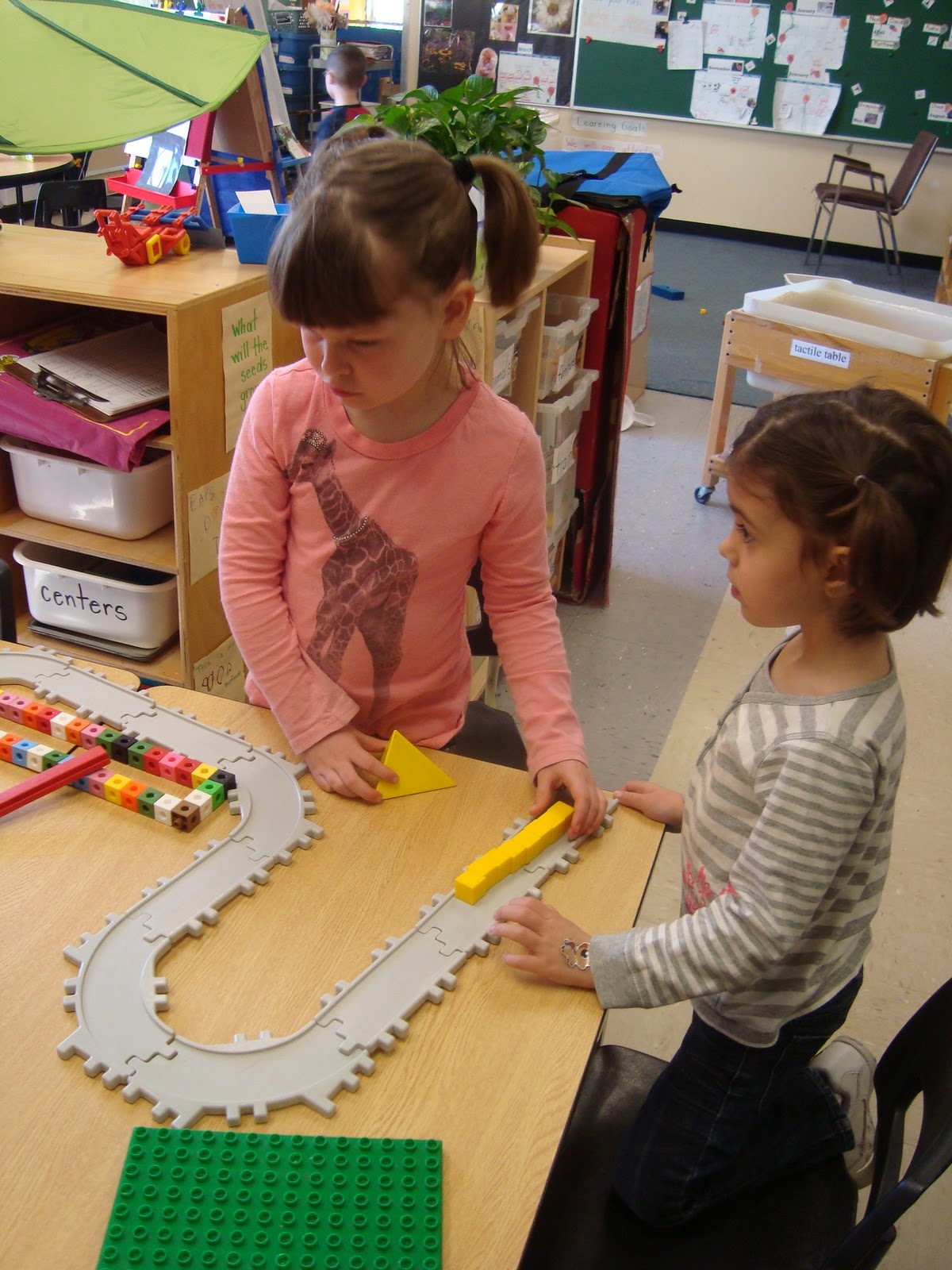
The girls decide that the park is where the ducks start their adventure. They create a swing using the straws and balls, the loose green straws placed horizontally represent the grass, plastic trees and a park structure also enhance the setting.

The grate with the ramp the police officer used is ready and in place. The tow trucks are also on stand by.

Retelling the story together.


Here is the retell:


Wednesday, March 23, 2011
Pentaminoes
Some boys were hard at work putting the pentaminoes together! Look at their great creation!


Tuesday, March 22, 2011
Spring Pastel Painting
We added new shades of lovely pastel colours to the painting easel this week to celebrate the beginning of spring! The children loved mixing the paint together to make their own new colours.


The children are painting using basting brushes. We like to change the tools at the easel on a regular basis in order to provide a rich variety of materials to explore. The neat thing about these particular brushes is that they create a thick, textured look on the paper.


The children are painting using basting brushes. We like to change the tools at the easel on a regular basis in order to provide a rich variety of materials to explore. The neat thing about these particular brushes is that they create a thick, textured look on the paper.

At the table we also put out pastel paints with sponges so the children could create various colours of butterflies. We didn't premix the colours and instead encouraged the children to dab various colours on their papers in order to create many new shades.


Washing the Babies
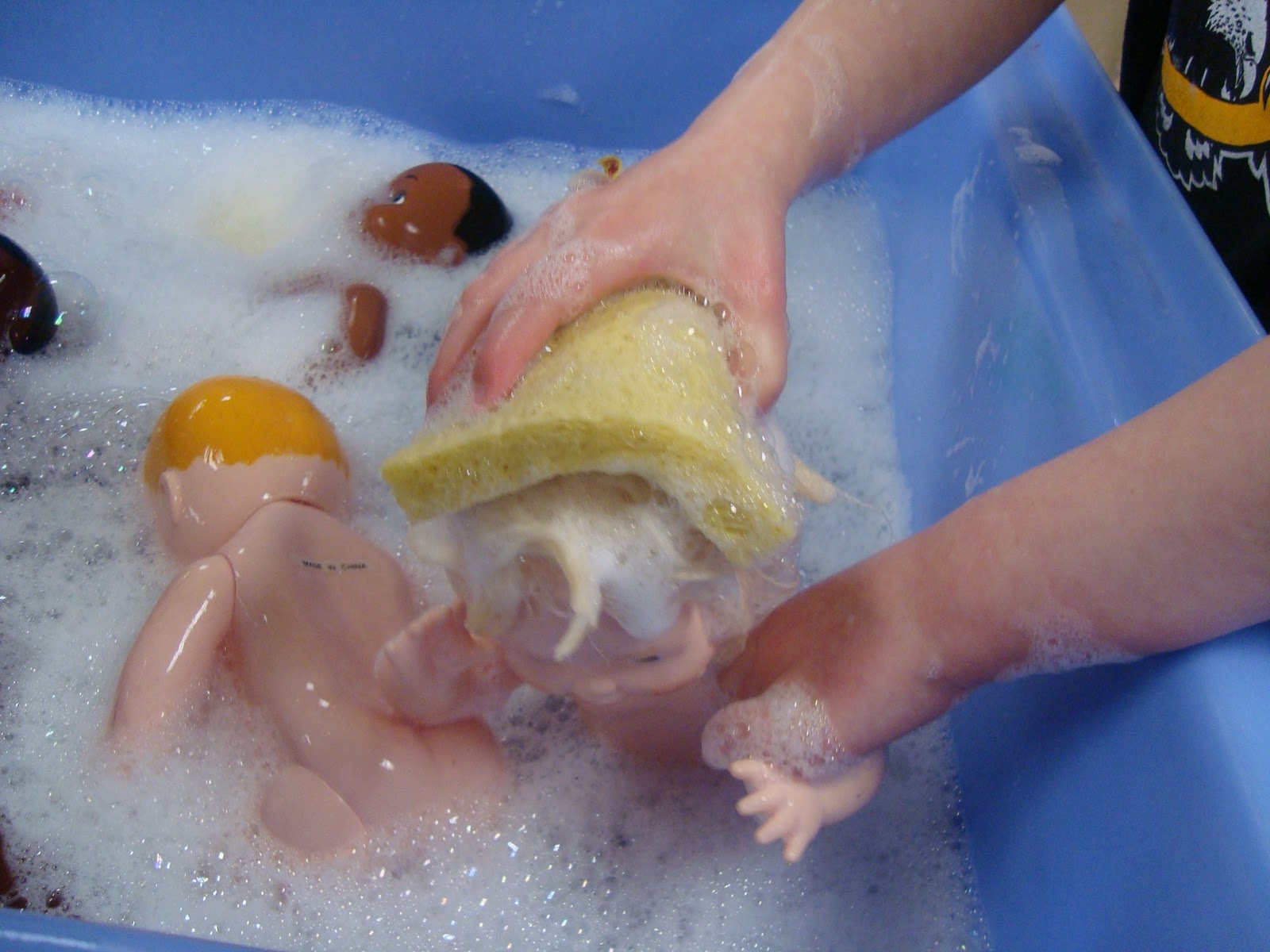
We added bubbles and babies to our water table today so the children could pretend that they were washing the babies. It was a very popular center! It was so sweet to see the children taking such good care of the babies - washing them with sponges and combing their hair. Once the babies were dried off many children swaddled and rocked them around the classroom.




Saturday, March 12, 2011
Colour Mixing Using Markers and Water
Earlier this week the children explored colour mixing by drawing on coffee filters and then spraying them with water. The water caused the marker to bleed together and the colours were absorbed by the filter. The results were stunning!


As the filter dried, the children noticed that an identical print was left on the background paper, resulting in the creation of two pieces of artwork! Many of the filters were turned into paper flowers in order to help decorate our room in celebration of the return of spring!
Paper Towel Experiment
We conducted a neat experiment with the children which explored the idea of absorption and gravity. Using two plastic cups, a paper towel strip, and coloured water, we set up the cups in such a way so that the water would be absorbed slowly by the paper towel and moved from the higher cup to the lower one. (The pictures in this post span two school days as the water moved quite slow.)
At first, we asked the children to predict what they thought might happen to the materials. Many focused on the colour of the water and how the paper towel was turning blue. They hypothesized that the colour of the water had something to do with whatever was going to happen over the course of the experiment. In reality, the water is coloured blue only to help it stand out as it's moved from cup to cup. It would move the exact same way even if it wasn't coloured.


By the end of the day, the children realized that the paper towel had become totally saturated with water and a few drops of liquid had pooled in the bottom cup. When asked to explain why this happened, a few children realized that the paper towel had "sucked up and spit out" the water. One child compared the paper towel to a vacuum cleaner. Many children agreed and thought more water would materialize in the bottom cup as time went on.

When we returned to school the next day half the water had been moved from the top cup and the children enthusiastically agreed that the paper towel had sucked the water up. They came up with the word 'absorb' to describe this process.

We left the cups out again over this past weekend and when children returned to school on Monday they found that the water had totally evaporated, leaving a blue strip of paper towel and no water in either cup. They were fascinated! We are hoping to follow up this experiment with other variations where children can test various strips of materials and see if they absorb the water and move it in the same way as the original paper towel.
This experiment is very easy to set up at home if you are looking for a March Break activity!
Thursday, March 10, 2011
Fighting Island
Families, if you are ready to commit to attending this wonderful field trip with us on May 9, please let me know as soon as possible so that I can begin recording who is coming and looking for other volunteers as we are hoping to have one adult per child for the entire day. Just send a note in your child's mailbag indicating the name (and relationship to the child) of who is coming. It's going to be a great experience!
Incorporating More Authentic Writing into Activities
This past Monday I had the opportunity to visit some amazing teachers at a school in Windsor. After viewing their kindergarten classroom and seeing children in action during play time, I came away with some great ideas for how to provide more opportunities for authentic, child-produced writing in our program. We started some of these this week and I am eager to share them with you so that perhaps you can engage your children in discussions about the writing they are doing at school.
We now have a "Sharing" space where each day children can write down ideas that they'd like to share with others. The children were eager to share information about what was important to them at both home and school. This open ended opportunity for writing helps encourage all children to share their ideas, regardless of what developmental stage of writing in which they are.


We also now have a make and display area where children can share their structures and creations. Children who want to display their work are encouraged to label it, so others can learn more about what they've made.


We've also added a writing space in our building area so that children can record their contruction ideas in print. Today a child was excited to share what she had made using the 3D connectors. She accurately drew her creation by tracing it, and then added the words after. What a neat idea!

We asked some children who had painted pictures to add captions so that others would know what had been created. Children sounded out their words with some teacher assistance and these are now on display in our classroom.

We are so thrilled with the enthusiasm our children have had towards these writing endeavours. You can help out at home by encouraging your child to engage in authentic writing. Providing a journal so that your child can freely draw pictures and write words is a great way to encourage and celebrate authentic writing. You can also have your child help write letters or emails to relatives, write or copy the grocery list, and make labels for their toys and other household items.
We now have a "Sharing" space where each day children can write down ideas that they'd like to share with others. The children were eager to share information about what was important to them at both home and school. This open ended opportunity for writing helps encourage all children to share their ideas, regardless of what developmental stage of writing in which they are.


We asked some children who had painted pictures to add captions so that others would know what had been created. Children sounded out their words with some teacher assistance and these are now on display in our classroom.

Subscribe to:
Posts (Atom)
