Saturday, April 29, 2017

The Power of a Puddle

Our children are drawn to water. This past week we had a lot of rain and it created a giant puddle in the playground. The children were curious about how to cross the puddle. It was too big and deep to skip or jump over and they needed to cross it in order to get to the other side where their stumps and other favoured areas were.

One child decided to try using some of our loose building parts. He gathered many pieces of wood and laid them starting from one edge of the puddle. As he placed them side by side he observed the edges of the wood to see if the puddle was deep enough for the wood to sink into.

"I don't know if the wood is high enough. If the puddle is deeper than the wood, then this won't work."

I observed him as he placed the wood and then stepped on each piece, watching to see if the water rose higher then the wood. I noted the complex math and problem solving that had emerged in his work. He was considering the depth of the water and whether it was deeper than the wood was tall.  After a few minutes some friends joined him.


As each piece was added the children continued to test their design to see if their feet stayed dry.

"We're making a bridge so we can cross!" 


The children continued to lay the wood side by side. When it ran out, they were perplexed.

"We don't have enough to finish the bridge!"

They stood around for many minutes, stepping on their bridge, counting the pieces that were side by side, and then looking around the yard for any loose pieces of wood they might have missed.

"I know! Let's take half of the pieces and move them so that we can make the bridge longer! We'll just have to walk one at a time instead!"

The children realized that if they narrowed their bridge they could double the length by moving the pieces in different positions. The amount of wood they used hadn't changed but their problem solving allowed them to complete a workable way of crossing the water.
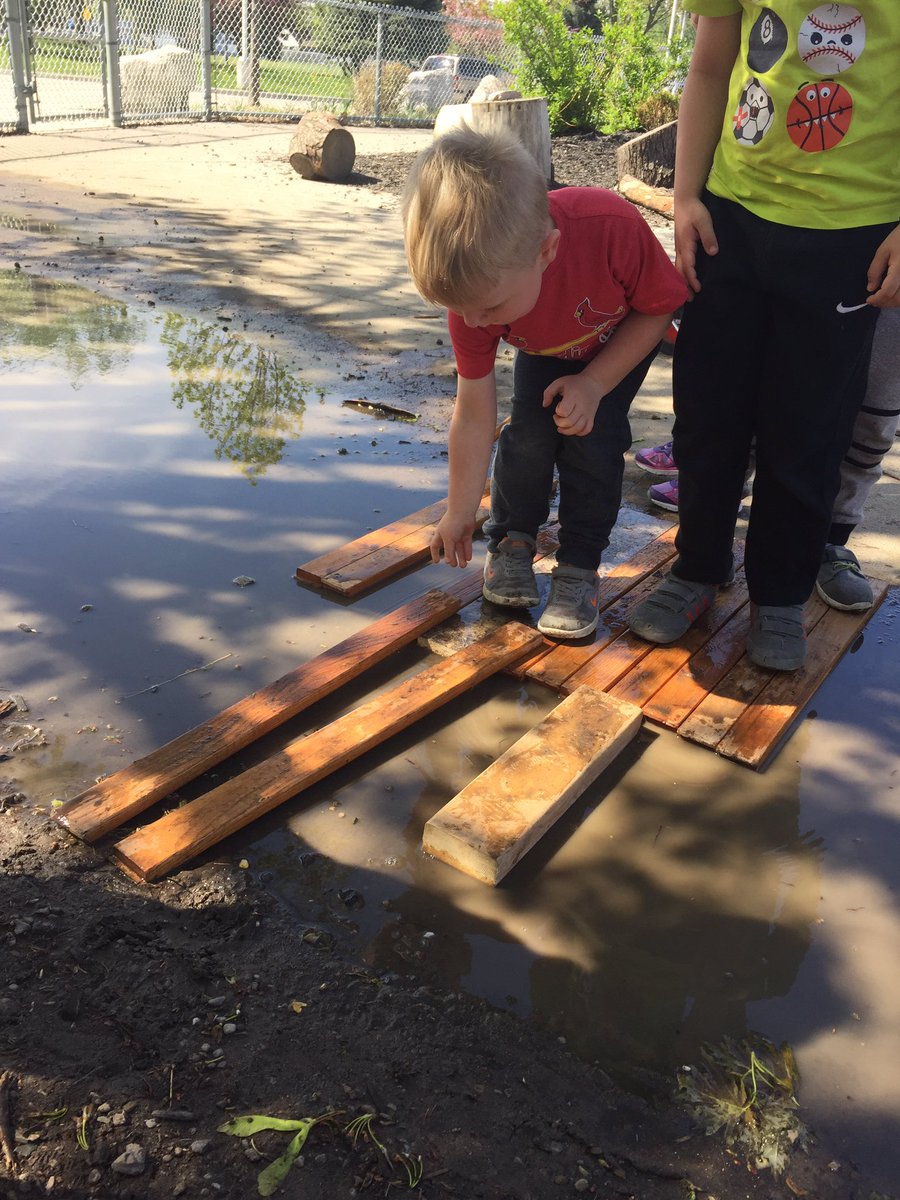

 Success! The children children spent the majority of their outdoor time racing one by one across the big puddle. They even tried driving the tricycles across it - the process of experimentation in doing so led to some amazing conversations about the weight of the bike and if the wood would hold it, the position of the wood pieces and if they would stay in place while being driven on, and how fast the bike could be driven across without the pieces shifting and becoming ineffective.


The outdoors is full of possibilities for children to mathematize their play; this authentic experience of crossing the puddle motivated the children to engage in robust math that incorporated measurement and problem solving!

Saturday, April 8, 2017

Math Learning - and a Touch of Science - in the Outdoor World

With spring in full bloom many kindergarten children are spending time exploring the outdoors! There is so much opportunity for rich math learning hidden among the natural treasures in any play space! If you'd like to learn about the potential for math in the outdoor world, check out my newest article:

Math Learning - and a Touch of Science - in the Outdoor World


Thursday, March 30, 2017

Creating Coding Stories and Games

We are pleased to be presenting Creating Coding Stories and Games at the 2017 ETFO Kindergarten Conference! You can access our powerpoint here: Coding Stories and Games


Tuesday, March 7, 2017

The Mitten Measurement Task

It's amazing the kinds of questions children can ask...
 
One of my favourite books to read in the winter in "The Mitten" by Jan Brett. The story is appealing to young children who love to retell the text and marvel at how big the mitten grows as each animal squeezes into it.  This week I read the book again upon request by one of the children.  At the end of the reading one child shared that she felt that the book wasn't really about "real things, because there was no way all those animals could fit into one small mitten". 
 
Sensing an opportunity for something rich, I questioned the children. I asked them to consider whether a mitten could really stretch that large to accommodate all the animals, and if it couldn't, how big did they think it would have to be in order to do so.
 

The children engaged in a lively discussion and agreed that the mitten would have to be very large - much larger than the one portrayed in the book - and it would be very time consuming to knit. We agreed that one would have to know exactly how big it had to be because if it was too small the animals wouldn't fit, and if it was too big it would waste the knitter's yarn and time.
 
I challenged the children to create a mitten the exact size it would need to be in real life to fit all the animals in the text: a mole, rabbit, hedgehog, owl, badger, fox, bear and mouse.  They readily accepted my challenge. The first thing we agreed upon was that we needed to know exactly how big each animal really was. The children weren't sure how to do this so I suggested researching their sizes on the internet. I helped them with this search.
 
Once we knew the size of the animals I helped the children measure out large butcher paper so that their drawings would be as realistic a size as possible. We discovered that the bear was the largest!


Here are the animals (excluding the bear) after the children researched, drew, and cut them out.


The next thing we needed to do was calculate how big the mitten needed to be. We referred to the book to see if the animals were side by side or on top of each other and then taped together large pieces of butcher paper to create the mitten.


The papers needed to be securely fastened...


...the outline of the mitten cut...
 

...and the seams stapled closed.


The children noticed that when complete the mitten was almost as big as our carpet!


The children enjoyed decorating it too!


We felt that it would be fun to retell the story while we placed each animal inside the mitten. We were eager to see if we were right and the animals all fit inside.


The children waited until it was their animal's turn and then gently placed their animal inside.


Once the retell was complete the children had one more question they asked to explore. Would a mitten that was large enough for all those animals hold 14 kindergarten children? They were quite eager to find out! One by one they hid inside the mitten, squeezing to the end and making room for their friends to join in!
 
This was also an incredibly rich math activity. The children had to consider the area of the mitten and if there would be enough room for all the children. They counted as each child entered the mitten and calculated how many more children were waiting on the carpet. They discussed how to preserve the integrity of their design as they entered the mitten so that it held together so all children could have a turn.


They were right! All 14 children did fit into the mitten!


But the best part of all? Getting out of the mitten!


Related Posts Plugin for WordPress, Blogger...