Friday, August 28, 2020

In Conversation With TVO Teach Ontario

 I was very excited to share some of my math ideas with the 'In Conversation With' feature of TVO Teach Ontario. You can read our interview here: In Conversation with Deanna Pecaski McLennan.


Friday, August 21, 2020

Inspiring Math Learning Outdoors using Moments and Photos

The world outdoors is filled with amazing math moments. Almost anything you find - whether it is natural or man made - contains an element of math.

From the symmetry we find in flowers or garden wheels...        


...the interesting shapes we can spot in structures and found objects...    


 ...the uniquely formed angles hiding in unexpected places...


 ...to the potential for discovering and playing with numbers.


The world around us uses math in the most interesting of ways.

Many educators are looking ahead to this school year, wondering how to engage children in authentic math moments while decreasing the risks associated with the current pandemic. Many experts recommend holding classes outside. This option is appealing, but some wonder how to take the math learning they traditionally offer in the classroom to the world beyond. How might one fulfill curriculum expectations and assess student learning while being outside?

I suggest looking to the world around you for math inspiration! 

Whether you are a teacher who will be holding your classes outside, or planning to engage children in online learning, using the outdoors to inspire math talks can be an authentic and exciting way for children to delve more deeply into math concepts while seeing their application to real life. 

Teachers can chose specific photos or places in the yard to introduce curriculum concepts needed to be covered (e.g., showing a photo of rain drops in a puddle to introduce the concept of radial symmetry) or ask children to see/think/wonder about a phenomena they notice and planning a mathematical inquiry centred around this (e.g., estimating and then problem solving for how to calculate the number of daisies that have grown in the garden).


There is math potential everywhere!

To help get you started, I have compiled a collection of 75 photos featuring natural and man made objects from the outdoors. You can access these here: Photos to Inspire Math Conversations

Feel free to use them to inspire math conversations in your physical classroom, or during an online math talk. Download them, print them, use them however you'd like to facilitate math learning with your students. Heading outside to explore math might seem daunting at first, but listening to the observations and questions that children have can be a wonderful start to a rich, mathematical inquiry.

I'd love to see the math learning you experience as we head back to school. Don't forget to tweet me @McLennan1977 and share the amazing #foundmath you discover in your explorations outdoors!


Thursday, August 20, 2020

Interview with CBC Afternoon Drive


It was a pleasure to chat with Chris dela Torre about my award winning paper 'The Beautiful Tree Project" on CBC's Afternoon Drive! To listen to our interview check out the link:

One LaSalle-area kindergarten teacher took her math class outside


Sunday, March 15, 2020

Spring Math

The last week has been interesting for those of us adjusting to a new kind of normal here in North America. Like many of you, my family and I had a whirlwind of a week - cancellation of a trip two years in the planning, notice of school closure for weeks after our March Break, no time visiting family and friends, and limits to how often we are travelling in our local community.

The first few days were surreal; I had a difficult time saying goodbye to my students on Friday, wondering how long it would be until I saw them again. As my teaching partner and I prepped our centers and morning message, we worried about when the next time we would see each other might be. I walked out of school bringing home my plants, teaching materials, and personal belongings, not knowing when I would return.

In times of uncertainty, helping one another is one of the best ways to get through the stress and worry of what awaits. I know that many educators and families right now are wondering how to help support children even when we can't be together physically.

I love math. I also love to help educators, families and children love math. I have decided to create this blog post in order to continually provide ideas for how children can explore math in their natural world. The CDC is asking us to engage in social distancing and being aware of what is recommended is important. Right now being outdoors in our yards, on trails, and in gardens is still safe and encouraged. I realize that some of us are limited by our personal circumstances and not everyone has access to a yard or natural trail. I will try my best to vary activities in order to meet as many circumstances as possible. I will also tweet ideas for math learning on a regular basis @McLennan1977.

My hope is that the website will give ideas to educators who might be providing virtual support to the children and families in their care (e.g., if you are providing home schooling ideas, if you are engaging children in virtual classrooms), or ideas for families who are trying to engage their children in a sense of normalcy by playing and exploring math together in the outdoors. Check here regularly for new ideas as I will add more every few days, and feel free to email me questions or suggestions deannapecaskimclennan@yahoo.ca.

Here are some fun ways to get outside and see/think/wonder about the math you discover:

1.  Natural and Man Made Patterns
Go on a hunt and see what patterns you can see or hear (e.g., bird calls, veins on leaves, fence posts, brick designs, tile mosaics). Bring a clipboard and crayons and ask children to copy and extend the patterns they see. Ask children to classify the patterns as natural or man made.

2.  Same and Different
Choose two or more random objects from the outdoors (e.g., a rock and stick, a leaf and bird). Ask children to describe the characteristics of each and see how many similarities and differences they can find between the two objects (e.g., a rock and stick are both hard and nonliving; a stick is longer than a rock).

3.  Number Hunt
Choose a range of numbers appropriate for the age of the child (e.g., 0 to 10, 0 to 20, 0 - 100). Create an easy template for children to use that help them track the numbers they see. Go on a walk with your child and encourage him or her to record how many of each number they can spot by placing a check mark next to the corresponding number on their sheet. At the end of the walk calculate how many of each numbers were spotted and analyze your data (e.g., which number was spotted the most, least, the same).

4.  Estimate and Count
Before venturing out with a specific destination in mind (e.g., biking around the block, walking to the mailbox) ask your child how long it will take to get there (e.g., five minutes to bike one block, twenty steps to the mailbox). Decide how you will conduct an accurate measure (e.g., use a stopwatch to time your bike ride, count steps as you walk). Once you have reached your destination compare your estimate to the actual measurement. What do you notice?

5.  Shape Hunt
Take a sketch pad and pencil with you on your next walk. Encourage your child to spot shapes in the world around them. Ask you child to consider if these are natural or man made shapes (e.g., a round flower, a triangle in the climber). Encourage your child to sketch a picture of the shapes they find or take digital pictures that can be reviewed at a later date.

6. Shadow Play
 
Experiment with how your shadow reflects your exact movements by playing in the sun. Ask your child to consider whether or not the shadow is a reflection? Ask them to explain their thinking and justify their reasoning. Play with shadows at different times of the day. Digital photos can be taken and the lengths compared.

7. Wiggly Worms
Worms are a treat for many children to find on wet, spring days. Ask the child to closely examine how the worm moves, and hypothesize how it travels so easily without arms or legs. Worms move by constricting their body muscles in a pattern. Ask the child to closely examine the stretching and pulling motion that it makes while wriggling about.

8. Puddles
Children love to jump and splash in puddles. Puddles offer children many rich math opportunities too! Ask a child to determine how deep a puddle might be (e.g., looking at how high it is on their boot, using a stick). Ask the child to hypothesize how s/he might go about measuring just how much water is in the puddle. Watch the puddle over time and record how long it takes to evaporate. Note how much smaller it is each day by drawing the outline with sidewalk chalk each passing day and comparing the different rings to one another. 

9. I Spy
Encourage children to pay careful attention to their surroundings. While walking outdoors look for interesting designs. Play a math "I Spy" game with children using only math clues (e.g., "I spy something with a circular pattern." "I spy something that has a growing pattern.").

10. Bubbles
 
Blowing bubbles provides an opportunity to engage your child in rich discussions about open ended math questions: What is the biggest/smallest bubble you can blow? Why is the size of the bubble different depending on the force of your breath? How high/far do you think your bubble might travel? 

11. Unusual Numbers
 
Encourage your child to look for numbers in unusual places (like the 185 on this hydrant). Ask your child to identify the number, and hypothesize the purpose for the number. See if you can find other similiar objects with numbers too (e.g., find other hydrants and keep track of what numbers are listed on each).

12. Foil Textures
 
Look for interesting textures outdoors (e.g., tree bark, bricks, paving stones). Give your child a small piece of foil and encourage him/her to smooth the foil on top of the object, carefully revealing the texture as the foil is pressed and molds against the object.

13. Number Challenge
Keep track of the different numbers you find. Challenge your child to find specific numbers (e.g., the highest number, the lowest number, their age, an even number, an odd number).

14. Sorting Rule
 
Find an interesting collection of objects (e.g., pile of rocks, sticks, flowers in a garden). Ask you child to list as many different ways that she/he could sort the objects as possible (e.g., sort by size, colour, shape, function). If possible ask your child to physically sort the objects.

15. Different Number of Groupings
 
Challenge your child to find groupings of objects. Can you spot 2s, 3s, 4s, & 5s? Here we spotted 3 groupings of 3 grasses for a total of 9 similar plants in the yard. Encourage multiplicative thinking when asking your child for the total number of objects (e.g., Three groups of three equals 9.).

16. Tape Resist Art
 
You (or your child) can create an interesting geometric design with tape on a flat, outdoor surface. Fill each section of the tape with sidewalk chalk or paint. When each section is filled, remove the tape to reveal a beautiful piece of mathematical art!

17. How Many Steps?
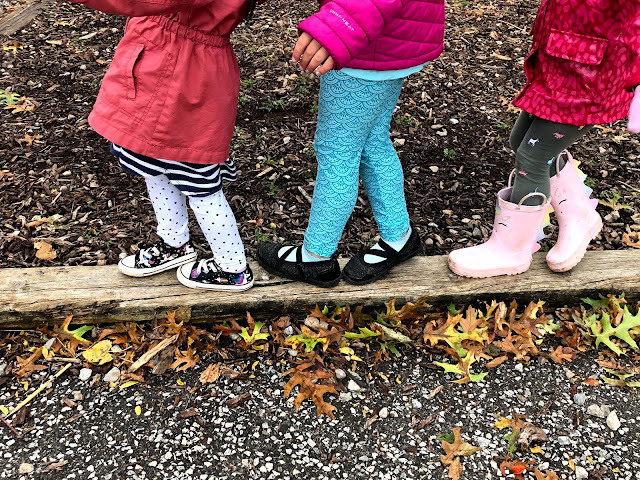
Find a challenging walking surface, like the wooden beam at the edge of a garden. Encourage your child to walk one step after the other along the length of the beam. Count each step. See how many steps your child can walk before she/he steps off the beam. Challenge your child to reach the highest number she or he can!

18. Leaf Patterns
 
Look for leaves on your walks - new leaves are emerging with the warmer weather and many older leaves are preserved in piles gathered in landscaping. Turn the leaf over and examine the vein pattern you discover. Use crayons and paper to create rubbings of all the different patterns you find.

19. Measuring Stick
 
Create a 'measuring stick' by finding a sturdy branch outside and wrapping it in equal segments using a heavy duty duct or masking tape. This is a nonstandard measuring tool so as long as the segments are equal, it will work. Encourage your child to explore the outdoor space and look for different things to measure (e.g., the depth of a puddle, the height of a plant).

20. Outdoor Easel
 
Create an easy 'easel' for painting or drawing still life observations outdoors by using a recycled plastic hanger to attach a paper to the fence. The hanger prevents the paper from blowing in the breeze, and can be used to hang the painting until it is dry. Encourage your child to paint or draw patterns that are visible in the outdoor space.  

21. Real Life Arrays
 
Encourage your child to look for real life arrays while exploring the neighbourhood, Help your child reframe the array as a multiplication sentence (e.g., "Three rows of three is the same as three multiplied by three.") and ask you child to calculate the product.

Spring Math Walk

To help inspire children and provide background information regarding the math that is accessible in the natural world around us, I am making the Kindle version of my newest book Spring Math Walk free on March 19. This offer is only valid on the amazon.com site. I will add additional dates in the future. I'm hoping that this free resource will be of interest for families looking for additional math information for their children - helping them venture outdoors and becoming inspired by the amazing math nature has to offer!


Tuesday, November 26, 2019

Encouraging Computational Thinking In Kindergarten

Young children are capable of engaging in rich computational thinking activities in the classroom. In emergent programs, the questions and wonderings children have about the world around them can easily be embedded into unplugged coding activities. Activities that incorporate computational thinking are often misinterpreted as 'more screen time' for young children, when in fact, all of the activities I use in my classroom to encourage computational thinking are screen-free without the need for computers or tablets.


Computational thinking is a foundation of computer science, and intricately related to many of the big math ideas and practices found in early childhood curriculum. It involves many concepts and approaches.

There are many different elements of computational thinking including:
  • using logic to predict and analyze when engaging in problem-solving
  • making judgments when faced with problems in order to evaluate what is happening and consider how to move forward
  • creating and following algorithms (or steps of action) in order to move through the problem solving process
  • using patterns in his/her work to find and use similarities efficiently 
  • deconstructing larger problems or actions into smaller, more manageable parts
  • filtering out information that isn't directly related to the problem or an efficient way of solving it

The computational thinker:
  •  tinkers with loose parts and other open-ended materials
  • designs innovative projects and follows through on creating them in some capacity
  • debugs by finding errors in his/her work and correcting them in order to move a project forward
  • perseveres and continues with projects even when they are challenging
  • collaborates with others as part of a team for the betterment of a project 
'Hour of Code' is December 9 to the 15 this year. Hour of Code originally started as a project to inspire people everywhere to spend one hour coding, in order to show that anyone, anywhere can code. It has become a world wide celebration of computational thinking and coding, and many global classrooms participate. 

Looking to engage children with computational thinking in your classroom? Here are some ideas to get you started. 

1. Use a read aloud to introduce the concept to children. Computational thinking can seem abstract, especially out of context. The book 'Think Like a Coder' introduces computational thinking to everyday activities that children experience including cooking, building, and even exploring the outdoors.
2. Look for everyday activities that naturally engage children in inquiry, problem solving, and computational thinking. Building with wooden blocks is a great start! Help children articulate the steps they took to build their structure, and ask them how they problem solved when difficulties arose with their creation (e.g., how they fixed a tower that kept falling over).

3. Provide STEM challenges to children. Ask them to use specific materials to achieve a certain goal, and encourage them to articulate the steps and criteria they used in order to be successful. In this photo a child turns a geoboard into a marble run maze. 


4. Introduce the idea of coding using arrow coding cards and positional language. Children can easily explore pathways by creating them using different building materials (e.g., blocks, legos, magnetic tiles) and then exploring direction of movement.


 5. Transfer coding into algorithms by helping children create and follow specific sequences of actions. Here children create and follow an 'exercise code' where they must look at each line of code in the script, and follow the movements precisely.


Computational thinking is a versatile, foundational approach to learning that helps engage children in rich mathematical activities. As Hour of Code approaches be sure to check out my twitter and instagram @McLennan1977 for more ideas on how to bring computational thinking and coding to your early years and primary classroom. 

Let's connect! Have a great idea to share? Leave it below in the comment section or tweet me and use the hashtags #kindercoding #joyfulmath #HourofCode and #MTBoS!

Saturday, October 26, 2019

Autumn Math Walk


"Notice that autumn is more the season of the soul than of nature."
 Friedrich Nietzsche

What better time of year to head outside and enjoy the beauty of nature than in the fall!

We have been spending long amounts of time each day exploring the treasures in our yard. The children have been fascinated by how the world around us is changing - leaves are changing colours and falling from trees, Monarchs are gathering the last bit of nectar from the garden before heading South, and we are enjoying the last flowers in our gardens before they wilt and dry.

The children have had many questions about some of the interesting objects they have found in the yard - stumps, leaves, creatures and flowers.


Many of their wonderings have been mathematical in nature - Why is there a pattern on the sunflower's seedhead? What are those holes in the stump and where did it come from? Why is a Daddy Long Legs an arachnid and not a spider?  How do leaves change colours?

There is math everywhere. If one looks deeply enough, there is always a mathematical connection in nature. The sunflower seeds follow the Fibonacci Sequence - a numerical pattern meant to help maximize space and fit as many seeds into the head as possible. The perfect little circles in the stump might have been caused by a wood boring insect or bird looking deep into the bark for food. Daddy Long Legs have a different body than spiders even though they have eight legs. Leaves change colour because the amount of sunlight they need to create their own food lessens in cold weather (as the Earth's axis tilts us away from the sun), resulting in a chemical change in the leaves. 

I've been motivated to continue to look for rich mathematical wonderings and opportunities for inquiry each time I'm outside - even on the weekend with my own children. I find it fascinating to see math applied in an authentic, interesting, real world connection. The math in nature is beautiful! Consider going on your own autumn math walk and seeing what amazing questions and connections emerge with on your journey!

I'm excited to publish my first children's book Autumn Math Walk (Kindle edition) on amazon now. Stay tuned for a print version!


Saturday, September 21, 2019

Math and Literacy Family Bags

Many families are eager to help their children practice literacy and numeracy work from school. Although traditional 'paper and pencil' homework is not developmentally appropriate in many circumstances, providing 'take home' games and activities in the form of literacy and math bags is welcomed and appreciated by many families. These interactive, hands-on, developmentally appropriate activities are easy to create and target many emergent skills and knowledge needed by young children. They are a good alternative when the school community expects work to be sent home from school. Take home bags help parents and guardians understand how literacy and numeracy can be nurtured and celebrated in the lives of young children.

You can access these, along with many free math printables, here:  https://www.teacherspayteachers.com/Store/Joyful-Learning-In-The-Early-Years

As always feedback and suggestions for future resources is always appreciated!


Related Posts Plugin for WordPress, Blogger...