Showing posts with label Halloween. Show all posts

Sunday, October 26, 2025

Spider Catapults


Spiders continue to be a popular topic of exploration in our classroom! To infuse this interest with math and fine motor work we introduced clothespin catapults to the children this week. Wooden catapults are easily made by securing a clothespin to a steady base (like a wooden block) with an elastic. 

They require concentration and perseverance for children to operate. As children become more confident using them they are able to use strategy to aim the catapult in a specific direction or apply pressure to further or reduce the launch power. 

Small plastic spiders (ours were from the local dollar store in the Halloween section) are light and perfect for playing with. We offer 'webs' made from wrapping a shallow basket with yarn. Children are encouraged to fire the spiders into the webs.


Once children master launching the spider into the web additional math tools can be offered to enhance the experience. A five or ten frame or hundreds chart are easy tools for children to use when tracking how many spiders they have landed in the webs.   


Additional targets can be provided for children to play with (e.g., alphabet chart, number chart, printable web with points). The possibilities are endless! 

Saturday, October 2, 2021

Pumpkin Math

Autumn is such a wonderful time of year! The colours and textures can inspire such rich math conversation! This past weekend we visited a few farm stands in the area and all I saw was math around me! I'm hoping that these photos will be useful as math prompts for 'math talk' conversations with children.

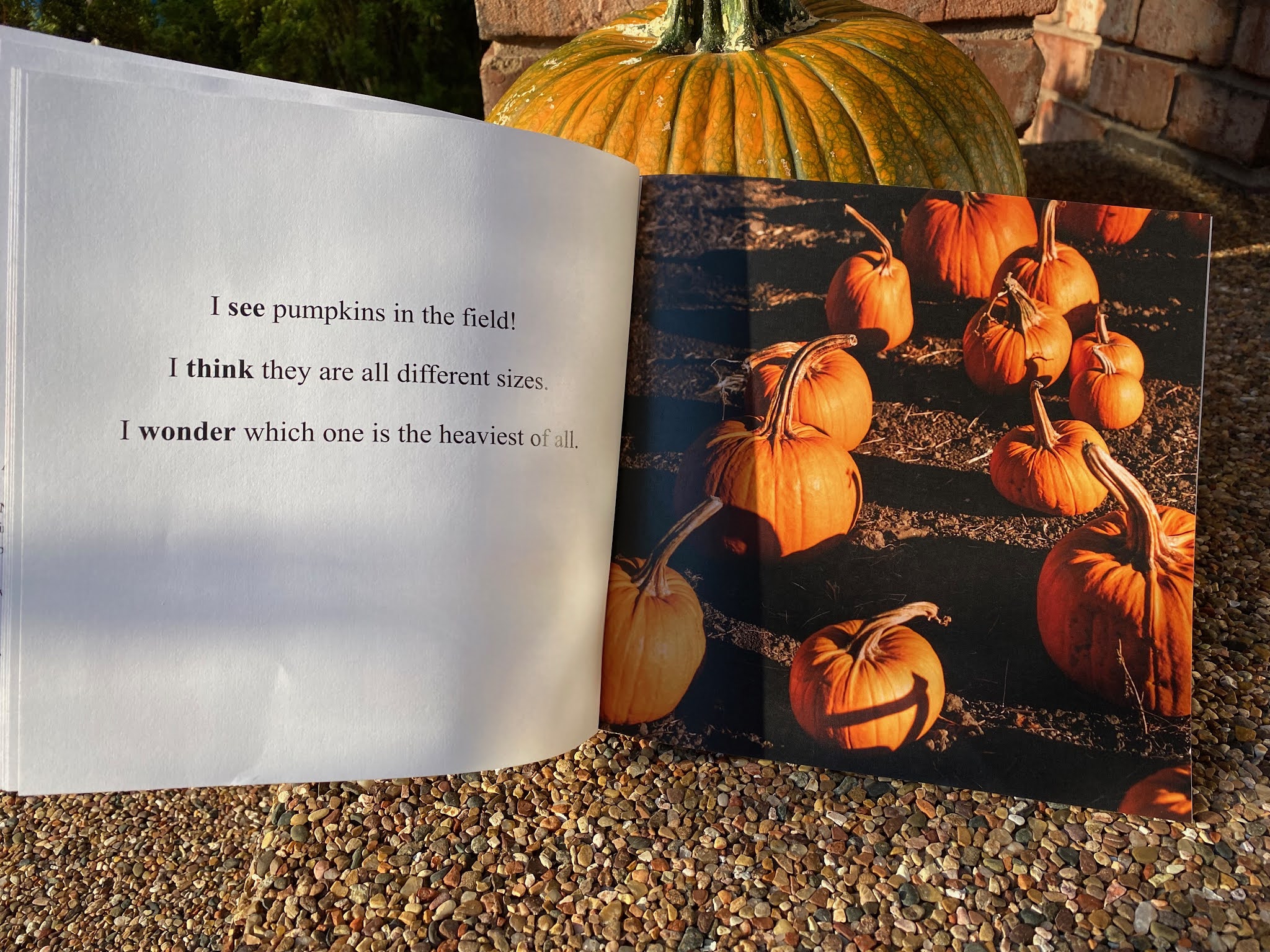
Show children a photo and ask them to share what they 'see, think and wonder' about each photo. The 'see, think, wonder' thinking routine can be used to help children delve more deeply into exploring and articulating what they notice in a specific situation. As children notice and name what they see, they can make connections to their own experiences and ideas, and form questions for further exploration and math research. 

Educators can also ask children specific math questions to guide their thinking. This can be especially helpful if the math concepts in the photos are geared towards an existing exploration the children are having, or if specific curriculum and assessment investigations are needed by the children. Sample math questions are provided below!

How many bumps are on this pumpkin?
 How big around is the stem?
What patterns do you notice?

How are these gourds organized?
What other ways can you sort the objects?
How many do you think are in each bushel? How do you know? 

 
What patterns do you see?
Why is the pumpkin more narrow at the top?
How big around might this be in the largest part?  

How many pumpkins do you estimate are in this box?
How many pumpkins might fit in the box if it was filled to the top?
How much money do you think the farmer should charge for the entire box of pumpkins? Why?

If these pumpkins are $3.50 each, how much would all of these cost? 
Should bigger pumpkins cost more than smaller ones? Why?
Which do you think is the biggest? How do you know?

Which pumpkin would you pick if you only had $2? Why? 
If you had X dollars, how many pumpkins could you buy?
How much money do all these pumpkins cost altogether?
What symmetry do you notice?
What patterns do you see?
How many pumpkins would a full crate hold?
 
Which gourd does not belong? Why?
How could you sort these? What's your sorting rule?
How many gourds do you think are in this bushel?
 
Halloween Math uses the 'see, think, wonder' thinking routine to explore seasonal objects and experiences in a mathematical context and is now available from Amazon!

Wednesday, October 28, 2020

Which One Doesn't Belong? Using Autumn Treasures to Inspire Math Talk

 The children were gathered for whole group. I displayed a collection of pumpkins and asked them a question - which one does not belong?

"I think this one doesn't belong. It's got the thickest stem. If you look at the others their stems are thinner. One pumpkin doesn't even have a stem."
 
"No, that one is green. All the other colours are normal pumpkin colours but that one isn't. Green is a dark colour and I don't even think pumpkins are supposed to be green."
 
"What if we make two piles - green and non-green?"
 
"What about this one? It's got the longest stem. That's different from the others. The stem is even longer than my hand if I put them next to each other."
 
"Yeah, but this one doesn't even have stem. That makes it different from the others. I wonder how it grew without a stem!"
 
"I know! This little one is different. It's the smallest. If I put the pumpkins in order by size this one would be on the end. It's teeny-tiny!"
 
"No. This is the one that is different. It's the only one with bumps."
 
Math talks can be incredible powerful experiences for young children; as they engage in interesting and meaningful conversations they uncover problems of importance (e.g., which pumpkin does not belong), engage in a problem-solving approach (e.g., using their senses to explore the pumpkins in depth and making connections between previous experiences and current explorations), and discover a variety of solutions (e.g., justifying why their chosen pumpkin does not belong using descriptive language). This builds confidence and agency in their work as mathematicians. They build theories about the world around them as they support their ideas with observations, draw upon previous experiences, listen to and consider the opinions of their peers, and revise their thinking as needed. Open ended math talks give children time and space to notice and wonder about something they find interesting and meaningful about the world around them. I purposely chose pumpkins for this math talk because the children have been quite excited about Halloween, and curious about the autumn artifacts we have placed around our classroom and outdoor space (e.g., leaves, gourds, decorative corn).

According to Antonia Cameron (2020) in addition to helping educators fulfill curriculum and assessment obligations, thinking routines included in regular math talks can be used to:
  • develop specific content ideas
  • meet different standards
  • develop playful mindsets in children
  • practice problem-solving models
  • facilitate communication skills  
Children are natural researchers who engage playfully with the world around them. They are driven to answer questions that promote a curious and wondrous mindset. They test their theories and revise their understandings through conversation and experience. Math talks can become powerful learning routines that empower children and build community over time. Children can share their ideas, justify their thinking, consider the ideas of their peers and whether or not they agree with them, and use this information to advance their mathematical understandings.
 
West and Cameron (2013) suggest a number of reflective points for educators to consider when designing mathematical thinking routines including:
  • what is the purpose of the math talk?
  • what big mathematical ideas are you hoping to embed within the conversation?
  • what are the needs of children and is the talk differentiated enough to include all?
  • what directions do you anticipate the conversation taking?
  • what assessment opportunities will the math talk provide?

A starting point for any math conversation is to provide a tangible artifact for children to explore (e.g., a pumpkin, piece of artwork, collection of loose parts) and ask them to notice and name what they see. Once they articulate their observations about characteristics of the object (e.g., shape, size, colour, texture, smell) they can make connections between these and the world around them (e.g., other objects, experiences, texts). Perhaps questions emerge in the conversation and children can wonder about some element of the object or conversation. This can lead to a research query to explore further. 

Giving children freedom to play with problems empowers them as mathematical learners. They grow their individual and collective mindset as they trust their abilities and engage in productive struggle. They question the world around them and delve deeply into complex wonderings and questions. This provides educators with rich opportunities to infuse complex math ideas into authentic moments of learning; building the big math ideas and spiralling curriculum as needed. Making time for regular math talk in the classroom celebrates children's thinking and empowers them as the amazing mathematicians they are! 
 
Cameron, A. (2020). Early childhood math routines: Empowering young minds to think. 
    Portsmouth, NH: Stenhouse Publishers.
 
West, L., & Cameron, A. (2013). Agents of change: How content coaching transforms 
    teaching and learning. Portsmouth, NH: Heinemann.

Thursday, October 27, 2016

Halloween Inspired Coding

The children have been very interested in maps lately; they create them at our writing table and use them in their dramatic play, refer to printed maps during outside time as they run and ride around on the tricycles, and talk about hiding treasure in our classroom and creating maps to help others find it. They are curious about places in our school and the hallways we need to take to get there.

As I reflected upon their genuine interest in location and maps, I thought it was the perfect time to introduce them to coding. Why coding?

1. Coding is basic language in the digital age. Computer programming is a language and is going to be an essential skill for many of our children to know as they grow. Our world is digital - providing children with activities that integrate communication, thinking and problem solving will be valuable for their future success. So many people are technology shy, and helping our children to be technologically literate is vital. The earlier one learns and practices the basics of this type of language, the easier it will be and the more positively it will affect their developing brains. 

2.  Coding is math. It involves spatial reasoning and logic. Helping children to think about direction, location and movement will strengthen their math skills. Children need to count the number of spaces being moved and indicate in which direction they are headed. Coding integrates a number of math skills together in one experience.

3.  Coding encourages problem solving. When activities like coding provide a challenge for the user, or there are multiple ways of solving the same problem, an emphasis can be placed on the process of learning and the child can consider multiple paths of arriving at a solution and choose the best or most efficient strategy. Planning ahead and being critical about the path of the activity is key for success.

4. Coding strengthens communication. When a child codes, she or he needs to indicate directions to another person (or the computer). These directions need to be as succinct as possible. When two children are playing coding games the child receiving the directions needs to be an active listener in order to move the coding pieces in the correct way. Clear communication is essential for success.

Want to learn how to better support your child's coding at home? Read this great article from CBC called Why Kids Should Learn to Code (And How to Get Them Started)

For today's coding activity I decided to use a spooky Halloween scenario to get the children to buy into the experience right from the start.

I created a simple grid using masking tape and our clear sensory bin lid. I wanted to engage the children in an experience that would help them understand the basics of coding. For this game we had four basic commands - "go right", "go left", "go up" and "go down". 


We had two pictures - one of a house (where the character would start) and one of candy (which is where the character needed to end). The children pretended that this was a trick-o-treater heading out on a scary Halloween night where many obstacles like bats, spiders, and other spooky creatures might be blocking the path. The ultimate goal was to move a character from the house to the candy as efficiently as possible without running into a spooky obstacle. 


The children used sticky notes with arrows drawn on them to indicate the codes. I encouraged them to verbalize their thinking and count the number of steps in their code. (e.g., "Move left 3 times, move up three times, move left one time, move up two times, move right one time").


This activity generated a great amount of interest, with many spectators watching the action or offering suggestions for more efficient ways to get to the candy faster.


As the children became more comfortable they created more complex paths to the candy by strategically placing the obstacles in the way. They were also very attuned to the grid and noticed when too many obstacles were placed on it and wouldn't allow a clear path.


In order to offer children a different perspective, I also had paper grids prepared with the same experience (house, candy, spooky obstacles) and invited the children to plan out the code directly on the paper.


Blank hundreds charts were also available for those children who wanted to draw their own Halloween obstacles and then program the code.


Stay tuned as we will continue with our spooky Halloween coding tomorrow and use more ideas that can be easily implemented into many scenarios to encourage children to use the basics of programming. For those who would like to print the coding pages used in this experience, please click on the following links.

Simple Halloween Coding Grid

Difficult Halloween Coding Grid

Printable Halloween Coding Pieces

Blank Hundreds Grid

Thursday, October 20, 2016

Spider Ring Roll

We played a fun game that capitalized on the children's love of spiders and encouraged subitizing and comparing quantities. Spider ring roll was a fun and easy way to infuse some math into a small group experience. You can see from the pictures that many children were interested in trying the activity out!
 
To play this game each player rolls a die (or multiple dice if you would like to encourage subitizing and adding). That player identifies the number rolled and puts that many spider rings on his or her fingers. For example if a four is rolled then you get to wear four sparkly spider rings.
 
Once every player is wearing their rings the hands are compared. First the rings are counted and a number is identified and then the children see who is wearing the most rings. Player with the most spiders on his or her hands wins the round!


Friday, November 9, 2012

Real Life Retell

I have been eager to incorporate some technology into our daily activities so when the kids carved their pumpkins, I thought it would be the perfect time to bring out the ipad and encourage my daughter to record the experience by taking some pictures.

As we participated in each stage of jack-o-lantern making, Cadence took a picture. It was a little tricky to do due to the size of the ipad.


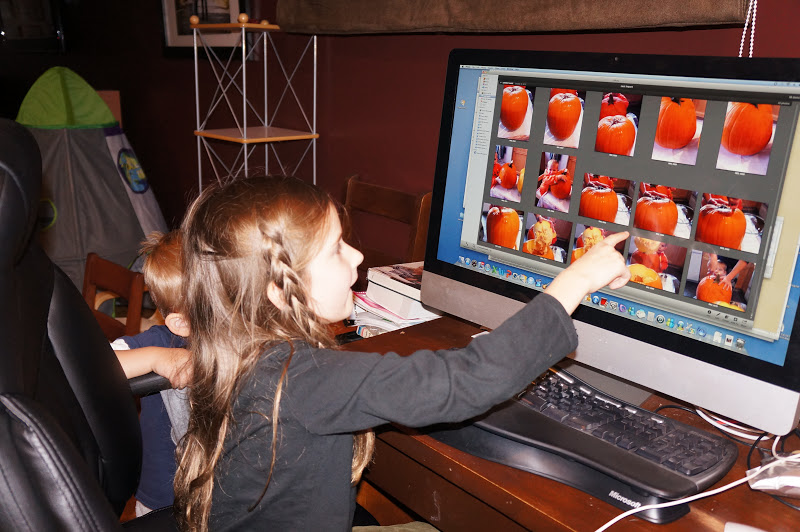
We then transfered the photos from the ipad to the computer. It was a great mini lesson on technology and what happens to digital photos when we are ready to use them. Cadence took her time analyzing the photos and choosing the ones she wanted.


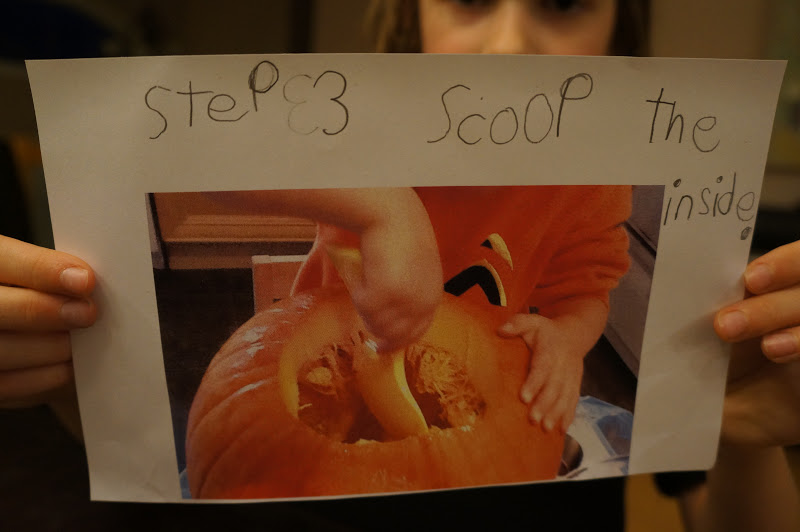
We printed them and then she spent some time writing about what was happening in each picture.


We then spread them out randomly on the floor and Cadence practiced sequencing the pictures according to their order.


This was a great way to practice sequencing/retelling a familiar story using technology as a way of capturing the events. I found that because Cadence had taken the photos herself, she was very invested in the activity. I also liked that it was an easy way to infuse some technology into the activity. Once we are done playing with the pictures we are planning on making them into a "How to Make a Jack-o-lantern" book to be kept on our bookshelf for future reference and reading enjoyment.
Related Posts Plugin for WordPress, Blogger...