
Showing posts with label planting. Show all posts
Showing posts with label planting. Show all posts
Friday, January 10, 2014


Saturday, March 23, 2013
Honouring Children's Questions
A few weeks ago Cadence ran off the school bus and excitedly held something in her hand. It was an orange seed that she had saved from a snack the school had served. "I wonder if it will grow," she yelled to me as she ran across the front yard.

Seeing this as an excellent provocation for inquiry, we planted the seed in a clear cup, using cotton balls for soil. The cotton balls held moisture and the clear cup allowed us to observe the changes in the seed.

We also planted peas and bean seeds alongside the orange seed. I thought it would be interesting to compare the seeds to each other and see the differences in how they sprouted. We placed the cups in a sunny window and kept track of how many days it took for them to sprout by recording the number on a post it note.


When it was time to transplant the seedlings to pots with real soil, we spent a few minutes examining them on the light table and discussing the names of each part of the plant. The root systems were so complex and it was really neat to observe them when illuminated by the light table.


We carefully transplanted the seedlings to little pots that can be planted directly in our garden as soon as it's warm enough. These are now sitting next to a sunny window.


The orange seed never grew. It turned moldy after a few days and then we threw it out. This lead to some really interesting conversations about why the kids thought it didn't grow (perhaps because oranges grow in warmer climates than ours?) and what the needs of plants and living things are. By honouring Cadence's question about whether the orange seed would grow, we spent three weeks exploring and examining how seeds grow and what living things need in order to thrive.

Seeing this as an excellent provocation for inquiry, we planted the seed in a clear cup, using cotton balls for soil. The cotton balls held moisture and the clear cup allowed us to observe the changes in the seed.

We also planted peas and bean seeds alongside the orange seed. I thought it would be interesting to compare the seeds to each other and see the differences in how they sprouted. We placed the cups in a sunny window and kept track of how many days it took for them to sprout by recording the number on a post it note.


This was an incredibly engaging activity. Each morning the kids would rush to the window to see what changes had occurred in the seeds. It was so interesting to see the root systems develop and stems grow longer until they bent upwards and reached out the cup.


When it was time to transplant the seedlings to pots with real soil, we spent a few minutes examining them on the light table and discussing the names of each part of the plant. The root systems were so complex and it was really neat to observe them when illuminated by the light table.


We carefully transplanted the seedlings to little pots that can be planted directly in our garden as soon as it's warm enough. These are now sitting next to a sunny window.


The orange seed never grew. It turned moldy after a few days and then we threw it out. This lead to some really interesting conversations about why the kids thought it didn't grow (perhaps because oranges grow in warmer climates than ours?) and what the needs of plants and living things are. By honouring Cadence's question about whether the orange seed would grow, we spent three weeks exploring and examining how seeds grow and what living things need in order to thrive.
Tuesday, January 10, 2012
Planting Spring Bulbs
Now that we are well into winter it's nice to bring a breath of spring into the room to help us antipate what's to come. Yesterday we planted paperwhite bulbs with the children.
They were intrigued by the puck of compressed dirt that came with the planting kit. We had children pass the puck, investigate it, and guess what they thought it was.

Many children thought it was a wood cookie like the ones we have in our building center because of its colour, texture and smell.

When we added water to the dirt something magical happened!

The children were amazed as the dirt suddenly expanded with the water!


We passed the bowl around so the children could feel the difference between the compressed and expanded dirt.

Next we passed the paperwhite bulbs around. The children thought they looked like onions! We discussed how the roots were on the bottom and the sprouts were on top.


We planted all three bulbs and placed them on a shelf in our room where they will get sunlight. We are encouraging the children to check out the bulbs each day and notice any differences that indicate they are growing. Paperwhites grow quite tall, so once the stems begin to grow, we will place measuring and recording materials near them so the children can record their observations.

Thursday, June 9, 2011
Flower Garden
We turned our tactile table into a flower garden this week. Children were encouraged to use their imaginations and 'plant' their own gardens.


Wednesday, May 18, 2011
Our New Plant
Check out our new plant. Do you think we can train it to grow on the trellis? We are hoping it adds a tall splash of green to the center of our classroom!


Thursday, February 17, 2011
Mustard Seeds on a Sponge
Miss Rahman led the children in an interesting experiment this week. They placed mustard seeds on wet sponges and left them under a layer of plastic wrap for a few days. When the children returned to school today, they were amazed to see that many of the seeds had sprouted - complete with a mini root system and a pair of little green leaves.


When we asked the children how the seeds could sprout without being planted in soil, they had some interesting explanations.
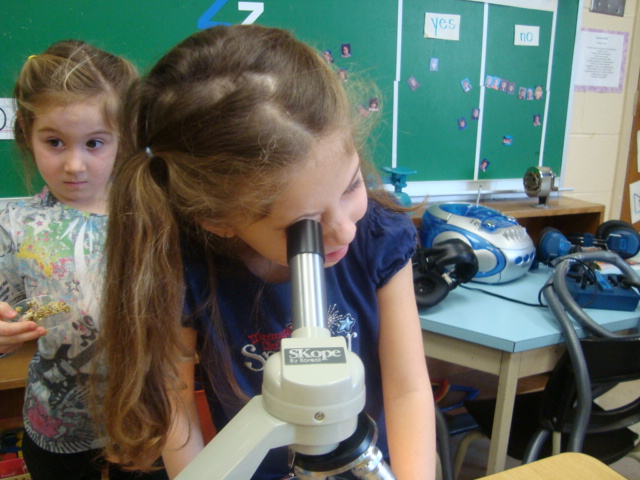
Wanting the explore the seeds/sprouts further, we placed them on our science table along with petri dishes, tweezers, and a high powered microscope. The children spent time teasing the sprouts apart and examining them in great depth. They noticed the seeds had a distinct smell coming from them.


Ontario Curriculum Expectations this activity fulfilled includes:


When we asked the children how the seeds could sprout without being planted in soil, they had some interesting explanations.
Wanting the explore the seeds/sprouts further, we placed them on our science table along with petri dishes, tweezers, and a high powered microscope. The children spent time teasing the sprouts apart and examining them in great depth. They noticed the seeds had a distinct smell coming from them.


Ontario Curriculum Expectations this activity fulfilled includes:
1.3 express their thoughts (e.g., on a science discovery, on something they have made) and share experiences (e.g., experiences at home,
cultural experiences)
2.3 demonstrate self-motivation, initiative, and confidence in their approach to learning by selecting and completing learning tasks (e.g., choose learning centres independently, try something new, persevere with tasks)
1.1 ask questions about and describe some natural occurrences, using their own observations and representations (e.g., drawings, writing)
2.2 make predictions and observations before and during investigations
2.4 communicate results and findings from individual and group investigations (e.g., explain and/or show how they made their structure; state simple conclusions from an experiment; record ideas using pictures, numbers, labels)
Subscribe to:
Posts (Atom)
