"Between every two pines is
a doorway to a new world."
John Muir
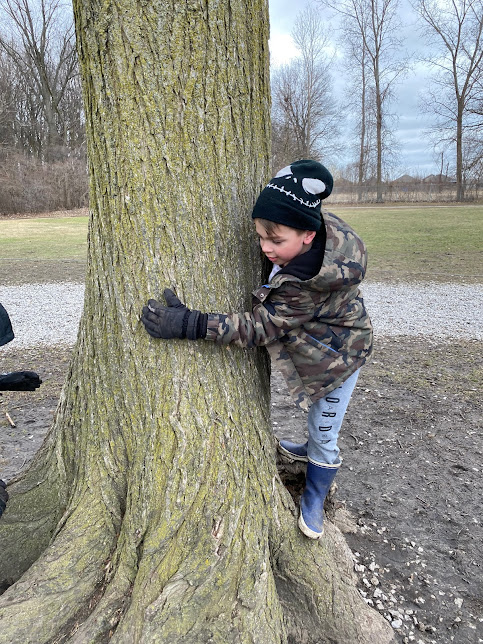
"Look at me!" Kyle called as he stood on his tiptoes. "I can reach so high. If I jump I can reach even higher!"
"That's nothing. I bet I can reach higher," Asher responded.
"Ok, let's see you do it!" Kyle laughed. "I can reach this high." He jumped and slapped a spot on the tree.
Asher copied the movements, jumping and tapping the tree in a different place.
"Who was higher?" they called to me.
"I'm not sure," I answered. "It's hard to tell where you each touched and compare the spots. You'll have to think of a way to mark and measure to be accurate."
Harper had been standing next to me watching the boys.
"I know," she said. "What if you each hold a piece of chalk in your hand. When you jump you can touch the tree and leave a mark."
"Oh good idea!" I answered. "And we can check our wonder wagon to see if we have any tools that measure."
"Like a measuring stick!" Harper answered.
Spending time outside in nature each day is important for children's growth and development. There is a misconception that a robust outdoor program needs numerous tools and materials in order to be successful. However in my practice I have found that often the best inquiries spark from examining and exploring natural elements in our play yard. One of the most intriguing artifacts that children love to explore is a tree. Trees are usually easy to find, diverse, and offer endless possibilities for child-centred inquiry. Responding to children's observations and wonderings about trees can inspire rich math, literacy and science work.
Interested in exploring the trees in your surroundings with children? Here are some ideas for getting started.
Tell stories about the interesting markings you find on trees. Children love to hypothesize about unique things. Ask children to imagine how a spot ended upon a tree, or look for the math within the markings (here the knot on the tree appears to be made from concentric circles).
Explore the different textures you feel on trees. Many children are sensory learners who enjoy exploring their surroundings through touch. Encourage children to feel different parts of a tree (e.g., bark, leaves, blossoms) and describe what they feel. Sensations can be categorized and sorted (e.g., making a pile of smooth leaves).
Research the different objects that grow on trees. The life cycle of trees often results in the creation of flowers and fruit. This growth pattern can be observed and tracked over time.
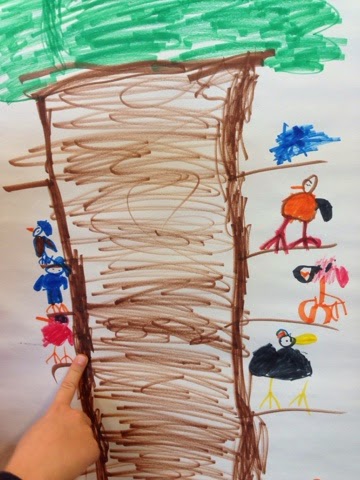
Inquire about what living things make their homes in trees. Each area is unique with specific animals and insects using trees as shelters. Nests can be observed and described (e.g., a robin's nest is perfectly circular). Children can be encouraged to draw pictures detailing what they see.
Hypothesize the age of a tree using different clues. The rings on a stump can help determine the age of a tree as well as its type and size. Look for stumps and ask children to count as many of the concentric circles as they can see. They can estimate the age of the tree. If a tree is still standing children can estimate how tall or old it might be.
Build gross motor skills and perseverance by climbing trees. Building resiliency, grit and perseverance helps children in all aspects of their learning. Climbing trees encourages these skills as well as being a great physical experience that many children enjoy.
Investigate how trees change over time by exploring decomposition. Logs left over time provide a wonderful opportunity for children to become curious about how it has transitioned from tree to rotting wood. Many insects make their homes in and under logs. Ask children to tell stories about what they think might have happened to fell the tree, or investigate who has been using it as shelter.
Search for clues on the tree to guess who might have visited before you. Holes in the bark can tell stories of what animals have been searching for food in the bark, or using the tree as shelter. Children can observe bark for changes over time and conduct research.
Ponder why some trees stay green all year while others lose their leaves. Coniferous trees do not usually drop their needles. Ask children to describe and categorize the trees in the yard or neighbourhood, and observe them over the course of several weeks or months.
Use materials gathered from the tree as loose parts for imaginative play. Pinecones, twigs, leaves, needles and acorns are great manipulatives for math or creative work outdoors. These can be collected from the yard or donated by families, adding variety and interest to process-based play.
Measure, record and compare the sizes and shapes of different trees. Find the largest or smallest tree in your area and challenge children to find different ways to measure the trunk's circumference. Keep track of the measurements by recording them in a nature notebook or chart paper.
These suggestions are just a starting point for using trees as the basis for rich inquiry during outdoor learning. Listening to the observations and wonderings of children can spark amazing projects. Children often have the best ideas!
.jpeg)
.jpeg)


.jpeg)
.jpeg)


.jpeg)
.jpeg)

.jpeg)

.jpeg)