Showing posts with label insects. Show all posts

Sunday, April 13, 2025

STEAM in the Garden - Constructing Insect Houses using Natural Loose Parts

"Look deep into nature and then you will understand everything better."

Albert Einstein

The children were gathered around a large landscaping rock, working together to arrange twigs and flowers they had picked from the ground nearby.

"I think that this side should be the living room and the bedroom can be over here," Jack gestured as he spoke. "The living room will be next to the bedroom and the ladybug can crawl across by using this little bridge."

"So what are these little sticks here for?" Mary pointed to a little row of twigs placed next to each other.

"Oh, those are going to be the bed." Olive answered.

"But that's way too big to be a ladybug's bed," Mary responded.

"Oh," Olive pondered. "I didn't think about that.
 
"That's okay," Mary smiled. "We'll just find more than one ladybug and then the bed will be the perfect size for them to share." 

Spring was in the air and the children were excited to discover that many little creatures were venturing out into the warm sun. Ladybugs, rolly pollies, and ants were abundant and this sparked the children's imaginations. Eager to 'help' the insects the children set to work building little houses for them. They searched the yard to gather materials they felt would be best suited to this task. 
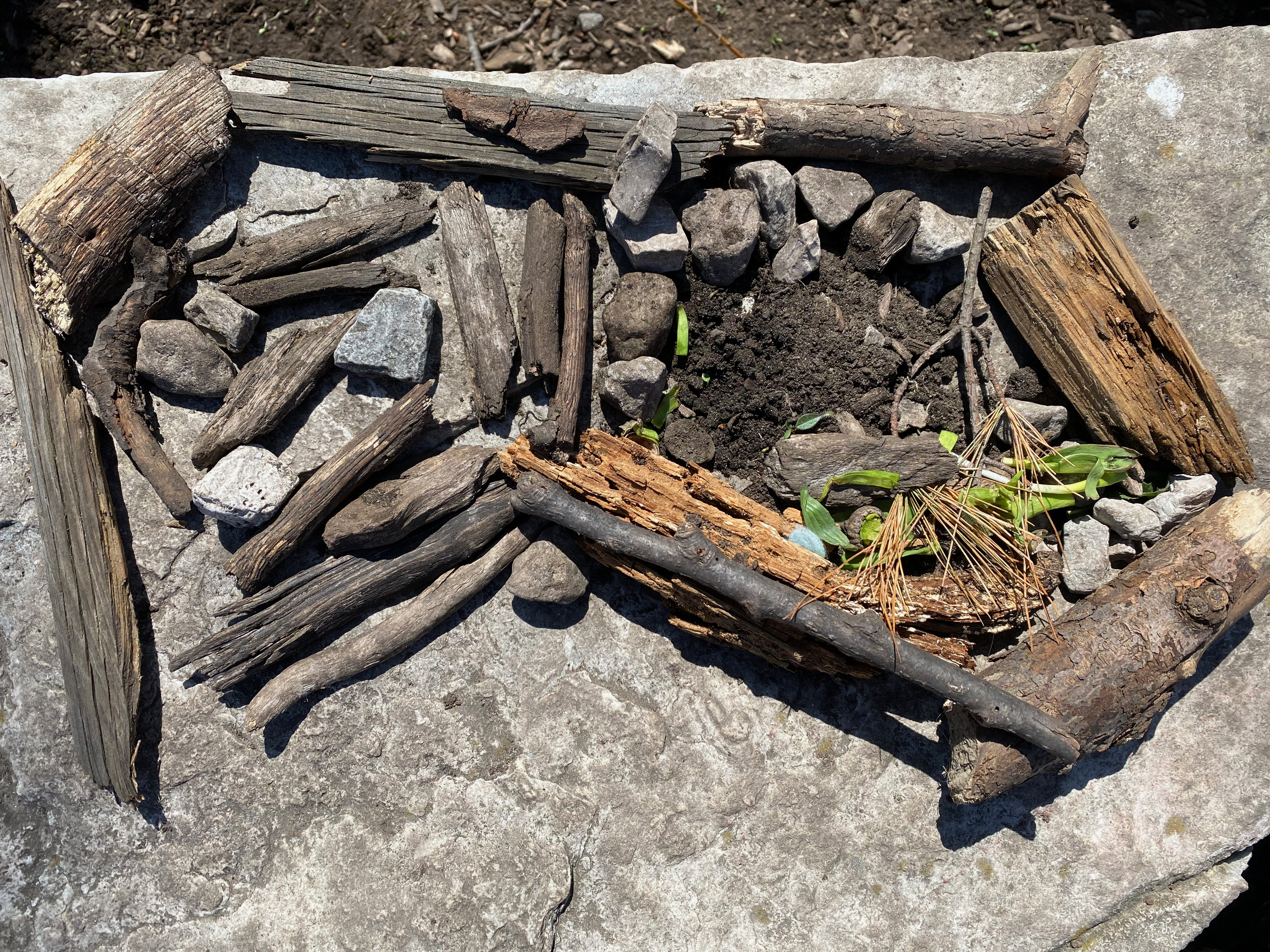
Each day the children would return to the mini houses and continue their work, focused on creating the most aesthetic and functional space for whatever creature they had found that day.  
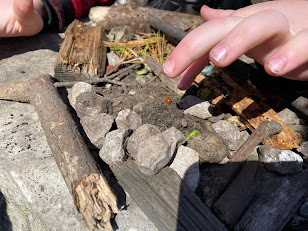
   There are four steps to the design process for young children. When I reflect upon the children's garden engineering of the habitats I observed these steps in action:

Identifying a Problem - the children felt the insects needed a home
Imagining and Planning - children brainstormed that natural loose parts could be used to design and construct a habitat and engaged in conversations about what this might look like
Creating - children spent time over many days creating different homes for different living creatures
Improving - children revisited their creations each day and revised their plans when necessary
after they noticed new things about the insects or had engaged in conversations with peers
  
What might seem like a playful activity outdoors has the potential for much rich learning using an engineering mindset. When children create habitats outdoors they are participating in rich math exploration in action including:
 
-discussing, designing, and refining a plan
-classifying and sorting materials by common characteristics
-considering proportion as they build for specific insects
-using spatial reasoning and design as they manipulate materials
-thinking about measurement as they incorporate area and perimeter into their 'house' or discuss the attributes of materials (e.g., the heaviness of rocks, the length of sticks)
-counting materials gathered and used in the design process
-naming colours and shapes that emerge in their work
-using positional language to describe their creations
-thinking about balance and stability as they assemble materials 
-incorporating patterns or symmetry as they create aesthetic structures
 
It's amazing to notice and name the rich math learning that emerges in children's self-directed play outdoors. Taking photos and videos of the work, engaging in discussions with kids about their play, and reflecting upon the experiences can help educators make this rich learning visible to others! Sometimes nature is the most effective math teacher of all!

Sunday, October 23, 2022

Mother Nature as Mathematician: Learning Outdoors without Commercial Materials

“In every walk with nature, one receives far more than he seeks.”

John Muir


In our program we spend at least one hour outside each day exploring our play yard and interacting with nature rain or shine (excluding dangerous weather). Although we are fortunate to have an ample collection of materials to use, there are many days that we bring nothing extra outdoors with us. We ask children to interact with the world around them and spend time immersed in nature. Challenged to create play opportunities using only natural elements encourages children to pay close attention to what the world offers and they often wonder about objects and phenomena that they might not otherwise have noticed (e.g., the strength of the wind, an interesting insect, the size of leaves). It's also a great way to encourage children to become resourceful and use their imaginations. In land-based learning knowledge is shared and a respect for nature is encouraged.

 
Curious about the size and colours of leaves, the children were encouraged to gather a leaf collection on a stick. This helped them practice fine motor skills and they were eager to quantify the leaves they collected.
 
Much of what the children discover is mathematical. Mother Nature tends to be a beautiful mathematician offering a variety of sizes, shapes and patterns in natural objects. Children are curious as they describe, classify and sort what they find into collections. How many times have you found an assortment of rocks in a child's pocket? Being outdoors without toys also facilitates amazing risky play and children are eager to quantify their achievements (e.g., how fast/high/far can my body move compared to my friend's?). Risky play is an amazing way to encourage math learning in kids (see this post for more information). 
 
I'm often asked by others how children become so attuned with their surroundings and invested in their work in the natural world. I believe that it is because we spend so much time outdoors that children are so immersed and excited. As educators we act as play partners with the children and explore together. We use a 'notice and wonder' thinking routine where we think aloud about something we are curious about (e.g., "I see the leaves swirling in a circle on the pavement. I wonder what is causing them to move that way.") and model for children how we might go about exploring this further (e.g., "I think I'm going to record what I see using my device so I can watch the leaves moving again and think about why this is happening."). I also really enjoy standing away from children and just listening to their observations and theories about the world around them. The things they notice, and the questions they ask, provoke some of the deepest math learning experienced in our program. Children are deeply invested in their work. 
 
Since children become so aware of their surroundings, they are often quick to notice changes. The landscape evolves as the weather and seasons shift and these patterns offer many mathematical learning opportunities. Knowing the land so well also means that children become invested in caring for it and understanding how and why we need to be sustainable learners. 

The children were proud of their abilities to balance on a wiggly log. They decided to count as they stood on it, and see if they could beat their 'time' with each subsequent try.

 After finding a pair of ladybugs in the grass the children created a 'home' for them using natural loose parts. Interesting discussion occurred regarding what the ladybugs would need in their home, and what size would be best for each feature (e.g., bed, kitchen).

 The children enjoyed picking dandelions one spring day. We challenged them to see who could find the longest and shortest stems. Without measuring tools the children had to figure out how to fairly measure each stem. 

Although we are lucky to have a lovely, large play yard to use, exploring nature can happen anywhere. Even a puddle has the potential to spark children's imaginations and facilitate rich discovery and discussion. If your space is limited, consider going on nature walks around the community in which your school is located. Perhaps a trail or garden can be visited nearby. Field trips are also a fun option (e.g., orchard, farm). Bringing natural objects into the classroom is another way to help children connect with nature (e.g., pumpkins, sticks, acorns) and continue their explorations after outdoor time has ended.
 The children marvelled at the circumference of the large trees located near our school. We asked them how they might measure and compare the trunks in order to find the largest one.

 After making snowballs on a winter day the children thought it would be fun to see how many they could stack inside angled branches of a tree.

 
Prints in the snow always spark rich conversation about who (or what) might have visited the yard. 

 
Dew drops on a web discovered early one morning led to fascinating theories about how strong a web must be. 

 
Finding fossilized rocks and identifying shapes and patterns leads to some great imaginative thinking about what might have lived within the rock long ago.
 
Some tips for getting started:
  • Learn more about your local habitat so that you can facilitate discussions with children regarding interesting objects and events that occur in your area (e.g., native plants, migration patterns).
  • Go on guided walks to help children practice using their senses to observe the world around them. Scavenger hunts focused on the senses can be fun and spark inquiries (e.g., listening walks, bird hunts).
  • Start collections of objects found outdoors that can be displayed in classroom (e.g., feathers, seeds, dried flowers).
  • Provide challenges for children that will help them interact with natural materials (e.g., Can you build a house for the ladybug? Can you find and order ten sticks from largest to smallest?).
  • Use tech to support your work outdoors. There are many great apps that can help you identify leaves and insects. Posting ideas and questions on social media can facilitate discussions with others from different areas.
  • Take photos and videos of children's work outdoors and share this for reflection during a consolidation circle. Use the discussion to help spark future work outdoors (e.g., Today we found many flower patterns in the garden. I wonder if there are patterns on other living things in our yard.).  
It's rare that we don't visit the outdoor space. On the days when it is too stormy or cold to head out, we often find children watching the outside world through the windows. In a time when children may suffer from a Vitamin N(ature) deficit, spending unstructured time outdoors without the distraction of toys or teacher-prepared materials may spark a deep love of nature and facilitate rich math learning that would not be possible otherwise.

Wednesday, September 14, 2016

Exploring Cicadas

Today two of our children brought a very exciting surprise to school - perfectly preserved cicadas! It was fascinating to see them perfectly intact, even with their beautiful wings visible!
 
 
At circle we passed them around and described what we saw.

 
It was so interesting to see the cicadas. Some friends were even brave enough to touch one.


At play time we displayed the cicadas on a table along with magnifying glasses to help us explore them and some writing tools so we could carefully record our observations.

 
The children were quite captivated and it was interesting to listen to their conversations. Many overcame their reluctance and touched the cicadas. Others noticed just how interesting their legs and wings were when made large. 


A few friends tried to draw what they saw. We reminded the children that scientists make careful observations and then record their ideas using pictures and words. It was thrilling to see this authentic moment of literacy happening as a result of something interesting found outdoors! Tomorrow we will add some nonfiction books to our centre so the children can see what other insects look like up close.

Families, we always welcome interesting 'treasures' that you find outdoors and love to encourage the children to bring things for us to explore at school. Thank you for your support of our children and program!


Wednesday, April 27, 2016

Exploring Insects

We have noticed many insects in our play yard. The children spent time finding them and gently catching them so we could explore them up close. 


We placed them in separate Petri dishes...


...and placed them on our light table for observation up close. 


Because the insects were contained reluctant children could safely explore without fear of the insects escaping or touching them. 


The light also illuminated the insects so it was easier to see their body parts. 


Wednesday, April 20, 2016

Honouring Children's Questions

We often spend sunny days exploring our beautiful yard. There is a rock garden on the side of the school that the children love. The rocks are challenging to walk through as you need to balance and climb on parts of the path, and there is interesting landscaping that is awaking from its slumber now that the days are turning warm.


In one of the bushes we noticed a peculiar object - it reminded the children of our Painted Lady cocoons we observed last year.


 During circle we invited the children to guess what the object might be. They had some excellent connections to past experiences that were shared to support their opinions. We created an idea web to organize our thoughts.


One of the children suggested we tweet our followers the picture to see if any other class or teacher knew what this object was...


...and immediately 10 of our followers shared their opinion that it was a preying mantis egg sac! We researched this to confirm and then explored how to keep the sac safe in our room for further exploration. We gently removed a branch from the bush with one sac and placed it in an aquarium for observation. Stay tuned!


Fighting Island

We spent a gorgeous Monday enjoying Fighting Island this week. It's always such a fantastic trip as the children get to explore animals in a local habitat.

Fun on the bus...


Waiting for our boat across to the island...


Exploring natural artifacts...


We came across a snake almost right away and the children were so excited to see it up close!


Finding animal tracks and making plaster prints...


The pond was alive with turtles and frogs enjoying the gorgeous spring weather!


Scooping for wildlife...


Crayfish holes!


Exploring patterns on natural treasures!


Insect hunting!


A big thank you to all the family members that we had join us that day! We couldn't have done the trip without you!

Related Posts Plugin for WordPress, Blogger...