Showing posts with label water. Show all posts

Thursday, November 4, 2021

10 Math Concepts that Children Learn from Puddle Play

"Childhood is that state which ends the moment a puddle is first viewed as an obstacle instead of an opportunity."

K. Williams


Puddle play is an incredibly rich learning activity that many children enjoy. Spending time outdoors exploring many natural elements helps children recognize that there is no such thing as bad weather. There is beauty and wonder to be found in every aspect of nature. Sometimes in early childhood education we need to help our families and school community understand the authentic learning that can happen when children play with sensory materials like puddle water outdoors. Demonstrating the meaningful math connections that emerge in this type of play can build support for outdoor exploration and learning. Sharing this through regular communication including documentation can be incredibly helpful in cultivating positive partnerships and support for messy play outdoors.

Here are ten math ideas that can be introduced and strengthened when children play in the puddles:

1. Patterning

When rain drops fall into water their impact disturbs the surface tension of the water. The ripples spread outward from this impact point. This reaction forms concentric circles which are two or more circles that have the same center point. Each subsequent circle is larger than the last, creating a growing geometric pattern for children to explore.

2. Opposites (Float and Sink)

Children love to place objects in water and experiment with what happens to them. A favourite outdoor activity for our children is to place many different objects in water and see if they float or sink. An object's density determines whether it stays above or below the water. The object will float in the puddle if it is less dense than the water. If it sinks, it is more dense than the water. 

 3. Temperature

The temperature of puddles can vary depending on the ground and air temperature. Children enjoy feeling the water with their hands and describing how hot or cold it seems. An engaging activity is to provide kid-friendly thermometers to children and challenge them to read the temperature of the different puddles in the yard. Are the larger ones a different temperature than the smaller ones? Does the temperature of a single puddle change over the course of the day? Ask children to generate theories about why this is happening.

4. Measurement

Sensory experiences are vital for children's growth and development. Most children love to play in mud using cooking items and utensils. A favourite activity for us is to use the puddles for water play. Not only do we not have to worry about a wet floor indoors, children are captivated using cups, spoons, funnels and bowls to collect the water. Challenge children to measure how much water they can collect. Ask them to see if they can empty a puddle and calculate how much water it had altogether. 
 
5. Cause and Effect
Cause and effect activities help children realize that every action they take has a reaction. When children jump in puddles, the water splashes. Experimenting with cause and effect helps children play with variables that can control the reactions in different ways. For example, and bigger jump in the puddle usually results in a larger splash of water. Children can change their actions (e.g., increasing movement, decreasing movement, modifying direction) and observe the results.

6. Comparison
Puddle water can look many different ways. Some puddles are clear while others are muddy and filled with debris. Children can travel the yard and observe/describe what they see as they compare puddles to one another. They can also experiment with the different materials and observe the reactions that occur. For example when water is added to soil, the soil appears a darker colour. This occurs because wetter soil has less oxygen compares to drier soil. Some puddles are so saturated with dirt that there is a layer of mud that settles on the bottom and a layer of water that has risen to the top. As children explore different puddles they can notice and name what they see, and compare the properties of each to one another.

7. STEAM (science, technology, art, engineering, art, math)

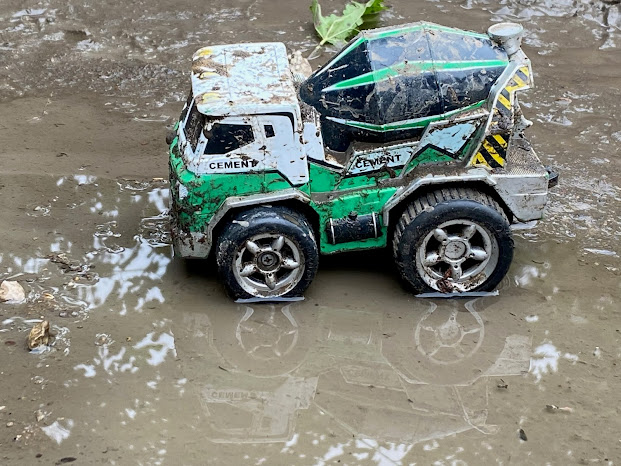
STEAM challenges are highly motivating for children. Puddles offer many opportunities for educators to ask children to design and build an object to be used with the puddles. A favourite in our classroom is to ask children to create a puddle boat from loose parts (e.g., wooden craft sticks, cardboard, foam, aluminum foil) that floats. Another highly motivating construction activity is for children to build a bridge over the puddle for the mini cars to use to cross the puddle. 

8. Counting

In our yard we often have very large puddles when the rain falls due to the slope and drainage of the playground pavement. A fun activity is for children to crowd in and count how many can fit in the area of the puddle. Great math questions emerge in this activity - can the same number of children fit in the different sized puddles in the yard? How many boots altogether are in the puddle? Can we count the boots by 2s?

9. Reflection
 
Water is a reflective surface. When the water in a puddle is still, the surface is flat and can easily reflect light. If the wind is blowing and ripples appear, the reflection can become distorted. The harder the wind is blowing the more distorted the reflection appears. This type of reflection also offers an exploration of symmetry as children can identify the line of symmetry and see how each side appears. This symmetry is often curious for children who notice that the reflected side appears lighter/faded than the real object. Children can experiment with reflective symmetry by placing and moving different materials into the puddle and seeing the result.

10. Area and Perimeter

The size and shape of a puddle can often inspire conversation about its area and perimeter as children wonder about how big or small it might be. Sometimes we will use loose parts to help us measure (e.g., How many rocks fit around the outside of the puddle?  How many leaves can float on top of the puddle?). The distance across a puddle is also interesting to measure as children leap across the puddle and measure how far they've jumped, or build bridges to help the mini cars cross the puddle.
 
What other math have you explored in the puddles? Tweet me and share your awesome ideas and experiences! @McLennan1977

Looking for a resource to read with kids to support authentic math play in the puddles? Check out my new book Puddle Math: See, Think and Wonder! 


Sunday, September 30, 2018

Puddle Play - Rethinking the 'Math Classroom'

We are always looking for opportunities to head outside and enjoy the weather, even when it might be a little wet or cold. Last week our area enjoyed quite a bit of heavy autumn rain. The children spent much of the morning peering through the window and marveling at how much rain was falling. After a few hours they noticed a giant puddle forming in the corner. As the rain continued to fall and the puddle grew, the children became concerned that their outdoor play time would be hampered by the rain.

Fortunately by the early afternoon the rain tapered and the children were able to head outdoors. We are lucky to have a class set of rain boots purchased by the school parent council for use in our outdoor classroom. This way children can enjoy playing in our school yard, even when they might forget to bring their boots to school that day. We are always prepared and the children ready to explore the world outdoors. Even the giant puddle would be no problem that day!

The children scurried outside after eating lunch - many wearing mismatched school boots because they couldn't get them on their feet fast enough because they were so eager to explore the water.


As I approached them I was amazed by the authentic math talk developing in this natural and authentic learning environment. As I listened into their conversations I overhead children wondering with each other about amazingly big math ideas...

How many children could fit in the puddle?  Did each person's feet have to be touching to be counted? Did children who were jumping in and out of the puddle count too?


How deep was the water? How much water was there really in the big puddle? Could it fill a bath tub? How could it even be measured?


Who could make the biggest splash? How would they even judge how big the splash was? Could it be measured? Was the biggest splash the one that soaked the most children standing nearby?


Could the water be used to make soup? How much water was needed in the recipe? Would anyone even want to eat mud soup?


How much water was in one's rain boots after a big splash? How long did it take to dump it out? How did all that water get in there in the first place?


How much more water was needed to cover the stump? Was the stump floating or sinking in the water?  How tall was the stump? What if it rained more...would the stump be under water?


How long would it take to run across the puddle? Who could run the fastest over the water? How could we measure and record the puddle races?


The children were making connections between their puddle play and math in the world around them. The questions they were posing about their experiences in the water were meaningful to them, supporting and strengthening their productive disposition towards math. As an educator involved in their play, I was able to listen to their questions and facilitate conversation and critical thinking about the big math ideas. How could we figure out who could make the biggest splash? What experiences did the children have measuring the size of something irregular. What tools and resources were available to help support this inquiry? Could technology play a role? Would children be interested in revisiting these math questions at a later time or would their interest only occur when playing in the puddles?

As the children and I engaged in conversations about their questions they were developing adaptive reasoning skills - this is the capacity for logical thought, reflection and justification in their math thinking. As children connected what they were observing and experiencing in the puddle play to their own unique experiences and ideas, they were engaged in rich learning as they reflected upon and justified their questions, ideas and strategies to solve the puddle math problems.

Even though many of the children's questions were not answered, the purposeful outdoor math exploration encouraged children to develop a strong conceptual understanding of a variety of developmentally appropriate math topics related specifically to our curriculum including measurement, counting, capacity, classification, time and quantity. I was able to support their conversations and provide suggestions and strategies in the moment. I became a play participant together with them by playing in the puddles myself.

What had originally looked to be a damper on our outdoor fun turned into a complex and layered opportunity for rich math thinking during an activity that most children love to do - explore the rain. It just shows that math can happen anywhere, anytime, when we are willing to rethink what the 'math classroom' should look like.

Saturday, April 29, 2017

The Power of a Puddle

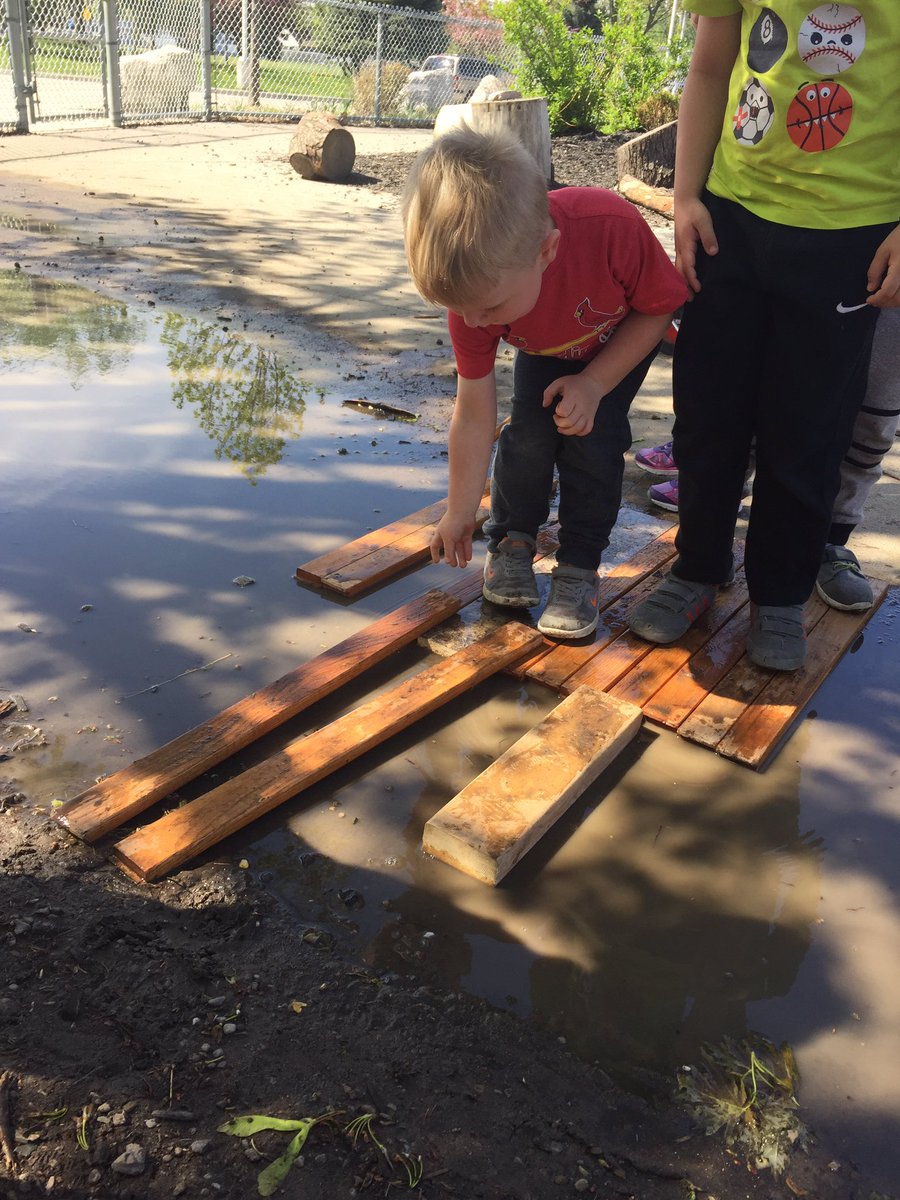
Our children are drawn to water. This past week we had a lot of rain and it created a giant puddle in the playground. The children were curious about how to cross the puddle. It was too big and deep to skip or jump over and they needed to cross it in order to get to the other side where their stumps and other favoured areas were.

One child decided to try using some of our loose building parts. He gathered many pieces of wood and laid them starting from one edge of the puddle. As he placed them side by side he observed the edges of the wood to see if the puddle was deep enough for the wood to sink into.

"I don't know if the wood is high enough. If the puddle is deeper than the wood, then this won't work."

I observed him as he placed the wood and then stepped on each piece, watching to see if the water rose higher then the wood. I noted the complex math and problem solving that had emerged in his work. He was considering the depth of the water and whether it was deeper than the wood was tall.  After a few minutes some friends joined him.


As each piece was added the children continued to test their design to see if their feet stayed dry.

"We're making a bridge so we can cross!" 


The children continued to lay the wood side by side. When it ran out, they were perplexed.

"We don't have enough to finish the bridge!"

They stood around for many minutes, stepping on their bridge, counting the pieces that were side by side, and then looking around the yard for any loose pieces of wood they might have missed.

"I know! Let's take half of the pieces and move them so that we can make the bridge longer! We'll just have to walk one at a time instead!"

The children realized that if they narrowed their bridge they could double the length by moving the pieces in different positions. The amount of wood they used hadn't changed but their problem solving allowed them to complete a workable way of crossing the water.


 Success! The children children spent the majority of their outdoor time racing one by one across the big puddle. They even tried driving the tricycles across it - the process of experimentation in doing so led to some amazing conversations about the weight of the bike and if the wood would hold it, the position of the wood pieces and if they would stay in place while being driven on, and how fast the bike could be driven across without the pieces shifting and becoming ineffective.


The outdoors is full of possibilities for children to mathematize their play; this authentic experience of crossing the puddle motivated the children to engage in robust math that incorporated measurement and problem solving!

Monday, October 3, 2016

Water Table Retell

Mrs. Wishy-Washy is a favourite character to explore at the beginning of the year, especially because the texts are so easily read and accessible for the children. We read two of our favourites today. 

We asked the children if they wanted to explore the text further. After a discussion as to who the characters were in the books, the children set to work around the room finding all the animals that were in the books. They decided that they each wanted to role-play being Mrs. Wishy-Washy.


We thought the water table would be the perfect place to retell the events of the text. I laminated pages from the story and attached them directly in the water table for reference with heavy duty clear tape.


The children used a variety of brushes to wash the animals and retell the text as they went along.


It was so much fun to hear the children singing "wishy-washy, wishy-washy" and pass the animals and different scrubbers back and forth!


Having the text directly in the water table supported literacy by encouraging the correct sequence of events and helping children connect the written words to the pictures.


Some friends were even inspired to revisit the big book and copy the pictures so they could have their own copy of the text!


Monday, June 27, 2016

Exploring Colour and Light

"He who knows how to appreciate colour relationships, the influence of one colour on another, their contrasts and dissonances, is promised an infinitely diverse imagery."
Sonia Delaunay
 
 
Exploring colour is something our children have revisited over and over this year. They have spent time wondering about the diverse shades of nature in each changing season, appreciated the nuances of shades in natural and found treasures, and used light and colour to create their own amazing art both in and out of the classroom.
 
Last week we introduced the overhead transparency machine and the children were consumed with creating transient art using a variety of interesting loose parts. In order to celebrate the last week of school we hoped to take their interest in light and projection and combine it with colour mixing for one final artistic and scientific exploration before summer vacation. We wondered what they would do if the primary colours of water were presented to them on the overhead machine. (In order to do this safely, an adult was always present at the centre to support and encourage. The machine itself was covered with a plastic sheet and a vent in the plastic was left open for the fan vent).  
 

The children were immediately captivated; with the light dimmed in the room their attention focused on the illuminated tray and the interesting projection that was cast on the wall. The water in the tray danced as children brushed up against the table, clambering to get close and have a look. The reflection mirrored on the wall and the interesting way the water looked caught many children's attention.
 
"Why is it moving like that?"
"It's jumping; it's happy to see us."
"It's happy to have colour in it. The colours are pretty."
"I'm going to make more pretty colours. I'm going to mix them together."
"We need droppers to do this!"
 
The children have become quite proficient using droppers in their water play. Droppers are an excellent tool because they encourage persistence as children learn how to use them efficiently and also strengthen fine motor skills in little hands and fingers. 


We used a clear tray (donated by a parent who worked in a store that sold kinder eggs) filled with water. One spot had red food colouring, one had yellow and one had blue. The children used the droppers to collect the primary colours and move them from spot to spot on the tray. As they mixed new and interested shades emerged and were illuminated by the light underneath.
 
 
It was interesting to observe the children collaborate as they created new shades ("You need to add some blue if you want that to be a dark purple." "I like that colour - golden orange - it looks like your shirt.") and listen to their rich art talk. They vividly described the different shades of beautiful colours, named them (e.g., golden orange, sky blue, dandelion yellow), and explained how they created each using math language ("If you want to create golden orange you need to add three drops of red, three drops of yellow to make it equal and then add a drop or two of brown."). The process of what was being created was more important in this experience than a final product. When the tray became filled with colours and most had turned brown from overmixing, it was cleared and fresh water and new primary colours were added.


The overhead machine worked as a light source to illuminate the tray from below and also projected the creations on the wall. Because the tray was clear the different shades of colour were projected onto the white board and cast an interesting hue to that corner of our room. Children who were playing at centres nearby would often stop to watch as new colours were projected - it was interesting to hear their observation as well as they watched the different drops of colour get added to the tray and then the new colour emerged.
 
 "Look! She just added blue to that but it's turning green!"
"I like that pink one. Pink is my favourite."
"I'm going to go play there next. I like to mix colours too!"


Anytime invitations can be offered to children that integrate unique curriculum expectations in unexpected ways, learning becomes magnified as children use previous experiences to form a base of knowledge both from which to draw and as inspiration for next steps. We love combining art, technology and science into captivating provocations that help children create transient artwork. These precious fleeting moments of beauty and wonder shape our space and make learning fun! The overhead machine has proven to be an indispensable piece of technology for our room - leave comments below to tell us how you have used it in your space!


Tuesday, March 29, 2016

Bubble Prints

A favourite, fun activity to explore colour mixing and print making!

Use an individual straw to blow big bubbles!


When the bubbles are big enough stamp your paper. 


Lift to reveal your print! Repeat with all the bubbles to mix colours too!


Related Posts Plugin for WordPress, Blogger...