Showing posts with label fine motor. Show all posts

Sunday, October 26, 2025

Spider Catapults


Spiders continue to be a popular topic of exploration in our classroom! To infuse this interest with math and fine motor work we introduced clothespin catapults to the children this week. Wooden catapults are easily made by securing a clothespin to a steady base (like a wooden block) with an elastic. 

They require concentration and perseverance for children to operate. As children become more confident using them they are able to use strategy to aim the catapult in a specific direction or apply pressure to further or reduce the launch power. 

Small plastic spiders (ours were from the local dollar store in the Halloween section) are light and perfect for playing with. We offer 'webs' made from wrapping a shallow basket with yarn. Children are encouraged to fire the spiders into the webs.


Once children master launching the spider into the web additional math tools can be offered to enhance the experience. A five or ten frame or hundreds chart are easy tools for children to use when tracking how many spiders they have landed in the webs.   


Additional targets can be provided for children to play with (e.g., alphabet chart, number chart, printable web with points). The possibilities are endless! 

Sunday, December 3, 2023

Ten Easy Holiday Math Activities

The holidays are such a lovely time of year to spend with children! However the last few weeks before the winter break can be hectic. Here are ten easy to assemble activities that can infuse playtime with math by capturing the magic of the season! Many of the seasonal loose parts included in these photos were found at the local dollar store. Enjoy!

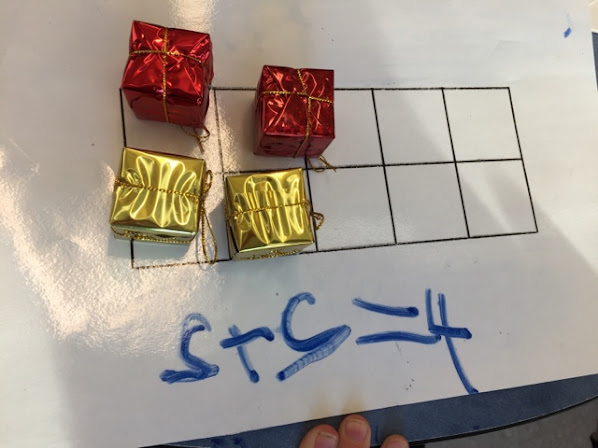
1. Count the Presents - offer children mini presents (or other seasonal trinkets including bells or ornaments) and number cards. Encourage children to match the corresponding number of objects to the cards. Children can also place presents on a laminated ten frame and write a corresponding addition or subtraction sentence using a dry erase marker.


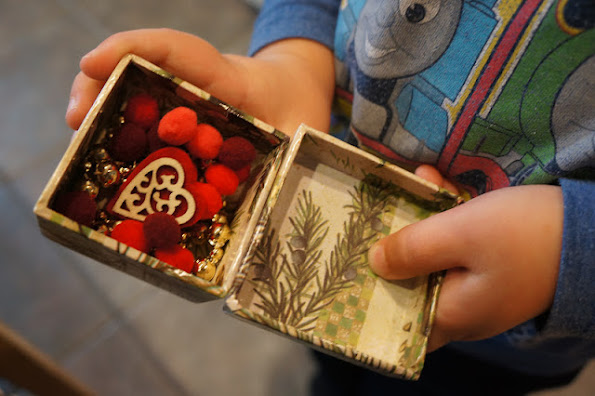
2.  Holiday Sensory Bin with Mini Boxes - fill a sensory bin with seasonal trinkets and treasures. Add mini present boxes and encourage children to fill the boxes with different objects. Children can then use a hundreds grid to count how many objects fit in each box!


3. Catapult the Gingerbread Man to Safety - help mini Gingerbread Men land to safety over the river by firing them using catapults made from clothespins attached to blocks using elastics. This activity works fine motor muscles too!


4. Cookie Cutter Bell Count - display a collection of bells in a tray with a variety of seasonal cookie cutters. Challenge children to fill one cutter with bells and use a hundreds grid to count how many it holds. Which cutter holds the most? Least?


5. What's Inside the Presents? - fill different holiday boxes with loose parts. Encourage children to shake one at a time and estimate how many objects might be inside. They can then open the box and spill the objects out. Each object can be placed on a number grid and counted.

6. Fill a Tree with Trinkets - children can explore the concepts of area and perimeter by filling or outlining wooden trees (or other seasonal place mats or shapes) with a variety of bead strings, ribbons or small objects.

7. String a Pattern - secure a number of green pipe cleaners to a sturdy cardstock or cardboard base in the form of a tree. Encourage children to string beads to 'decorate' the tree using different patterns. Children can also count how many beads they use for each section.
 

8. How Many Elastics? - children can wrap a number of elastics around cookie cutters until they are filled. Encourage children to count how many times they wrap each elastic. For an added fine motor challenge have children remove the elastics one at a time.


9. Gingerbread House STEM Challenge - provide children with magnet shapes and challenge them to build an intricate gingerbread house. Ask them to search the room for various loose parts that will attach to the magnets and 'decorate' the house (e.g., here the staples in mini bows attract to the magnets).

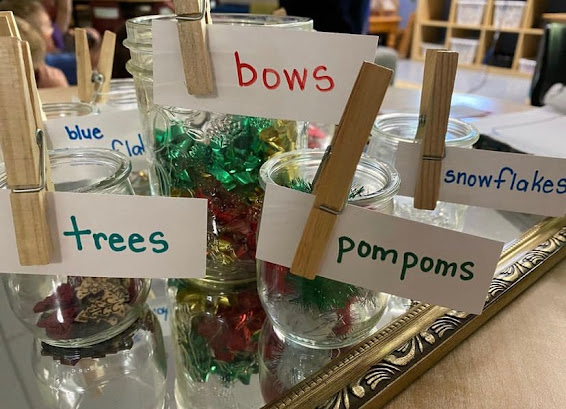
10. Holiday Guessing Jars - fill glass jars with seasonal loose parts. Encourage children to estimate how many objects are in each jar. The objects can then be shaken out and counted using math tools such as number grids and ten frames.


Looking for a book to support holiday math learning? Check out my book Holiday Math


Wednesday, September 21, 2016

Mirror Writing

We always love to have engaging literacy activities available for the children to explore. Motivating them to draw and write is fun when we use exciting materials like mirrors and dry erase markers. The markers wipe off so easily and the reflection and unique surface (and experience) of writing on a mirror is very interesting for young learners.

It was interesting to see what the children drew. Many noticed their reflection and drew that. Others practised printing their name.


We noticed counting happening too as the children drew their own five and ten frames!


Others drew interesting designs! Whatever it was that was drawn, the conversation around the table was lively as many children squeezed in to share the fun tools!


Monday, September 19, 2016

What's Inside?

Last week the children were very interested in seeing what they had each brought for snack. There were some great conversations happening at the snack centre about what the food looked like, smelled like, and tasted like.
 
Today I brought in some different kinds of squash. I wanted to extend the children's interests and thought this would be an engaging way to do so.
 
First we passed the different squash around the carpet. The children were encouraged to use many senses to explore; what did the squash feel like (exploring textures), how heavy was it (exploring measurement), how did it look (noting similarities and differences). This was also a good activity to reinforce turn taking.


During playtime the children were invited to explore the inside of the squash. This lead to many interesting math discussions - equality (2 halves of a squash are the same as 1 whole), estimation and counting (how many seeds are inside), measurement (which squash is biggest? which has the biggest seeds?) and shape (some squash are round and some are not). The children also practiced their fine motor skills as they used the tweezers to pick the seeds out. This took a lot of patience and perseverance because the seeds were slippery and stuck in the squash guts!


Families we are hoping to cook some squash for the children to taste. If you have any you are able to donate to our room, we would appreciate it! Also, if you are interested in volunteering to help with this activity, please let us know! Thank you!


Monday, June 27, 2016

Exploring Colour and Light

"He who knows how to appreciate colour relationships, the influence of one colour on another, their contrasts and dissonances, is promised an infinitely diverse imagery."
Sonia Delaunay
 
 
Exploring colour is something our children have revisited over and over this year. They have spent time wondering about the diverse shades of nature in each changing season, appreciated the nuances of shades in natural and found treasures, and used light and colour to create their own amazing art both in and out of the classroom.
 
Last week we introduced the overhead transparency machine and the children were consumed with creating transient art using a variety of interesting loose parts. In order to celebrate the last week of school we hoped to take their interest in light and projection and combine it with colour mixing for one final artistic and scientific exploration before summer vacation. We wondered what they would do if the primary colours of water were presented to them on the overhead machine. (In order to do this safely, an adult was always present at the centre to support and encourage. The machine itself was covered with a plastic sheet and a vent in the plastic was left open for the fan vent).  
 

The children were immediately captivated; with the light dimmed in the room their attention focused on the illuminated tray and the interesting projection that was cast on the wall. The water in the tray danced as children brushed up against the table, clambering to get close and have a look. The reflection mirrored on the wall and the interesting way the water looked caught many children's attention.
 
"Why is it moving like that?"
"It's jumping; it's happy to see us."
"It's happy to have colour in it. The colours are pretty."
"I'm going to make more pretty colours. I'm going to mix them together."
"We need droppers to do this!"
 
The children have become quite proficient using droppers in their water play. Droppers are an excellent tool because they encourage persistence as children learn how to use them efficiently and also strengthen fine motor skills in little hands and fingers. 


We used a clear tray (donated by a parent who worked in a store that sold kinder eggs) filled with water. One spot had red food colouring, one had yellow and one had blue. The children used the droppers to collect the primary colours and move them from spot to spot on the tray. As they mixed new and interested shades emerged and were illuminated by the light underneath.
 
 
It was interesting to observe the children collaborate as they created new shades ("You need to add some blue if you want that to be a dark purple." "I like that colour - golden orange - it looks like your shirt.") and listen to their rich art talk. They vividly described the different shades of beautiful colours, named them (e.g., golden orange, sky blue, dandelion yellow), and explained how they created each using math language ("If you want to create golden orange you need to add three drops of red, three drops of yellow to make it equal and then add a drop or two of brown."). The process of what was being created was more important in this experience than a final product. When the tray became filled with colours and most had turned brown from overmixing, it was cleared and fresh water and new primary colours were added.


The overhead machine worked as a light source to illuminate the tray from below and also projected the creations on the wall. Because the tray was clear the different shades of colour were projected onto the white board and cast an interesting hue to that corner of our room. Children who were playing at centres nearby would often stop to watch as new colours were projected - it was interesting to hear their observation as well as they watched the different drops of colour get added to the tray and then the new colour emerged.
 
 "Look! She just added blue to that but it's turning green!"
"I like that pink one. Pink is my favourite."
"I'm going to go play there next. I like to mix colours too!"


Anytime invitations can be offered to children that integrate unique curriculum expectations in unexpected ways, learning becomes magnified as children use previous experiences to form a base of knowledge both from which to draw and as inspiration for next steps. We love combining art, technology and science into captivating provocations that help children create transient artwork. These precious fleeting moments of beauty and wonder shape our space and make learning fun! The overhead machine has proven to be an indispensable piece of technology for our room - leave comments below to tell us how you have used it in your space!


Thursday, May 12, 2016

Beautiful Beading

We had some delicate treasures that arrived to the classroom as part of our "Beautiful Stuff" project this week! The children were captivated by the many beautiful beads, buttons, and jewelry that came in the brown paper bags. There is something so rich, so magical about beads and buttons. Perhaps it is because we don't know the story of how they came to be; whose outfit did they fall from, what travels have they had? We love working with them in our classroom. Today we displayed this treasure in baskets at our art area and encouraged the children to explore.
 

They noticed that there were many beautiful colours in the collection; we gave them plates and encouraged them to begin sorting what they saw. Soon the children had designated a colour to themselves and searched the collection for trinkets of that colour. It led to a very rich discussion about how colours have many shades, and depending on how you look at the colour, it might be considered a part of more than one group. For example there was a lively debate about whether a teal button belonged with the green or blue group.
 
Once the children sorted their objects we encouraged them to string them together using clear fishing line. The added challenge of working with such delicate materials is that the children had to persevere with stringing many beads and this helped strengthen their fine motor control.


Once the colour strings were finished we displayed them in our art window so they could be illuminated by the sun. They are a gorgeous, happy addition to this spot!
 

We also liked how this activity promoted mathematical thinking; children were using their knowledge of colour to sort the objects accordingly. They were also measuring to see which string was longer and how many times it could be wrapped around the branch.


"The only difference between an extraordinary life and an ordinary one is the extraordinary pleasures you find in ordinary things."
 
Veronique Vienne
Related Posts Plugin for WordPress, Blogger...