Showing posts with label literacy. Show all posts

Sunday, October 4, 2026

Welcome to our Reggio Emilia Inspired Classroom

Every material, space, and invitation tells a child: You are capable. You are curious. Your ideas matter.
For many years now I have been greatly inspired by the Reggio Emilia approach to early childhood education and have sought any source of information that I could get my hands on! When FDK was first introduced in Ontario many years ago I was thrilled to see that many of Reggio's beliefs were interwoven in the document and honouring children's interests through play, inquiry and documentation were highlighted. As educators who follow a standardized curriculum we have great flexibility in our interpretation and implementation of the expectations and this makes our role exciting and dynamic.

I believe in having a fluid, evolved space that continues to change to better reflect the needs of the children and support heightened understandings of explorations and inquiries as well as enhanced abilities in the various domains of learning. We want to support the whole child in developmentally appropriate experiences and integrate learning materials from centres in diverse and unconventional ways.  

Some of the Reggio principles that have guided our work include:
  • children are capable of constructing their own learning
  • children form an understanding of themselves and their place in the world through their interactions with others
  • children are communicators
  • the environment is the third teacher
  • the adults in the room are mentors and guides
  • there is an emphasis and importance on documenting children's thoughts and experiences
  • there are hundreds of languages of children and these are used to explore and communicate ideas and experiences

Our classroom door welcomes every learner and celebrates the diversity of our student population. Our classroom is a safe space for all.

A sensory wall welcomes children to the space along with a photo of staff and books to inspire those who visit. 

A light up sensory table is also near the door and offers children an opportunity to explore different materials in a fun way. The trellis behind holds photos and vocabulary cards related to the materials being explored to encourage literacy behaviours. 

Above each child's cubby is a recent photo and painted self-portrait. These change a few times each year (usually a new photo and self-portrait per term) to help show their growth. We like including a real photo to celebrate each child and love how the children use the language of art to represent their perception of self.  

 
Our families are also represented on a photo wall located on one of our bulletin boards. We request family photos at the beginning of the year and these are displayed together to help us recognize and celebrate the diversity that exists in our student population and help children feel represented in the space.
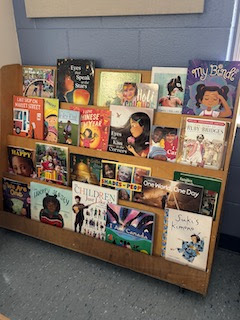
Our quiet reading corner has a collection of books and trinkets and treasures to explore. It's a comfortable area for children who want a quiet space to read or rest. The shelf contains a collection of books that explore diversity and invite children to explore new and familiar families and traditions. This helps children feel reflected in the learning space and also helps them learn about other ways of being. Comfortable seating, cozy pillows and a whimsical light invite children to stay for a while and read a book or chat with a friend.  
Our math shelf has many things available for children. We include mentor texts, learning props, and documentation to showcase and support our program. Math organizers including number lines and ten frames are also available. Children are encouraged to explore these materials during play time, and having them housed together makes it easier when we need activities to support small group learning.
Our drama centre changes based on the interests and requests of the children. Currently it is set up as a little 'house'.  We include many real objects and antiques for the children to use in their imaginative play; real objects communicate the message to children that they are capable of using these tools and make the context for the imaginary play very real and meaningful. Antiques make the space interesting while children learn to care for delicate objects.
This is our writing area. We like to have a beautiful, inspiring space for the children to use when they want to draw pictures or write with their friends. Books are available to browse for writing inspiration. A variety of writing tools including markers, pencils, crayons and coloured pencils are arranged by colour in jars. Baskets of different kinds of paper including index cards, mini books, stationary and colouring pages are arranged on the shelves for easy student access. Alphabet charts and vocabulary cards are also provided to support student writing. 
A survey is posted for children to practice reading and writing their names. At the beginning of the year it is educator created and as the year progresses children take over this responsibility. 
 
We are fortunate to have a very large wall of windows on one side of the space and this is where we house our science and art areas. The view outdoors often inspires children as they observe nature and enjoy watching the wildlife outdoors. 
 
An aquarium and plants provide opportunities for children to care for living things. 
A mini table offers a chance for children to explore objects or a concept in depth. Here it is presenting colours using a puzzle, matching cards, vocabulary and a read aloud. Later in the year it will change to reflect different seasons and interests the children have. 
Two sensory tables invite children to explore objects. The first is a large collection of natural shells collected over time. The round table changes with children's interests and usually holds sensory materials that can be manipulated including beans, pasta, sand and water. 
This shelf houses baskets of different materials to encourage play, building and exploration including mini animals, rocks, sticks, wooden frame corners and dinosaurs. Children can use these materials in the red imaginary play table to create habitats for small world play. 
A light panel encourages a different kind of play and exploration as different materials are rotated throughout the year (e.g., alphabet, shapes, leaves, flowers).
Natural objects are housed on this shelf for further exploration including shells, nests, feathers, fossils, jars with different natural loose parts, and animal cards. These are available for student observation and exploration. 
Baskets of science tools are stored here for use as needed including shovels, rakes, magnifying glasses and tweezers. 
The art studio is located in a sunny window of the classroom. The materials are aesthetically arranged to be accessible for children and also decorate the space. 
Materials are usually sorted and arranged by colour or type to help make the space aesthetic and functional. 
A table in the middle provided a space for children to work. Sometimes an educator provided invitation is prepared to help children practice using tools or specific artistic skills. Other times it is left open for student inspired work. 
Thank you for visiting us! We love feedback and to learn about your classroom and program. Please share in the comment section below or connect with us on Twitter @McLennan1977.

Sunday, September 20, 2026

Sprinking Literacy Around the Classroom

In our classroom I look for opportunities to add literacy prompts in different spaces. After noticing that children spent a lot of time observing the aquarium, I hoped to capitalize on this interest and transform it into a richer experience. Next to the tank I added vocabulary cards, writing tools, and a clipboard with fishy outlines.

Children were encouraged to observe the fish in the tank and draw what they saw, or decorate the fish outline however they liked. Some recalled the book The Rainbow Fish and created that character using the template. Others were interested in the vocabulary cards and spent time reading them and then copying the print onto their fish papers. 
 
To reignite interest, I am adding papers with snail outlines this week as there are also brightly coloured water snails in our tank. As the days pass I will observe our classroom and see where else kids gravitate and add prompts and tools to those areas to further the literacy experiences. 
 
Click here for free downloadable copies of the vocabulary and templates to add to your own aquarium area.  

Sunday, April 20, 2025

Bringing Math to Life: Sparking Joy and Curiosity through Play

On April 16, 2025 I had the pleasure of presenting my workshop Bringing Math to Life: Sparking Joy and Curiosity through Play for Early Childhood Investigation Webinars! With over 3000 registrants it was my largest audience to date! I absolutely love inviting educators into my kindergarten classroom and sharing the rich math learning that children experience through play and inquiry! Connecting with others drives my practice and inspires me greatly! A big thank you to all who attended! A copy of the presentation slides are available and can be found at this link.

The presentation was recorded and is available for viewing if you are interested in revisiting the information I shared, or did not have a chance to view it live. You can access it here:


Sunday, March 30, 2025

Overcome the Math Blahs to Reinvigorate Joyful Math Play and Learning

Looking for some professional development to help you refresh your math program using play and exploration? My next workshop is just for you! Join me with Early Childhood Investigation Webinars on April 16 at 2 pm Eastern Time. 


 Workshop description:

Do you feel less confident or enthusiastic about incorporating math experiences into your early childhood program? If so, you’re not alone! Many early educators feel more comfortable teaching language and literacy than math. This hesitation may stem from your own experiences as a young learner.

If you’re looking for inspiration to bring joyful math moments into children’s play and make this learning visible to families, this webinar is for you! Young children are curious about Math-related concepts and Math connects to every aspect of a developmentally appropriate practice in early learning. In this idea-filled session presented by experienced educator, researcher, and writer Deanna Pecaski McLennan, we’ll reimagine what math looks like in early childhood. You will explore ways to reinvigorate your practice with hands-on, integrated activities that excite and engage young learners based on Deanna’s real-life examples from her kindergarten classroom.

Discover how to create invitations for young children to explore math through art, literacy, and outdoor play. We’ll focus on designing learning spaces where children see themselves as mathematical thinkers, valuing their ideas in meaningful and authentic ways. Drawing from her extensive experience and her books, Deanna will inspire you to approach math with curiosity, take risks, experiment with new strategies, observe deeply, and collaborate with children as co-learners. Let’s transform the way we think about early math together!

In this workshop you will:

  • reflect upon your definition of math and where it can be found in the early childhood classroom
  • explore stories, vignettes, and photos illustrating how educators can develop learning environments that foster curiosity and wonder in mathematics
  • gather practical and easy to implement suggestions for how to invite children to engage in mathematical play throughout the day
  • learn ways to document children’s experiences to make math learning visible to families and the greater community

Sunday, February 2, 2025

Introducing Children to Strong Characters Using Diverse Texts

"Simply put, a book is both a mirror and a window. It can reflect the reality of a child’s life, allowing them to see the story of someone who looks like them, thinks like them, or lives like them. It can also help a child understand what it’s like for those who live different realities, whether that is a different racial background, religion, socio-economic status, or another facet of identity."

As an educator I have always tried to include diverse texts in my classroom. Whether they are provided freely and permanently to children in the cozy reading area or explored during whole and small group learning, I feel it is so important to help children learn about the amazing diversity in our world. I have spent my entire career collecting texts that help represent the diversity of the children in my care and introducing them to the beauty of humanity beyond their current life experience. I want children to feel seen, represented and appreciated in our learning space.  

A favourite character of mine is Peter featured in books by Ezra Jack Keats. Peter is a typical little boy - spending time exploring nature, connecting with his dog Willie, and feeling the changes that happen in his family when a new sibling is born. I appreciate the artwork created by Keats in the Peter books. They are a staple in my classroom.

This winter I was inspired to research Keats more deeply. I knew he authored The Snowy Day in 1962 but was surprised to learn that Peter is considered to be one of the most consequential children's book characters. Keats felt it was unfair for children to read books that only featured white characters so he created more diverse stories. How did I not know this? Peter is one of the first Black protagonists in a children's story that won the Caldecott award.

Looking back on past readings of The Snowy Day and Peter's Chair, I felt I may have glossed over Peter's Blackness, focusing instead on the plot of the book and its beautiful illustrations. I wonder how many of my students recognized Peter as Black, and made personal connections with him through the beauty of the text. This time I aimed to accomplish more. Before reading the story I introduced Peter to the children as one of the first Black characters in a book. We talked about representation and how before The Snowy Day Black characters were not prominent in books. We discussed how unfair that was and how important Keat's work would have been at that time. This was perfect timing because the children had just learned about the work of Alma Thomas in a previous exploration of concentric art work. During our research we learned Thomas could not attend school because she was Black, and was one of the first Black female artists to have her art displayed in a gallery. Exploring Peter consecutively with Alma Thomas helped give children context when thinking about social issues and racial discrimination. This made our 'text to self' connections to Keat's books richer and more attainable for children. 

I also intended to help children feel more connected to Peter. We used class discussions to think about him. How old did we think Peter might be? How were we alike? What might we say and do if Peter were a member of our class?


My teaching partner and I offered children STEM challenges to help design a new chair for Peter...

          
...and we explored the setting and actions he experienced using the language of art. The intent was for children to continue to think deeply about Peter as a character and feel connected to him beyond our initial explorations of the text.
         
As we continue to explore books that Keats wrote featuring Peter and his family, I am hopeful that children will think more deeply about him as a character and recognize that despite our differences we are really the same children at heart, and that all people have a right to feel seen, heard and represented in our classrooms and world. Digging into diverse texts, understanding their histories and connecting with strong characters is a step in the right direction.

Tuesday, January 21, 2025

Exploring Different Fonts of Numbers

Sorting numbers that are presented using different fonts is an effective way to help children understand that numbers can look many different ways. This activity requires children to sort and glue numbers onto a chart. A basket of cut numbers was offered to children along with a template/chart and glue sticks. Children were challenged to find as many of each different number as they could.

Want to try the activity with your students? Click here to get free printable font pages and the template. Happy sorting!


Related Posts Plugin for WordPress, Blogger...