Showing posts with label vocabulary. Show all posts

Sunday, September 20, 2026

Sprinking Literacy Around the Classroom

In our classroom I look for opportunities to add literacy prompts in different spaces. After noticing that children spent a lot of time observing the aquarium, I hoped to capitalize on this interest and transform it into a richer experience. Next to the tank I added vocabulary cards, writing tools, and a clipboard with fishy outlines.

Children were encouraged to observe the fish in the tank and draw what they saw, or decorate the fish outline however they liked. Some recalled the book The Rainbow Fish and created that character using the template. Others were interested in the vocabulary cards and spent time reading them and then copying the print onto their fish papers. 
 
To reignite interest, I am adding papers with snail outlines this week as there are also brightly coloured water snails in our tank. As the days pass I will observe our classroom and see where else kids gravitate and add prompts and tools to those areas to further the literacy experiences. 
 
Click here for free downloadable copies of the vocabulary and templates to add to your own aquarium area.  

Thursday, March 10, 2016

Adding Links

We used probability tools with links today to encourage and reinforce subitizing, adding, and measuring concepts with children. Players had a choice of using a spinner or dice. 

The purpose of the activity was to spin or roll in order to arrive at a number. 


Then the child added that many links to the chain. 


The more rolls or spins the longer the chain became!


Rich measurement talk emerged as the children noticed how long their chain was growing and compared their chains to see who had the most links (or longest chain)! The longer the chain, the higher number of links the child had which challenged them to work with large numbers. 


Some children even walked around the room with their chain, trying to find things that were the same length or to find things that were longer/shorter than it!


An added bonus? The work with links helped children practise and persist with fine motor skills!

Friday, December 4, 2015

Sidewalk Chalk Painting

Mixing equal parts cornstarch and water with food colouring creates a fun painting medium. 


The children immediately noticed how different the consistency of this was from regular tempra paint. 


They were fascinated by how quickly the mixture dried; sometimes before they had moved onto using a different colour on the same piece of paper. 


The interesting consistency of the paint also meant it could be drizzled and splattered onto the paper. We heard some great verb vocabulary at the table as the children experimented. 


The best part? The leftovers can be brought outdoors for painting the blacktop!

Wednesday, November 25, 2015

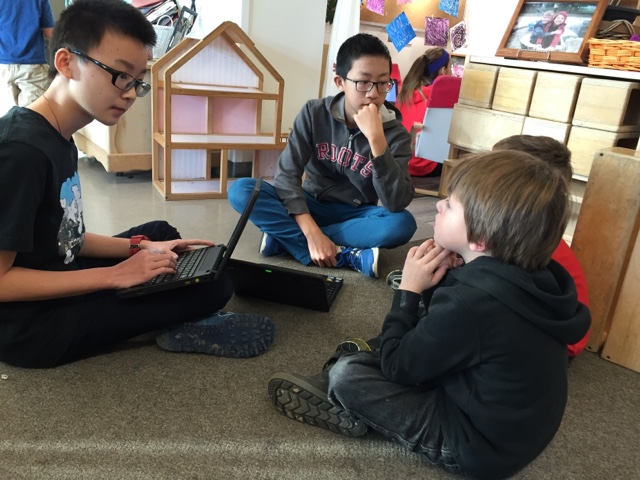
Generating Wordles with Grade 8 Technology Buddies

Wordles are 'word clouds' and are a great way to capture a lot of information on a subject in an aesthetic way. Today we met with the Grade 8 class to do some partnered technology work. Each kindergarten child shared what he or she loved about school and their Grade 8 buddy used this information to generate a personalized wordle. The Grade 8 prompted the kindergarten child by asking thoughtful questions about school in order to promote reflection and rich oral language.


Here are a few examples of the completed Wordles. It was amazing to review these with the children and see what they loved about school! Copies will be coming home shortly - why don't you consider engaging your child is a discussion about how they created the Wordle and what their favourite parts of school are?


Tuesday, December 2, 2014

Exploring Goop!

Our children love sensory experiences. Goop is corn starch and water with a bit of food colouring. Like Gak, it acts as both a solid and liquid and is fun to play with utensils that allow it to ooze. 


This experience really motivated children to use descriptive language and vocabulary related to both science and math. 

Tuesday, October 28, 2014

Autumn Wordle

Observing the changes happening outdoors is something that has been a great interest to the children. We have also been working on building inquiry-specific vocabulary. In an effort to embed some meaningful technology into our circle time, we encouraged the children to participate in a shared writing activity where we used a website called "Wordle" to create a collection of autumn words. 
 

The children suggested various autumn words and then we generated the wordle together using the website. The more times the word was suggested the bigger it appeared in the wordle.
 

Many children expressed an interest in creating additional wordles. Here is the website for those of you who would like to try this activity at home. http://www.wordle.net/ If your child creates a wordle, please send it in so we can share and celebrate their writing!

Friday, October 10, 2014

How to Nurture a Growing Reader

 Children love to imitate adults. A popular activity in our classroom is for the children to play 'teacher' and read familiar poems and stories to others.


Reading doesn't just happen. It is a skill that must be nurtured from a child's earliest years. Once children know how to read, they still need gentle coaxing and support to fulfill their potential as readers.

Here are a dozen tips for nurturing your growing reader:

1.  Read with your children at least once every day.

2.  Make sure they have plenty to read. Take them to the library regularly, and keep books and other reading materials in their reach.  Many books are available for free reading through online websites or the local library.

3.  Notice what interests your child, and help find books about those things.

4.  Respect your child's choices. There's nothing wrong with reading the same type of book over and over if it's what keeps a young reader turning the pages.

5.  Praise your children's efforts and newly acquired skills.

6.  Help your child build a personal library. Children's books, new or used, make great gifts.  Designate a bookcase, shelf or box where your children can keep their books.

7.  Check up on your children's progress. Listen to them as they explore the pictures and text in a book. Listen to them read aloud, read what they write, and don't hesitate to inquire about their progress in our classroom.

8.  Go places and do things with your children to build their background knowledge and vocabulary, and to give them a basis for understanding what they read.

9.  Tell stories. It's a fun way to teach values, pass on family history and build your children's listening and thinking skills.

10.  Be a reading role model. Let your children see you read, and share some interesting things with them that you have read about in books, newspapers, or magazines.

11.  Continue reading aloud to older children even after they have learned to read by themselves.

12.  Encourage writing along with reading. Ask children to sign their artwork, add words to your shopping list, take messages, and make their own books and cards as gifts.

Wednesday, November 14, 2012

Portable Water Play

Water play is usually a big hit around here, with bath time being a favourite. Last year I actually brought the water table from the backyard in our kitchen for the winter so that the kids could still have water play. It was cumbersome and got in the way. This year I decided to try something different.

We have a small wooden Ikea children's table. I placed a very large, clear plastic storage bin on top to create a portable water table. The bin is just the right size to hold enough water to sustain lots of creative, exploratory play, and I love that it's clear so the water and materials can be seen from the side. This would be a great solution for anyone wanting to encourage their children to engage in water play but do not have or want to spend the money on large wooden water/sand tables.


I love adding colour to water play by using food colouring. It adds another dimension to the sensory play, and it's great for mini lessons on colour mixing. Caleb decided he wanted to make green water, so I encouraged him to add yellow food colouring to the water.


He then added some blue food colouring...


...and was amazed as he mixed the colours and they turned green!


Although I have brought in some of our outdoor water table toys, I added in every day tools from around the house like spoons, cups, and funnels. This was a great way to introduce new vocabulary by naming the tools (e.g., graduated cylinder, funnel) and engaging in a discussion about how they might be used.


Related Posts Plugin for WordPress, Blogger...