Showing posts with label leaves. Show all posts

Sunday, October 23, 2022

Mother Nature as Mathematician: Learning Outdoors without Commercial Materials

“In every walk with nature, one receives far more than he seeks.”

John Muir


In our program we spend at least one hour outside each day exploring our play yard and interacting with nature rain or shine (excluding dangerous weather). Although we are fortunate to have an ample collection of materials to use, there are many days that we bring nothing extra outdoors with us. We ask children to interact with the world around them and spend time immersed in nature. Challenged to create play opportunities using only natural elements encourages children to pay close attention to what the world offers and they often wonder about objects and phenomena that they might not otherwise have noticed (e.g., the strength of the wind, an interesting insect, the size of leaves). It's also a great way to encourage children to become resourceful and use their imaginations. In land-based learning knowledge is shared and a respect for nature is encouraged.

 
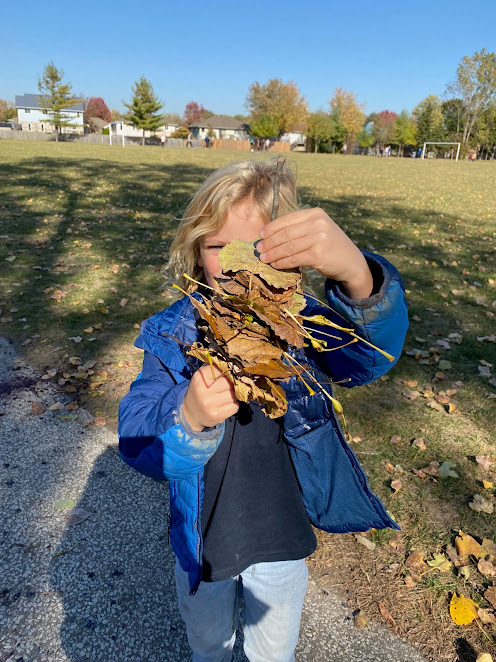
Curious about the size and colours of leaves, the children were encouraged to gather a leaf collection on a stick. This helped them practice fine motor skills and they were eager to quantify the leaves they collected.
 
Much of what the children discover is mathematical. Mother Nature tends to be a beautiful mathematician offering a variety of sizes, shapes and patterns in natural objects. Children are curious as they describe, classify and sort what they find into collections. How many times have you found an assortment of rocks in a child's pocket? Being outdoors without toys also facilitates amazing risky play and children are eager to quantify their achievements (e.g., how fast/high/far can my body move compared to my friend's?). Risky play is an amazing way to encourage math learning in kids (see this post for more information). 
 
I'm often asked by others how children become so attuned with their surroundings and invested in their work in the natural world. I believe that it is because we spend so much time outdoors that children are so immersed and excited. As educators we act as play partners with the children and explore together. We use a 'notice and wonder' thinking routine where we think aloud about something we are curious about (e.g., "I see the leaves swirling in a circle on the pavement. I wonder what is causing them to move that way.") and model for children how we might go about exploring this further (e.g., "I think I'm going to record what I see using my device so I can watch the leaves moving again and think about why this is happening."). I also really enjoy standing away from children and just listening to their observations and theories about the world around them. The things they notice, and the questions they ask, provoke some of the deepest math learning experienced in our program. Children are deeply invested in their work. 
 
Since children become so aware of their surroundings, they are often quick to notice changes. The landscape evolves as the weather and seasons shift and these patterns offer many mathematical learning opportunities. Knowing the land so well also means that children become invested in caring for it and understanding how and why we need to be sustainable learners. 

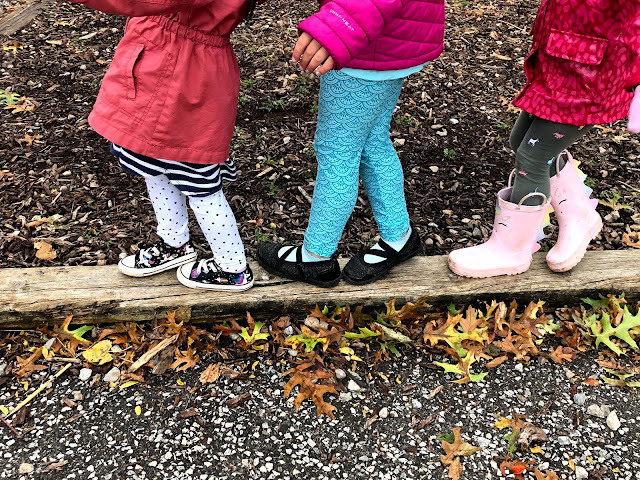
The children were proud of their abilities to balance on a wiggly log. They decided to count as they stood on it, and see if they could beat their 'time' with each subsequent try.

 After finding a pair of ladybugs in the grass the children created a 'home' for them using natural loose parts. Interesting discussion occurred regarding what the ladybugs would need in their home, and what size would be best for each feature (e.g., bed, kitchen).

 The children enjoyed picking dandelions one spring day. We challenged them to see who could find the longest and shortest stems. Without measuring tools the children had to figure out how to fairly measure each stem. 

Although we are lucky to have a lovely, large play yard to use, exploring nature can happen anywhere. Even a puddle has the potential to spark children's imaginations and facilitate rich discovery and discussion. If your space is limited, consider going on nature walks around the community in which your school is located. Perhaps a trail or garden can be visited nearby. Field trips are also a fun option (e.g., orchard, farm). Bringing natural objects into the classroom is another way to help children connect with nature (e.g., pumpkins, sticks, acorns) and continue their explorations after outdoor time has ended.
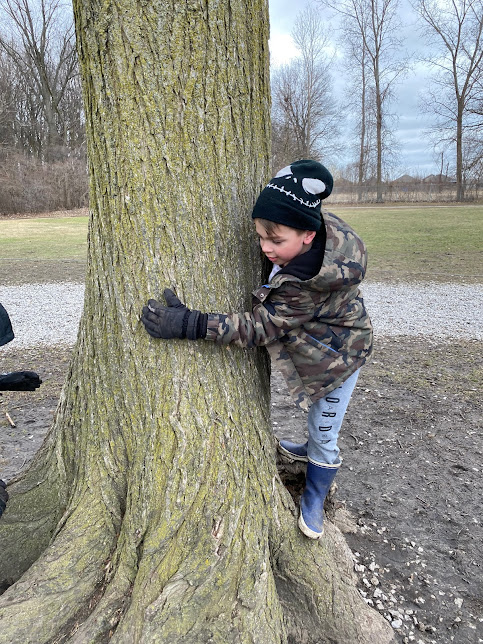
 The children marvelled at the circumference of the large trees located near our school. We asked them how they might measure and compare the trunks in order to find the largest one.

 After making snowballs on a winter day the children thought it would be fun to see how many they could stack inside angled branches of a tree.

 
Prints in the snow always spark rich conversation about who (or what) might have visited the yard. 

 
Dew drops on a web discovered early one morning led to fascinating theories about how strong a web must be. 

 
Finding fossilized rocks and identifying shapes and patterns leads to some great imaginative thinking about what might have lived within the rock long ago.
 
Some tips for getting started:
  • Learn more about your local habitat so that you can facilitate discussions with children regarding interesting objects and events that occur in your area (e.g., native plants, migration patterns).
  • Go on guided walks to help children practice using their senses to observe the world around them. Scavenger hunts focused on the senses can be fun and spark inquiries (e.g., listening walks, bird hunts).
  • Start collections of objects found outdoors that can be displayed in classroom (e.g., feathers, seeds, dried flowers).
  • Provide challenges for children that will help them interact with natural materials (e.g., Can you build a house for the ladybug? Can you find and order ten sticks from largest to smallest?).
  • Use tech to support your work outdoors. There are many great apps that can help you identify leaves and insects. Posting ideas and questions on social media can facilitate discussions with others from different areas.
  • Take photos and videos of children's work outdoors and share this for reflection during a consolidation circle. Use the discussion to help spark future work outdoors (e.g., Today we found many flower patterns in the garden. I wonder if there are patterns on other living things in our yard.).  
It's rare that we don't visit the outdoor space. On the days when it is too stormy or cold to head out, we often find children watching the outside world through the windows. In a time when children may suffer from a Vitamin N(ature) deficit, spending unstructured time outdoors without the distraction of toys or teacher-prepared materials may spark a deep love of nature and facilitate rich math learning that would not be possible otherwise.

Thursday, April 28, 2022

The Wonder of Trees

"Between every two pines is 

a doorway to a new world."

John Muir
 

"Look at me!" Kyle called as he stood on his tiptoes.  "I can reach so high. If I jump I can reach even higher!"

"That's nothing. I bet I can reach higher," Asher responded.

"Ok, let's see you do it!" Kyle laughed. "I can reach this high." He jumped and slapped a spot on the tree.

Asher copied the movements, jumping and tapping the tree in a different place.

"Who was higher?" they called to me.

"I'm not sure," I answered. "It's hard to tell where you each touched and compare the spots. You'll have to think of a way to mark and measure to be accurate."

Harper had been standing next to me watching the boys. 

"I know," she said. "What if you each hold a piece of chalk in your hand. When you jump you can touch the tree and leave a mark."

"Oh good idea!" I answered. "And we can check our wonder wagon to see if we have any tools that measure."

"Like a measuring stick!" Harper answered.

Spending time outside in nature each day is important for children's growth and development. There is a misconception that a robust outdoor program needs numerous tools and materials in order to be successful. However in my practice I have found that often the best inquiries spark from examining and exploring natural elements in our play yard. One of the most intriguing artifacts that children love to explore is a tree. Trees are usually easy to find, diverse, and offer endless possibilities for child-centred inquiry. Responding to children's observations and wonderings about trees can inspire rich math, literacy and science work. 

Interested in exploring the trees in your surroundings with children? Here are some ideas for getting started. 

Tell stories about the interesting markings you find on trees.  Children love to hypothesize about unique things. Ask children to imagine how a spot ended upon a tree, or look for the math within the markings (here the knot on the tree appears to be made from concentric circles).

Explore the different textures you feel on trees. Many children are sensory learners who enjoy exploring their surroundings through touch. Encourage children to feel different parts of a tree (e.g., bark, leaves, blossoms) and describe what they feel. Sensations can be categorized and sorted (e.g., making a pile of smooth leaves).

Research the different objects that grow on trees. The life cycle of trees often results in the creation of flowers and fruit. This growth pattern can be observed and tracked over time.

Inquire about what living things make their homes in trees. Each area is unique with specific animals and insects using trees as shelters. Nests can be observed and described (e.g., a robin's nest is perfectly circular). Children can be encouraged to draw pictures detailing what they see.

Hypothesize the age of a tree using different clues. The rings on a stump can help determine the age of a tree as well as its type and size. Look for stumps and ask children to count as many of the concentric circles as they can see. They can estimate the age of the tree. If a tree is still standing children can estimate how tall or old it might be.

Build gross motor skills and perseverance by climbing trees. Building resiliency, grit and perseverance helps children in all aspects of their learning. Climbing trees encourages these skills as well as being a great physical experience that many children enjoy.

Investigate how trees change over time by exploring decomposition. Logs left over time provide a wonderful opportunity for children to become curious about how it has transitioned from tree to rotting wood. Many insects make their homes in and under logs. Ask children to tell stories about what they think might have happened to fell the tree, or investigate who has been using it as shelter.

Search for clues on the tree to guess who might have visited before you. Holes in the bark can tell stories of what animals have been searching for food in the bark, or using the tree as shelter. Children can observe bark for changes over time and conduct research.

Ponder why some trees stay green all year while others lose their leaves. Coniferous trees do not usually drop their needles. Ask children to describe and categorize the trees in the yard or neighbourhood, and observe them over the course of several weeks or months.

Use materials gathered from the tree as loose parts for imaginative play. Pinecones, twigs, leaves, needles and acorns are great manipulatives for math or creative work outdoors. These can be collected from the yard or donated by families, adding variety and interest to process-based play.
Measure, record and compare the sizes and shapes of different trees. Find the largest or smallest tree in your area and challenge children to find different ways to measure the trunk's circumference. Keep track of the measurements by recording them in a nature notebook or chart paper.
These suggestions are just a starting point for using trees as the basis for rich inquiry during outdoor learning. Listening to the observations and wonderings of children can spark amazing projects. Children often have the best ideas!

Thursday, August 26, 2021

15 Easy Autumn Invitations for Learning

Autumn is a beautiful time of year! There is so much potential for encouraging rich, playful exploration with natural objects that children find fascinating to explore. In this post I will share 15 easy to create autumn invitations for learning that can be presented in the classroom as table top activities, or investigated during outdoor play. These sparks for learning integrate math, literacy and science while offering potential for additional inquiries depending on how children explore and manipulate the materials. 

Educators can observe each activity and provoke further discovery using a 'see, think, and wonder' learning routine. After watching the children play with the materials, ask them to share what they are noticing while playing by stating "I see...". They can then be asked to reflect upon their observations and begin to build their theories about the play by making connections in an "I think..." statement. Finally a question for further exploration can be crafted in an "I wonder..." open-ended query. As children pose questions and share their curiosities about the materials and the world around them, the educator can record observations, reflect upon how to support children in additional work, and gather materials to enhance and evolve the play. 

For example - "I see many different kinds of leaves. I think they might be different sizes. I wonder if I can order them from smallest to biggest."

Natural Objects Colour Matching - recycle paint chip strips by providing them to children and encouraging them to find objects in the yard or placed on a table that match each shade as closely as possible. Encourage children to explore the different shades of each colour.

Roll and Fill the Web - create a spider web by wrapping a shallow basket with thick yarn. Encourage children to roll a die (or multiple dice), add or subitize the pips, and add that many spiders to their web.

Spider Game - create mini catapults by securing a wooden clothespin to a solid block or piece of wood with an elastic. Children can manipulate the catapult and fire a plastic spider into the web. Every spider that lands on the web earns them a point! Children can record their points using tallies, and compare their scores to others.
Measuring Circumference - present a variety of interesting pumpkins and gourds to children. Ask them to suggest ways to measure the circumference of each object. Order the objects from smallest to largest circumference.
Counting Seeds - encourage children to use fine motor skills to remove the inside contents of a squash, gourd, or pumpkin. Provide a variety of tools (e.g., hundreds charts, ten frames) for the to use when calculating the total number of seeds they have removed.
Gourd Runs - present a variety of gourds and recycled floor boards to children. Encourage them to create a variety of ramps and runs to experiment with rolling the gourds down.
Geo-Pumpkins - encourage children to create their own shapes and designs on pumpkins by using pushpins and elastics. Children can push the pins into different places on the pumpkins and then stretch an elastic around them.
Gourd Catapults - present a variety of recycled tubes, wooden boards and mini pumpkins to children. Model how the tubes and boards can be used to make a catapult. Children can be encouraged to stomp on the catapult and launch the pumpkin as far as they can. Brainstorm with children how to record how far the pumpkin travels. Discussing safety rules beforehand is recommended (e.g., ensuring no one is standing in front of the catapult before launching a pumpkin).
Creepy Crawly Pick Up - provide a variety of seasonal trinkets to children in trays. Encourage children to pick up and move the materials using a variety of fine motor tools (e.g., chopsticks, tweezers). Children can sort the materials in the trays in different ways (e.g., by colour, size).
Roll and Fill - provide a template for children to use (grid paper also works). As children roll the dice and add the pips, they then colour the corresponding number of objects or squares on their paper. First to fill a line, section or the entire page wins. 
Big Body Spider Webs - encourage children to wind yarn or twine around natural materials outdoors (e.g., stumps, tree trunks, branches), creating a large spider web. If the web is large enough, children can move their bodies in and out of the web, avoiding the yarn as an obstacle course. Large plastic spiders can also be added and the web transformed into a dramatic playscape.
Pumpkin Weigh In - provide a variety of measuring tools (e.g., balance scales, digital scales) for children along with a collection of pumpkins and gourds. Encourage children to measure and record the weight of the objects. Provide challenges like asking children to find the lightest/heaviest pumpkin or ordering them from lightest to heaviest.
Hanging Leaves - attach yarn or twine between to objects (e.g., tree trunks, posts). Provide a variety of real or fabric leaves and clothespins. Encourage children to attach the leaves to the twine in a variety of ways (e.g., sorted by shade, in a pattern, smallest to largest). Children can explore the play yard for other interesting objects to hang on the line.
Natural Materials Sensory Table - fill a sensory table with autumn items found in the play yard or provided by families. Add tools including magnifying glasses, tweezers, scissors and sorting trays to enhance the play.
Which One Doesn't Belong - present a variety of different pumpkins to children. Ask them to explain which one they feel doesn't belong and articulate their thinking using math ideas and terminology.


Saturday, October 26, 2019

Autumn Math Walk


"Notice that autumn is more the season of the soul than of nature."
 Friedrich Nietzsche

What better time of year to head outside and enjoy the beauty of nature than in the fall!

We have been spending long amounts of time each day exploring the treasures in our yard. The children have been fascinated by how the world around us is changing - leaves are changing colours and falling from trees, Monarchs are gathering the last bit of nectar from the garden before heading South, and we are enjoying the last flowers in our gardens before they wilt and dry.

The children have had many questions about some of the interesting objects they have found in the yard - stumps, leaves, creatures and flowers.


Many of their wonderings have been mathematical in nature - Why is there a pattern on the sunflower's seedhead? What are those holes in the stump and where did it come from? Why is a Daddy Long Legs an arachnid and not a spider?  How do leaves change colours?

There is math everywhere. If one looks deeply enough, there is always a mathematical connection in nature. The sunflower seeds follow the Fibonacci Sequence - a numerical pattern meant to help maximize space and fit as many seeds into the head as possible. The perfect little circles in the stump might have been caused by a wood boring insect or bird looking deep into the bark for food. Daddy Long Legs have a different body than spiders even though they have eight legs. Leaves change colour because the amount of sunlight they need to create their own food lessens in cold weather (as the Earth's axis tilts us away from the sun), resulting in a chemical change in the leaves. 

I've been motivated to continue to look for rich mathematical wonderings and opportunities for inquiry each time I'm outside - even on the weekend with my own children. I find it fascinating to see math applied in an authentic, interesting, real world connection. The math in nature is beautiful! Consider going on your own autumn math walk and seeing what amazing questions and connections emerge with on your journey!

I'm excited to publish my first children's book Autumn Math Walk (Kindle edition) on amazon now. Stay tuned for a print version!


Monday, October 20, 2014

Mighty Oaks

A big thank you to Mrs. Tullio for thinking of us and collecting some beautiful oak leaves and acorns for our science center. The children enjoyed exploring them with magnifying glasses and tweezers. 


Families we are always interested in receiving objects from nature and your backyard! Thank you!

Wednesday, October 15, 2014

Leaf Manipulatives

The children are drawn to our light table. It's amazing to witness their interest and excitement when something 'magical' is placed on it. This week we included some beautiful fall leaf manipulatives for the children to explore.


The children naturally sorted the objects. When I asked them their sorting rule, they explained that they first sorted the leaves by colour, and then by shape. Curious, I asked them to expand on this. "We sorted the leaves by what kind of tree they came from," one child responded. "We sorted them as either Maple or Oak."


The children then spent some time creating their own unique patterns with the leaves. What a great way to infuse some math into our science and light table experiences, especially with the interest the children have in nature and the changing of the seasons right now!


Related Posts Plugin for WordPress, Blogger...