“In every walk with nature, one receives far more than he seeks.”
John Muir
.jpeg)
In our program we spend at least one hour outside each day exploring our play yard and interacting with nature rain or shine (excluding dangerous weather). Although we are fortunate to have an ample collection of materials to use, there are many days that we bring nothing extra outdoors with us. We ask children to interact with the world around them and spend time immersed in nature. Challenged to create play opportunities using only natural elements encourages children to pay close attention to what the world offers and they often wonder about objects and phenomena that they might not otherwise have noticed (e.g., the strength of the wind, an interesting insect, the size of leaves). It's also a great way to encourage children to become resourceful and use their imaginations. In land-based learning knowledge is shared and a respect for nature is encouraged.
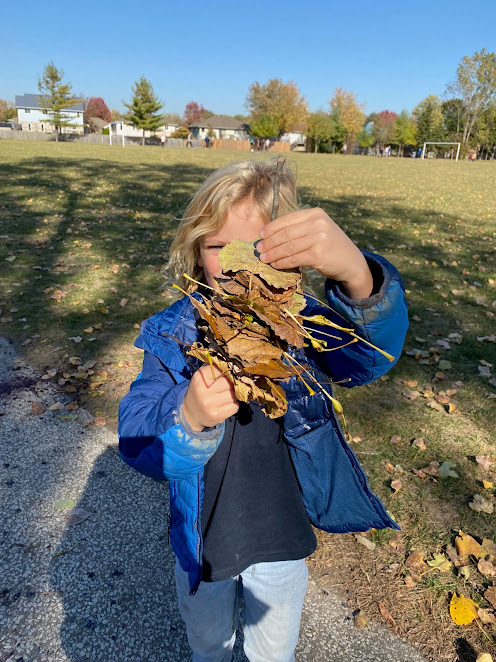
Curious about the size and colours of leaves, the children were encouraged to gather a leaf collection on a stick. This helped them practice fine motor skills and they were eager to quantify the leaves they collected.
Much of what the children discover is mathematical. Mother Nature tends to be a beautiful mathematician offering a variety of sizes, shapes and patterns in natural objects. Children are curious as they describe, classify and sort what they find into collections. How many times have you found an assortment of rocks in a child's pocket? Being outdoors without toys also facilitates amazing risky play and children are eager to quantify their achievements (e.g., how fast/high/far can my body move compared to my friend's?). Risky play is an amazing way to encourage math learning in kids (see this post for more information).
I'm often asked by others how children become so attuned with their surroundings and invested in their work in the natural world. I believe that it is because we spend so much time outdoors that children are so immersed and excited. As educators we act as play partners with the children and explore together. We use a 'notice and wonder' thinking routine where we think aloud about something we are curious about (e.g., "I see the leaves swirling in a circle on the pavement. I wonder what is causing them to move that way.") and model for children how we might go about exploring this further (e.g., "I think I'm going to record what I see using my device so I can watch the leaves moving again and think about why this is happening."). I also really enjoy standing away from children and just listening to their observations and theories about the world around them. The things they notice, and the questions they ask, provoke some of the deepest math learning experienced in our program. Children are deeply invested in their work.
Since children become so aware of their surroundings, they are often quick to notice changes. The landscape evolves as the weather and seasons shift and these patterns offer many mathematical learning opportunities. Knowing the land so well also means that children become invested in caring for it and understanding how and why we need to be sustainable learners.
The children were proud of their abilities to balance on a wiggly log. They decided to count as they stood on it, and see if they could beat their 'time' with each subsequent try.
After finding a pair of ladybugs in the grass the children created a 'home' for them using natural loose parts. Interesting discussion occurred regarding what the ladybugs would need in their home, and what size would be best for each feature (e.g., bed, kitchen).
The children enjoyed picking dandelions one spring day. We challenged them to see who could find the longest and shortest stems. Without measuring tools the children had to figure out how to fairly measure each stem.
Although we are lucky to have a lovely, large play yard to use, exploring nature can happen anywhere. Even a puddle has the potential to spark children's imaginations and facilitate rich discovery and discussion. If your space is limited, consider going on nature walks around the community in which your school is located. Perhaps a trail or garden can be visited nearby. Field trips are also a fun option (e.g., orchard, farm). Bringing natural objects into the classroom is another way to help children connect with nature (e.g., pumpkins, sticks, acorns) and continue their explorations after outdoor time has ended.
The children marvelled at the circumference of the large trees located near our school. We asked them how they might measure and compare the trunks in order to find the largest one.
After making snowballs on a winter day the children thought it would be fun to see how many they could stack inside angled branches of a tree.
Prints in the snow always spark rich conversation about who (or what) might have visited the yard.
Dew drops on a web discovered early one morning led to fascinating theories about how strong a web must be.
Finding fossilized rocks and identifying shapes and patterns leads to some great imaginative thinking about what might have lived within the rock long ago.
Some tips for getting started:
- Learn more about your local habitat so that you can facilitate discussions with children regarding interesting objects and events that occur in your area (e.g., native plants, migration patterns).
- Go on guided walks to help children practice using their senses to observe the world around them. Scavenger hunts focused on the senses can be fun and spark inquiries (e.g., listening walks, bird hunts).
- Start collections of objects found outdoors that can be displayed in classroom (e.g., feathers, seeds, dried flowers).
- Provide challenges for children that will help them interact with natural materials (e.g., Can you build a house for the ladybug? Can you find and order ten sticks from largest to smallest?).
- Use tech to support your work outdoors. There are many great apps that can help you identify leaves and insects. Posting ideas and questions on social media can facilitate discussions with others from different areas.
- Take photos and videos of children's work outdoors and share this for reflection during a consolidation circle. Use the discussion to help spark future work outdoors (e.g., Today we found many flower patterns in the garden. I wonder if there are patterns on other living things in our yard.).
It's rare that we don't visit the outdoor space. On the days when it is too stormy or cold to head out, we often find children watching the outside world through the windows. In a time when children may suffer from a Vitamin N(ature) deficit, spending unstructured time outdoors without the distraction of toys or teacher-prepared materials may spark a deep love of nature and facilitate rich math learning that would not be possible otherwise.

.jpeg)
.jpeg)
.jpeg)
.jpeg)

.jpeg)
.jpeg)


