Showing posts with label playscape. Show all posts

Saturday, April 26, 2025

Code a City!

A favourite small world play activity that the children enjoy is our 'Code a City' challenge. This math invitation requires just a few materials - a city template, blocks, dice, and mini vehicles. The 'Skyscrapers' book is a perfect nonfiction resource to supplement the learning.

Children select a template. They can use one or multiple dice depending on their ability. Roll and add the pips on the dice together. 
Write the corresponding number in a space on the template.
Build a tower with that many blocks.
When your city is complete add mini vehicles for some small world play!

Saturday, August 14, 2021

Small World Play and Math

 "Old things are better than new things, because they've got stories in them."

Kami Garcia

What is hiding in your cupboards and closets? For 20 years now I have kept an old, beautiful china set from my grandmother high up on my shelves. I can honestly say that I haven't used it once; life with busy children doesn't lend itself to tea parties and fancy dinners. Each time I opened the particular cupboard in which these beautiful objects were stored, I'd feel a sense of guilt. They were treasured by my Nana and used for special gatherings. Now they collected dust.

As I look ahead to the next school year, I am eager to bring beautiful, inspiring materials back into our classroom. Covid has meant that many children have been home with their families, isolated from the world. I anticipate a higher than normal level of anxiety and stress as we return to school, even if we are eager and ready for this new chapter. Having beautiful, interesting materials in the classroom space can often welcome children and pique their curiosity, helping them transition into the space and overcome their feelings of anxiety.

Last week I cleaned the kitchen and as I handled the china, I wondered if it could be integrated into the classroom as play props. Not only would that give the bowls and cups a sense purpose, they would beautify our space. I liked the idea of being able to enjoy them on a regular basis; each time I look at them they remind me of my grandmother and I love feeling her presence in my life.

I had been eager to use a small teacup set (found at Value Village) in some way. I knew that the children loved small world play, and that imaginative mini playscapes held potential for rich math learning. I decided to turn my china into a tea garden. In each piece I placed small stones at the bottom for drainage. I planted succulents in the potting soil because of their hardiness and ease of care. 

     
I anticipate placing these materials on a low shelf in the classroom. They will be a semi-permanent fixture there. They will beautify our space when not in use, and be accessible enough that children can access them without needing to move them around the classroom. I have always felt comfortable integrating fragile materials into our space. My experience has been that when children feel empowered as learners, they care deeply for the materials and handle them gently. I'm also prepared for the possibility of accidents. The children are capable and careful when something breaks and I am willing to trade this risk with the reward of using these materials.

I am purposely not adding character props to this learning invitation. I would rather see how children integrate other materials we have into their play (e.g., mini animals, wooden clothespin dolls), or create their own fairies and other figures at the art center. I also see potential for creating a similar invitation outdoors in some way (e.g., fairy door in a stump). As I observe the children I will take note of their ideas and interests, and help to scaffold and support the math learning as it emerges. Some math ideas I think might present include:

  • a discussion of proportional reasoning as children explore the size of the small world and create additional play props
  • an observation of pattern as children see, think and wonder about what they find on the china
  • practice with one to one correspondence as children set the table for a tea party and create additional props to support their storytelling (e.g., plates, forks, food)
  • STEAM as children create their own figures to integrate in this play (e.g., dolls, fairies) or create their own mini worlds (e.g., dollhouses from boxes)
  • observations of shape and size as teacups are compared to one another
  • connections with capacity as children consider how much liquid might fit into the cups, or create their own tea parties while playing in the mud kitchen or water table

I'm sure as children explore the materials additional ideas will emerge. I can't wait to see what they discover! I'm eager to search my closets for other materials to upcycle and bring into our learning space!

Tuesday, October 25, 2016

Indoor Spider Web Weaving

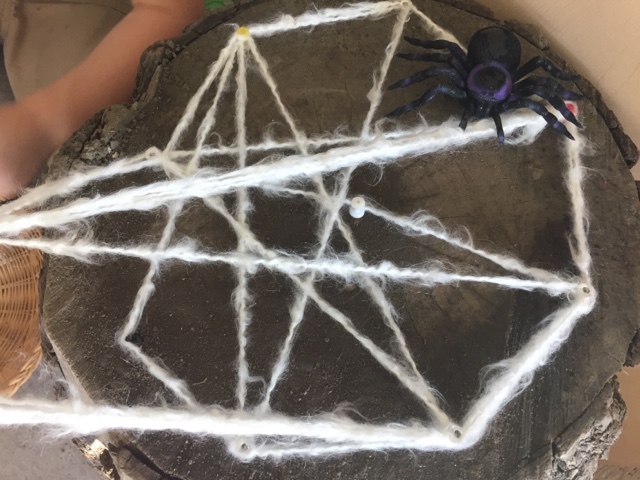
The children have continued with their interest in spiders so today I thought it would be fun to have a mini spider playscape that promoted cooperation, storytelling, and mathematical observations.

We used two sturdy logs. I stuck pushpins into the top surface of the log and encouraged the children to connect the logs with a mathematical experience or tool we have in our classroom. The children immediately suggested that the pegs on the log reminded them of our geoboards. We brainstormed how we could use the pegs to make spider webs. The children were keen to weave and wind fuzzy white yarn in order to make as realistic a web as possible.


As the children wove they counted how many times around the pegs they went - 1, 2, 3... They noticed shapes emerging in the web and compared to see which was the largest shape. 

"Look! I see so many triangles! How many are there?"

"The outside needs a longer piece of yarn than the middle."

"It reminds me of a pizza with all the little parts inside."


The children wanted to connect the two logs together with a web so the spiders could move from one place to another. They needed to cooperate and problem solve how to connect the webs without disrupting the original one. Once the web continued they needed to find a way to keep the web from unraveling. They noticed the bigger spiders were heavier and would sink lower on the middle web. I overheard much rich mathematical conversation as the children played with the spiders. 


At the end of the day we unwound the web and I challenged the children to think of what we might add to the logs tomorrow to make the spider playscape even more interesting....perhaps some prey for the spiders? What would you add to the playscape?

Friday, October 14, 2016

Spider Dramatic Playscape

The children have been fascinated by spiders this week. We have read stories about them and used them as math manipulatives in some of our ten frame activities.  Today the children hoped to bring them outside.
 
"We can use yarn for the web! We can spin a web ourselves for them!"
 
The children took turns weaving and winding a light coloured length of yarn around a circle of tree stumps.
 
 
This took some coordination and effort as the children had to move over and under the yarn in order to create a realistic web.


"Look at all the shapes! There are a lot of triangles in this web!"  Math is everywhere, even outdoors the children observed!


After the web was created the children used the stumps as chairs and sat in a circle in order to play together more effectively.


As an observer I overheard much rich oral language in the children's discussions. They were roleplaying that the spiders were a family on the hunt for food - this involved turn taking, speaking in role, and the use of specialized vocabulary in order to make the play meaningful and realistic.
 

Many children participated and although the spiders looked quite realistic, no child was too scared to play.


As an eco-focused school instilling a love and respect for nature and all living things is a priority. What better way to help children appreciate nature then by encouraging them to play with realistic spiders right out in the beautiful autumn sun!


Eventually the spiders were on the move and found new homes in the yard! I can't wait to see what adventures await us on Monday!
 

Tuesday, May 31, 2016

Painted Ladies

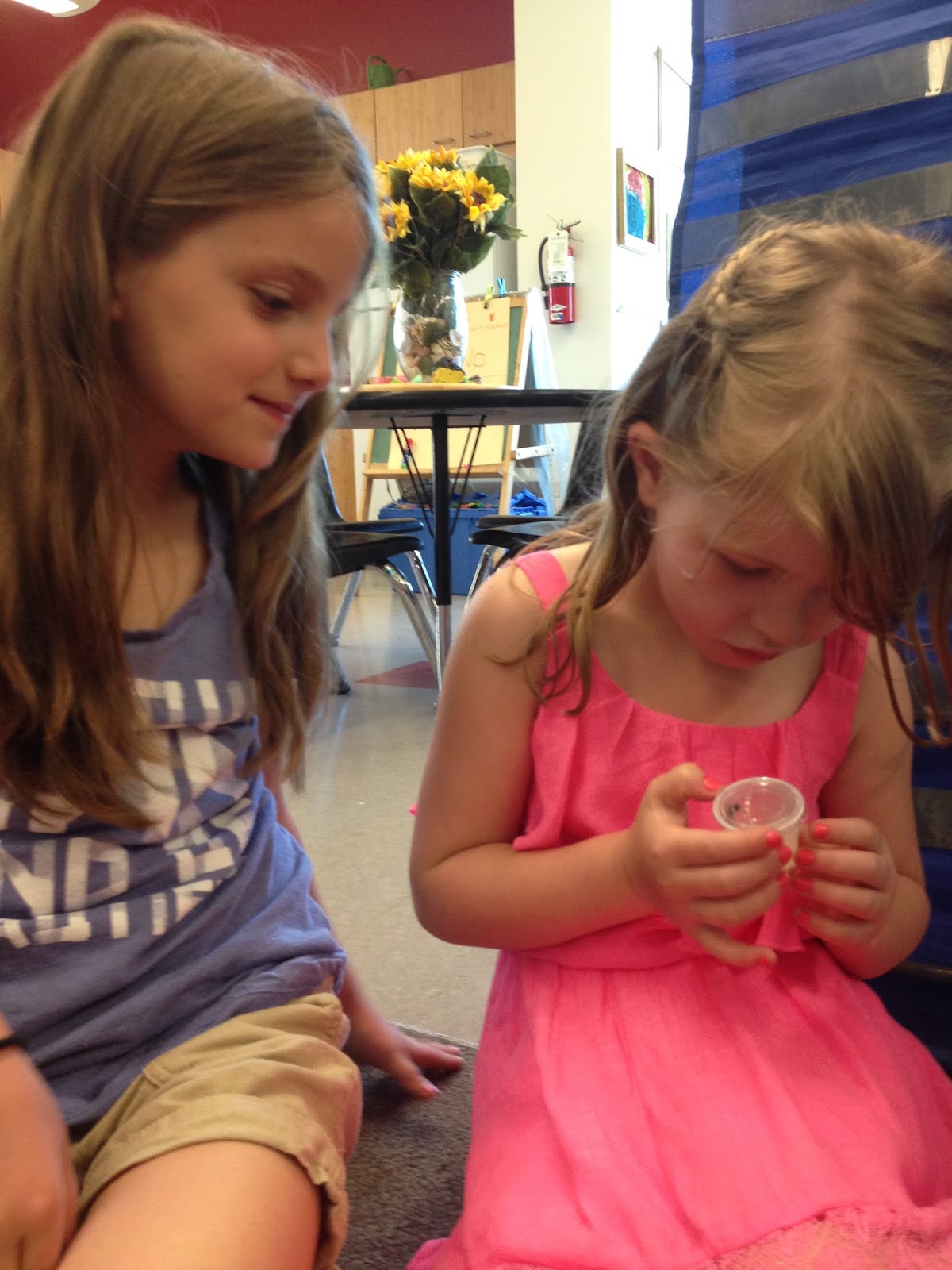
We received a surprise in the mail this week! Our Painted Lady caterpillars arrived! The children were so excited to see them crawling around in their little cups! It's interesting to learn about why they spin a web (to help them move around) and why they seem to shed their end (because they are outgrowing their exoskeleton and are growing bigger). We passed them around the circle and examined them up close!


The children have been helping create our interactive caterpillar display. Many children wrote their name on our June calendar to predict when they thought the caterpillars would emerge from their cocoon. Some of our children read about the Painted Ladies to see how long their transformation would be so they could have an accurate prediction!


The children drew pictures of what they thought the caterpillars would look like as butterflies. We had not yet done research on Painted Ladies when the drawing were made so it's interesting to note that many children appeared to use their prior butterfly knowledge and made theirs look like Monarchs.


We have many books about butterflies, caterpillars and lifecycles in an appealing rustic basket. The stages of the lifecycle are pinned to the sides for easy display and access by the children.


Fun mini manipulatives showing the different stages of the caterpillar/butterfly have been fun to play with in our mini playscapes as well as sequence to tell the story of the lifecycle.


Similar to our planting journals, the children are recording their ideas and observations in the form of communal butterfly journals. Whenever a child would like to share their thoughts they are invited to add a page to these booklets.


We also have lifecycle specific vocabulary cards that the children can access when writing in the journals. These have pictures on one side and kid print on the other for easy writing support. Children can copy the word directly or refer to it after sounding it out independently.


We can't wait to add more child-created materials to the centre as the caterpillars develop and we have deeper understandings of this wonder!
Related Posts Plugin for WordPress, Blogger...