Showing posts with label flowers. Show all posts

Thursday, April 28, 2022

The Wonder of Trees

"Between every two pines is 

a doorway to a new world."

John Muir
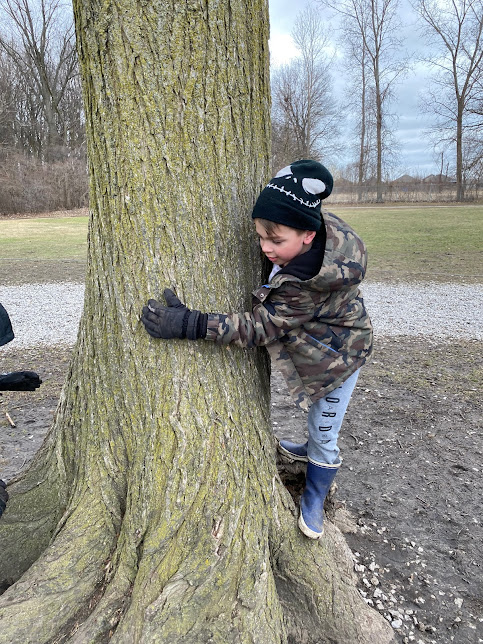
 

"Look at me!" Kyle called as he stood on his tiptoes.  "I can reach so high. If I jump I can reach even higher!"

"That's nothing. I bet I can reach higher," Asher responded.

"Ok, let's see you do it!" Kyle laughed. "I can reach this high." He jumped and slapped a spot on the tree.

Asher copied the movements, jumping and tapping the tree in a different place.

"Who was higher?" they called to me.

"I'm not sure," I answered. "It's hard to tell where you each touched and compare the spots. You'll have to think of a way to mark and measure to be accurate."

Harper had been standing next to me watching the boys. 

"I know," she said. "What if you each hold a piece of chalk in your hand. When you jump you can touch the tree and leave a mark."

"Oh good idea!" I answered. "And we can check our wonder wagon to see if we have any tools that measure."

"Like a measuring stick!" Harper answered.

Spending time outside in nature each day is important for children's growth and development. There is a misconception that a robust outdoor program needs numerous tools and materials in order to be successful. However in my practice I have found that often the best inquiries spark from examining and exploring natural elements in our play yard. One of the most intriguing artifacts that children love to explore is a tree. Trees are usually easy to find, diverse, and offer endless possibilities for child-centred inquiry. Responding to children's observations and wonderings about trees can inspire rich math, literacy and science work. 

Interested in exploring the trees in your surroundings with children? Here are some ideas for getting started. 

Tell stories about the interesting markings you find on trees.  Children love to hypothesize about unique things. Ask children to imagine how a spot ended upon a tree, or look for the math within the markings (here the knot on the tree appears to be made from concentric circles).

Explore the different textures you feel on trees. Many children are sensory learners who enjoy exploring their surroundings through touch. Encourage children to feel different parts of a tree (e.g., bark, leaves, blossoms) and describe what they feel. Sensations can be categorized and sorted (e.g., making a pile of smooth leaves).

Research the different objects that grow on trees. The life cycle of trees often results in the creation of flowers and fruit. This growth pattern can be observed and tracked over time.

Inquire about what living things make their homes in trees. Each area is unique with specific animals and insects using trees as shelters. Nests can be observed and described (e.g., a robin's nest is perfectly circular). Children can be encouraged to draw pictures detailing what they see.

Hypothesize the age of a tree using different clues. The rings on a stump can help determine the age of a tree as well as its type and size. Look for stumps and ask children to count as many of the concentric circles as they can see. They can estimate the age of the tree. If a tree is still standing children can estimate how tall or old it might be.

Build gross motor skills and perseverance by climbing trees. Building resiliency, grit and perseverance helps children in all aspects of their learning. Climbing trees encourages these skills as well as being a great physical experience that many children enjoy.

Investigate how trees change over time by exploring decomposition. Logs left over time provide a wonderful opportunity for children to become curious about how it has transitioned from tree to rotting wood. Many insects make their homes in and under logs. Ask children to tell stories about what they think might have happened to fell the tree, or investigate who has been using it as shelter.

Search for clues on the tree to guess who might have visited before you. Holes in the bark can tell stories of what animals have been searching for food in the bark, or using the tree as shelter. Children can observe bark for changes over time and conduct research.

Ponder why some trees stay green all year while others lose their leaves. Coniferous trees do not usually drop their needles. Ask children to describe and categorize the trees in the yard or neighbourhood, and observe them over the course of several weeks or months.

Use materials gathered from the tree as loose parts for imaginative play. Pinecones, twigs, leaves, needles and acorns are great manipulatives for math or creative work outdoors. These can be collected from the yard or donated by families, adding variety and interest to process-based play.
Measure, record and compare the sizes and shapes of different trees. Find the largest or smallest tree in your area and challenge children to find different ways to measure the trunk's circumference. Keep track of the measurements by recording them in a nature notebook or chart paper.
These suggestions are just a starting point for using trees as the basis for rich inquiry during outdoor learning. Listening to the observations and wonderings of children can spark amazing projects. Children often have the best ideas!

Saturday, October 23, 2021

Uncovering Math Using Observational Drawing

 "When we as teachers are purposeful about bringing nature into our classrooms, we create opportunities for curiosity, questioning, observation, collecting and analyzing information."

(Nenia & Clucas Walter, pg. 8)

I recently read the article 'Exploring Nature Indoors with Observational Drawing and Scientific Thinking' by Kendra Nenia and Melissa Clucas Walter in the Fall 2021issue of Teaching Young Children. In it the authors discuss the many literacy benefits for children who carefully observe and draw objects from nature. As I was reading I was also considering the rich mathematical wonderings and connections that observational drawing can offer children. 

Observational drawing is when children draw what they see. If they are observing and exploring a natural object they are creating a realistic portrayal of the object in a drawn format. Children can sketch black and white representations using only pencil or marker, or draw their outlines first and then add colourful details after. 


As children explore ask them to consider what they see. Use varied questions to prompt a deeper exploration of the object including:

  • What shape is this object?
  • What size is this object?
  • What textures do they feel when they handle the object?
  • How heavy/light is the object?
  • Are there any patterns on the object?
  • What colours can be seen on the object?
  • Does sunlight or artificial light affect the object? 
  • Are there any shadows created on the object when it's placed in the light?
  • What contours can be observed? 
  • Of what does this object remind you?

Ask children to consider how they can draw the object in order to highlight their observations and ensure they are represented. What other drawing tools can be used to help in this artistic representation (e.g., pastels, watercolours)? What math is uncovered in this process? Engaging in supportive discussions with children throughout the drawing can help them to 'notice and name' the math they see. Educators can enhance this mathematical understanding by scaffolding the conversation and highlighting additional math concepts (e.g., proportional reasoning, perspective, reflections, symmetry) and encouraging children to include these in their drawings.

Once a child is satisfied with his or her drawing, encourage the child to represent the object in another way using a different artistic medium such as clay, Plasticine or wire.

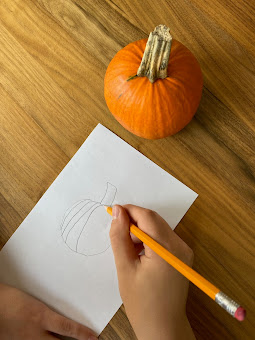
When we tried observational drawing we first examined and drew a small pumpkin.

               
We also explored dried hydrangeas from the garden.


As children draw, ask them to look back and forth between their drawing and the object to ensure they are including any interesting nuances that will help give character to their artwork. Remind children that there is no right or wrong way to create art, and that repeated practice over time (even with the same object) helps us to refine our skills. Observational drawing should not be rushed. Encourage children who might become fatigued or frustrated to take a break from their work - they can tuck their object and drawing away and return to it when they feel inspired again.  
 
The interest in observational drawing in our classroom continued as the children became curious about some different leaves that had been collected and donated to our science table. Notice how the children became comfortable drawing the object using pencil first, and then added additional colourful details to show the shapes, lines, and patterns they saw.


Once children are satisfied with their drawings encourage them to share these with their peers. Children can reflect upon their experience - How did their mistakes help them to learn and improve their work? What did they enjoy about the experience? What might they do differently next time? How might children like to display their work? Sometimes children enjoy gifting their art to others, or displaying it in a public space like the school library. These drawings can be added near the shelf where books about nature are housed. Perhaps children will be inspired to create a documentation display to share the process of their observational drawing, and the final pieces, with others in the school or community. 
 
Observational drawing is an incredibly rich artistic experience that is infused with science, literacy and math. As each season brings new treasures, it can be revisited over and over throughout the school year.

Monday, September 26, 2016

Exploring Sunflowers

Sunflowers are such a fun, vibrant flower to explore as we begin to notice the seasons changing and autumn arrive. We explored a wonderful text called "Lilla's Sunflowers" last week that discusses how many sunflowers are planted all over the country when a young girl shares seeds with her military father. This text is beautifully written with easy to understand narrative and captivating illustrations.
 
In order to help our children make connections to the book, we offered real sunflowers and dried sunflowers at a table along with the book and tools like tweezers, sorting trays and magnifying glasses.


The children were encouraged to visit the centre and use the tools to examine the sunflowers up close and then pick out the seeds. This activity required detailed fine motor work and helped strengthen children's patience as well as their pincher grasp.


The next day we offered the large dried sunflowers as tools for making prints. The children were interested in how the stems acted as handles and kept their hands clean during the activity.


We pressed the sunflowers into paint and made a beautiful print!


Wednesday, June 15, 2016

Mindful Sketching in our Special Garden Spots

"Looking at beauty in the world
is the first step of purifying the mind."
Amit Ray

We have been spending much time this year helping children become mindful of their thoughts, emotions, and bodies. Through active engagement, reflection, and focus on the immediate moments of our time together, we hope that children realize that there is much potential for growth and learning when we engage truly with the present moment.

In our room children have much choice and control over their activities. They choose what areas of the room they'd like to visit, what materials they'd like to use, and the direction and scope of their individual and collective play. Educators serve in role as attuned facilitators carefully observing, supporting and scaffolding children's experiences.

A few times a week we ask children to participate in a whole group activity, usually focused on literacy. Our individual student clipboards are a versatile tool to use when we want to engage children in reflective writing/drawing outside of the classroom. Today we encouraged children to choose a drawing tool they enjoy and headed up to the rooftop garden.

There children were asked to carefully choose an area that captivated them and then quietly observe what they noticed for a few minutes. What did they wonder about the space? What did they think happened there before we arrived? After we left? Who lived there? We invited the children to sketch a drawing to show their interpretation and tell the story of their special garden spot.


It was amazing to see the children's quiet, careful attention to their drawings. Many chose to use pencil and the details of their artwork told a rich story. Some chose to work in solitude while a few others quietly whispered, sharing their drawings and pointing out other aspects of the garden to each other.  


They carefully noticed the details and highlighted what they liked about each other's drawings. We overheard very kind words and careful, constructive feedback as children offered suggestions to one another in order to help improve the drawing in some way. 


Many FDK teachers wonder about whole group activity time - is it appropriate and meaningful to ask all children to do the same thing and at the same time? Is a program still emergent and child-centred if children are asked to participate in teacher suggested activities like drawing in the garden? 


We consider ourselves advocates for child-guided play and exploration but feel there is also a time and place for adult initiated activities such as this. We have noticed that many children have been curious about the different plants growing in our school yard and predicted that they would find the ones growing upstairs just as interesting. We also know that many of the children spend much of their play time drawing so the activity would appeal to them. The actual act of drawing is very open ended and there are entry points for every child with this activity. The process is emphasized as being more important than the product and there isn't any wrong way of participating in the activity. For those few children who don't spend much time drawing this activity helps carve some time in our day where all children have opportunity and encouragement to do so. There are entry points for everyone.


In a few days we will revisit our garden spots and compare our drawing with a new moment in time. We wonder if the garden will have changed much since our last visit and how children will enhance their drawings in order to reflect this growth and change. We predict that like the vegetation, our children will also experience growth and development each time we revisit this type of experience together. Perhaps next fall we will start this process even earlier in the year so that children can visit the same garden spot over and over again and witness the full cycle of life with the changing of each season!

Tuesday, May 24, 2016

How Many Petals? How Explicit Math Instruction Transitions to Child-Centred Learning

In my experience as an Additional Qualifications instructor, one of the most commonly asked questions is how to find a balance in FDK between teacher guided and child-led activities. In an emergent program is it okay for the teacher to take the lead and initiate activities? Do whole group times always have to revolve around the children's interests or is it okay to veer in a new direction? How do adult created invitations for learning transition into child-centred explorations? What does this look like in a real classroom?

Today I set up a beautiful math invitation for children drawn from the text Reggio-Inspired Mathematics (Novakowski, 2015). From our recent experiences discussing nature in our yard in our Beautiful Tree Project I know that our children gravitate to interesting living things. This weekend I did some gardening at my home and picked some of the most interesting flowers I had. I wanted to engage the children as soon as they walked into the classroom in the morning. Not only were the colours vivid, the smell from the combination of flowers could be noticed throughout the room. Each flower had a velvety soft feel and the variety of shapes and textures was interesting to look at. This collection appealed to the children's many senses and was irresistible upon entry into our room. 


Along with the vase I placed many varied, colourful close up photos of other kinds of flowers not displayed in the vase, writing materials (small child-sized clipboards are always more fun to use and easier for the children to handle on an already cozy table), and small wooden blocks. During our first play block the children had open investigation of the invitation. Some smelled the flowers and moved on, others sketched the arrangement, some played with only the wooden blocks.


During our opening circle I brought the materials to the carpet and invited the children to discuss them. I asked them to reflect upon and share what they had experienced at the centre during playtime; I wanted them to describe what they saw, what they noticed about the flowers, what they wondered about the materials. I read the sign included in the centre "How many petals altogether?" and encouraged them to consider my question about the flowers.

Many children were interested in the idea that we could count the number of petals and offered suggestions for how to do this.  One child wanted to place one block on each petal of all the flowers and count them to get a total.


Another child thought that each flower petal should first be counted in the vase and then the same number of blocks could be represented in a collection next to it.


After discussing the suggestions and ending our circle time, the children flowed back into the play activities. We noticed that many new children visited the flower activity and were quite eager to see if they could calculate the petals.

Some children represented the totals with blocks and then transcribed the total as a number on the paper...


...others placed the blocks on the pictures and then drew the flower with the corresponding number of blocks...


...and some created addition sentences after putting blocks on many pictures and wanting to discover a total number of petals in all the pictures.


One child spent a long time at the centre. I observed her play; she experimented with stacking and organizing the blocks in many different ways, finally arriving at the following arrangement. When I asked her to explain her work, this is what she said:

"I put one block in the middle where the pollen is. I put one block on each petal, so that's 5. Then I put blocks on the outside of the flower. I wanted to see its outline."


Fascinated by her work, I continued the conversation by reminding her of our work with the tree circumferences in our current outdoor exploration. I introduced the term 'perimeter' and helped model and explain for her that we could find the perimeter of any object including the two dimensional pictures of the flowers at the centre. This is the sort of beautiful evolution of teacher-initiated activities that emerge when children are able to manipulate materials freely and creatively in their own time and space. Educators who engage in playful experiences together with children can first observe, question, introduce and then scaffold more complex math concepts with those children who appear engaged and interested. Discovering the perimeter of the flowers certainly was not what I had anticipated doing with the initial flower invitation, but this is where I was led by this child.


She was quite eager to record her ideas and our conversation and independently shared her math thinking in a written format. Her idea to help explain to others the meaning of perimeter included drawing a picture of the flower and then writing numbers on it to represent the number of blocks used for the outline.


It's my hope that by sharing this example it's evident that not only is it developmentally appropriate to share teacher invitations for explorations, they can be introduced during whole group time and then rediscovered by children in new and innovative ways. Had I first introduced this math invitation at circle the children might have not been as interested, or only counted the flower petals as modeled at the circle. However providing open-ended time for them to discover and explore the invitation before discussing it helped bring richer background knowledge and ideas to our collective exploration. Revisiting the materials after a free and then focused time working with the pictures and manipulatives might have encouraged more children to visit the centre or think more deeply or differently about the topic. As the educator in the space I am satisfied that the idea of counting the petals using manipulatives was explicitly introduced to the whole group and that I was able to meet individual children at their interest and ability levels, especially those that wanted to represent and add multiple flowers together, or measure the perimeter.

My next step for this activity will be to invite the children who visited the centre today to share their ideas (and photos of the experience) tomorrow during our consolidation and sharing circle as we ran out of time today. Perhaps this will help us introduce the idea of measuring perimeter to the whole group and encourage other children to think about measurement and the invitation in a different, more evolved way.

Related Posts Plugin for WordPress, Blogger...