Showing posts with label puddles. Show all posts

Thursday, November 4, 2021

10 Math Concepts that Children Learn from Puddle Play

"Childhood is that state which ends the moment a puddle is first viewed as an obstacle instead of an opportunity."

K. Williams


Puddle play is an incredibly rich learning activity that many children enjoy. Spending time outdoors exploring many natural elements helps children recognize that there is no such thing as bad weather. There is beauty and wonder to be found in every aspect of nature. Sometimes in early childhood education we need to help our families and school community understand the authentic learning that can happen when children play with sensory materials like puddle water outdoors. Demonstrating the meaningful math connections that emerge in this type of play can build support for outdoor exploration and learning. Sharing this through regular communication including documentation can be incredibly helpful in cultivating positive partnerships and support for messy play outdoors.

Here are ten math ideas that can be introduced and strengthened when children play in the puddles:

1. Patterning

When rain drops fall into water their impact disturbs the surface tension of the water. The ripples spread outward from this impact point. This reaction forms concentric circles which are two or more circles that have the same center point. Each subsequent circle is larger than the last, creating a growing geometric pattern for children to explore.

2. Opposites (Float and Sink)

Children love to place objects in water and experiment with what happens to them. A favourite outdoor activity for our children is to place many different objects in water and see if they float or sink. An object's density determines whether it stays above or below the water. The object will float in the puddle if it is less dense than the water. If it sinks, it is more dense than the water. 

 3. Temperature

The temperature of puddles can vary depending on the ground and air temperature. Children enjoy feeling the water with their hands and describing how hot or cold it seems. An engaging activity is to provide kid-friendly thermometers to children and challenge them to read the temperature of the different puddles in the yard. Are the larger ones a different temperature than the smaller ones? Does the temperature of a single puddle change over the course of the day? Ask children to generate theories about why this is happening.

4. Measurement

Sensory experiences are vital for children's growth and development. Most children love to play in mud using cooking items and utensils. A favourite activity for us is to use the puddles for water play. Not only do we not have to worry about a wet floor indoors, children are captivated using cups, spoons, funnels and bowls to collect the water. Challenge children to measure how much water they can collect. Ask them to see if they can empty a puddle and calculate how much water it had altogether. 
 
5. Cause and Effect
Cause and effect activities help children realize that every action they take has a reaction. When children jump in puddles, the water splashes. Experimenting with cause and effect helps children play with variables that can control the reactions in different ways. For example, and bigger jump in the puddle usually results in a larger splash of water. Children can change their actions (e.g., increasing movement, decreasing movement, modifying direction) and observe the results.

6. Comparison
Puddle water can look many different ways. Some puddles are clear while others are muddy and filled with debris. Children can travel the yard and observe/describe what they see as they compare puddles to one another. They can also experiment with the different materials and observe the reactions that occur. For example when water is added to soil, the soil appears a darker colour. This occurs because wetter soil has less oxygen compares to drier soil. Some puddles are so saturated with dirt that there is a layer of mud that settles on the bottom and a layer of water that has risen to the top. As children explore different puddles they can notice and name what they see, and compare the properties of each to one another.

7. STEAM (science, technology, art, engineering, art, math)

STEAM challenges are highly motivating for children. Puddles offer many opportunities for educators to ask children to design and build an object to be used with the puddles. A favourite in our classroom is to ask children to create a puddle boat from loose parts (e.g., wooden craft sticks, cardboard, foam, aluminum foil) that floats. Another highly motivating construction activity is for children to build a bridge over the puddle for the mini cars to use to cross the puddle. 

8. Counting

In our yard we often have very large puddles when the rain falls due to the slope and drainage of the playground pavement. A fun activity is for children to crowd in and count how many can fit in the area of the puddle. Great math questions emerge in this activity - can the same number of children fit in the different sized puddles in the yard? How many boots altogether are in the puddle? Can we count the boots by 2s?

9. Reflection
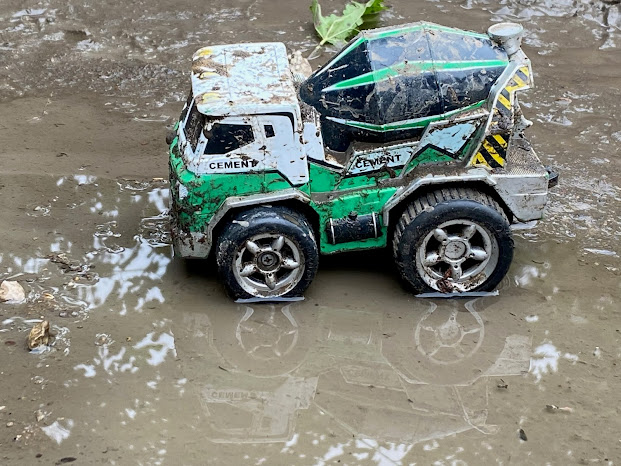
 
Water is a reflective surface. When the water in a puddle is still, the surface is flat and can easily reflect light. If the wind is blowing and ripples appear, the reflection can become distorted. The harder the wind is blowing the more distorted the reflection appears. This type of reflection also offers an exploration of symmetry as children can identify the line of symmetry and see how each side appears. This symmetry is often curious for children who notice that the reflected side appears lighter/faded than the real object. Children can experiment with reflective symmetry by placing and moving different materials into the puddle and seeing the result.

10. Area and Perimeter

The size and shape of a puddle can often inspire conversation about its area and perimeter as children wonder about how big or small it might be. Sometimes we will use loose parts to help us measure (e.g., How many rocks fit around the outside of the puddle?  How many leaves can float on top of the puddle?). The distance across a puddle is also interesting to measure as children leap across the puddle and measure how far they've jumped, or build bridges to help the mini cars cross the puddle.
 
What other math have you explored in the puddles? Tweet me and share your awesome ideas and experiences! @McLennan1977

Looking for a resource to read with kids to support authentic math play in the puddles? Check out my new book Puddle Math: See, Think and Wonder! 


Thursday, October 14, 2021

Autumn Math Walk

 “I'm so glad I live in a world where there are Octobers.”
L. M. Montgomery, Anne of Green Gables 

What a beautiful time of year it is in Southern Ontario! We have been spending much time outside each school day exploring the changes in our school yard. The children are curious about the world around them and ask many questions about their surroundings and the autumn treasures they find. Many of their wonderings have been mathematical in nature - Why is there a pattern on the sunflower's seed head? What are those holes in the stump and where did it come from? Why is a Daddy Long Legs an arachnid and not a spider?  How do leaves change colours? Why are the clouds moving so fast in the sky?

There is math everywhere. If one looks deeply enough, there is always a mathematical connection in nature. The sunflower seeds follow the Fibonacci Sequence - a numerical pattern meant to help maximize space and fit as many seeds into the head as possible. The perfect little circles in the stump might have been caused by a wood boring insect or bird looking deep into the bark for food. Daddy Long Legs have a different body than spiders even though they have eight legs. Leaves change colour because the amount of sunlight they need to create their own food lessens in cold weather (as the Earth's axis tilts us away from the sun), resulting in a chemical change in the leaves. 

I've been motivated to continue to look for rich mathematical wonderings and opportunities for inquiry each time I'm outside - even on the weekend with my own children. I find it fascinating to see math applied in an authentic, interesting, real world connection. The math in nature is beautiful! Inspired by this mathematical beauty I have written a book called Autumn Math Walk that includes photos and narrative to help readers delve deeply into exploring math in the outside world. I've appreciated the interest in this book and loved seeing the ways educators have used the text in their classrooms. Learning from one another is so inspiring!


I'm so very excited to partner with Pembroke Publishers and offer a free teaching resource to complement my book Autumn Math Walk!

Autumn Math Walk Teacher's Guide is a free resource that can help educators understand the math that exists in the natural world, and use this information to provoke conversation and understand with children as they explore nature. Perhaps children will be inspired to author and illustrate their own Autumn Math Walk book unique to their specific surroundings!

Sunday, September 30, 2018

Puddle Play - Rethinking the 'Math Classroom'

We are always looking for opportunities to head outside and enjoy the weather, even when it might be a little wet or cold. Last week our area enjoyed quite a bit of heavy autumn rain. The children spent much of the morning peering through the window and marveling at how much rain was falling. After a few hours they noticed a giant puddle forming in the corner. As the rain continued to fall and the puddle grew, the children became concerned that their outdoor play time would be hampered by the rain.

Fortunately by the early afternoon the rain tapered and the children were able to head outdoors. We are lucky to have a class set of rain boots purchased by the school parent council for use in our outdoor classroom. This way children can enjoy playing in our school yard, even when they might forget to bring their boots to school that day. We are always prepared and the children ready to explore the world outdoors. Even the giant puddle would be no problem that day!

The children scurried outside after eating lunch - many wearing mismatched school boots because they couldn't get them on their feet fast enough because they were so eager to explore the water.


As I approached them I was amazed by the authentic math talk developing in this natural and authentic learning environment. As I listened into their conversations I overhead children wondering with each other about amazingly big math ideas...

How many children could fit in the puddle?  Did each person's feet have to be touching to be counted? Did children who were jumping in and out of the puddle count too?


How deep was the water? How much water was there really in the big puddle? Could it fill a bath tub? How could it even be measured?


Who could make the biggest splash? How would they even judge how big the splash was? Could it be measured? Was the biggest splash the one that soaked the most children standing nearby?


Could the water be used to make soup? How much water was needed in the recipe? Would anyone even want to eat mud soup?


How much water was in one's rain boots after a big splash? How long did it take to dump it out? How did all that water get in there in the first place?


How much more water was needed to cover the stump? Was the stump floating or sinking in the water?  How tall was the stump? What if it rained more...would the stump be under water?


How long would it take to run across the puddle? Who could run the fastest over the water? How could we measure and record the puddle races?


The children were making connections between their puddle play and math in the world around them. The questions they were posing about their experiences in the water were meaningful to them, supporting and strengthening their productive disposition towards math. As an educator involved in their play, I was able to listen to their questions and facilitate conversation and critical thinking about the big math ideas. How could we figure out who could make the biggest splash? What experiences did the children have measuring the size of something irregular. What tools and resources were available to help support this inquiry? Could technology play a role? Would children be interested in revisiting these math questions at a later time or would their interest only occur when playing in the puddles?

As the children and I engaged in conversations about their questions they were developing adaptive reasoning skills - this is the capacity for logical thought, reflection and justification in their math thinking. As children connected what they were observing and experiencing in the puddle play to their own unique experiences and ideas, they were engaged in rich learning as they reflected upon and justified their questions, ideas and strategies to solve the puddle math problems.

Even though many of the children's questions were not answered, the purposeful outdoor math exploration encouraged children to develop a strong conceptual understanding of a variety of developmentally appropriate math topics related specifically to our curriculum including measurement, counting, capacity, classification, time and quantity. I was able to support their conversations and provide suggestions and strategies in the moment. I became a play participant together with them by playing in the puddles myself.

What had originally looked to be a damper on our outdoor fun turned into a complex and layered opportunity for rich math thinking during an activity that most children love to do - explore the rain. It just shows that math can happen anywhere, anytime, when we are willing to rethink what the 'math classroom' should look like.
Related Posts Plugin for WordPress, Blogger...