Showing posts with label October. Show all posts

Sunday, November 10, 2024

Facilitating Math Talks with Young Children - Printables to Support the Math Talk Books

Math talks are a great way to engage children in open-ended explorations that invite them to think critically and creatively about a concept. Math talks are like number talks, yet include any area of math that an educator would like children to explore. An effective math prompt to facilitate a rich math discussion will be layered; it should be open-ended with multiple entry points for engagement. Even children as young as kindergarten are capable of participating in complex math conversations. In our classroom I aim to invite children into a math talk at least once a day; I sometimes use the numerical date on our morning message as the spark for exploration. Other times an interesting photo or collection of loose parts will be engaging and incite children into further exploration. I try to vary the invitations I provide in order to diversify the math we discuss and to reach as many learning interests as possible. 

In our program we have a morning circle time. This circle is our first whole group gathering time for the day and helps set a positive atmosphere in our classroom. It is also a time to celebrate being together, and share news from our homes. We often use it as an opportunity to read a story and discuss any new and exciting activities or additions to our classroom space about which the children should know in order to be successful for the day. 

When I first started teaching kindergarten many years ago it was expected that the morning circle would begin with 'calendar time' where children would put a sticky number on a large grid to depict the day and there would be an extensive discussion about the calendar (e.g., day of the week, month, year). However over the years I realized that this was a very teacher-directed task and not as meaningful a use of our time. After reading Sherry Parrish's work on number talks I was inspired to use our morning message as an anchor for math talks. Wanting to still introduce the date to students, the numerical representation of the date became the foundation for our number talks most days. Sometimes I would use other prompts depending on the events and interests emerging in our classroom. If you would like to read more about number talks in kindergarten, you can access an article I wrote for the Journal of Teaching and Learning here: Joyful Number Talks in Kindergarten. 
 

Over the years I have shared my math talks on social media and have been asked repeatedly to create a guide to support educators who wish to engage their students in math talks. This inspired my collection of monthly math talk books. Each book contain 25 prompts to engage children in regular conversations in the classroom. The prompts do not need to be followed in order. In order to help educators I have also created free downloadable PDFs that can be printed and used with students. 


Click on the book's image to be linked to where it can be purchased. 


Click on the printable to be linked to where it can be printed.
Printables that can be used to support this book:


Printables that can be used to support this book:


Printables that can be used to support this book:


Saturday, October 2, 2021

Pumpkin Math

Autumn is such a wonderful time of year! The colours and textures can inspire such rich math conversation! This past weekend we visited a few farm stands in the area and all I saw was math around me! I'm hoping that these photos will be useful as math prompts for 'math talk' conversations with children.

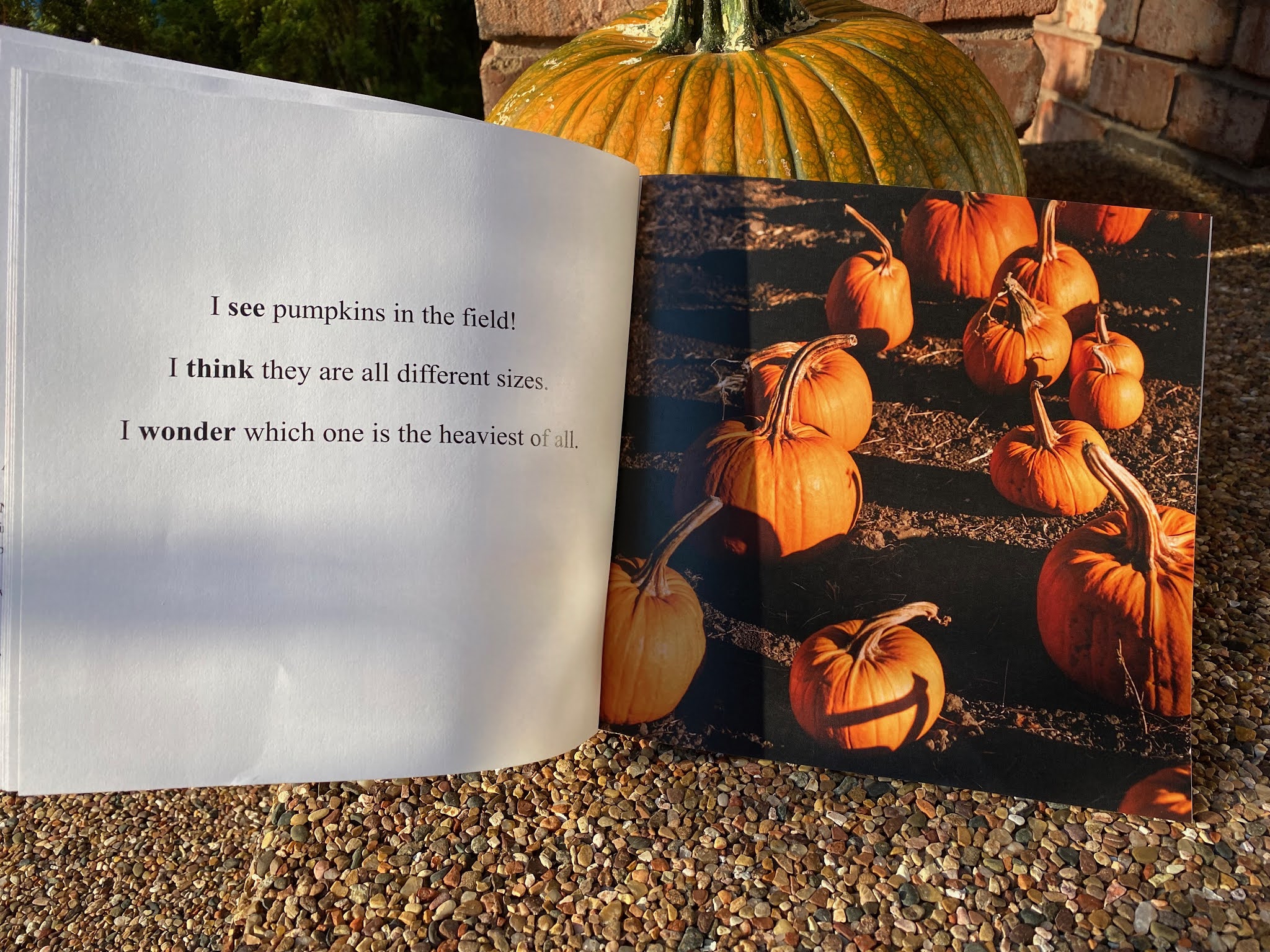
Show children a photo and ask them to share what they 'see, think and wonder' about each photo. The 'see, think, wonder' thinking routine can be used to help children delve more deeply into exploring and articulating what they notice in a specific situation. As children notice and name what they see, they can make connections to their own experiences and ideas, and form questions for further exploration and math research. 

Educators can also ask children specific math questions to guide their thinking. This can be especially helpful if the math concepts in the photos are geared towards an existing exploration the children are having, or if specific curriculum and assessment investigations are needed by the children. Sample math questions are provided below!

How many bumps are on this pumpkin?
 How big around is the stem?
What patterns do you notice?

How are these gourds organized?
What other ways can you sort the objects?
How many do you think are in each bushel? How do you know? 

 
What patterns do you see?
Why is the pumpkin more narrow at the top?
How big around might this be in the largest part?  

How many pumpkins do you estimate are in this box?
How many pumpkins might fit in the box if it was filled to the top?
How much money do you think the farmer should charge for the entire box of pumpkins? Why?

If these pumpkins are $3.50 each, how much would all of these cost? 
Should bigger pumpkins cost more than smaller ones? Why?
Which do you think is the biggest? How do you know?

Which pumpkin would you pick if you only had $2? Why? 
If you had X dollars, how many pumpkins could you buy?
How much money do all these pumpkins cost altogether?
What symmetry do you notice?
What patterns do you see?
How many pumpkins would a full crate hold?
 
Which gourd does not belong? Why?
How could you sort these? What's your sorting rule?
How many gourds do you think are in this bushel?
 
Halloween Math uses the 'see, think, wonder' thinking routine to explore seasonal objects and experiences in a mathematical context and is now available from Amazon!

Thursday, October 27, 2016

Geo-Pumpkins!

In order to capitalize on the children's interests in all things Halloween, I offered a large pumpkin, pushpins, and elastics today to see what they would do. They immediately began to make connections!

"Look! It's like the spider webs we made yesterday!"

"This is like when we put elastics on the geoboards!"

"I want to poke the pins all over the pumpkin like it's having a big operation!"


They immediately got to work, being mindful to not put elastics on pins that weren't fully inserted into the shell because these weren't strong enough and the elastic would snap off.


"Look at all the shapes! It's like the pumpkin has a mixed up face! I see diamond eyes, but they aren't in the right spot!"


It's pretty hard to tell who has the bigger smile here!


Related Posts Plugin for WordPress, Blogger...