Autumn is a
beautiful time of year! There is so much potential for encouraging rich,
playful exploration with natural objects that children find fascinating
to explore. In this post I will share 15 easy to create autumn
invitations for learning that can be presented in the
classroom as table top activities, or investigated during outdoor play.
These sparks for learning integrate math, literacy and science while offering potential for additional inquiries depending on how children explore and manipulate the materials.
Educators
can observe each activity and provoke further discovery using a
'see, think, and wonder' learning routine. After watching the children
play with the materials, ask them to share what they are noticing while
playing by stating "I see...". They can then be asked to reflect
upon their observations and begin to build their theories about the play
by making connections in an "I think..." statement. Finally a question for further exploration can be crafted in an "I wonder..."
open-ended query. As children pose questions and share their
curiosities about the materials and the world around them, the educator
can record observations, reflect upon how to support children in
additional work, and gather materials to enhance and evolve the play.
For example - "I see many different kinds of leaves. I think they might be different sizes. I wonder if I can order them from smallest to biggest."
Natural Objects Colour Matching - recycle paint chip strips by providing them to children and encouraging them to find objects in the yard or placed on a table that match each shade as closely as possible. Encourage children to explore the different shades of each colour.
Roll and Fill the Web - create a spider web by wrapping a shallow basket with thick yarn. Encourage children to roll a die (or multiple dice), add or subitize the pips, and add that many spiders to their web.

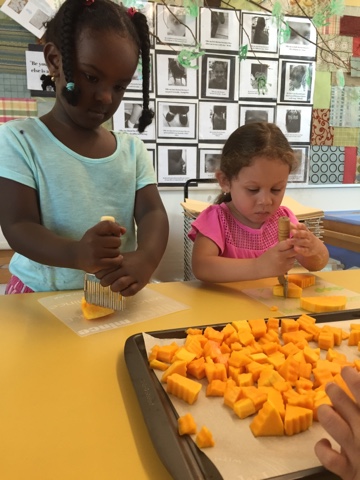
Counting Seeds - encourage children to use fine motor skills to remove the inside contents of a squash, gourd, or pumpkin. Provide a variety of tools (e.g., hundreds charts, ten frames) for the to use when calculating the total number of seeds they have removed.
Gourd Runs - present a variety of gourds and recycled floor boards to children. Encourage them to create a variety of ramps and runs to experiment with rolling the gourds down.
Geo-Pumpkins - encourage children to create their own shapes and designs on pumpkins by using pushpins and elastics. Children can push the pins into different places on the pumpkins and then stretch an elastic around them.
Gourd Catapults - present a variety of recycled tubes, wooden boards and mini pumpkins to children. Model how the tubes and boards can be used to make a catapult. Children can be encouraged to stomp on the catapult and launch the pumpkin as far as they can. Brainstorm with children how to record how far the pumpkin travels. Discussing safety rules beforehand is recommended (e.g., ensuring no one is standing in front of the catapult before launching a pumpkin).
Creepy Crawly Pick Up - provide a variety of seasonal trinkets to children in trays. Encourage children to pick up and move the materials using a variety of fine motor tools (e.g., chopsticks, tweezers). Children can sort the materials in the trays in different ways (e.g., by colour, size).
Roll and Fill - provide a template for children to use (grid paper also works). As children roll the dice and add the pips, they then colour the corresponding number of objects or squares on their paper. First to fill a line, section or the entire page wins.
Big Body Spider Webs - encourage children to wind yarn or twine around natural materials outdoors (e.g., stumps, tree trunks, branches), creating a large spider web. If the web is large enough, children can move their bodies in and out of the web, avoiding the yarn as an obstacle course. Large plastic spiders can also be added and the web transformed into a dramatic playscape.
Pumpkin Weigh In - provide a variety of measuring tools (e.g., balance scales, digital scales) for children along with a collection of pumpkins and gourds. Encourage children to measure and record the weight of the objects. Provide challenges like asking children to find the lightest/heaviest pumpkin or ordering them from lightest to heaviest.
Hanging Leaves - attach yarn or twine between to objects (e.g., tree trunks, posts). Provide a variety of real or fabric leaves and clothespins. Encourage children to attach the leaves to the twine in a variety of ways (e.g., sorted by shade, in a pattern, smallest to largest). Children can explore the play yard for other interesting objects to hang on the line.
Natural Materials Sensory Table
- fill a sensory table with autumn items found in the play yard or
provided by families. Add tools including magnifying glasses, tweezers,
scissors and sorting trays to enhance the play. Which One Doesn't Belong - present a variety of different pumpkins to children. Ask them to explain which one they feel doesn't belong and articulate their thinking using math ideas and terminology.