Showing posts with label spiders. Show all posts

Sunday, October 26, 2025

Spider Catapults


Spiders continue to be a popular topic of exploration in our classroom! To infuse this interest with math and fine motor work we introduced clothespin catapults to the children this week. Wooden catapults are easily made by securing a clothespin to a steady base (like a wooden block) with an elastic. 

They require concentration and perseverance for children to operate. As children become more confident using them they are able to use strategy to aim the catapult in a specific direction or apply pressure to further or reduce the launch power. 

Small plastic spiders (ours were from the local dollar store in the Halloween section) are light and perfect for playing with. We offer 'webs' made from wrapping a shallow basket with yarn. Children are encouraged to fire the spiders into the webs.


Once children master launching the spider into the web additional math tools can be offered to enhance the experience. A five or ten frame or hundreds chart are easy tools for children to use when tracking how many spiders they have landed in the webs.   


Additional targets can be provided for children to play with (e.g., alphabet chart, number chart, printable web with points). The possibilities are endless! 

Monday, October 13, 2025

Spider Math

 "Oh look! There's a spider on the school! 

Maybe he's coming to learn too!"

Autumn always brings with it many treasures. Recently my students have been curious about the many creepy crawlies they have been discovering in the yard. Although spiders can be scary for some, they serve a big purpose in our local ecosystem as they eat insects and also are a source of food for others. Exploring them together also helps those who are scared or reluctant learn to see them in a new way. 

I always look for ways to incorporate children's interests into our activities, specifically math. Here five spider math ideas for you to use with your little ones!

1. Which One Doesn't Belong - encourage children to examine and describe these collections of images and articulate which they believe doesn't not belong in the group and their reasoning why.


2. See, Think and Wonder - this thinking routine asks children to carefully examine something and clearly describe what they see, articulate their thinking about the object, and express curiosity through wonderings and questions related to the subject. This picture of an intricate web might be an interesting prompt for discussion.

3. Spider Survey - ask children to record their names on a t-chart that indicates whether or not they like spiders. Calculate and interpret the results of the survey with children. Click the image to access the printable.


4. Spider Subitizing - use this printable with children to explore different ways of representing a number. Write a number on the spider and ask children to brainstorm and record many different ways of showing the number (e.g., tallies, dots, ten frames, word). Click the image to access the printable.


5. Spider Symmetry - use this printable with children to explore the concept of symmetry. Encourage children to draw the missing half of the spider and web as best as they can. Explore symmetry in photos of real life spiders!
Click the image to access the printable.


Friday, October 9, 2020

A Playground for Mr. Big Legs - STEM in the Outdoor Classroom

"Look! Look at this spider! His legs are so long! Let's call him Mr. Big Legs!"

The children found an interesting spider in the garden one day. Curious, they gently picked it up and let it climb up and down their arms. It was so graceful in its movements that even reluctant children came for a closer look.

"He's so cute! Why was he in the garden?"

"Maybe that's where he lives."

"How do you know he's a boy?" 

"The garden is so boring for him - nothing is growing right now."

"I know! Let's build him a playground!"


Curious about the children's ideas and how I could use their interest in spiders to enrich our outdoor space, I took photos and mentally planned for how we might proceed next. I considered what curriculum expectations might be met, and anticipated the math that might emerge. Such a simple and quick interaction with nature sparked a rich mathematical inquiry in our outdoor classroom that lasted for several days.  

Our first step was to conduct some research. What did children already know about spiders? What did they wonder about Mr. Big Legs specifically? How might they design a playground that he would like? What could they use to help them acquire more information?

We read a number of texts together to gather information that might help enrich their understandings of what exactly a spider was and needed in order to survive. We organized our ideas on a large chart paper and referenced this over the course of our inquiry.


While exploring our school yard for more spiders, we noticed a really interesting tunnelled web just outside our window. The location was the perfect place to set up a 'spider observation window' where children could safely check on the spider during play time and carefully watch it in its habitat. Not only did this give children an additional opportunity to research, it provided children who weren't comfortable holding a spider a safe way to observe one up close without needing to handle it. (We wondered if the spider had eaten two others, or if this particular one shed its skin.)


The more the children learned about spiders, the more determined they were in their quest to create a playground for Mr. Big Legs. They designed spaces for him - a garden, house, slide, swing, and bridge - by drawing blueprints on their clipboards. They considered the size, shape, and materials needed for each creation.


During the next outdoor play time, the children brought their drawings outside and referred to them as they worked in the garden. Some children enhanced their drawings and others started anew. They looked to the materials available outdoors, and planned for how to build using only natural materials found in our space. 


Their work was stunning; the level of thought put into creating the tiny structures was incredible. Children considered measurement and proportional reasoning as they built to scale. Here are some of their creations:

A bed - notice how the sticks point upwards in a circular direction and there are leaves to cushion the center. "The leaves will be so comfortable for him! It will be a soft place to sleep, and the sticks will keep other bugs away."


A swing - notice how this child has balanced the top section of the swing onto two sticks. Later on he would add a long, slender leaf in the middle for Mr. Big Legs to swing on. "I hope that he can balance because this isn't very stable right now."

An obstacle course - notice how Mr. Big Legs will have to climb through the structure, along the stick, hop on top of each of the stones and land on the leaf. The child who build this sequenced the steps in her course and articulated exactly what the spider would need to accomplish along the way while playing here. "This would be so much fun to play on - do you think he will know where to start and where to finish?"

 
A bedroom - this child created a circular structure so that Mr. Big Legs could weave a web near his playground using the rocks as anchors. She knew that many spiders used webs as a home and place to catch prey, and wanted to be sure he had this in his new area. "Spider webs are circles, so I put the rocks in a circle."


A garden - this child dragged his fingers in the dirt to make rows for Mr. Big Legs to use when planting rows of vegetables. "They need to be evenly spaced, because they need room to grow. That's what my dad does in our garden."


A slide - this child placed two sticks together on a slope resting in the corner of the garden. "I wonder if he will know to lift his legs. If he doesn't then he won't go down as fast because they are long and will bump against the slide."


A bridge - this child broke twigs so that they were approximately the right fit to be placed in the narrow hole in the garden. "I couldn't find any sticks that fit, so I broke them. I think Mr. Big Legs needs a bridge in case this hole is too deep for him. If it rains maybe he can pretend it's his pool.

Towards the end of the week the children found another Mr. Big Legs climbing on the brick wall. They eagerly picked him up and placed him in the garden so he could explore everything they had created. Proud of their work, they pointed out each structure and explained to him how he could use the equipment.

"This is your slide and here's your swing. You can play on those!"

"I made you a garden in case you don't catch any bugs in your web."

"And when you get tired, here's a bed for you to sleep on!"

I couldn't help but smile at their enthusiasm. I was amazed that something as simple as finding a spider in our yard could inspire such authentic STEM learning.

Tuesday, October 25, 2016

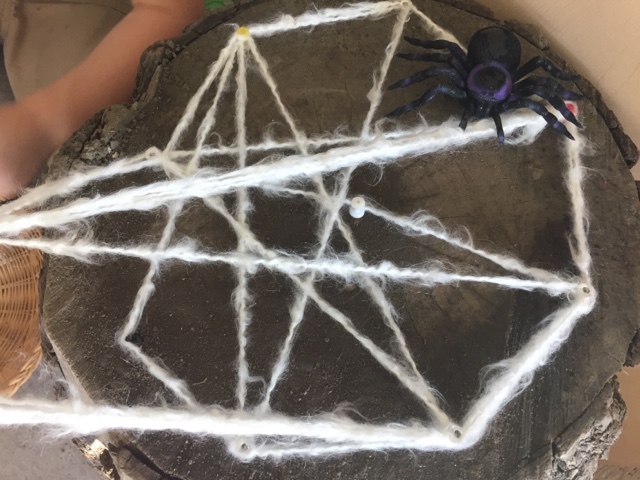
Indoor Spider Web Weaving

The children have continued with their interest in spiders so today I thought it would be fun to have a mini spider playscape that promoted cooperation, storytelling, and mathematical observations.

We used two sturdy logs. I stuck pushpins into the top surface of the log and encouraged the children to connect the logs with a mathematical experience or tool we have in our classroom. The children immediately suggested that the pegs on the log reminded them of our geoboards. We brainstormed how we could use the pegs to make spider webs. The children were keen to weave and wind fuzzy white yarn in order to make as realistic a web as possible.


As the children wove they counted how many times around the pegs they went - 1, 2, 3... They noticed shapes emerging in the web and compared to see which was the largest shape. 

"Look! I see so many triangles! How many are there?"

"The outside needs a longer piece of yarn than the middle."

"It reminds me of a pizza with all the little parts inside."


The children wanted to connect the two logs together with a web so the spiders could move from one place to another. They needed to cooperate and problem solve how to connect the webs without disrupting the original one. Once the web continued they needed to find a way to keep the web from unraveling. They noticed the bigger spiders were heavier and would sink lower on the middle web. I overheard much rich mathematical conversation as the children played with the spiders. 


At the end of the day we unwound the web and I challenged the children to think of what we might add to the logs tomorrow to make the spider playscape even more interesting....perhaps some prey for the spiders? What would you add to the playscape?

Thursday, October 20, 2016

Spider Ring Roll

We played a fun game that capitalized on the children's love of spiders and encouraged subitizing and comparing quantities. Spider ring roll was a fun and easy way to infuse some math into a small group experience. You can see from the pictures that many children were interested in trying the activity out!
 
To play this game each player rolls a die (or multiple dice if you would like to encourage subitizing and adding). That player identifies the number rolled and puts that many spider rings on his or her fingers. For example if a four is rolled then you get to wear four sparkly spider rings.
 
Once every player is wearing their rings the hands are compared. First the rings are counted and a number is identified and then the children see who is wearing the most rings. Player with the most spiders on his or her hands wins the round!


Friday, October 14, 2016

Spider Dramatic Playscape

The children have been fascinated by spiders this week. We have read stories about them and used them as math manipulatives in some of our ten frame activities.  Today the children hoped to bring them outside.
 
"We can use yarn for the web! We can spin a web ourselves for them!"
 
The children took turns weaving and winding a light coloured length of yarn around a circle of tree stumps.
 
 
This took some coordination and effort as the children had to move over and under the yarn in order to create a realistic web.


"Look at all the shapes! There are a lot of triangles in this web!"  Math is everywhere, even outdoors the children observed!


After the web was created the children used the stumps as chairs and sat in a circle in order to play together more effectively.


As an observer I overheard much rich oral language in the children's discussions. They were roleplaying that the spiders were a family on the hunt for food - this involved turn taking, speaking in role, and the use of specialized vocabulary in order to make the play meaningful and realistic.
 

Many children participated and although the spiders looked quite realistic, no child was too scared to play.


As an eco-focused school instilling a love and respect for nature and all living things is a priority. What better way to help children appreciate nature then by encouraging them to play with realistic spiders right out in the beautiful autumn sun!


Eventually the spiders were on the move and found new homes in the yard! I can't wait to see what adventures await us on Monday!
 

Related Posts Plugin for WordPress, Blogger...