Showing posts with label cars. Show all posts

Saturday, April 26, 2025

Code a City!

A favourite small world play activity that the children enjoy is our 'Code a City' challenge. This math invitation requires just a few materials - a city template, blocks, dice, and mini vehicles. The 'Skyscrapers' book is a perfect nonfiction resource to supplement the learning.

Children select a template. They can use one or multiple dice depending on their ability. Roll and add the pips on the dice together. 
Write the corresponding number in a space on the template.
Build a tower with that many blocks.
When your city is complete add mini vehicles for some small world play!

Tuesday, September 13, 2016

Recycled Frame Corners

The children have been very interested in visiting our loose parts shelf. In this area there are many bins of interested found and recycled materials. One basket of particular interest was the frame corners. These vary in size, colour and texture and have become a very versatile building material during play. 
 

Today the children began joining the frames together to create along zigzag roadway. They worked cooperatively, stretching the road along the carpet.


Many children noticed the roadway and became quite interested in seeing what was happening.


They were curious to see how the pieces fit together and why the Velcro on the back made the corners stick to well to the carpet.


Once the roadway was complete a 'parking lot' was constructed...


...perfect for cars AND dinosaurs!
 

Friday, December 9, 2011

Delivering Holiday Trees!

Today during one of our circle time discussions, Mrs. Bombardier and the children talked about how some families cut down a fresh Christmas tree. The children were interested in learning how those families transported the tree back to their houses.  During play time, Mrs. Bombardier added some miniature trees to our block center.


The children were drawn to the trees and immediately began to attach them to our toy cars and trucks so they could be delivered to people's houses.


Some children also made houses too!


Check out the sign that one of our children wrote - trees for sale!

Friday, February 11, 2011

Rolling and Racing!

The children played a racing game on Thursday. The object of the game was to roll a die and race your car to the end of the 'road' first. It was very popular!


This activity helped the children to engage in a fun game that reinforced turn-taking and number sense skills.

Some Ontario Curriculum Expectations fulfilled by this activity include:


1.2 demonstrate the ability to take turns in activities and discussions (e.g., engage in play activities with others, listen to peers and adults)

1.3 begin to make use of one-to-one correspondence in counting objects and matching groups of objects (e.g., one napkin for each of the people at the table)

1.5 recognize some quantities without having to count, using a variety of tools (e.g., dominoes, dot plates, dice, number of fingers) or strategies (e.g., composing or decomposing numbers, subitizing)

Thursday, January 20, 2011

Box Car Racing

What can you make with a cardboard box?  A race car!

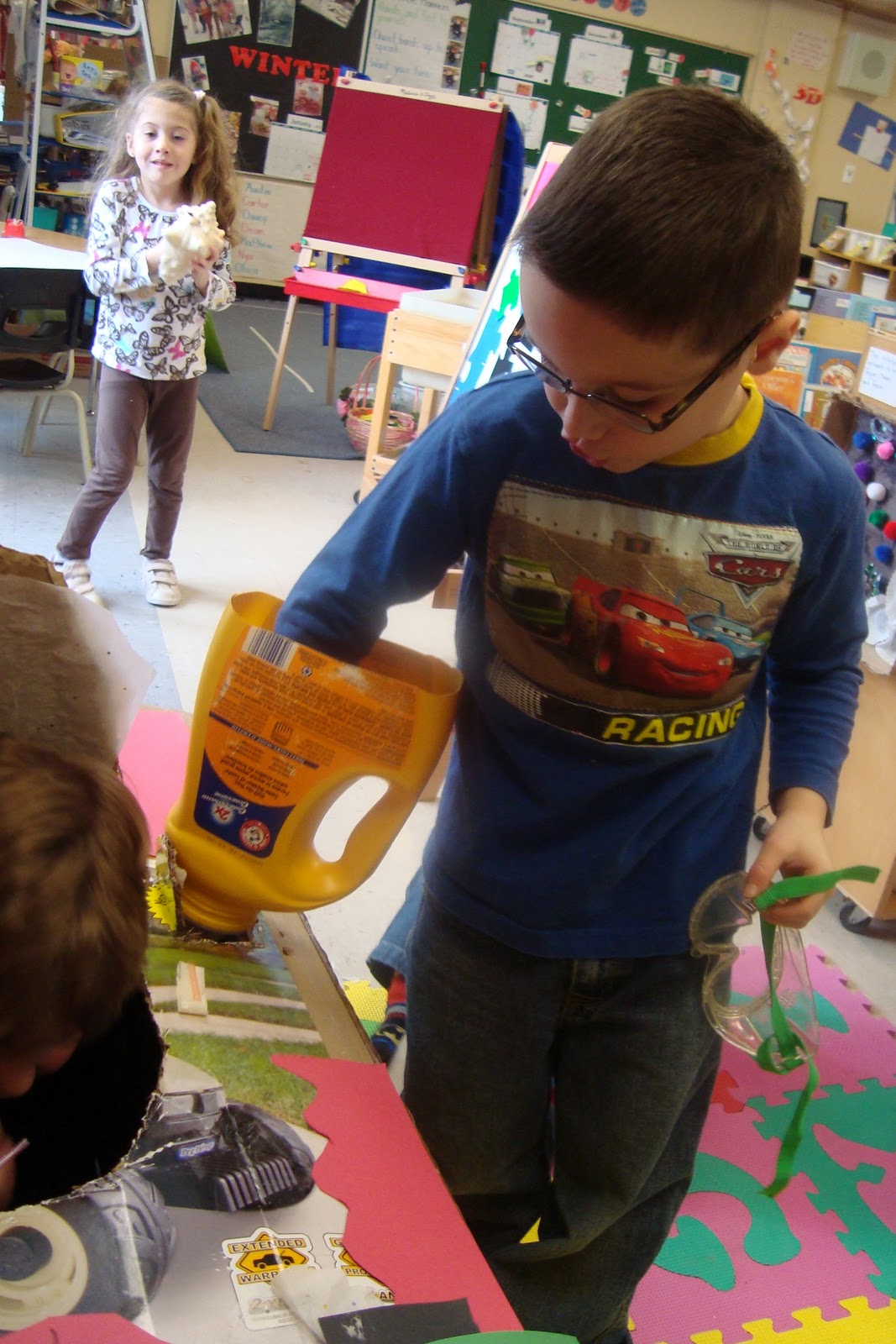
We brought in a large cardboard box today and invited the children to turn it into whatever they liked. They overwhelmingly voted to make it a race car. Using materials from the art center, they worked most of the morning to transform the box into the car, complete with a working sunroof, wheels, headlights, and interior parts like the pedals, transmission, and clutch! Thanks for your help Mr. Cipkar!


Once the car was finished the children pretended to race it, complete with safety racing goggles!


Someone directed the car using a traffic light to indicate when the car should start and stop racing.


When a lap was finished the car was gassed up and the wheels were changed.


Some Ontario Curriculum this activity fulfilled includes:


1.2 demonstrate the ability to take turns in activities and discussions

1.2 identify and talk about their own interests and preferences

2.5 interact cooperatively with others in classroom events and activities (e.g., offer and accept help in group situations, engage in small- and large-group games and activities, participate in democratic decision making)

4.2 state problems and pose questions as part of the design process

4.4 select and use tools, equipment, and materials to construct things using the design process

Wednesday, December 8, 2010

The Trucks are Stuck!

We read a great book today called The Trucks are Stuck by Judy Sierra. In this story a variety of vehicles become stuck in some very deep, sticky mud. The children were able to chime along with the story and predict what would happen next due to the patterning nature of the book.


First a pizza van gets stuck.
Next a police car gets stuck.
Then a tow truck gets stuck.
Then a backhoe gets stuck.
Finally a fire truck gets stuck.

At the end of the story a group of preschool children who are nearby race to the recue and help dig out each of the vehicles.

To extend our literacy experience and integrate some math into our circle time, we asked the children to vote for their favourite vehicle from the story. The pizza van overwhelmingly won with a vote of 13!


We are focusing on helping our children to understand the comprehension elements of stories (who, what, where, when, why, and how) and retelling the events in proper sequence. We use the words first, next, then, and finally to help describe the order of events. To enrich your literacy experiences at home, why don't you consider using these words too when reading stories with your children?

During play time we decided to create the setting of the story in our sand table - the perfect place to have a large, messy mud puddle!  The children helped us gather the various vehicles from around the classroom. They carefully observed the vehicles to make sure that each matched the description in the book. They also made sure that the preschool children used at the center were animals (and not our little people) as the children in the book were animal figures. One child made a pizza van because we did not have one.


The children spent time working together exploring the mud and retelling the story with some adult prompting.


Some Ontario Curriculum expectations these activities fulfilled includes:


1.2   identify and talk about their own interests and preferences

1.6 use language to talk about their thinking, to reflect, and to solve problems

2.9 retell stories, in proper sequence, that have been read by and with the EL–K team, using pictures in the book and/or props (e.g., use props such as finger puppets or flannel-board characters; use plastic models at the sand table to tell the story “The Gingerbread Man”)

DM5.2 collect objects and data and make representations of their observations, using concrete graphs
Related Posts Plugin for WordPress, Blogger...