Showing posts with label observation. Show all posts

Sunday, September 20, 2026

Sprinking Literacy Around the Classroom

In our classroom I look for opportunities to add literacy prompts in different spaces. After noticing that children spent a lot of time observing the aquarium, I hoped to capitalize on this interest and transform it into a richer experience. Next to the tank I added vocabulary cards, writing tools, and a clipboard with fishy outlines.

Children were encouraged to observe the fish in the tank and draw what they saw, or decorate the fish outline however they liked. Some recalled the book The Rainbow Fish and created that character using the template. Others were interested in the vocabulary cards and spent time reading them and then copying the print onto their fish papers. 
 
To reignite interest, I am adding papers with snail outlines this week as there are also brightly coloured water snails in our tank. As the days pass I will observe our classroom and see where else kids gravitate and add prompts and tools to those areas to further the literacy experiences. 
 
Click here for free downloadable copies of the vocabulary and templates to add to your own aquarium area.  

Monday, January 10, 2022

See, Think, and Wonder Math Routine Using Videos

Math is all around us! As an educator I love helping children discover the authentic ways we use math in our everyday lives! As children recognize the integrated, meaningful ways math helps our world work, their interest and confidence in the subject will grow. Exploring the authentic math that exists in our surroundings may help nurture children’s interest and confidence, building a strong foundation for subsequent experiences. 

The ‘see, think, and wonder’ routine is a specific sequence of steps that guides children’s thinking regarding a specific observation. Children first describe what they see, focusing on their power of observation. Next, they interpret these observations and articulate connections to what they have seen. Finally, they share a question or wondering about the object in order to guide their future thinking work.

The 'Winter Day - See, Think and Wonder' video can be used in physical or virtual learning spaces to help facilitate math conversations. At first children can be invited to carefully observe each photo and share what they see. Ask children to use rich description as they articulate their observations. Next, ask children to make personal connections to the information presented in the text and photos. They can articulate what they think about the question prompts in the text, or make inferences about the information shared in the photos. Finally, ask children to share what they wonder about the text and photos. Educators can pause the video at any point to give children more time to engage in math conversation about their observations and wonderings.

As children engage in conversation, reflect upon their ideas. What are children curious about? What do they notice in the foreground, and background of each photo? What connections can they make to the video? What experiences do they have that relate to the objects or situations being presented? Is there something they are interested in learning further? How might they go about conducting mathematical research if they have access to these objects or scenarios in real life? What knowledge do they need to have in order to research their question? What tools and supports might help them in their quest? How can they share their findings with others?

After the children have explored the video, consider asking them to co-create their own version of the media in the form of a 'See, Think, and Wonder' class book. Children can illustrate pictures and write their own narratives. Invite children to look around their homes and communities for other seasonal situations to explore. Perhaps children can digitally document what they find and add these to their own Winter Day book. Images can also be gathered and shared in a video form. The possibilities are as endless as the questions children ask.


YouTube link is Here: Winter Day - See, Think and Wonder

Saturday, October 23, 2021

Uncovering Math Using Observational Drawing

 "When we as teachers are purposeful about bringing nature into our classrooms, we create opportunities for curiosity, questioning, observation, collecting and analyzing information."

(Nenia & Clucas Walter, pg. 8)

I recently read the article 'Exploring Nature Indoors with Observational Drawing and Scientific Thinking' by Kendra Nenia and Melissa Clucas Walter in the Fall 2021issue of Teaching Young Children. In it the authors discuss the many literacy benefits for children who carefully observe and draw objects from nature. As I was reading I was also considering the rich mathematical wonderings and connections that observational drawing can offer children. 

Observational drawing is when children draw what they see. If they are observing and exploring a natural object they are creating a realistic portrayal of the object in a drawn format. Children can sketch black and white representations using only pencil or marker, or draw their outlines first and then add colourful details after. 


As children explore ask them to consider what they see. Use varied questions to prompt a deeper exploration of the object including:

  • What shape is this object?
  • What size is this object?
  • What textures do they feel when they handle the object?
  • How heavy/light is the object?
  • Are there any patterns on the object?
  • What colours can be seen on the object?
  • Does sunlight or artificial light affect the object? 
  • Are there any shadows created on the object when it's placed in the light?
  • What contours can be observed? 
  • Of what does this object remind you?

Ask children to consider how they can draw the object in order to highlight their observations and ensure they are represented. What other drawing tools can be used to help in this artistic representation (e.g., pastels, watercolours)? What math is uncovered in this process? Engaging in supportive discussions with children throughout the drawing can help them to 'notice and name' the math they see. Educators can enhance this mathematical understanding by scaffolding the conversation and highlighting additional math concepts (e.g., proportional reasoning, perspective, reflections, symmetry) and encouraging children to include these in their drawings.

Once a child is satisfied with his or her drawing, encourage the child to represent the object in another way using a different artistic medium such as clay, Plasticine or wire.

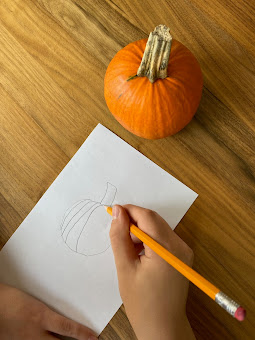
When we tried observational drawing we first examined and drew a small pumpkin.

               
We also explored dried hydrangeas from the garden.


As children draw, ask them to look back and forth between their drawing and the object to ensure they are including any interesting nuances that will help give character to their artwork. Remind children that there is no right or wrong way to create art, and that repeated practice over time (even with the same object) helps us to refine our skills. Observational drawing should not be rushed. Encourage children who might become fatigued or frustrated to take a break from their work - they can tuck their object and drawing away and return to it when they feel inspired again.  
 
The interest in observational drawing in our classroom continued as the children became curious about some different leaves that had been collected and donated to our science table. Notice how the children became comfortable drawing the object using pencil first, and then added additional colourful details to show the shapes, lines, and patterns they saw.


Once children are satisfied with their drawings encourage them to share these with their peers. Children can reflect upon their experience - How did their mistakes help them to learn and improve their work? What did they enjoy about the experience? What might they do differently next time? How might children like to display their work? Sometimes children enjoy gifting their art to others, or displaying it in a public space like the school library. These drawings can be added near the shelf where books about nature are housed. Perhaps children will be inspired to create a documentation display to share the process of their observational drawing, and the final pieces, with others in the school or community. 
 
Observational drawing is an incredibly rich artistic experience that is infused with science, literacy and math. As each season brings new treasures, it can be revisited over and over throughout the school year.

Thursday, October 22, 2020

New Podcast!

PODCAST: Building a Curious and Playful Early Childhood Math Community

In this episode of Teacher's Corner, I talk about my new book, Joyful Math. I also discuss how to nurture a curious and joyful early childhood math community with the author of Early Childhood Math Routines, Antonia Cameron. 


Click here to listen:  https://blog.stenhouse.com/podcast-building-a-curious-and-playful-early-childhood-math-community

Sunday, September 18, 2016

Pastel Self-Portraits

A favourite activity of ours to do each September is encourage the children to draw self-portraits. We have been discussing how each child is our class is special and unique and a wonderful part of our community of learners. We have also been reading books about how we are similar and different as individuals. Emphasizing our names and learning about one another's interests and abilities has been a great way to grow our relationships and gel our class. 

Mirrors, a variety of pastels, and drawing papers were available for the children to explore and use. Hand held mirrors could be used for close up observation and the large mirrors on stands reflected light and provided a hands-free way for the children to observe as they drew.


The results were beautiful and are on display in our quiet corner. We are hoping to encourage the children to revisit this activity in a few weeks in order to see their growth and development in observation and drawing interests and abilities and compare self-portraits (from old to new)!

Each one unique, each one beautiful!


Thursday, May 5, 2016

Sunflower Still Life

"Look deep into nature, and then you will understand everything better." 
Albert Einstein


Our children created delicate black outlined water colour paintings today. There work is stunning; with time and practice they have emerged as observant and skilled artists. We love still life art because it really encourages the children to take time to carefully observe the many details of the subject and use the materials and tools they feel will help them best represent what they see. It's always so interesting to see their interpretations of the same object and how different the finished pieces are.


Wednesday, April 20, 2016

Honouring Children's Questions

We often spend sunny days exploring our beautiful yard. There is a rock garden on the side of the school that the children love. The rocks are challenging to walk through as you need to balance and climb on parts of the path, and there is interesting landscaping that is awaking from its slumber now that the days are turning warm.


In one of the bushes we noticed a peculiar object - it reminded the children of our Painted Lady cocoons we observed last year.


 During circle we invited the children to guess what the object might be. They had some excellent connections to past experiences that were shared to support their opinions. We created an idea web to organize our thoughts.


One of the children suggested we tweet our followers the picture to see if any other class or teacher knew what this object was...


...and immediately 10 of our followers shared their opinion that it was a preying mantis egg sac! We researched this to confirm and then explored how to keep the sac safe in our room for further exploration. We gently removed a branch from the bush with one sac and placed it in an aquarium for observation. Stay tuned!


Related Posts Plugin for WordPress, Blogger...