Showing posts with label collaboration. Show all posts

Saturday, August 21, 2021

Cultivating a Classroom Space for Math Learning

“Do not wait until the conditions are perfect to begin. 

Beginning makes the conditions perfect.” 

Alan Cohen 


As we head back into the school year many educators are working thoughtfully to create environments that are rich with math possibility. In Reggio Emilia the environment exists as the 'third teacher' inspiring, supporting, and extending children's learning in rich and complex ways. I have been contacted by many educators asking for advice on how to best set up their classroom and routines in order to create as many opportunities for authentic math as possible. This has inspired today's blog post - how to cultivate a math rich learning space for children at the beginning of another school year. (I recognize that many areas will have Covid restrictions and following the advice of your local health unit will be important as you plan for your programming.)

When I reflect upon my own math pedagogy and practice these are what I think stand out as mathematically meaningful for the educators, children and families that share our space. Although this check list isn't all inclusive, I thought it might spark some ideas to support and inspire as we enjoy the final weeks of summer and start back in our classroom with open eyes, minds and hearts this year.


1. Make math a part of every space in the classroom and child's school world. In the classroom are there math tools and materials available for use beyond a 'math center or math shelf'? Do children see how math relates to every subject in the space (e.g., how materials are sorted and stored on the toy shelf, how measurement is used when children decide on a size of paper to use for their project)? Can they translate math tools and ideas into other spaces in their immediate school world (e.g., see how math relates to their walks in the hallway or work in the gym)?

2. Ground and build math concepts into known objects for children. When introducing, extending or innovating a math idea is it organic and natural to the child's explorations and world? For example, it is more natural to engage children in an exploration of measurement if they measure things in their immediate world using the stick they are playing with, instead of using a standardized ruler (e.g., "Can you find something the same length as your stick in the yard?", "What is taller than your body?").

3. Use available math moments with children. In our classroom we have a large block of uninterrupted play each day. It's sometimes challenging to manage children, materials and activities during center time. However I try to engage with children as much as possible in the activities, and take on the role of 'play partner' together with them. When I am actively playing I am able to closely observe what they are saying and doing, helping me to identify and extend the rich math learning that is organically occurring (e.g., helping children to recognize why their tower keeps falling, using math terms when they equally share the play dough, introducing math terms as they discuss how many cars are in their parking lot).

4. Become a math role-model for children, families, and colleagues. Even if math isn't your favourite subject, how do you discuss it within your school and classroom? Are you excited by new activities and resources? Do you demonstrate a growth mindset? When mathematical situations arise with children that you aren't sure of, can you use these opportunities to showcase positive thinking and problem-solving? Share your new math learning with others - suggest articles and books you're reading and post these throughout your classroom to enhance documentation displays.

5. Find the math in everything. Many educators plan forward by choosing curriculum and programming expectations and then building activities to fulfill these. Try back-mapping activities from time to time; embrace child-centered, organic experiences and then deconstruct them in order to identify the rich math concepts and curriculum expectations that they utilize. You'll be surprised to find that math happens in almost every experience children have in the classroom.

6. Try looking at life through a mathematical lens. When planning invitations for learning in your classroom, see what math you can sneak in as well. Changing one or two elements of the experience might be enough to engage children in rich math. It reminds me of how I used to sneak veggies into my children's meals - a little can go a long way!

7. Collaborate mathematically with colleagues. Share new ideas and resources informally. It's easy and effective to create math invitations and activities and share these within your school or division. If every educator plans one or two activities and these are shared, children will benefit from many rich and interesting games and activities without the burden of planning and preparation it would take one educator to accomplish the same.

8. Record and celebrate your math moments. Help children, families, and colleagues recognize that math happens everywhere in the classroom by creating a documentation display with photos, anecdotal observations and connections to curriculum. This bulletin board can be built over the course of the school year as artifacts of learning are continually added by staff and students. Keep sticky notes nearby and invite observers to record their own ideas and share them by posting the notes within the documentation.

9. Engage families in joyful math with children outside of school. Consider ways that you can promote and extend math for children after school. Encouraging families to play math games and activities together with their children will not only provide children with additional meaningful math moments, but it may help older family members reconcile their fear or dislike of math. In our classroom we send home family math bags once a week. These are filled with math invitations and materials so that children and their families can play games inspired by our classroom work.

10. Build your collection of math stories, songs and games. Children love to sing, dance and play games. Ask colleagues to share their favourite games and activities, and use these to help with transitions and other 'math moments' throughout the day. Quite often the words in songs can easily be improvised to match something happening in your classroom, and many rich storybooks have mathematical elements and problems embedded within them that can inspire children.

Thursday, May 10, 2018

Printable Pentominoes

In our kindergarten classroom children enjoy spending time working with math manipulatives 
that encourage playful explorations with shape in a variety of ways. One of our favourite tools are 
versatile pentominoes.

Pentominoes are polygons made of five, equal-sized squares connected edge-to-edge. There are twelve 
different pentominoes in one set. You can purchase pentominoes from educational resource stores, or 
print paper copies on card stock and laminate for children’s use here:https://bit.ly/2wtFt0d


There are many reasons why pentominoes are an essential math tool for any early childhood classroom. 
Pentominoes:

1. are gamelike in nature and promote a positive attitude towards math
2. encourage cooperation and collaboration among children 
3. Promote math thinking in a variety of areas including spatial reasoning (logic when solving
 puzzles, symmetry, reflection, rotation, design), measurement (considering the area and perimeter 
of designs), and number sense (counting the number of tiles or squares in a design, calculating the 
total number of squares using the anchor of 5)
 We have used pentominoes in many classroom activities. To see what we've done and follow our math journey, follow us on twitter @McLennan1977. Share your favourite pentomino activities in the comment section below!

Saturday, April 29, 2017

The Power of a Puddle

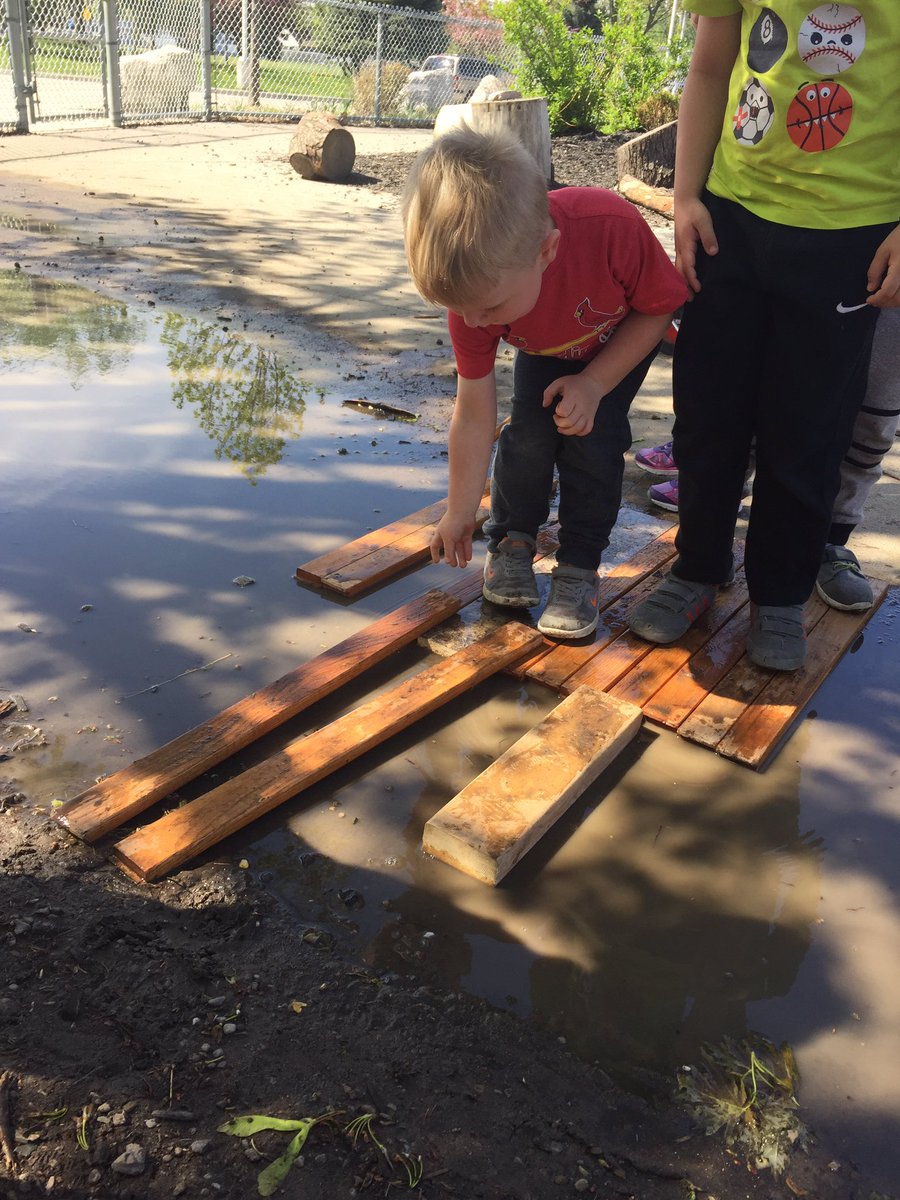
Our children are drawn to water. This past week we had a lot of rain and it created a giant puddle in the playground. The children were curious about how to cross the puddle. It was too big and deep to skip or jump over and they needed to cross it in order to get to the other side where their stumps and other favoured areas were.

One child decided to try using some of our loose building parts. He gathered many pieces of wood and laid them starting from one edge of the puddle. As he placed them side by side he observed the edges of the wood to see if the puddle was deep enough for the wood to sink into.

"I don't know if the wood is high enough. If the puddle is deeper than the wood, then this won't work."

I observed him as he placed the wood and then stepped on each piece, watching to see if the water rose higher then the wood. I noted the complex math and problem solving that had emerged in his work. He was considering the depth of the water and whether it was deeper than the wood was tall.  After a few minutes some friends joined him.


As each piece was added the children continued to test their design to see if their feet stayed dry.

"We're making a bridge so we can cross!" 


The children continued to lay the wood side by side. When it ran out, they were perplexed.

"We don't have enough to finish the bridge!"

They stood around for many minutes, stepping on their bridge, counting the pieces that were side by side, and then looking around the yard for any loose pieces of wood they might have missed.

"I know! Let's take half of the pieces and move them so that we can make the bridge longer! We'll just have to walk one at a time instead!"

The children realized that if they narrowed their bridge they could double the length by moving the pieces in different positions. The amount of wood they used hadn't changed but their problem solving allowed them to complete a workable way of crossing the water.


 Success! The children children spent the majority of their outdoor time racing one by one across the big puddle. They even tried driving the tricycles across it - the process of experimentation in doing so led to some amazing conversations about the weight of the bike and if the wood would hold it, the position of the wood pieces and if they would stay in place while being driven on, and how fast the bike could be driven across without the pieces shifting and becoming ineffective.


The outdoors is full of possibilities for children to mathematize their play; this authentic experience of crossing the puddle motivated the children to engage in robust math that incorporated measurement and problem solving!

Thursday, April 28, 2016

Invested Children = Robust Math Explorations

Research tells us that when children are empowered by adults who believe in them, a positive mathematical mindset, and robust math tasks (low floor, high ceiling) anything is possible. Reflecting back on the beginning of our week I certainly wouldn't have predicted the rich math learning opportunities and problem-solving that our children delivered. Here is the story of what happened...

I have been doing much professional reading about mathematical mindset (Jo Boaler, www.youcubed.org) and saw the following pattern in one of the books. I was fascinated by the math potential of the question and thought this activity might be something that would be of interest and a challenge for our children.
 

After presenting the question during our morning message, we tweeted our ideas about the pattern and figures. Two classrooms from elsewhere in the province decided to also explore the problem in their classrooms, and tweeted us back their ideas. Using social media to share our mathematical thinking and collaborate with other children grows our ideas and abilities as mathematicians as we learn there are many ways to communicate with others and that when we work collaboratively on a task, the outcome is greater and our understanding richer.


We discussed the ideas shared by Ms. Van der Veen and Ms. Ralph's classes and added their ideas to our own understandings of the pattern. This is what we noticed - the pattern grows and we can represent this with a mathematical equation (1, 1+2, 1+2+3, 1+2+3+4, etc.). We noticed that the base was growing by one each time and that the number assigned to the figure (e.g., figure 1) matched the number of blocks in the base and edge (e.g., figure 5 had 5 blocks in the base and 5 on the left edge). 


To help us test this theory we used blocks to build what we noticed. We extended the pattern and built figure 5 and 6.


I asked the children to think about the many other figures that might be created in this pattern. The children wondered what the 100th figure would look like. We decided to set this up as a math exploration for the children today. We provided photos of our previous work, the chart paper reference page, mini wooden blocks, and writing materials.


The children started by building the original figures in the problem. They realized that it was more effective to build the figure flat because building upwards wasn't reliable. The figures would easily tip.


One child immediately went to work on building the 100th figure. She understood the pattern (the 100th figure would have a base and edge each of 100) so she set to work.


This task required great patience and perseverance because the blocks are small and move easily. Putting them back in a straight line and counting and recounting to ensure that there were 100 took great commitment.


Other children became curious and stopped by. "Is the base longer than you?" he asked and we measured to find out.


Once the base was completed the left edge was started. Again, counting out 100 blocks and lining them up in a straight edge was a complicated task and it required great patience and persistence with the task.


She did it! Yeah! This is what the 100th figure's base and edge would look like! Now onto filling it in. Would we have enough blocks?


Another child thought that drawing the figure on a paper would be a better idea because he didn't think we had enough blocks to fill it in. He began, carefully counting out 100 squares to represent the base...


...and learned his paper wasn't big enough. He problem-solved by taping the papers together...


...and together and together and together...  Mrs. Tullio stopped by to assist. She was interested in learning about what the children were doing and they were so eager to share their thinking with her. They recognized the significance of this project. 


Once the base and edge were counted out and drawn, we decided to draw the other outside edge. Because we used chart paper and lined the papers up when taping them together, we didn't feel we needed to draw each individual block inside the figure.


Other friends stopped by to watch the work unfolding and to double and triple check to ensure we had 100 squares in our base and 100 in our edge.


He did it! This is what the 100th figure would look like! You can tell just how large this is with him sitting inside. Each paper is an easel sized paper and the total papers taped together is almost the size of our large carpet. Taking our time to think slowly and deeply about this problem, and working together with people both inside and outside our school, helped us to accomplish an incredibly impressive feat for kindergarten children. We couldn't be more prouder and wonder what problem we will solve next!


Tuesday, May 3, 2011

Box Art

A box is NOT just a box! Check out this collaborative creation!


(We gladly take any large boxes for our children to use when exploring, experimenting, and creating. We are especially grateful to receive large appliance boxes if you have them. Thank you!)

Thursday, October 28, 2010

Collaborative Work with the Grade Two Class

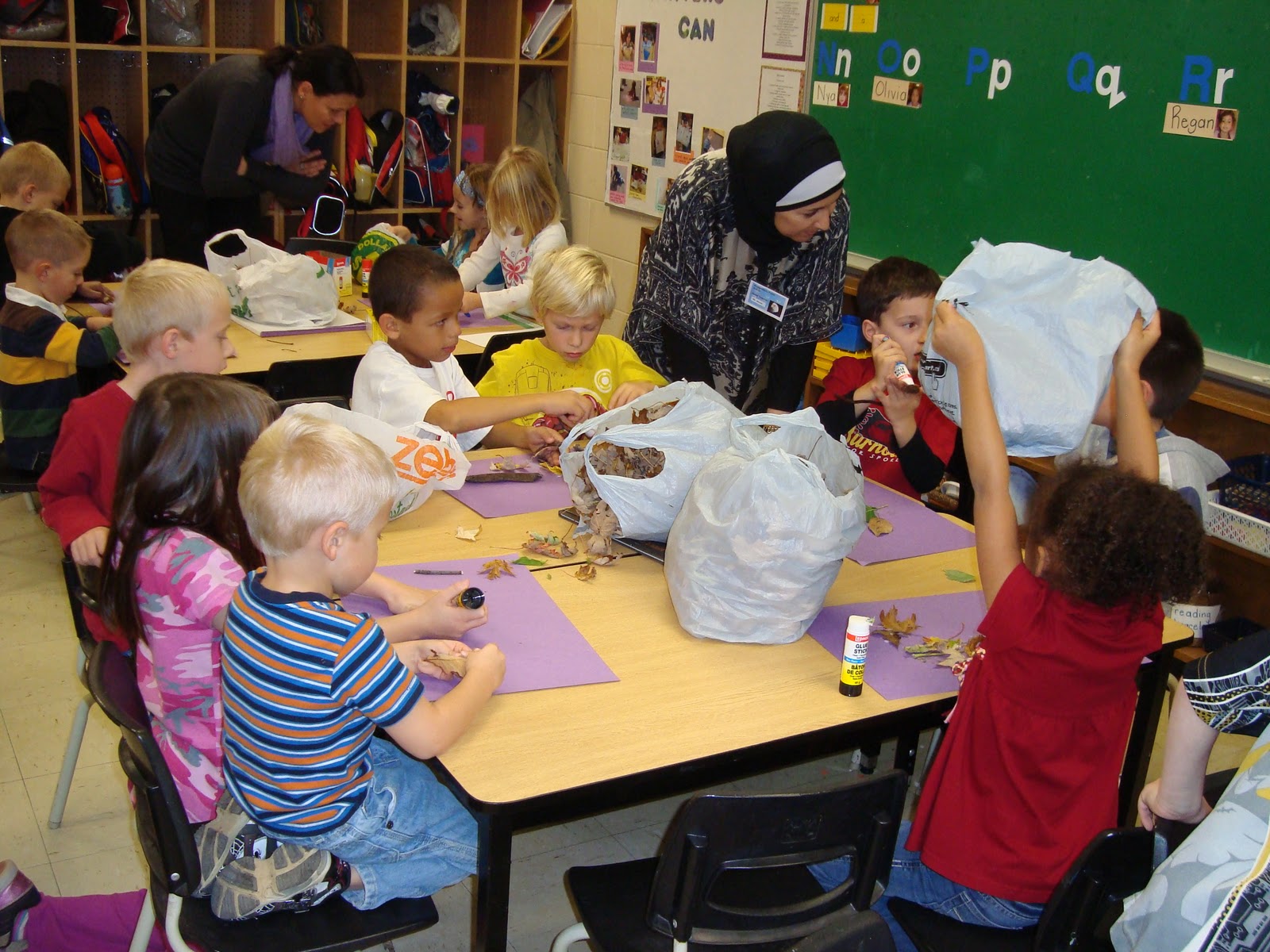
We spent time today partnering with the Grade Two class at our school. After reading the book "Leaf Man" by Lois Elhert, we became inspired to create our own leaf creations.

Reading the book together in our classroom


Examining the intricate illustrations in detail


Searching for the perfect materials for our own leaf creations


Back in the classroom working together


Some of our Leaf Men


Related Posts Plugin for WordPress, Blogger...