Showing posts with label pumpkins. Show all posts

Saturday, October 23, 2021

Uncovering Math Using Observational Drawing

 "When we as teachers are purposeful about bringing nature into our classrooms, we create opportunities for curiosity, questioning, observation, collecting and analyzing information."

(Nenia & Clucas Walter, pg. 8)

I recently read the article 'Exploring Nature Indoors with Observational Drawing and Scientific Thinking' by Kendra Nenia and Melissa Clucas Walter in the Fall 2021issue of Teaching Young Children. In it the authors discuss the many literacy benefits for children who carefully observe and draw objects from nature. As I was reading I was also considering the rich mathematical wonderings and connections that observational drawing can offer children. 

Observational drawing is when children draw what they see. If they are observing and exploring a natural object they are creating a realistic portrayal of the object in a drawn format. Children can sketch black and white representations using only pencil or marker, or draw their outlines first and then add colourful details after. 


As children explore ask them to consider what they see. Use varied questions to prompt a deeper exploration of the object including:

  • What shape is this object?
  • What size is this object?
  • What textures do they feel when they handle the object?
  • How heavy/light is the object?
  • Are there any patterns on the object?
  • What colours can be seen on the object?
  • Does sunlight or artificial light affect the object? 
  • Are there any shadows created on the object when it's placed in the light?
  • What contours can be observed? 
  • Of what does this object remind you?

Ask children to consider how they can draw the object in order to highlight their observations and ensure they are represented. What other drawing tools can be used to help in this artistic representation (e.g., pastels, watercolours)? What math is uncovered in this process? Engaging in supportive discussions with children throughout the drawing can help them to 'notice and name' the math they see. Educators can enhance this mathematical understanding by scaffolding the conversation and highlighting additional math concepts (e.g., proportional reasoning, perspective, reflections, symmetry) and encouraging children to include these in their drawings.

Once a child is satisfied with his or her drawing, encourage the child to represent the object in another way using a different artistic medium such as clay, Plasticine or wire.

When we tried observational drawing we first examined and drew a small pumpkin.
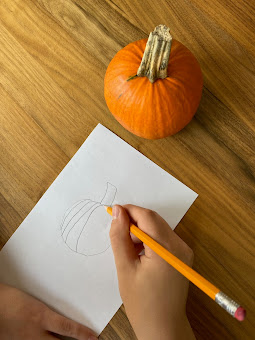
               
We also explored dried hydrangeas from the garden.


As children draw, ask them to look back and forth between their drawing and the object to ensure they are including any interesting nuances that will help give character to their artwork. Remind children that there is no right or wrong way to create art, and that repeated practice over time (even with the same object) helps us to refine our skills. Observational drawing should not be rushed. Encourage children who might become fatigued or frustrated to take a break from their work - they can tuck their object and drawing away and return to it when they feel inspired again.  
 
The interest in observational drawing in our classroom continued as the children became curious about some different leaves that had been collected and donated to our science table. Notice how the children became comfortable drawing the object using pencil first, and then added additional colourful details to show the shapes, lines, and patterns they saw.


Once children are satisfied with their drawings encourage them to share these with their peers. Children can reflect upon their experience - How did their mistakes help them to learn and improve their work? What did they enjoy about the experience? What might they do differently next time? How might children like to display their work? Sometimes children enjoy gifting their art to others, or displaying it in a public space like the school library. These drawings can be added near the shelf where books about nature are housed. Perhaps children will be inspired to create a documentation display to share the process of their observational drawing, and the final pieces, with others in the school or community. 
 
Observational drawing is an incredibly rich artistic experience that is infused with science, literacy and math. As each season brings new treasures, it can be revisited over and over throughout the school year.

Thursday, August 26, 2021

15 Easy Autumn Invitations for Learning

Autumn is a beautiful time of year! There is so much potential for encouraging rich, playful exploration with natural objects that children find fascinating to explore. In this post I will share 15 easy to create autumn invitations for learning that can be presented in the classroom as table top activities, or investigated during outdoor play. These sparks for learning integrate math, literacy and science while offering potential for additional inquiries depending on how children explore and manipulate the materials. 

Educators can observe each activity and provoke further discovery using a 'see, think, and wonder' learning routine. After watching the children play with the materials, ask them to share what they are noticing while playing by stating "I see...". They can then be asked to reflect upon their observations and begin to build their theories about the play by making connections in an "I think..." statement. Finally a question for further exploration can be crafted in an "I wonder..." open-ended query. As children pose questions and share their curiosities about the materials and the world around them, the educator can record observations, reflect upon how to support children in additional work, and gather materials to enhance and evolve the play. 

For example - "I see many different kinds of leaves. I think they might be different sizes. I wonder if I can order them from smallest to biggest."

Natural Objects Colour Matching - recycle paint chip strips by providing them to children and encouraging them to find objects in the yard or placed on a table that match each shade as closely as possible. Encourage children to explore the different shades of each colour.

Roll and Fill the Web - create a spider web by wrapping a shallow basket with thick yarn. Encourage children to roll a die (or multiple dice), add or subitize the pips, and add that many spiders to their web.

Spider Game - create mini catapults by securing a wooden clothespin to a solid block or piece of wood with an elastic. Children can manipulate the catapult and fire a plastic spider into the web. Every spider that lands on the web earns them a point! Children can record their points using tallies, and compare their scores to others.
Measuring Circumference - present a variety of interesting pumpkins and gourds to children. Ask them to suggest ways to measure the circumference of each object. Order the objects from smallest to largest circumference.
Counting Seeds - encourage children to use fine motor skills to remove the inside contents of a squash, gourd, or pumpkin. Provide a variety of tools (e.g., hundreds charts, ten frames) for the to use when calculating the total number of seeds they have removed.
Gourd Runs - present a variety of gourds and recycled floor boards to children. Encourage them to create a variety of ramps and runs to experiment with rolling the gourds down.
Geo-Pumpkins - encourage children to create their own shapes and designs on pumpkins by using pushpins and elastics. Children can push the pins into different places on the pumpkins and then stretch an elastic around them.
Gourd Catapults - present a variety of recycled tubes, wooden boards and mini pumpkins to children. Model how the tubes and boards can be used to make a catapult. Children can be encouraged to stomp on the catapult and launch the pumpkin as far as they can. Brainstorm with children how to record how far the pumpkin travels. Discussing safety rules beforehand is recommended (e.g., ensuring no one is standing in front of the catapult before launching a pumpkin).
Creepy Crawly Pick Up - provide a variety of seasonal trinkets to children in trays. Encourage children to pick up and move the materials using a variety of fine motor tools (e.g., chopsticks, tweezers). Children can sort the materials in the trays in different ways (e.g., by colour, size).
Roll and Fill - provide a template for children to use (grid paper also works). As children roll the dice and add the pips, they then colour the corresponding number of objects or squares on their paper. First to fill a line, section or the entire page wins. 
Big Body Spider Webs - encourage children to wind yarn or twine around natural materials outdoors (e.g., stumps, tree trunks, branches), creating a large spider web. If the web is large enough, children can move their bodies in and out of the web, avoiding the yarn as an obstacle course. Large plastic spiders can also be added and the web transformed into a dramatic playscape.
Pumpkin Weigh In - provide a variety of measuring tools (e.g., balance scales, digital scales) for children along with a collection of pumpkins and gourds. Encourage children to measure and record the weight of the objects. Provide challenges like asking children to find the lightest/heaviest pumpkin or ordering them from lightest to heaviest.
Hanging Leaves - attach yarn or twine between to objects (e.g., tree trunks, posts). Provide a variety of real or fabric leaves and clothespins. Encourage children to attach the leaves to the twine in a variety of ways (e.g., sorted by shade, in a pattern, smallest to largest). Children can explore the play yard for other interesting objects to hang on the line.
Natural Materials Sensory Table - fill a sensory table with autumn items found in the play yard or provided by families. Add tools including magnifying glasses, tweezers, scissors and sorting trays to enhance the play.
Which One Doesn't Belong - present a variety of different pumpkins to children. Ask them to explain which one they feel doesn't belong and articulate their thinking using math ideas and terminology.


Thursday, October 27, 2016

Geo-Pumpkins!

In order to capitalize on the children's interests in all things Halloween, I offered a large pumpkin, pushpins, and elastics today to see what they would do. They immediately began to make connections!

"Look! It's like the spider webs we made yesterday!"

"This is like when we put elastics on the geoboards!"

"I want to poke the pins all over the pumpkin like it's having a big operation!"


They immediately got to work, being mindful to not put elastics on pins that weren't fully inserted into the shell because these weren't strong enough and the elastic would snap off.


"Look at all the shapes! It's like the pumpkin has a mixed up face! I see diamond eyes, but they aren't in the right spot!"


It's pretty hard to tell who has the bigger smile here!


Monday, September 19, 2016

What's Inside?

Last week the children were very interested in seeing what they had each brought for snack. There were some great conversations happening at the snack centre about what the food looked like, smelled like, and tasted like.
 
Today I brought in some different kinds of squash. I wanted to extend the children's interests and thought this would be an engaging way to do so.
 
First we passed the different squash around the carpet. The children were encouraged to use many senses to explore; what did the squash feel like (exploring textures), how heavy was it (exploring measurement), how did it look (noting similarities and differences). This was also a good activity to reinforce turn taking.


During playtime the children were invited to explore the inside of the squash. This lead to many interesting math discussions - equality (2 halves of a squash are the same as 1 whole), estimation and counting (how many seeds are inside), measurement (which squash is biggest? which has the biggest seeds?) and shape (some squash are round and some are not). The children also practiced their fine motor skills as they used the tweezers to pick the seeds out. This took a lot of patience and perseverance because the seeds were slippery and stuck in the squash guts!


Families we are hoping to cook some squash for the children to taste. If you have any you are able to donate to our room, we would appreciate it! Also, if you are interested in volunteering to help with this activity, please let us know! Thank you!


Friday, October 17, 2014

Pumpkin Goop

The children have been interested in pumpkins since our trip to the store. We opened one up today and encouraged the children to use special tools to explore it. 


How much fun was that?  Goopy stuff is so much fun to explore! On Monday we are going to cook the pumpkin seeds and do a taste test!

Friday, November 9, 2012

Real Life Retell

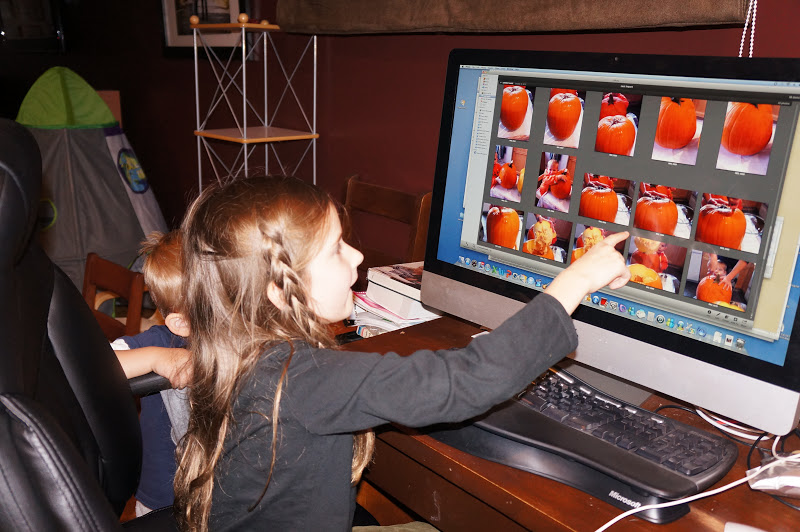
I have been eager to incorporate some technology into our daily activities so when the kids carved their pumpkins, I thought it would be the perfect time to bring out the ipad and encourage my daughter to record the experience by taking some pictures.

As we participated in each stage of jack-o-lantern making, Cadence took a picture. It was a little tricky to do due to the size of the ipad.


We then transfered the photos from the ipad to the computer. It was a great mini lesson on technology and what happens to digital photos when we are ready to use them. Cadence took her time analyzing the photos and choosing the ones she wanted.


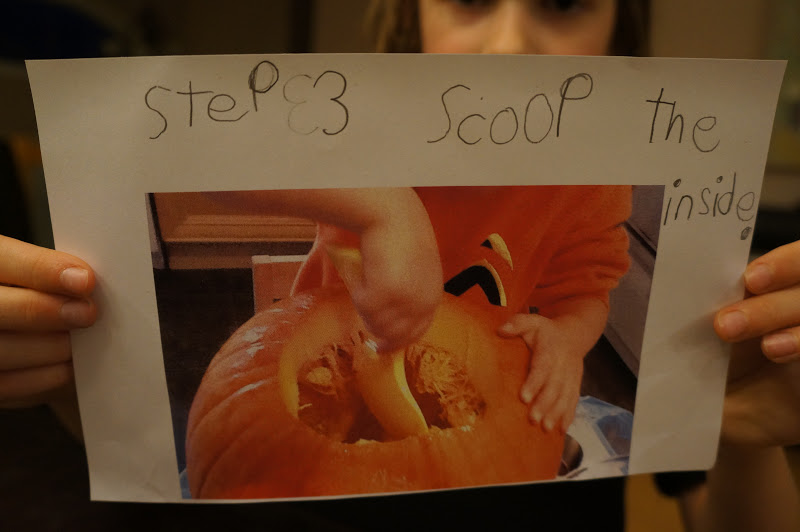
We printed them and then she spent some time writing about what was happening in each picture.


We then spread them out randomly on the floor and Cadence practiced sequencing the pictures according to their order.


This was a great way to practice sequencing/retelling a familiar story using technology as a way of capturing the events. I found that because Cadence had taken the photos herself, she was very invested in the activity. I also liked that it was an easy way to infuse some technology into the activity. Once we are done playing with the pictures we are planning on making them into a "How to Make a Jack-o-lantern" book to be kept on our bookshelf for future reference and reading enjoyment.
Related Posts Plugin for WordPress, Blogger...