Showing posts with label pictures. Show all posts

Tuesday, April 25, 2023

Calendar Math: Daily Date-Inspired Prompts to Inspire Math Talk

Math talks are regular, short conversations about purposeful math problems with children. These are intentionally crafted to invite children into specific math situations, helping them to improve their mathematical confidence and abilities. Math talks are meant to be open-ended opportunities that have multiple entry points and approaches for interpreting and solving the problem. To learn more please read my article Joyful Number Talks in Kindergarten available here:


The Journal of Teaching and Learning

Vol. 13, No. 2 (2019) pp.43–54

https://jtl.uwindsor.ca/index.php/jtl/article/view/5684/5082


In my classroom I engage children in daily math talks during our first whole group time together. I often use the date as a focus for the number talk. For example, if the date is December 10, I use the number ten as the focal point of our math exploration. 


Over the years I have shared my math talks on social media and have been asked repeatedly to create a guide to support educators who wish to engage their students in math talks. This served as the inspiration my book Calendar Math. This book provides photo prompts and accompanying questions is that educators can use these to engage children in regular conversations in the classroom. In the book each calendar date (numbers 1 through 31) has four different pages with accompanying prompts. Use them for different months and also as sparks for creating your own daily number talks with children. 


To help educators get started here is a collection of photos representing the numbers 1 to 31 available as a PDF file. They can be digitally projected or printed and used as part of your morning math talk. Feel free to use them to support and supplement math discussions with your students!


Sunday, July 24, 2022

A Writer's Dream Come True

“Every morning you have two choices: continue to sleep with your dreams, or wake up and chase them.” 

For as long as I can remember I have always wanted to be an author. I dreamed of writing books that would inspire people. I especially hoped to help educators and children overcome their hesitations and fears regarding math learning, and view math as a beautiful and complex subject that could be discovered everywhere in the world around us.

It was with much excitement that my dream became reality. I was thrilled to publish multiple books regarding both math pedagogy and practice. I was thrilled to find out this summer that many of my books are now available through a favourite Canadian bookstore of mine - Indigo. Thank you to all of you who have helped to support my writing; from those who have proofread and given suggestions for improvement, to those who use the books in their classrooms each day - I am forever grateful!

You can find the books at Indigo here: https://bit.ly/3PSxBJu


Saturday, October 23, 2021

Uncovering Math Using Observational Drawing

 "When we as teachers are purposeful about bringing nature into our classrooms, we create opportunities for curiosity, questioning, observation, collecting and analyzing information."

(Nenia & Clucas Walter, pg. 8)

I recently read the article 'Exploring Nature Indoors with Observational Drawing and Scientific Thinking' by Kendra Nenia and Melissa Clucas Walter in the Fall 2021issue of Teaching Young Children. In it the authors discuss the many literacy benefits for children who carefully observe and draw objects from nature. As I was reading I was also considering the rich mathematical wonderings and connections that observational drawing can offer children. 

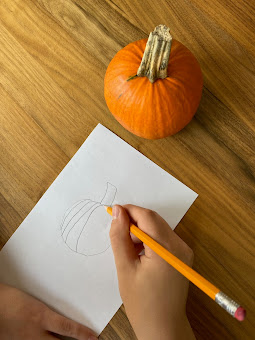
Observational drawing is when children draw what they see. If they are observing and exploring a natural object they are creating a realistic portrayal of the object in a drawn format. Children can sketch black and white representations using only pencil or marker, or draw their outlines first and then add colourful details after. 


As children explore ask them to consider what they see. Use varied questions to prompt a deeper exploration of the object including:

  • What shape is this object?
  • What size is this object?
  • What textures do they feel when they handle the object?
  • How heavy/light is the object?
  • Are there any patterns on the object?
  • What colours can be seen on the object?
  • Does sunlight or artificial light affect the object? 
  • Are there any shadows created on the object when it's placed in the light?
  • What contours can be observed? 
  • Of what does this object remind you?

Ask children to consider how they can draw the object in order to highlight their observations and ensure they are represented. What other drawing tools can be used to help in this artistic representation (e.g., pastels, watercolours)? What math is uncovered in this process? Engaging in supportive discussions with children throughout the drawing can help them to 'notice and name' the math they see. Educators can enhance this mathematical understanding by scaffolding the conversation and highlighting additional math concepts (e.g., proportional reasoning, perspective, reflections, symmetry) and encouraging children to include these in their drawings.

Once a child is satisfied with his or her drawing, encourage the child to represent the object in another way using a different artistic medium such as clay, Plasticine or wire.

When we tried observational drawing we first examined and drew a small pumpkin.

               
We also explored dried hydrangeas from the garden.


As children draw, ask them to look back and forth between their drawing and the object to ensure they are including any interesting nuances that will help give character to their artwork. Remind children that there is no right or wrong way to create art, and that repeated practice over time (even with the same object) helps us to refine our skills. Observational drawing should not be rushed. Encourage children who might become fatigued or frustrated to take a break from their work - they can tuck their object and drawing away and return to it when they feel inspired again.  
 
The interest in observational drawing in our classroom continued as the children became curious about some different leaves that had been collected and donated to our science table. Notice how the children became comfortable drawing the object using pencil first, and then added additional colourful details to show the shapes, lines, and patterns they saw.


Once children are satisfied with their drawings encourage them to share these with their peers. Children can reflect upon their experience - How did their mistakes help them to learn and improve their work? What did they enjoy about the experience? What might they do differently next time? How might children like to display their work? Sometimes children enjoy gifting their art to others, or displaying it in a public space like the school library. These drawings can be added near the shelf where books about nature are housed. Perhaps children will be inspired to create a documentation display to share the process of their observational drawing, and the final pieces, with others in the school or community. 
 
Observational drawing is an incredibly rich artistic experience that is infused with science, literacy and math. As each season brings new treasures, it can be revisited over and over throughout the school year.

Monday, February 24, 2014

Felt Pictures

The children enjoyed creating felt pictures at the math table today. 


Wednesday, December 11, 2013

Photos on the Light Table

The children have been very interested in exploring pictures of themselves this week. We thought it would be interesting to photocopy our photos onto overhead transparencies for some exploration on the light table. They copied very well!


The children were drawn to the activity and were eager to first find themselves and then find a friend. It was interesting to listen to their conversations as they noted the differences between colour and black and white photos (e.g., "I can't see what colour your hair is in this picture. My eyes are blue, but not in this picture.") and sorted the photos based on common characteristics (e.g., gender, hair length).


We are hoping to add blank overheads to the centre to that the children can practice writing each other's name and matching names to photos.


Thursday, March 14, 2013

Patterns Around the House

I've been continuing to explore the possibilities with our new ipad app, Pic Collage. Today Cadence and I had some fun scavenger hunts around the house looking for, and finding patterns. We played the game this way. First I secretly found some interesting patterns from around our house and compiled them using the Pic Collage app. Here is a screen shot of what it looked like:


Cadence was able to search the house and see if she could spot where the patterns were. Her initial observations of the patterns were really interesting to hear. She noticed how size, shapes, and colours repeated and expressed what the pictures reminded her of.


It was so much fun to search the house and compare objects to the patterns and see if her guess was right!


When she had found all nine patterns we switched and she created her own pic collage with nine patterns that I had to then find. It was a great way to infuse patterning with technology and help us to become more comfortable using the ipad!

Wednesday, February 15, 2012

Melted Crayon Art

The children participated in a very interesting art activity that combined their interests in drawing with their recent observations of things melting. Mrs. Bombardier set up a griddle that was covered in foil and turned on the 'warm' setting. 


The children helped us peel some festive colours of crayons.


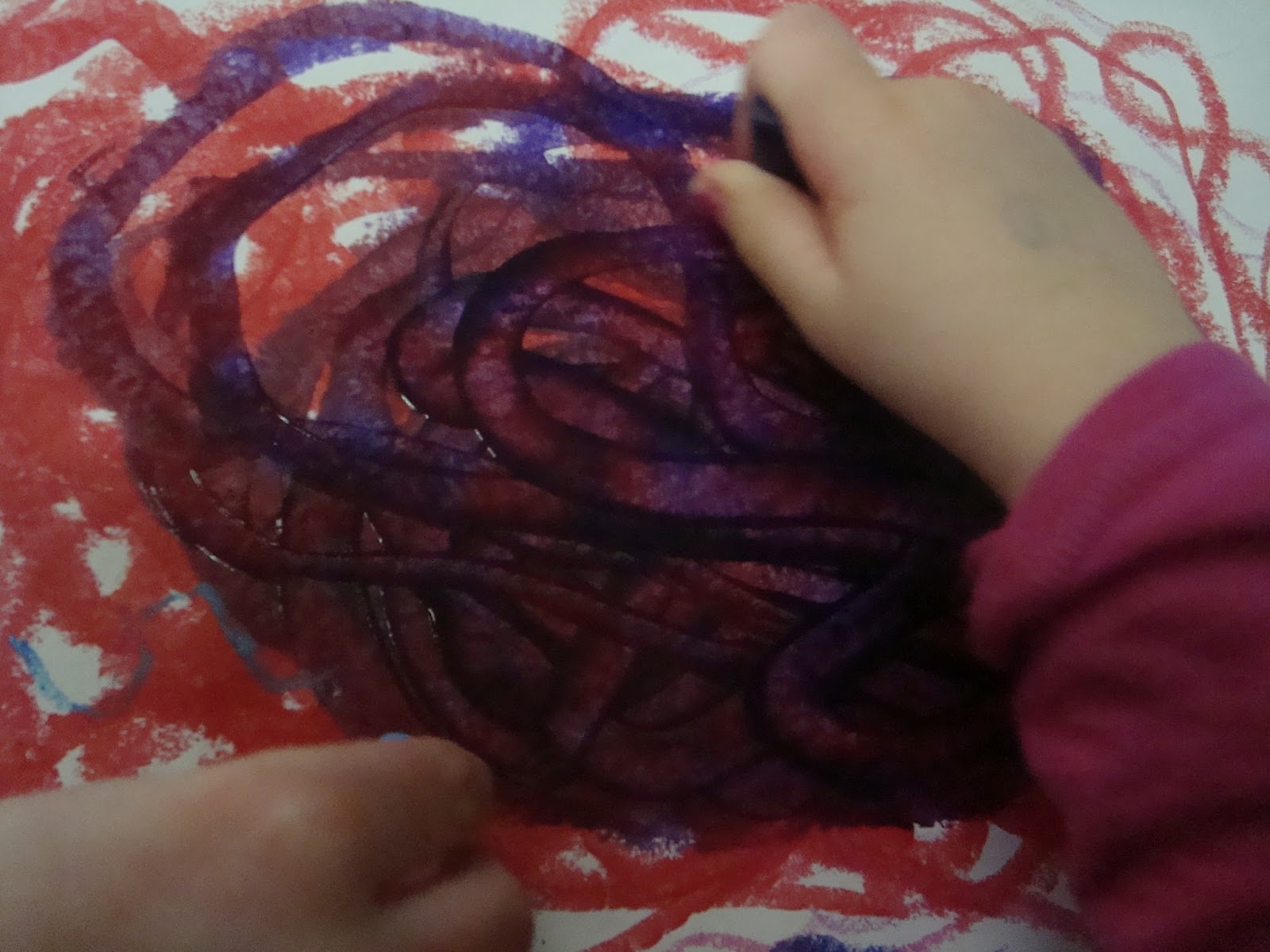
With adult supervision, the children were invited to draw on a piece of paper that was placed on the warm surface...as they coloured they noticed the crayons begin to melt!


The children observed that the slower they moved the crayon on the hot surface, the faster it melted.


And the more they coloured, the more wax was left on their paper, creating beautiful textures and the blending of new colours on the surface.


The finished product was a masterpiece of colours, lines, and textures!  As the art cooled and the wax hardened, the children could feel their artwork as well as see it!  Beautiful!


Tuesday, October 4, 2011

What is it?

We took close up pictures of some objects in our classroom today and invited the children to look around the room and see if they could figure out what/where they were.

Can you guess what they are?


Did you guess what the pictures were?

The children used many strategies to help figure out the pictures...

Holding them up to objects in the room, discussing their ideas with peers, and asking for help from a teacher.


They did a great job figuring it out. Did you?
Related Posts Plugin for WordPress, Blogger...