Showing posts with label dramascape. Show all posts

Saturday, August 14, 2021

Small World Play and Math

 "Old things are better than new things, because they've got stories in them."

Kami Garcia

What is hiding in your cupboards and closets? For 20 years now I have kept an old, beautiful china set from my grandmother high up on my shelves. I can honestly say that I haven't used it once; life with busy children doesn't lend itself to tea parties and fancy dinners. Each time I opened the particular cupboard in which these beautiful objects were stored, I'd feel a sense of guilt. They were treasured by my Nana and used for special gatherings. Now they collected dust.

As I look ahead to the next school year, I am eager to bring beautiful, inspiring materials back into our classroom. Covid has meant that many children have been home with their families, isolated from the world. I anticipate a higher than normal level of anxiety and stress as we return to school, even if we are eager and ready for this new chapter. Having beautiful, interesting materials in the classroom space can often welcome children and pique their curiosity, helping them transition into the space and overcome their feelings of anxiety.

Last week I cleaned the kitchen and as I handled the china, I wondered if it could be integrated into the classroom as play props. Not only would that give the bowls and cups a sense purpose, they would beautify our space. I liked the idea of being able to enjoy them on a regular basis; each time I look at them they remind me of my grandmother and I love feeling her presence in my life.

I had been eager to use a small teacup set (found at Value Village) in some way. I knew that the children loved small world play, and that imaginative mini playscapes held potential for rich math learning. I decided to turn my china into a tea garden. In each piece I placed small stones at the bottom for drainage. I planted succulents in the potting soil because of their hardiness and ease of care. 

     
I anticipate placing these materials on a low shelf in the classroom. They will be a semi-permanent fixture there. They will beautify our space when not in use, and be accessible enough that children can access them without needing to move them around the classroom. I have always felt comfortable integrating fragile materials into our space. My experience has been that when children feel empowered as learners, they care deeply for the materials and handle them gently. I'm also prepared for the possibility of accidents. The children are capable and careful when something breaks and I am willing to trade this risk with the reward of using these materials.

I am purposely not adding character props to this learning invitation. I would rather see how children integrate other materials we have into their play (e.g., mini animals, wooden clothespin dolls), or create their own fairies and other figures at the art center. I also see potential for creating a similar invitation outdoors in some way (e.g., fairy door in a stump). As I observe the children I will take note of their ideas and interests, and help to scaffold and support the math learning as it emerges. Some math ideas I think might present include:

  • a discussion of proportional reasoning as children explore the size of the small world and create additional play props
  • an observation of pattern as children see, think and wonder about what they find on the china
  • practice with one to one correspondence as children set the table for a tea party and create additional props to support their storytelling (e.g., plates, forks, food)
  • STEAM as children create their own figures to integrate in this play (e.g., dolls, fairies) or create their own mini worlds (e.g., dollhouses from boxes)
  • observations of shape and size as teacups are compared to one another
  • connections with capacity as children consider how much liquid might fit into the cups, or create their own tea parties while playing in the mud kitchen or water table

I'm sure as children explore the materials additional ideas will emerge. I can't wait to see what they discover! I'm eager to search my closets for other materials to upcycle and bring into our learning space!

Monday, January 14, 2013

Insect Dramascape


Caleb has been very interested in insects lately so I turned our portable water table into an insect drama/playscape using some potting soil, sand, shells, and plastic insects. I also added a few branches for interest and different levels of play.


He was immediately drawn to the playscape and began to dramatize using the various props.


I joined in the play and we had a great conversation about what bugs in the winter do - this lead to some rich vocabulary building (e.g., burrowing, layers, hibernation).


Dramascapes are a great way to encourage creativity and sensory play in a small space. Tonight I plan on reading a few nonfiction books about insects to help build our understanding and hopefully inspire more adventures in the bin tomorrow!


Monday, October 8, 2012

Spider Web Playscape

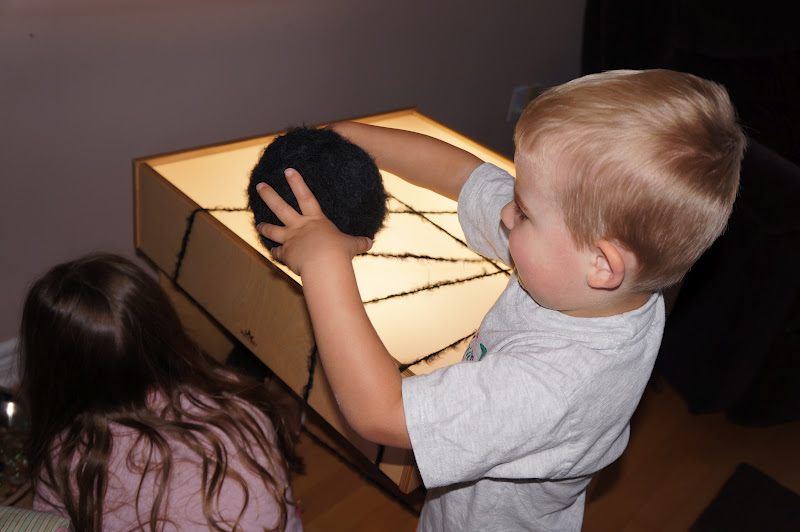
My children have been very interested in spiders lately. We have noticed so many webs in our gardens, especially in the morning when they are covered with dew. I thought it would be fun to use some black yarn and plastic spiders in order to turn our light table into a spider playscape. It was so easy to do!

First I tied the loose end of the yarn to one of the table's legs.


I modeled how my children could wind the yarn around and across the table, weaving it in and out in order to make a unique web. We ended up using two balls of yarn - one for each child - but if you are doing this with a larger group of children you might consider using only one ball and encourage the children to problem solve how they might take turns creating one web together.


This activity took a lot of coordination as each child needed to figure out how to wind the yarn around and across the large table, while keeping it tight enough to retain the 'web like' appearance. They also needed to work together. A few times they ended winding each other into the web and had to figure out how to cooperatively create the playscape.


As my children worked, they began to notice and name the shapes they saw in the web. They also realized that the sides of the table were beginning to look like they were covered in webs too, opening up the possibilities for the play space.


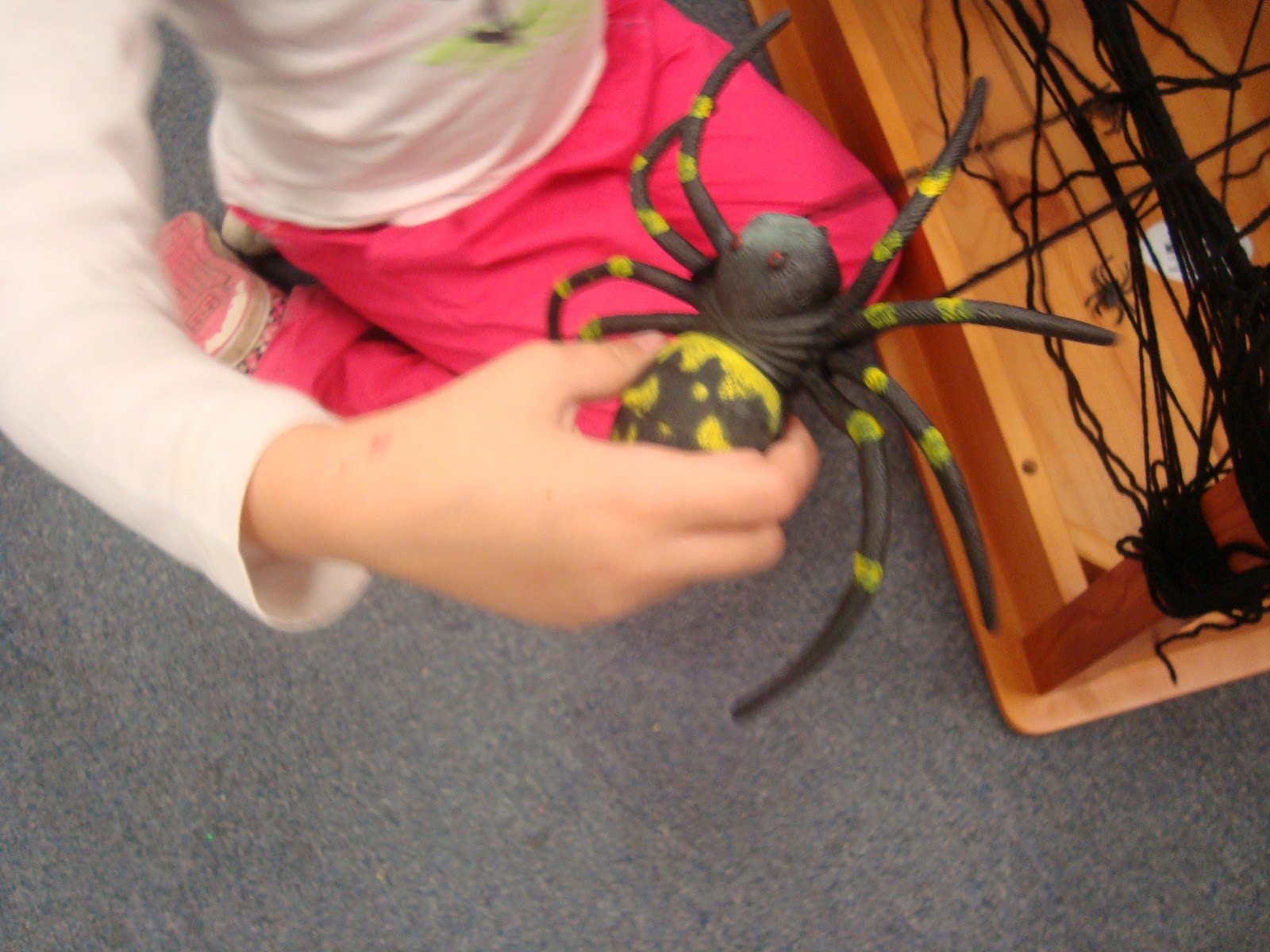
Once they were happy with the web, we added plastic spiders (found as Halloween rings at the local dollar store). I was pleased to see that neither child was reluctant to handle the very realistic looking spiders. I'm hoping it helps them feel even more comfortable with creepy crawlies when they encounter them in real life.


Such an easy way to use little materials and a light table to inspire creative dramatic play. Our spiders had all sorts of adventures on and around the table. Tomorrow I'm going to read some books about spiders and encourage my children to retell the texts on the table.


Friday, December 9, 2011

Delivering Holiday Trees!

Today during one of our circle time discussions, Mrs. Bombardier and the children talked about how some families cut down a fresh Christmas tree. The children were interested in learning how those families transported the tree back to their houses.  During play time, Mrs. Bombardier added some miniature trees to our block center.


The children were drawn to the trees and immediately began to attach them to our toy cars and trucks so they could be delivered to people's houses.


Some children also made houses too!


Check out the sign that one of our children wrote - trees for sale!

Monday, October 31, 2011

Weaving a Spider Web

We wanted to capitalize on the children's interest in weaving and were inspired by a recent post by Teacher Tom (a blog we follow), so we asked the children how they thought they might be able to weave a spider web. We turned a small table upside down, gave the children balls of black yarn, and sat back and watched.


The children immediately began to work together, passing the yarn back and forth and weaving the web in, out, and around. Once in a while a child would move out of the way so he or she didn't get caught in the web.


What an interesting creation and great way to solve the problem of how to create the web.


Once the web was finished, we provided the children with plastic spiders and the web became a dramatic playscape!


Tomorrow we will add sticks, rocks, and greenery to the playscape to encourage even richer interactions between the spiders and children!

Thursday, March 24, 2011

9-1-1 Quack!

We read a wonderful story called "9-1-1 Quack" with the children. This text tells the real story of a mother duck whose 8 ducklings fall into a sewer grate. The duck's frantic quacking leads a police officer to discover the fallen ducklings and help get them out of the grate.  Our children have been fascinated with the text and we decided to encourage them to engage in a dramatic retell using props from around the classroom.


These girls are consulting the text to see what characters and materials are needed to recreate the setting and plot from the story at the retell center.


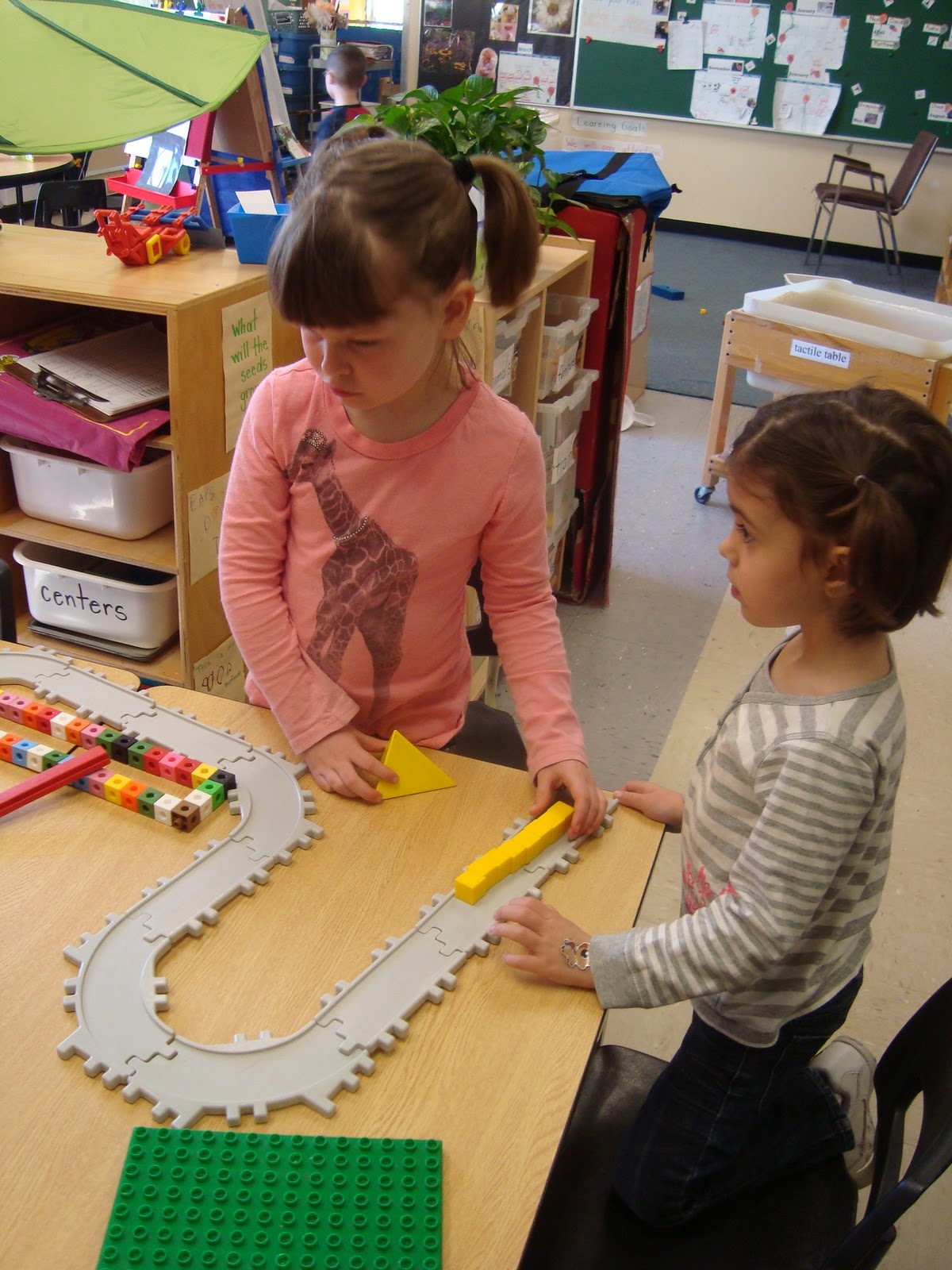
We weren't sure what to use in the classroom to make a grate. This child decided to try and use the unifix cubes. He used mathematical reasoning to determine what size to make the space in the grate - it had to be small enough for the mother to cross over, but too big for the ducklings.


These girls are setting up the road that the ducks walked down. The blue basket represents the pond they were headed towards before falling in the grate.


Characters from the story are gathered from around the classroom.


The grate is put into place. The mother duck is represented by the large yellow triangular prism and all 8 of the ducklings are the small cubes.


The girls decide that the park is where the ducks start their adventure. They create a swing using the straws and balls, the loose green straws placed horizontally represent the grass, plastic trees and a park structure also enhance the setting.


The grate with the ramp the police officer used is ready and in place. The tow trucks are also on stand by.


Retelling the story together.


Here is the retell:


Later on the materials were used by other children who enhanced their understanding of the text by extending the story. Here the boys pretend that instead of following their mother the ducklings play on the swing, preventing them from falling into the grate.


Related Posts Plugin for WordPress, Blogger...