Showing posts with label animals. Show all posts

Sunday, April 16, 2023

Using Outdoor Discoveries to Inspire Rich Math Talks

"It's the little details that are vital. Little things make big things happen."
John Wooden

Now that spring is emerging muddy conditions are common in our school yard. Although some educators shy away from messy spots, I find they are often one of the best places to notice and name rich, authentic math.

One morning the children were exploring the yard and noticed interesting tracks on the path. They took their time observing the different prints they found. They wondered who had been visiting the space and how the markings were made. They noticed that the prints appeared to be dried in the dirt and preserved in the thick mud. 


The tracks that fascinated us the most were those made by animals. Our school is located near a wooded trail and our yard is frequented after hours by coyotes, deer, geese, wild turkeys and dogs. The children compared the different tracks and used their prior knowledge to try and identify the animals. We also used a handy animal tracks identifier to help us as the difference between some tracks is minimal.
 
               
The children were also very curious about the shoe/boot tracks that they found alongside the animal tracks. Within each we noticed intricate shape and line details that differentiated them from one another. We identified many shapes including circles, diamonds, hexagons and squares. There were also many different lines in each - straight, wavy, and zigzag.


We wondered if our footwear matched any of the tracks. The children examined each other's feet to see if they could find a match between their shoes and any of the tracks. This inspired rich observation and discussion as small details were noted and comparisons were made. 
 
In order to capitalize on this interest I printed large photos of a shoe and animal print and brought them to our whole group discussion. I asked the children to consider what was the same and different about each print. I also used the thinking routine 'see, think, and wonder' to facilitate math talk and help the children mathematize the photos. 
We also brought this interest in prints to our art center where children were invited to paint our spare classroom boots and stamp them to see what kinds of prints they made. 
Once the tread prints were dry the children brought them to our whole group gathering time and we continued to observe and discuss the shapes and lines we saw in each. The children grouped the prints according to similarities and also compared the size of the marking to their feet in order to see which was the bigger foot. 
 
As spring weather continues to bring rain, the children's interest in tracks endures. The children are now curious about how long an entire track path is, how deep the prints are in the mud and how much space is in between each print. They wonder about how far and fast the person or animal might have been travelling and use these clues to help them hypothesize the speed and distance. Each time a discovery is made in the yard I carefully document the findings using photos and videos so we can bring the information back to our whole group conversations and build our collective knowledge about tracks. 

Our next step will be to record ourselves making tracks in the mud using digital tools. We will use the different recording options on our smart device including time lapse photography and slow motion recording. These will be interesting to watch and will hopefully help us understand more clearly how the distance, pressure and speed of movement will affect the way a print is made in mud. Stay tuned! 

Looking for a resource to support mud play? Check out my book Muddy Math available on Amazon!

Sunday, October 23, 2022

Mother Nature as Mathematician: Learning Outdoors without Commercial Materials

“In every walk with nature, one receives far more than he seeks.”

John Muir


In our program we spend at least one hour outside each day exploring our play yard and interacting with nature rain or shine (excluding dangerous weather). Although we are fortunate to have an ample collection of materials to use, there are many days that we bring nothing extra outdoors with us. We ask children to interact with the world around them and spend time immersed in nature. Challenged to create play opportunities using only natural elements encourages children to pay close attention to what the world offers and they often wonder about objects and phenomena that they might not otherwise have noticed (e.g., the strength of the wind, an interesting insect, the size of leaves). It's also a great way to encourage children to become resourceful and use their imaginations. In land-based learning knowledge is shared and a respect for nature is encouraged.

 
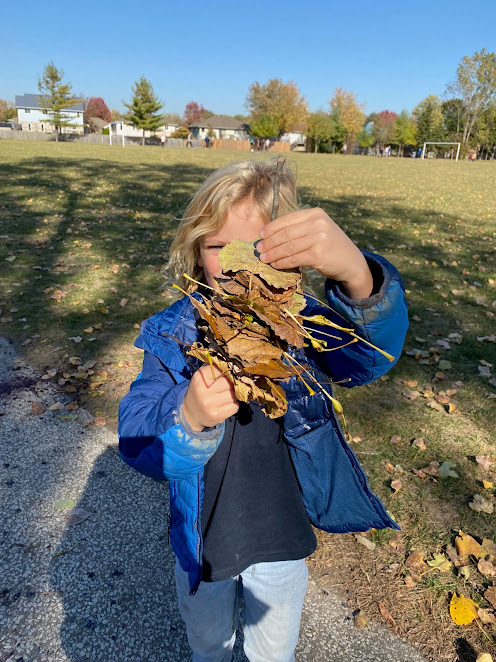
Curious about the size and colours of leaves, the children were encouraged to gather a leaf collection on a stick. This helped them practice fine motor skills and they were eager to quantify the leaves they collected.
 
Much of what the children discover is mathematical. Mother Nature tends to be a beautiful mathematician offering a variety of sizes, shapes and patterns in natural objects. Children are curious as they describe, classify and sort what they find into collections. How many times have you found an assortment of rocks in a child's pocket? Being outdoors without toys also facilitates amazing risky play and children are eager to quantify their achievements (e.g., how fast/high/far can my body move compared to my friend's?). Risky play is an amazing way to encourage math learning in kids (see this post for more information). 
 
I'm often asked by others how children become so attuned with their surroundings and invested in their work in the natural world. I believe that it is because we spend so much time outdoors that children are so immersed and excited. As educators we act as play partners with the children and explore together. We use a 'notice and wonder' thinking routine where we think aloud about something we are curious about (e.g., "I see the leaves swirling in a circle on the pavement. I wonder what is causing them to move that way.") and model for children how we might go about exploring this further (e.g., "I think I'm going to record what I see using my device so I can watch the leaves moving again and think about why this is happening."). I also really enjoy standing away from children and just listening to their observations and theories about the world around them. The things they notice, and the questions they ask, provoke some of the deepest math learning experienced in our program. Children are deeply invested in their work. 
 
Since children become so aware of their surroundings, they are often quick to notice changes. The landscape evolves as the weather and seasons shift and these patterns offer many mathematical learning opportunities. Knowing the land so well also means that children become invested in caring for it and understanding how and why we need to be sustainable learners. 

The children were proud of their abilities to balance on a wiggly log. They decided to count as they stood on it, and see if they could beat their 'time' with each subsequent try.

 After finding a pair of ladybugs in the grass the children created a 'home' for them using natural loose parts. Interesting discussion occurred regarding what the ladybugs would need in their home, and what size would be best for each feature (e.g., bed, kitchen).

 The children enjoyed picking dandelions one spring day. We challenged them to see who could find the longest and shortest stems. Without measuring tools the children had to figure out how to fairly measure each stem. 

Although we are lucky to have a lovely, large play yard to use, exploring nature can happen anywhere. Even a puddle has the potential to spark children's imaginations and facilitate rich discovery and discussion. If your space is limited, consider going on nature walks around the community in which your school is located. Perhaps a trail or garden can be visited nearby. Field trips are also a fun option (e.g., orchard, farm). Bringing natural objects into the classroom is another way to help children connect with nature (e.g., pumpkins, sticks, acorns) and continue their explorations after outdoor time has ended.
 The children marvelled at the circumference of the large trees located near our school. We asked them how they might measure and compare the trunks in order to find the largest one.

 After making snowballs on a winter day the children thought it would be fun to see how many they could stack inside angled branches of a tree.

 
Prints in the snow always spark rich conversation about who (or what) might have visited the yard. 

 
Dew drops on a web discovered early one morning led to fascinating theories about how strong a web must be. 

 
Finding fossilized rocks and identifying shapes and patterns leads to some great imaginative thinking about what might have lived within the rock long ago.
 
Some tips for getting started:
  • Learn more about your local habitat so that you can facilitate discussions with children regarding interesting objects and events that occur in your area (e.g., native plants, migration patterns).
  • Go on guided walks to help children practice using their senses to observe the world around them. Scavenger hunts focused on the senses can be fun and spark inquiries (e.g., listening walks, bird hunts).
  • Start collections of objects found outdoors that can be displayed in classroom (e.g., feathers, seeds, dried flowers).
  • Provide challenges for children that will help them interact with natural materials (e.g., Can you build a house for the ladybug? Can you find and order ten sticks from largest to smallest?).
  • Use tech to support your work outdoors. There are many great apps that can help you identify leaves and insects. Posting ideas and questions on social media can facilitate discussions with others from different areas.
  • Take photos and videos of children's work outdoors and share this for reflection during a consolidation circle. Use the discussion to help spark future work outdoors (e.g., Today we found many flower patterns in the garden. I wonder if there are patterns on other living things in our yard.).  
It's rare that we don't visit the outdoor space. On the days when it is too stormy or cold to head out, we often find children watching the outside world through the windows. In a time when children may suffer from a Vitamin N(ature) deficit, spending unstructured time outdoors without the distraction of toys or teacher-prepared materials may spark a deep love of nature and facilitate rich math learning that would not be possible otherwise.

Tuesday, March 7, 2017

The Mitten Measurement Task

It's amazing the kinds of questions children can ask...
 
One of my favourite books to read in the winter in "The Mitten" by Jan Brett. The story is appealing to young children who love to retell the text and marvel at how big the mitten grows as each animal squeezes into it.  This week I read the book again upon request by one of the children.  At the end of the reading one child shared that she felt that the book wasn't really about "real things, because there was no way all those animals could fit into one small mitten". 
 
Sensing an opportunity for something rich, I questioned the children. I asked them to consider whether a mitten could really stretch that large to accommodate all the animals, and if it couldn't, how big did they think it would have to be in order to do so.
 

The children engaged in a lively discussion and agreed that the mitten would have to be very large - much larger than the one portrayed in the book - and it would be very time consuming to knit. We agreed that one would have to know exactly how big it had to be because if it was too small the animals wouldn't fit, and if it was too big it would waste the knitter's yarn and time.
 
I challenged the children to create a mitten the exact size it would need to be in real life to fit all the animals in the text: a mole, rabbit, hedgehog, owl, badger, fox, bear and mouse.  They readily accepted my challenge. The first thing we agreed upon was that we needed to know exactly how big each animal really was. The children weren't sure how to do this so I suggested researching their sizes on the internet. I helped them with this search.
 
Once we knew the size of the animals I helped the children measure out large butcher paper so that their drawings would be as realistic a size as possible. We discovered that the bear was the largest!


Here are the animals (excluding the bear) after the children researched, drew, and cut them out.


The next thing we needed to do was calculate how big the mitten needed to be. We referred to the book to see if the animals were side by side or on top of each other and then taped together large pieces of butcher paper to create the mitten.


The papers needed to be securely fastened...


...the outline of the mitten cut...
 

...and the seams stapled closed.


The children noticed that when complete the mitten was almost as big as our carpet!


The children enjoyed decorating it too!


We felt that it would be fun to retell the story while we placed each animal inside the mitten. We were eager to see if we were right and the animals all fit inside.


The children waited until it was their animal's turn and then gently placed their animal inside.


Once the retell was complete the children had one more question they asked to explore. Would a mitten that was large enough for all those animals hold 14 kindergarten children? They were quite eager to find out! One by one they hid inside the mitten, squeezing to the end and making room for their friends to join in!
 
This was also an incredibly rich math activity. The children had to consider the area of the mitten and if there would be enough room for all the children. They counted as each child entered the mitten and calculated how many more children were waiting on the carpet. They discussed how to preserve the integrity of their design as they entered the mitten so that it held together so all children could have a turn.


They were right! All 14 children did fit into the mitten!


But the best part of all? Getting out of the mitten!


Related Posts Plugin for WordPress, Blogger...