Showing posts with label book. Show all posts

Monday, January 13, 2025

Goodreads!

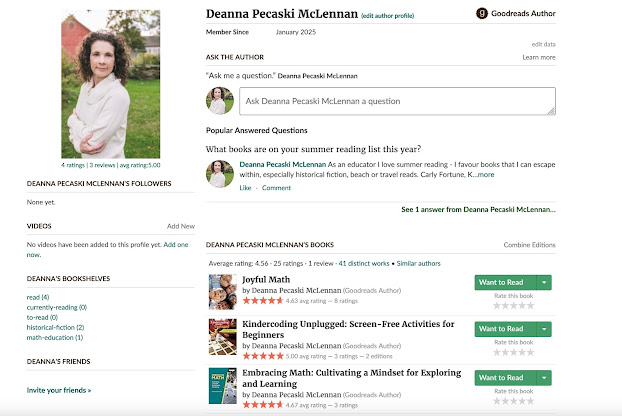
Like many educators I am a avid reader who devours historical fiction. This is nothing like a good book that pulls you in and helps you forget the cold, snowy January weather of Ontario. While researching my next read I stumbled upon the Goodreads website. Where has this been my whole life? I was fascinated to quickly and easily find many titles to add to my reading list. I was also deeply surprised to find many of the books I have authored on the site - not just their titles but ratings too! This inspired me to create an author page in order to help me connect with readers in a new and fresh way. If you are on Goodreads come find me! Even better I would love a review of my books if you have read or purchased them. Come ask me a question or suggest your favourite book to read! I'm excited to connect with you in a new way!

Deanna's Goodreads Page

Friday, July 26, 2024

Book Review

"Exploring trees outdoors is an enjoyable experience that children love to do! Swinging from a branch, exploring leaves and bark, and observing gnarled roots are all favourite activities that also integrate rich learning. Heading outside to explore the yard uses children's excitement and enthusiasm for sensory and nature experiences to inspire rich mathematical and scientific inquiries about what they are seeing and experiencing."


I was excited to see a review of my book Tree Math in the MAMT Spring Journal! You can access the review here!

Thursday, November 4, 2021

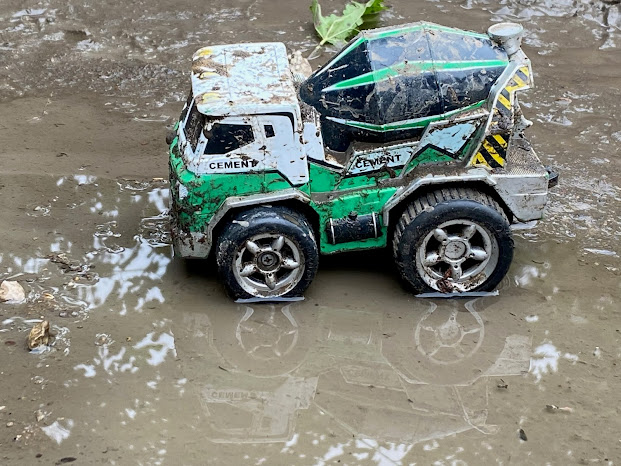
10 Math Concepts that Children Learn from Puddle Play

"Childhood is that state which ends the moment a puddle is first viewed as an obstacle instead of an opportunity."

K. Williams


Puddle play is an incredibly rich learning activity that many children enjoy. Spending time outdoors exploring many natural elements helps children recognize that there is no such thing as bad weather. There is beauty and wonder to be found in every aspect of nature. Sometimes in early childhood education we need to help our families and school community understand the authentic learning that can happen when children play with sensory materials like puddle water outdoors. Demonstrating the meaningful math connections that emerge in this type of play can build support for outdoor exploration and learning. Sharing this through regular communication including documentation can be incredibly helpful in cultivating positive partnerships and support for messy play outdoors.

Here are ten math ideas that can be introduced and strengthened when children play in the puddles:

1. Patterning

When rain drops fall into water their impact disturbs the surface tension of the water. The ripples spread outward from this impact point. This reaction forms concentric circles which are two or more circles that have the same center point. Each subsequent circle is larger than the last, creating a growing geometric pattern for children to explore.

2. Opposites (Float and Sink)

Children love to place objects in water and experiment with what happens to them. A favourite outdoor activity for our children is to place many different objects in water and see if they float or sink. An object's density determines whether it stays above or below the water. The object will float in the puddle if it is less dense than the water. If it sinks, it is more dense than the water. 

 3. Temperature

The temperature of puddles can vary depending on the ground and air temperature. Children enjoy feeling the water with their hands and describing how hot or cold it seems. An engaging activity is to provide kid-friendly thermometers to children and challenge them to read the temperature of the different puddles in the yard. Are the larger ones a different temperature than the smaller ones? Does the temperature of a single puddle change over the course of the day? Ask children to generate theories about why this is happening.

4. Measurement

Sensory experiences are vital for children's growth and development. Most children love to play in mud using cooking items and utensils. A favourite activity for us is to use the puddles for water play. Not only do we not have to worry about a wet floor indoors, children are captivated using cups, spoons, funnels and bowls to collect the water. Challenge children to measure how much water they can collect. Ask them to see if they can empty a puddle and calculate how much water it had altogether. 
 
5. Cause and Effect
Cause and effect activities help children realize that every action they take has a reaction. When children jump in puddles, the water splashes. Experimenting with cause and effect helps children play with variables that can control the reactions in different ways. For example, and bigger jump in the puddle usually results in a larger splash of water. Children can change their actions (e.g., increasing movement, decreasing movement, modifying direction) and observe the results.

6. Comparison
Puddle water can look many different ways. Some puddles are clear while others are muddy and filled with debris. Children can travel the yard and observe/describe what they see as they compare puddles to one another. They can also experiment with the different materials and observe the reactions that occur. For example when water is added to soil, the soil appears a darker colour. This occurs because wetter soil has less oxygen compares to drier soil. Some puddles are so saturated with dirt that there is a layer of mud that settles on the bottom and a layer of water that has risen to the top. As children explore different puddles they can notice and name what they see, and compare the properties of each to one another.

7. STEAM (science, technology, art, engineering, art, math)

STEAM challenges are highly motivating for children. Puddles offer many opportunities for educators to ask children to design and build an object to be used with the puddles. A favourite in our classroom is to ask children to create a puddle boat from loose parts (e.g., wooden craft sticks, cardboard, foam, aluminum foil) that floats. Another highly motivating construction activity is for children to build a bridge over the puddle for the mini cars to use to cross the puddle. 

8. Counting

In our yard we often have very large puddles when the rain falls due to the slope and drainage of the playground pavement. A fun activity is for children to crowd in and count how many can fit in the area of the puddle. Great math questions emerge in this activity - can the same number of children fit in the different sized puddles in the yard? How many boots altogether are in the puddle? Can we count the boots by 2s?

9. Reflection

 
Water is a reflective surface. When the water in a puddle is still, the surface is flat and can easily reflect light. If the wind is blowing and ripples appear, the reflection can become distorted. The harder the wind is blowing the more distorted the reflection appears. This type of reflection also offers an exploration of symmetry as children can identify the line of symmetry and see how each side appears. This symmetry is often curious for children who notice that the reflected side appears lighter/faded than the real object. Children can experiment with reflective symmetry by placing and moving different materials into the puddle and seeing the result.

10. Area and Perimeter

The size and shape of a puddle can often inspire conversation about its area and perimeter as children wonder about how big or small it might be. Sometimes we will use loose parts to help us measure (e.g., How many rocks fit around the outside of the puddle?  How many leaves can float on top of the puddle?). The distance across a puddle is also interesting to measure as children leap across the puddle and measure how far they've jumped, or build bridges to help the mini cars cross the puddle.
 
What other math have you explored in the puddles? Tweet me and share your awesome ideas and experiences! @McLennan1977

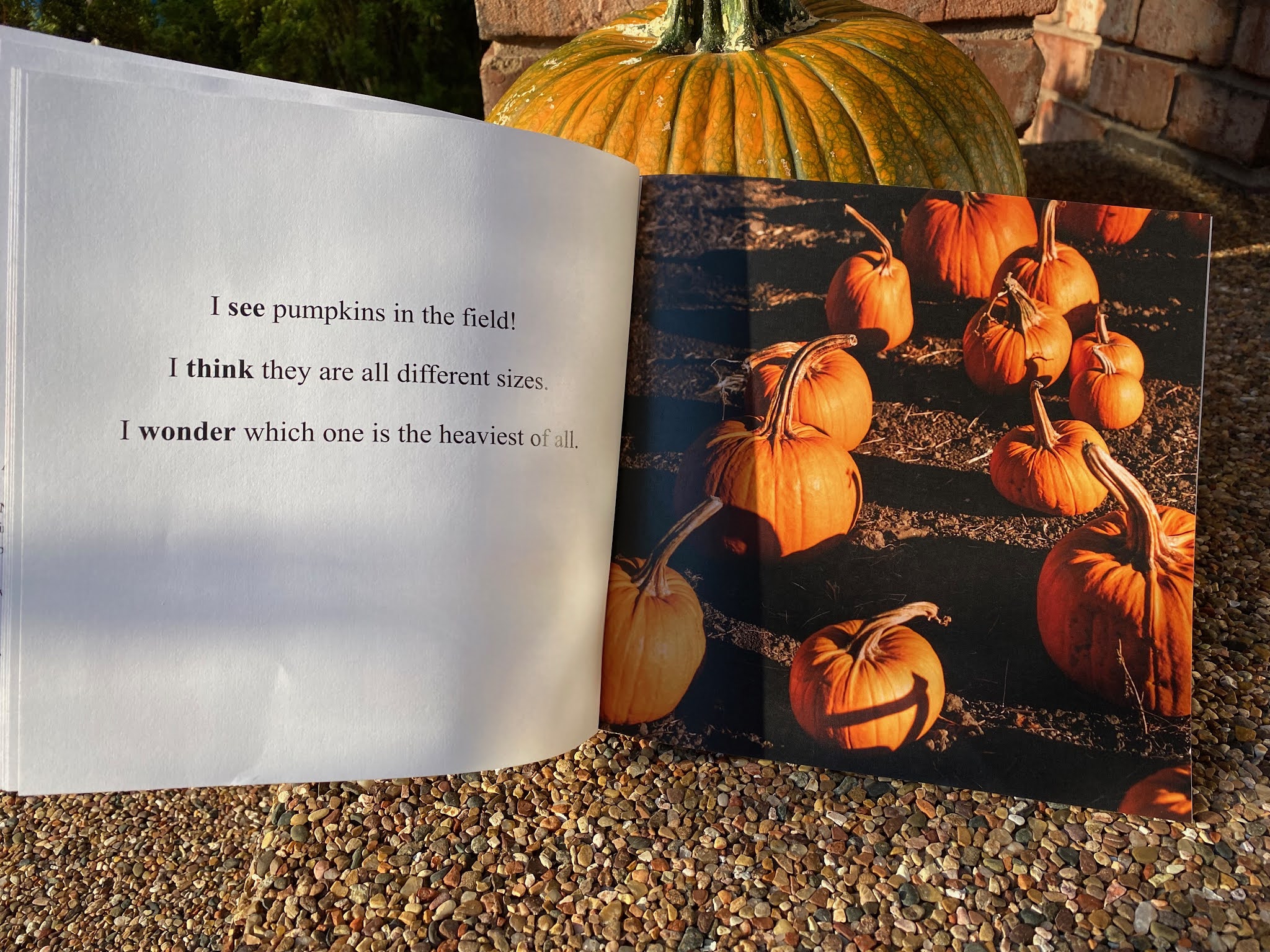
Looking for a resource to read with kids to support authentic math play in the puddles? Check out my new book Puddle Math: See, Think and Wonder! 


Tuesday, November 2, 2021

Most Requested Presentations

Hello everyone! I have been getting many requests for presentations lately. I love working directly with educators, especially in live workshops. There is something magical about helping people (re)discover a love of math. Due to Covid restrictions and my busy schedule, presentations can sometimes be difficult to plan. So as requested, I'm sharing my three most popular presentations here for those who are interested. I'd love to chat about what you are doing in your districts, schools and classrooms! Send me a message or tweet/instagram me @McLennan1977 and we can connect!


Books to continue the learning:


Thursday, October 14, 2021

Autumn Math Walk

 “I'm so glad I live in a world where there are Octobers.”
L. M. Montgomery, Anne of Green Gables 

What a beautiful time of year it is in Southern Ontario! We have been spending much time outside each school day exploring the changes in our school yard. The children are curious about the world around them and ask many questions about their surroundings and the autumn treasures they find. Many of their wonderings have been mathematical in nature - Why is there a pattern on the sunflower's seed head? What are those holes in the stump and where did it come from? Why is a Daddy Long Legs an arachnid and not a spider?  How do leaves change colours? Why are the clouds moving so fast in the sky?

There is math everywhere. If one looks deeply enough, there is always a mathematical connection in nature. The sunflower seeds follow the Fibonacci Sequence - a numerical pattern meant to help maximize space and fit as many seeds into the head as possible. The perfect little circles in the stump might have been caused by a wood boring insect or bird looking deep into the bark for food. Daddy Long Legs have a different body than spiders even though they have eight legs. Leaves change colour because the amount of sunlight they need to create their own food lessens in cold weather (as the Earth's axis tilts us away from the sun), resulting in a chemical change in the leaves. 

I've been motivated to continue to look for rich mathematical wonderings and opportunities for inquiry each time I'm outside - even on the weekend with my own children. I find it fascinating to see math applied in an authentic, interesting, real world connection. The math in nature is beautiful! Inspired by this mathematical beauty I have written a book called Autumn Math Walk that includes photos and narrative to help readers delve deeply into exploring math in the outside world. I've appreciated the interest in this book and loved seeing the ways educators have used the text in their classrooms. Learning from one another is so inspiring!


I'm so very excited to partner with Pembroke Publishers and offer a free teaching resource to complement my book Autumn Math Walk!

Autumn Math Walk Teacher's Guide is a free resource that can help educators understand the math that exists in the natural world, and use this information to provoke conversation and understand with children as they explore nature. Perhaps children will be inspired to author and illustrate their own Autumn Math Walk book unique to their specific surroundings!

Saturday, October 2, 2021

Pumpkin Math

Autumn is such a wonderful time of year! The colours and textures can inspire such rich math conversation! This past weekend we visited a few farm stands in the area and all I saw was math around me! I'm hoping that these photos will be useful as math prompts for 'math talk' conversations with children.

Show children a photo and ask them to share what they 'see, think and wonder' about each photo. The 'see, think, wonder' thinking routine can be used to help children delve more deeply into exploring and articulating what they notice in a specific situation. As children notice and name what they see, they can make connections to their own experiences and ideas, and form questions for further exploration and math research. 

Educators can also ask children specific math questions to guide their thinking. This can be especially helpful if the math concepts in the photos are geared towards an existing exploration the children are having, or if specific curriculum and assessment investigations are needed by the children. Sample math questions are provided below!

How many bumps are on this pumpkin?
 How big around is the stem?
What patterns do you notice?

How are these gourds organized?
What other ways can you sort the objects?
How many do you think are in each bushel? How do you know? 

 
What patterns do you see?
Why is the pumpkin more narrow at the top?
How big around might this be in the largest part?  

How many pumpkins do you estimate are in this box?
How many pumpkins might fit in the box if it was filled to the top?
How much money do you think the farmer should charge for the entire box of pumpkins? Why?

If these pumpkins are $3.50 each, how much would all of these cost? 
Should bigger pumpkins cost more than smaller ones? Why?
Which do you think is the biggest? How do you know?

Which pumpkin would you pick if you only had $2? Why? 
If you had X dollars, how many pumpkins could you buy?
How much money do all these pumpkins cost altogether?
What symmetry do you notice?
What patterns do you see?
How many pumpkins would a full crate hold?
 
Which gourd does not belong? Why?
How could you sort these? What's your sorting rule?
How many gourds do you think are in this bushel?
 
Halloween Math uses the 'see, think, wonder' thinking routine to explore seasonal objects and experiences in a mathematical context and is now available from Amazon!
Wednesday, August 18, 2021

Joyful Math Preview, Webinar and Review

Curious about my book Joyful Math? Click here for a preview!


"Deanna shows us that math can bring joy! Written to support play-based math learning for young children in clear and concise language, this colorfully illustrated text is all you need to give the gift of math to children. When math is connected to children's play it becomes real, meaningful, authentic, and joyful for children and their teachers."
--Dr. Diane Kashin, RECE, retired early childhood education professor, co-author of Play and Learning in Early Childhood Education

"Deanna's book provides a window into an early childhood classroom, sharing stories of young children's mathematics learning. The mathematics is embedded in a place of wonder, joy, and collaboration, full of playful learning with materials. The classroom stories share a joyful approach to the teaching and learning of mathematics which is sure to both inspire and provide a wealth of ideas for educators."
--Janice Novakowski, District Teacher Consultant (Mathematics) in Richmond, BC, Canada and coordinator of the BC Reggio-Inspired Mathematics Project

"In this beautiful book, Deanna McLennan shows us how teachers can create an environment for children to engage in mathematical play and learning with joy, curiosity, and discovery. Teachers will welcome these wonderfully authentic invitations to bring joyful playful math into their classrooms throughout the day."
--Katie Keier, kindergarten teacher and co-author of Catching Readers Before They Fall: Supporting Readers Who Struggle, K-4

"This is so much more than a math book. It's about a kindergarten teacher who is confident in her teaching, passing on sensible suggestions and practical advice to others who are looking to create interesting, engaging learning environments for their children, outside and in. It contains nuggets of commentary that are an inspiration and a joy to read. It's a reflective narrative of how Deanna integrates math into her everyday life of the class in meaningful and respectful ways based upon the principles and practice of the Reggio Emilia approach."
--Juliet Robertson, author of Messy Maths: A Playful, Outdoor Approach for Early Years

"What if all children had joyful math experiences in their earliest years? You may be wondering what would that look like and where do I start. Read Joyful Math and step inside Deanna McLennan's masterful, joy-filled kindergarten classroom. Here the natural curiosity, inventiveness, and exuberance of children is harnessed for deep mathematical learning through exploration and play. Deanna respectfully shares with teachers the methods she has developed over the years to surpass mathematical standards without leaving joy to chance. Rich with stories, conversations with children, and awe-inspiring photographs, Joyful Math is a game-changer for the early childhood math landscape."
--Katie Egan Cunningham, author of Start with Joy: Designing Literacy Learning for Student Happiness

Interested in learning more about how to bring Joyful Math to your classroom? I am pleased to share a webinar here that I have presented in the past for Pembroke Publishers.

"Join author/educator Deanna Pecaski McLennan as she discusses building a kindergarten classroom in which math is inseparable from everything students do. She encourages you to create invitations to engage with math through art, literacy, and outdoor play. With stories from her own classroom, Deanna inspires you to be curious about math, take risks, try new approaches, and collaborate with children as co-learners."
 
 
Read the review for Joyful Math in the June 2021 issue of Professionally Speaking. 
 
 
Eager to learn more? Consider joining the Facebook 'Joyful Math' book talk happening September to November 2021 on Facebook!  
 
Have you read and enjoyed Joyful Math? I'd appreciate a review on Goodreads or Amazon! Thank you!

Thursday, October 22, 2020

New Podcast!

PODCAST: Building a Curious and Playful Early Childhood Math Community

In this episode of Teacher's Corner, I talk about my new book, Joyful Math. I also discuss how to nurture a curious and joyful early childhood math community with the author of Early Childhood Math Routines, Antonia Cameron. 


Click here to listen:  https://blog.stenhouse.com/podcast-building-a-curious-and-playful-early-childhood-math-community

Related Posts Plugin for WordPress, Blogger...