Friday, October 9, 2020

A Playground for Mr. Big Legs - STEM in the Outdoor Classroom

"Look! Look at this spider! His legs are so long! Let's call him Mr. Big Legs!"

The children found an interesting spider in the garden one day. Curious, they gently picked it up and let it climb up and down their arms. It was so graceful in its movements that even reluctant children came for a closer look.

"He's so cute! Why was he in the garden?"

"Maybe that's where he lives."

"How do you know he's a boy?" 

"The garden is so boring for him - nothing is growing right now."

"I know! Let's build him a playground!"


Curious about the children's ideas and how I could use their interest in spiders to enrich our outdoor space, I took photos and mentally planned for how we might proceed next. I considered what curriculum expectations might be met, and anticipated the math that might emerge. Such a simple and quick interaction with nature sparked a rich mathematical inquiry in our outdoor classroom that lasted for several days.  

Our first step was to conduct some research. What did children already know about spiders? What did they wonder about Mr. Big Legs specifically? How might they design a playground that he would like? What could they use to help them acquire more information?

We read a number of texts together to gather information that might help enrich their understandings of what exactly a spider was and needed in order to survive. We organized our ideas on a large chart paper and referenced this over the course of our inquiry.


While exploring our school yard for more spiders, we noticed a really interesting tunnelled web just outside our window. The location was the perfect place to set up a 'spider observation window' where children could safely check on the spider during play time and carefully watch it in its habitat. Not only did this give children an additional opportunity to research, it provided children who weren't comfortable holding a spider a safe way to observe one up close without needing to handle it. (We wondered if the spider had eaten two others, or if this particular one shed its skin.)


The more the children learned about spiders, the more determined they were in their quest to create a playground for Mr. Big Legs. They designed spaces for him - a garden, house, slide, swing, and bridge - by drawing blueprints on their clipboards. They considered the size, shape, and materials needed for each creation.


During the next outdoor play time, the children brought their drawings outside and referred to them as they worked in the garden. Some children enhanced their drawings and others started anew. They looked to the materials available outdoors, and planned for how to build using only natural materials found in our space. 


Their work was stunning; the level of thought put into creating the tiny structures was incredible. Children considered measurement and proportional reasoning as they built to scale. Here are some of their creations:

A bed - notice how the sticks point upwards in a circular direction and there are leaves to cushion the center. "The leaves will be so comfortable for him! It will be a soft place to sleep, and the sticks will keep other bugs away."


A swing - notice how this child has balanced the top section of the swing onto two sticks. Later on he would add a long, slender leaf in the middle for Mr. Big Legs to swing on. "I hope that he can balance because this isn't very stable right now."

An obstacle course - notice how Mr. Big Legs will have to climb through the structure, along the stick, hop on top of each of the stones and land on the leaf. The child who build this sequenced the steps in her course and articulated exactly what the spider would need to accomplish along the way while playing here. "This would be so much fun to play on - do you think he will know where to start and where to finish?"

 
A bedroom - this child created a circular structure so that Mr. Big Legs could weave a web near his playground using the rocks as anchors. She knew that many spiders used webs as a home and place to catch prey, and wanted to be sure he had this in his new area. "Spider webs are circles, so I put the rocks in a circle."


A garden - this child dragged his fingers in the dirt to make rows for Mr. Big Legs to use when planting rows of vegetables. "They need to be evenly spaced, because they need room to grow. That's what my dad does in our garden."


A slide - this child placed two sticks together on a slope resting in the corner of the garden. "I wonder if he will know to lift his legs. If he doesn't then he won't go down as fast because they are long and will bump against the slide."


A bridge - this child broke twigs so that they were approximately the right fit to be placed in the narrow hole in the garden. "I couldn't find any sticks that fit, so I broke them. I think Mr. Big Legs needs a bridge in case this hole is too deep for him. If it rains maybe he can pretend it's his pool.

Towards the end of the week the children found another Mr. Big Legs climbing on the brick wall. They eagerly picked him up and placed him in the garden so he could explore everything they had created. Proud of their work, they pointed out each structure and explained to him how he could use the equipment.

"This is your slide and here's your swing. You can play on those!"

"I made you a garden in case you don't catch any bugs in your web."

"And when you get tired, here's a bed for you to sleep on!"

I couldn't help but smile at their enthusiasm. I was amazed that something as simple as finding a spider in our yard could inspire such authentic STEM learning.

Friday, August 28, 2020

In Conversation With TVO Teach Ontario

 I was very excited to share some of my math ideas with the 'In Conversation With' feature of TVO Teach Ontario. You can read our interview here: In Conversation with Deanna Pecaski McLennan.


Friday, August 21, 2020

Inspiring Math Learning Outdoors using Moments and Photos

The world outdoors is filled with amazing math moments. Almost anything you find - whether it is natural or man made - contains an element of math.

From the symmetry we find in flowers or garden wheels...        


...the interesting shapes we can spot in structures and found objects...    


 ...the uniquely formed angles hiding in unexpected places...


 ...to the potential for discovering and playing with numbers.


The world around us uses math in the most interesting of ways.

Many educators are looking ahead to this school year, wondering how to engage children in authentic math moments while decreasing the risks associated with the current pandemic. Many experts recommend holding classes outside. This option is appealing, but some wonder how to take the math learning they traditionally offer in the classroom to the world beyond. How might one fulfill curriculum expectations and assess student learning while being outside?

I suggest looking to the world around you for math inspiration! 

Whether you are a teacher who will be holding your classes outside, or planning to engage children in online learning, using the outdoors to inspire math talks can be an authentic and exciting way for children to delve more deeply into math concepts while seeing their application to real life. 

Teachers can chose specific photos or places in the yard to introduce curriculum concepts needed to be covered (e.g., showing a photo of rain drops in a puddle to introduce the concept of radial symmetry) or ask children to see/think/wonder about a phenomena they notice and planning a mathematical inquiry centred around this (e.g., estimating and then problem solving for how to calculate the number of daisies that have grown in the garden).


There is math potential everywhere!

To help get you started, I have compiled a collection of 75 photos featuring natural and man made objects from the outdoors. You can access these here: Photos to Inspire Math Conversations

Feel free to use them to inspire math conversations in your physical classroom, or during an online math talk. Download them, print them, use them however you'd like to facilitate math learning with your students. Heading outside to explore math might seem daunting at first, but listening to the observations and questions that children have can be a wonderful start to a rich, mathematical inquiry.

I'd love to see the math learning you experience as we head back to school. Don't forget to tweet me @McLennan1977 and share the amazing #foundmath you discover in your explorations outdoors!


Thursday, August 20, 2020

Interview with CBC Afternoon Drive


It was a pleasure to chat with Chris dela Torre about my award winning paper 'The Beautiful Tree Project" on CBC's Afternoon Drive! To listen to our interview check out the link:

One LaSalle-area kindergarten teacher took her math class outside


Sunday, March 15, 2020

Spring Math

The last week has been interesting for those of us adjusting to a new kind of normal here in North America. Like many of you, my family and I had a whirlwind of a week - cancellation of a trip two years in the planning, notice of school closure for weeks after our March Break, no time visiting family and friends, and limits to how often we are travelling in our local community.

The first few days were surreal; I had a difficult time saying goodbye to my students on Friday, wondering how long it would be until I saw them again. As my teaching partner and I prepped our centers and morning message, we worried about when the next time we would see each other might be. I walked out of school bringing home my plants, teaching materials, and personal belongings, not knowing when I would return.

In times of uncertainty, helping one another is one of the best ways to get through the stress and worry of what awaits. I know that many educators and families right now are wondering how to help support children even when we can't be together physically.

I love math. I also love to help educators, families and children love math. I have decided to create this blog post in order to continually provide ideas for how children can explore math in their natural world. The CDC is asking us to engage in social distancing and being aware of what is recommended is important. Right now being outdoors in our yards, on trails, and in gardens is still safe and encouraged. I realize that some of us are limited by our personal circumstances and not everyone has access to a yard or natural trail. I will try my best to vary activities in order to meet as many circumstances as possible. I will also tweet ideas for math learning on a regular basis @McLennan1977.

My hope is that the website will give ideas to educators who might be providing virtual support to the children and families in their care (e.g., if you are providing home schooling ideas, if you are engaging children in virtual classrooms), or ideas for families who are trying to engage their children in a sense of normalcy by playing and exploring math together in the outdoors. Check here regularly for new ideas as I will add more every few days, and feel free to email me questions or suggestions deannapecaskimclennan@yahoo.ca.

Here are some fun ways to get outside and see/think/wonder about the math you discover:

1.  Natural and Man Made Patterns
Go on a hunt and see what patterns you can see or hear (e.g., bird calls, veins on leaves, fence posts, brick designs, tile mosaics). Bring a clipboard and crayons and ask children to copy and extend the patterns they see. Ask children to classify the patterns as natural or man made.

2.  Same and Different
Choose two or more random objects from the outdoors (e.g., a rock and stick, a leaf and bird). Ask children to describe the characteristics of each and see how many similarities and differences they can find between the two objects (e.g., a rock and stick are both hard and nonliving; a stick is longer than a rock).

3.  Number Hunt
Choose a range of numbers appropriate for the age of the child (e.g., 0 to 10, 0 to 20, 0 - 100). Create an easy template for children to use that help them track the numbers they see. Go on a walk with your child and encourage him or her to record how many of each number they can spot by placing a check mark next to the corresponding number on their sheet. At the end of the walk calculate how many of each numbers were spotted and analyze your data (e.g., which number was spotted the most, least, the same).

4.  Estimate and Count
Before venturing out with a specific destination in mind (e.g., biking around the block, walking to the mailbox) ask your child how long it will take to get there (e.g., five minutes to bike one block, twenty steps to the mailbox). Decide how you will conduct an accurate measure (e.g., use a stopwatch to time your bike ride, count steps as you walk). Once you have reached your destination compare your estimate to the actual measurement. What do you notice?

5.  Shape Hunt
Take a sketch pad and pencil with you on your next walk. Encourage your child to spot shapes in the world around them. Ask you child to consider if these are natural or man made shapes (e.g., a round flower, a triangle in the climber). Encourage your child to sketch a picture of the shapes they find or take digital pictures that can be reviewed at a later date.

6. Shadow Play
 
Experiment with how your shadow reflects your exact movements by playing in the sun. Ask your child to consider whether or not the shadow is a reflection? Ask them to explain their thinking and justify their reasoning. Play with shadows at different times of the day. Digital photos can be taken and the lengths compared.

7. Wiggly Worms
Worms are a treat for many children to find on wet, spring days. Ask the child to closely examine how the worm moves, and hypothesize how it travels so easily without arms or legs. Worms move by constricting their body muscles in a pattern. Ask the child to closely examine the stretching and pulling motion that it makes while wriggling about.

8. Puddles
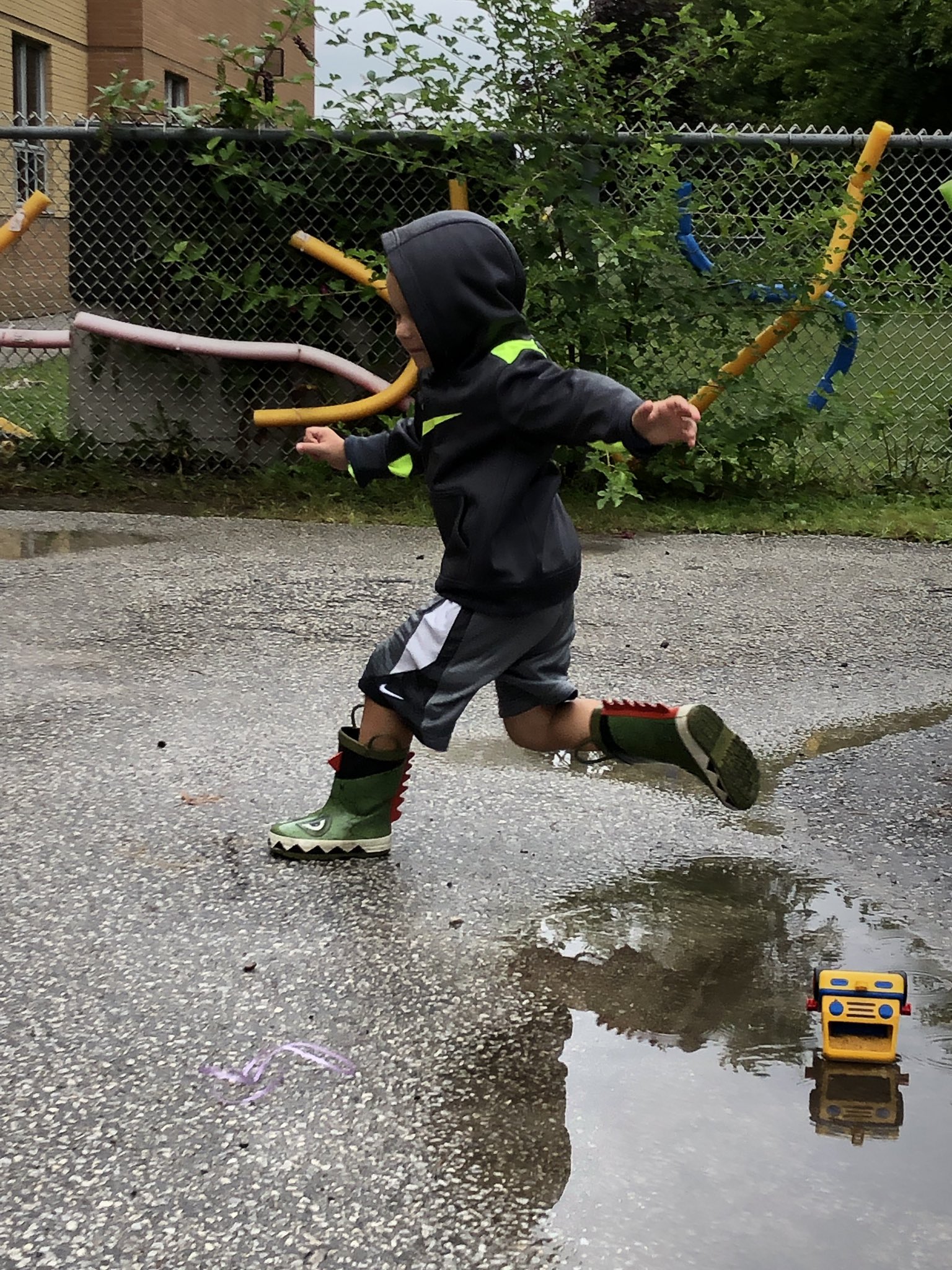
Children love to jump and splash in puddles. Puddles offer children many rich math opportunities too! Ask a child to determine how deep a puddle might be (e.g., looking at how high it is on their boot, using a stick). Ask the child to hypothesize how s/he might go about measuring just how much water is in the puddle. Watch the puddle over time and record how long it takes to evaporate. Note how much smaller it is each day by drawing the outline with sidewalk chalk each passing day and comparing the different rings to one another. 

9. I Spy
Encourage children to pay careful attention to their surroundings. While walking outdoors look for interesting designs. Play a math "I Spy" game with children using only math clues (e.g., "I spy something with a circular pattern." "I spy something that has a growing pattern.").

10. Bubbles
 
Blowing bubbles provides an opportunity to engage your child in rich discussions about open ended math questions: What is the biggest/smallest bubble you can blow? Why is the size of the bubble different depending on the force of your breath? How high/far do you think your bubble might travel? 

11. Unusual Numbers
 
Encourage your child to look for numbers in unusual places (like the 185 on this hydrant). Ask your child to identify the number, and hypothesize the purpose for the number. See if you can find other similiar objects with numbers too (e.g., find other hydrants and keep track of what numbers are listed on each).

12. Foil Textures
 
Look for interesting textures outdoors (e.g., tree bark, bricks, paving stones). Give your child a small piece of foil and encourage him/her to smooth the foil on top of the object, carefully revealing the texture as the foil is pressed and molds against the object.

13. Number Challenge
Keep track of the different numbers you find. Challenge your child to find specific numbers (e.g., the highest number, the lowest number, their age, an even number, an odd number).

14. Sorting Rule
 
Find an interesting collection of objects (e.g., pile of rocks, sticks, flowers in a garden). Ask you child to list as many different ways that she/he could sort the objects as possible (e.g., sort by size, colour, shape, function). If possible ask your child to physically sort the objects.

15. Different Number of Groupings
 
Challenge your child to find groupings of objects. Can you spot 2s, 3s, 4s, & 5s? Here we spotted 3 groupings of 3 grasses for a total of 9 similar plants in the yard. Encourage multiplicative thinking when asking your child for the total number of objects (e.g., Three groups of three equals 9.).

16. Tape Resist Art
 
You (or your child) can create an interesting geometric design with tape on a flat, outdoor surface. Fill each section of the tape with sidewalk chalk or paint. When each section is filled, remove the tape to reveal a beautiful piece of mathematical art!

17. How Many Steps?
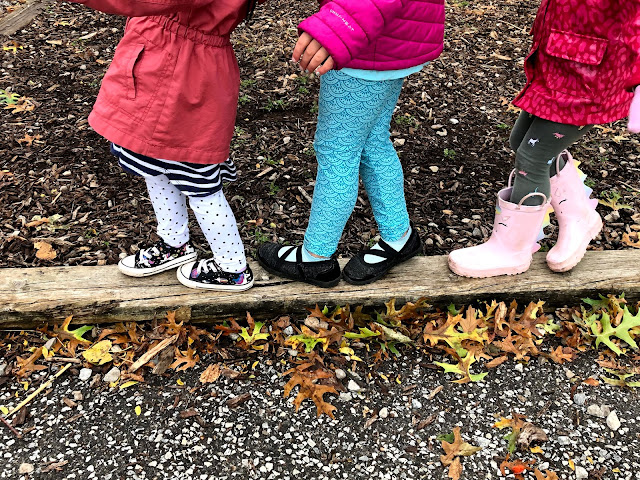
Find a challenging walking surface, like the wooden beam at the edge of a garden. Encourage your child to walk one step after the other along the length of the beam. Count each step. See how many steps your child can walk before she/he steps off the beam. Challenge your child to reach the highest number she or he can!

18. Leaf Patterns
 
Look for leaves on your walks - new leaves are emerging with the warmer weather and many older leaves are preserved in piles gathered in landscaping. Turn the leaf over and examine the vein pattern you discover. Use crayons and paper to create rubbings of all the different patterns you find.

19. Measuring Stick
 
Create a 'measuring stick' by finding a sturdy branch outside and wrapping it in equal segments using a heavy duty duct or masking tape. This is a nonstandard measuring tool so as long as the segments are equal, it will work. Encourage your child to explore the outdoor space and look for different things to measure (e.g., the depth of a puddle, the height of a plant).

20. Outdoor Easel
 
Create an easy 'easel' for painting or drawing still life observations outdoors by using a recycled plastic hanger to attach a paper to the fence. The hanger prevents the paper from blowing in the breeze, and can be used to hang the painting until it is dry. Encourage your child to paint or draw patterns that are visible in the outdoor space.  

21. Real Life Arrays
 
Encourage your child to look for real life arrays while exploring the neighbourhood, Help your child reframe the array as a multiplication sentence (e.g., "Three rows of three is the same as three multiplied by three.") and ask you child to calculate the product.

Spring Math Walk

To help inspire children and provide background information regarding the math that is accessible in the natural world around us, I am making the Kindle version of my newest book Spring Math Walk free on March 19. This offer is only valid on the amazon.com site. I will add additional dates in the future. I'm hoping that this free resource will be of interest for families looking for additional math information for their children - helping them venture outdoors and becoming inspired by the amazing math nature has to offer!


Saturday, October 26, 2019

Autumn Math Walk


"Notice that autumn is more the season of the soul than of nature."
 Friedrich Nietzsche

What better time of year to head outside and enjoy the beauty of nature than in the fall!

We have been spending long amounts of time each day exploring the treasures in our yard. The children have been fascinated by how the world around us is changing - leaves are changing colours and falling from trees, Monarchs are gathering the last bit of nectar from the garden before heading South, and we are enjoying the last flowers in our gardens before they wilt and dry.

The children have had many questions about some of the interesting objects they have found in the yard - stumps, leaves, creatures and flowers.


Many of their wonderings have been mathematical in nature - Why is there a pattern on the sunflower's seedhead? What are those holes in the stump and where did it come from? Why is a Daddy Long Legs an arachnid and not a spider?  How do leaves change colours?

There is math everywhere. If one looks deeply enough, there is always a mathematical connection in nature. The sunflower seeds follow the Fibonacci Sequence - a numerical pattern meant to help maximize space and fit as many seeds into the head as possible. The perfect little circles in the stump might have been caused by a wood boring insect or bird looking deep into the bark for food. Daddy Long Legs have a different body than spiders even though they have eight legs. Leaves change colour because the amount of sunlight they need to create their own food lessens in cold weather (as the Earth's axis tilts us away from the sun), resulting in a chemical change in the leaves. 

I've been motivated to continue to look for rich mathematical wonderings and opportunities for inquiry each time I'm outside - even on the weekend with my own children. I find it fascinating to see math applied in an authentic, interesting, real world connection. The math in nature is beautiful! Consider going on your own autumn math walk and seeing what amazing questions and connections emerge with on your journey!

I'm excited to publish my first children's book Autumn Math Walk (Kindle edition) on amazon now. Stay tuned for a print version!


Saturday, September 21, 2019

Math and Literacy Family Bags

Many families are eager to help their children practice literacy and numeracy work from school. Although traditional 'paper and pencil' homework is not developmentally appropriate in many circumstances, providing 'take home' games and activities in the form of literacy and math bags is welcomed and appreciated by many families. These interactive, hands-on, developmentally appropriate activities are easy to create and target many emergent skills and knowledge needed by young children. They are a good alternative when the school community expects work to be sent home from school. Take home bags help parents and guardians understand how literacy and numeracy can be nurtured and celebrated in the lives of young children.

You can access these, along with many free math printables, here:  https://www.teacherspayteachers.com/Store/Joyful-Learning-In-The-Early-Years

As always feedback and suggestions for future resources is always appreciated!


Saturday, September 14, 2019

Exploring the Outdoors Mathematically with the Five Senses

Stop! Listen!”

We were outside lining up next to the school ready to head in and start our morning when Carleigh held up her hand indicating that she wanted her peers to halt their conversations and pay attention.

“Do you hear that?”

In the distance I heard what had caught Carleigh’s attention. It was the joyful ‘chick-a-dee-dee-dee’ of a Black Capped Chickadee, a friendly native bird that enjoyed foraging in the yard adjacent to our playground.

“It’s a pattern!” Emme observed. “I hear it too! I hear the dee-dee-dee part over and over.”

The chickadee continued its happy song and we stood as still as we could and listened.

“I hear it too!”

“Chick a dee, dee, dee! Chick a dee, dee, dee!” Carleigh sang-song and within a few minutes the rest of her peers joined in, repeating the cadence of the neighboring bird’s early morning song. 

The natural world is waiting to be discovered and often the math that children first uncover is through mindful observation with their senses - sight, touch, taste, smell, and hearing. Children who emotionally connect with and nurture their surroundings will grow to be environmentally conscious and mindful of their impact on the earth. We spend at least an hour outside each day - this includes guided, teacher provided invitations and activities for learning, and also free exploration by children in the yard. This year we are also hoping to start 'Forest Fridays' where we walk the local nature trails in the community around our school on a weekly basis. The outside holds amazing learning for children. Helping children notice and name their mathematical findings by incorporating the senses increases their understanding and connection with the world. There are also many wonderful children’s books about the human body that can be used to introduce each sense and help children focus on paying attention to a particular sense when outside. ImageImage One of our favorite math activities is going on nature walks mindfully focused on one sense at a time. Children walk together and use technology to capture their findings (when going on a ‘hearing walk’ the children listened for different sounds in nature and we used the microphone feature of our iPads to capture what they discovered). Sometimes the math may begin to blend and blur with science topics. This is an important connection for children as they see the relevance and authenticity of math in their everyday life. It is also another way for educators to justify the time spent outside; integrating subjects such as math and science helps to fulfill more standards while making learning more meaningful and relevant to children's lives. So many children (and adults!) consider math (and science) to be 'textbook subjects' - ideas that are taught in a classroom in isolation from the rest of the world - when tangible and concrete exploration of these concepts is developmentally appropriate and helps children see the relationship between school subjects and their own lives.
Some suggestions of starting places include:
Sight *Ask children to observe the world around them. Using your eyes/sense of sight, what do you notice? What do you wonder?” These open-ended prompts help children to think deeply about their surroundings and notice and name small details. It also empowers them to ask the math questions about the world around them instead of following the teacher's lead.
*What patterns can you see and identify in our space?
*What shapes do you notice in your surroundings?
*Can you locate different numbers or groupings of objects? A pair? A group of three, four, five, etc. *How many different shades of one color do you see?
*Can you group objects based on a sorting rule?
*What’s a reasonable estimate for something large - how many leaves are on the tree? How many ants might be in the garden?
*Can you search the yard and locate/match similar objects based on how they look?
*Play a game of “I Spy” using math language and encourage children to make predictions on what object you are referring to (“I spy with my little eye something larger than my hand…. Something taller than our fence…) 
Touch *How do different objects feel? Can you describe them? What do you notice? What's the same? Different? After children have shared their observations you can also highlight the size, shape and texture of the various objects.
*Can you describe the object in a mystery bag by how it feels? Can you guess what it is?
*Run your hand along a patterned object and describe what it feels like.
*Can you sort objects based on how they feel (hard, soft, squishy)? 
*Encourage children to create a collage using natural objects they find in the yard. Identifying the object’s characteristics and then classifying and sorting helps children build data management skills. Children can discuss the inspiration behind their choices or their placement on the collage.
*Bring sculpting materials outside including play dough or clay and encourage children to sculpt it using natural loose parts. What prints can they make in the dough using different objects including pinecones, leaves or sticks? Can they see or feel patterns pressed in the dough? How do they describe these patterns to others? Can they continue a pattern? 
*Give children touch challenges - who can find the heaviest item in the yard? How many children does it take to lift this object? Is it even possible to lift it? How do children problem solve when they find an object that cannot be moved? Can they find the lightest? Can children order a collection of rocks by weight (lightest to heaviest) or flowers by shades of the same color (lightest to darkest)? 
*Ask children to feel different objects and describe their temperature. Are items hot? Cold? Can their properties change if heat or cold are added?  
Taste *Eat snack or lunch together picnic style - as children eat ask them to classify their food. What kinds of food do they have? Can they describe what they are eating using mathematical terms? (“This jam sandwich is so sticky I need to chew it ten times before I swallow!" "My celery stick takes five crunches to eat." "I lined up my crackers in a pattern!").  
*Harvest seeds, fruit or veggies from a garden and ask the children to count how many of each item they have grown. Can children measure to see how long their fruit or veggies are? Provide samples of each food and have children vote on whether or not they enjoyed the taste. Children can write their own recipes using these harvested foods and experiment with preparing or cooking them in different ways. 
*Offer children foods grown from the local area. After tasting samples of each ask the children to classify the foods using a common characteristic (crunchy, sweet, tangy, mushy, sour). Photos can represent each food and be placed in the appropriate place on a sorting ring or on a chart. 
Smell *Ask children to identify and describe the different smells they notice in various areas of the classroom, yard or school. What connections to the smells can they make?
*Encourage children to go on a ‘smell hunt’ around the yard and find natural items with different kinds of smells (sweet, strong, unpleasant). Children can place the object on a chart placed in a central location. After the hunt children can calculate how many of each item were found.
*Play a game of mystery smell. Place an object in a bag and have children close their eyes and smell. They can use language to describe the smell and then indicate whether or not they liked it by voting on a class chart. 
*Children love to create their own ‘potions’ outside. Often when objects are crushed they release a stronger smell. Encourage children to create their own recipes or smell equations by gathering different objects outside and mixing them together. Children can also use large rocks to crush and mix the objects together. Provide clipboards and pencils so children can write down their ‘equations’ (10 rose petals plus a handful of grass equals a sweet and strong smell). 
Hearing *Ask children to mindfully sit on a blanket in the middle of the outdoor space and close their eyes and observe what they hear. Can they identify what the sounds might be? How many different types of sound can they count? Can they guess the direction and distance of each sound? What patterns can they identify (bird calls, insect chirps). 
*Ask children to use their bodies to make different sound patterns. They can clap, stomp their feet, tap their knees, and snap their fingers in different rhythms. Play follow the leader where one child plays a pattern and the others have to repeat it. Children can articulate the pattern rules they hear (one clap, two stomps, one clap, two stomps).
*Study different animal calls - many have a repeating pattern in their sound. Play recorded animal calls on the iPad and ask children to describe what they hear. Challenge children to sit quietly in an area and try to get a bird’s attention by echoing its call. Record the noises you hear in the outside world and play these during quiet mindful time later on in the classroom.
*Create a musical wall by hanging recycled materials on a fence for children to explore - pots, pans, muffin tins, bells, metal pieces - and encourage children to create their own songs. These can be recorded as musical notations and ‘played’ by others. Encourage children to read other children’s music and play it using the materials provided.
*Provide a portable music source (wireless speaker, iPad) and encourage children to listen to and identify the different rhythms they hear. Add colourful scarves and other fun props to encourage big body creative movement incorporating patterning. Encouraging children to internalize and make emotional connections to the world around them using the five senses cultivates strong eco-stewardship and math learning. In addition to guiding children through the teacher-initiated games and activities listed above, there are many more ways to cultivate a mathematically rich and responsive learning environment in any outdoor space.

Related Posts Plugin for WordPress, Blogger...