Saturday, May 21, 2022

Daily Math Talks with Young Children

  “Mathematics is a very broad and multidimensional subject that requires reasoning, creativity, connection making, and interpretation of methods; it is a set of ideas that helps illuminate the world; and it is constantly changing.”
― Jo Boaler

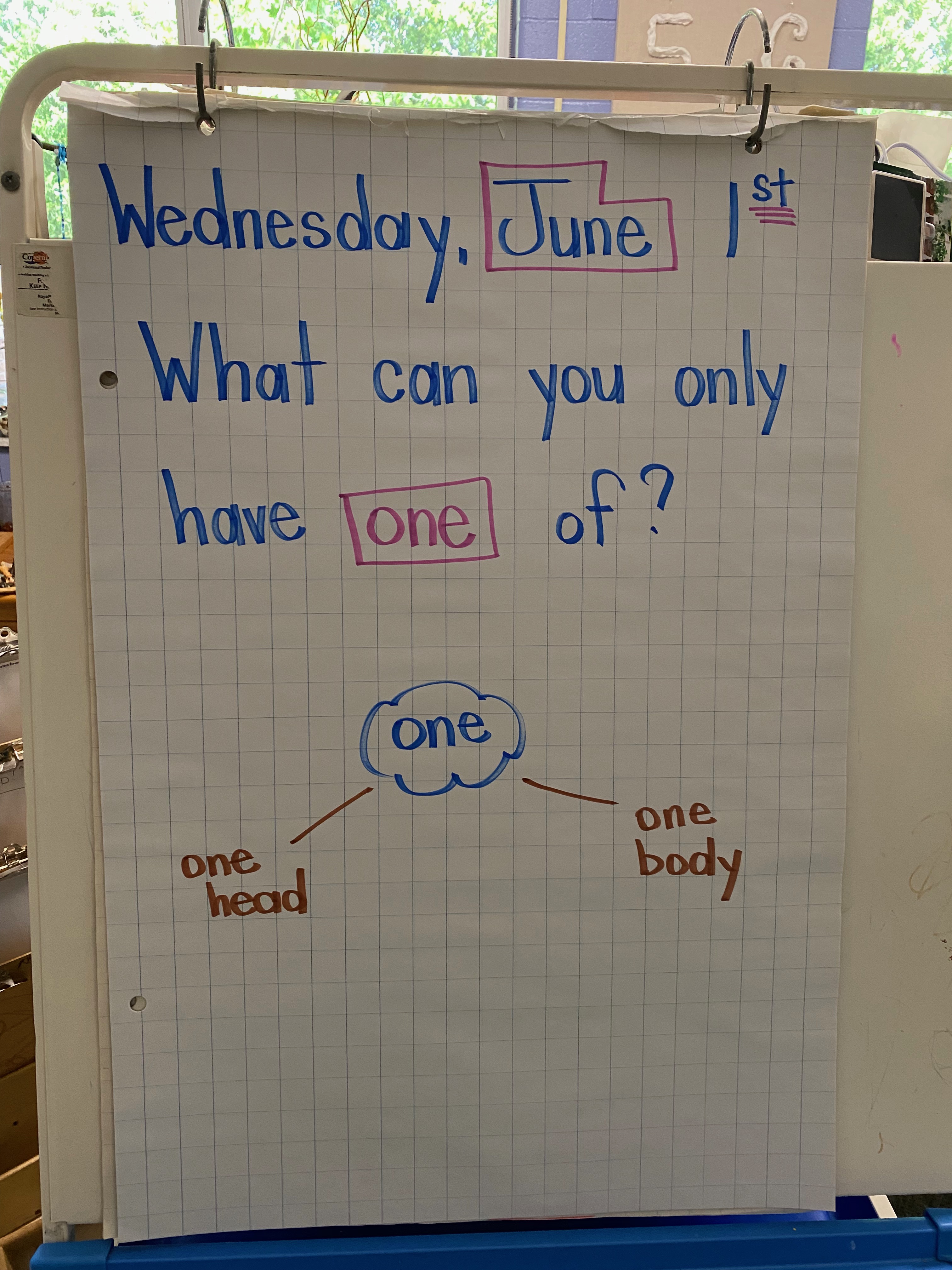
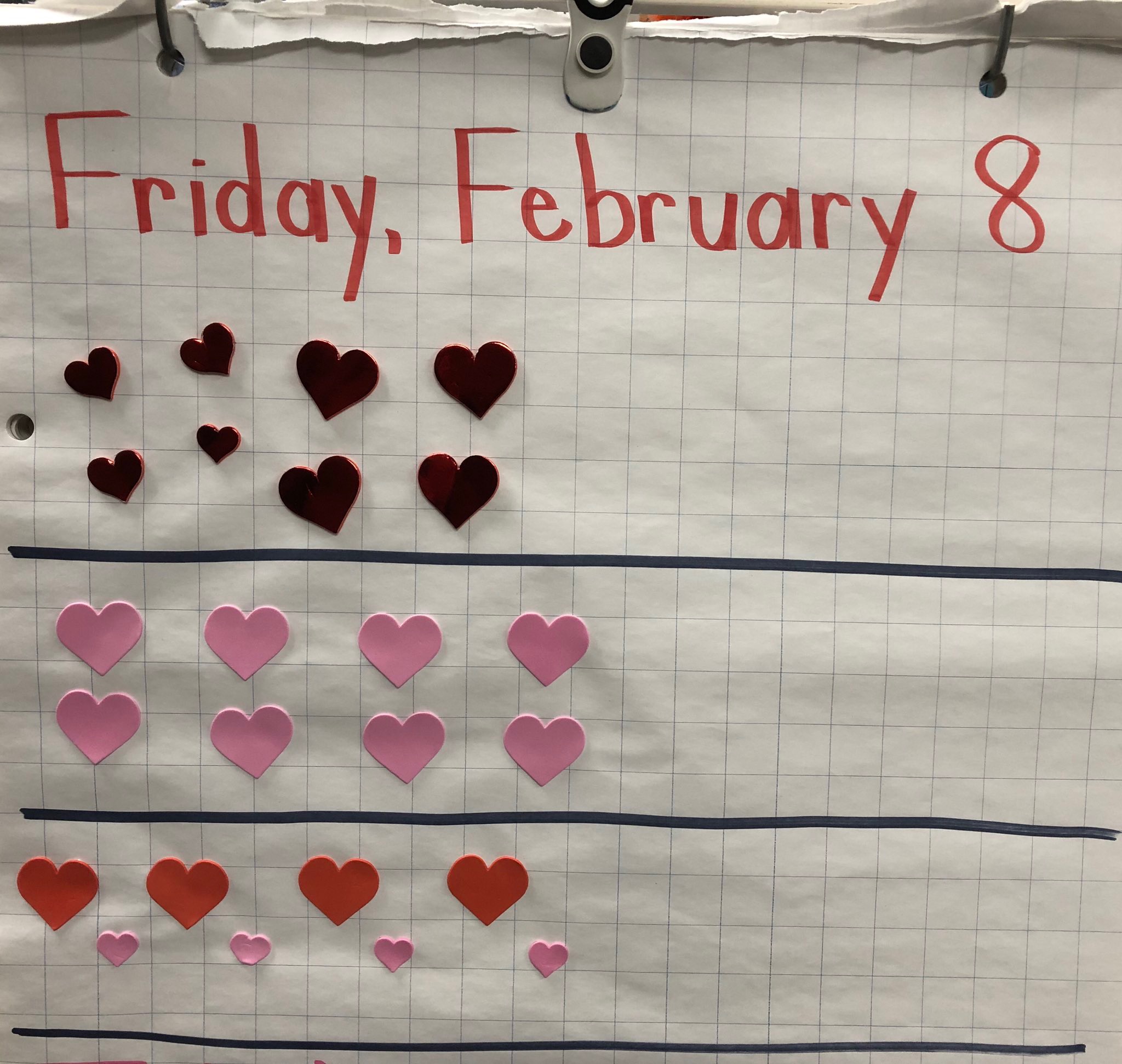
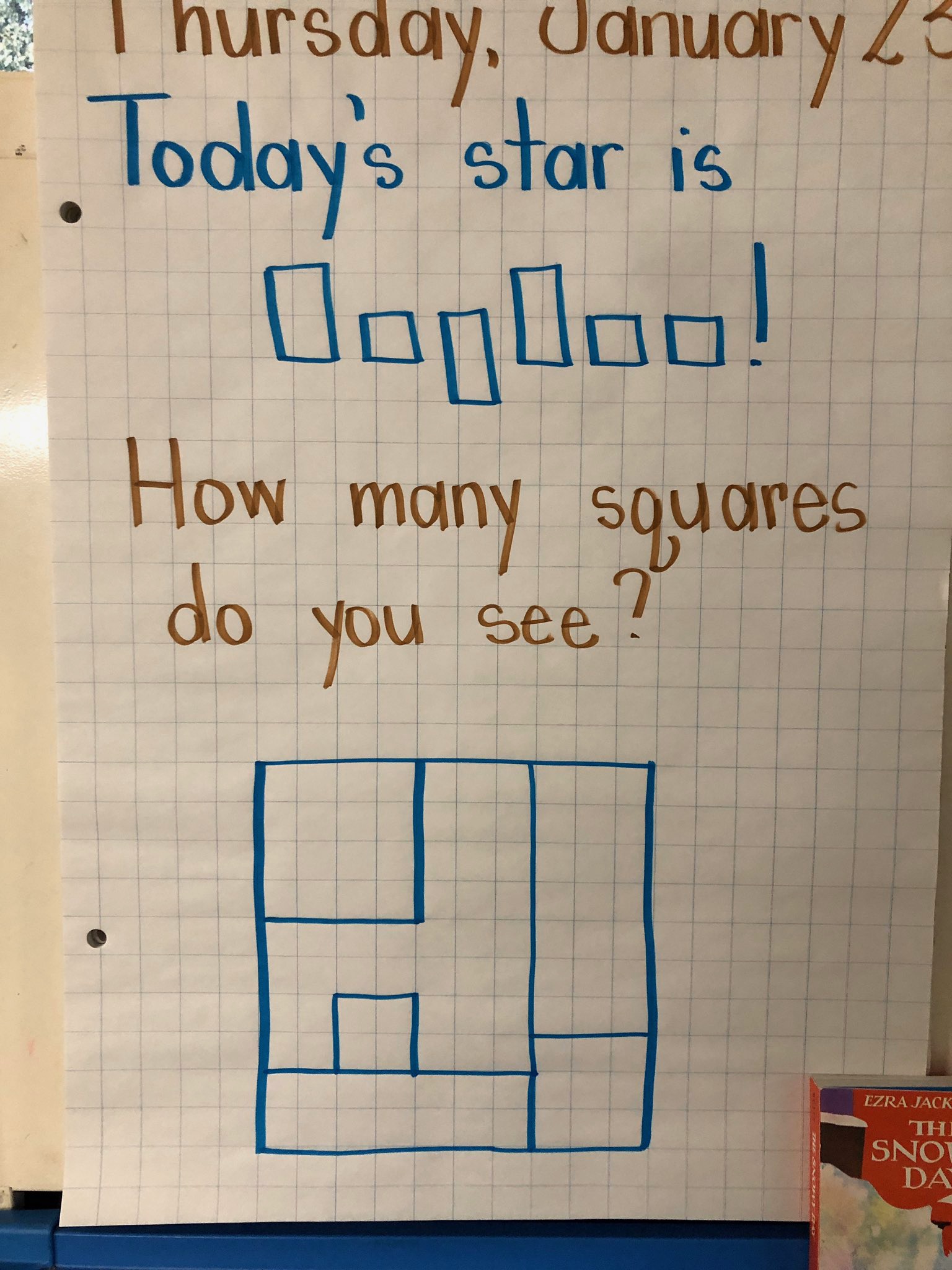
Math talks are a great way to engage children in open-ended explorations that invite them to think critically and creatively about a concept. An effective math prompt to facilitate a rich math discussion will be layered; it should be open-ended with multiple entry points for engagement. Even children as young as kindergarten are capable of participating in complex math conversations. In our classroom I aim to invite children into a math talk at least once a day; I sometimes use the numerical date on our morning message as the spark for exploration. Other times an interesting photo or collection of loose parts will be engaging and incite children into further exploration. I try to vary the invitations I provide in order to diversify the math we discuss and to reach as many learning interests as possible.

Recently I posted two Instagram Reels regarding our daily math talks that has generated many questions regarding how we engage young children in robust discussions about math each morning. There was much interest in these math prompts and many educators reached out with questions regarding how I create these prompts.


In our program we have a morning circle time. This circle is our first whole group gathering time for the day and helps set a positive atmosphere in our classroom. It is also a time to celebrate being together, and share news from our homes. We often use it as an opportunity to read a story and discuss any new and exciting activities or additions to our classroom space about which the children should know in order to be successful for the day. 
 
When I first started teaching kindergarten many years ago it was expected that the morning circle would begin with 'calendar time' where children would put a sticky number on a large grid to depict the day and there would be an extensive discussion about the calendar (e.g., day of the week, month, year). However over the years I realized that this was a very teacher-directed task and not as meaningful a use of our time. After reading Sherry Parrish's work on number talks I was inspired to use our morning message as an anchor for math talks. Wanting to still introduce the date to students, the numerical representation of the date became the foundation for our number talks most days. Sometimes I would use other prompts depending on the events and interests emerging in our classroom. If you would like to read more about number talks in kindergarten, you can access an article I wrote for the Journal of Teaching and Learning here: Joyful Number Talks in Kindergarten. 
 
I enjoy participating in a professional learning community with educators on social media and often tweet or Instagram my number talk prompts. Many educators have reached out to me how I create these open ended math talks, and to ask if I would consider sharing some ideas to try. Here are some examples of number talks we have used in the classroom. Feel free to share your own ideas in the comment section or tweet/instagram me @McLennan1977. 
 

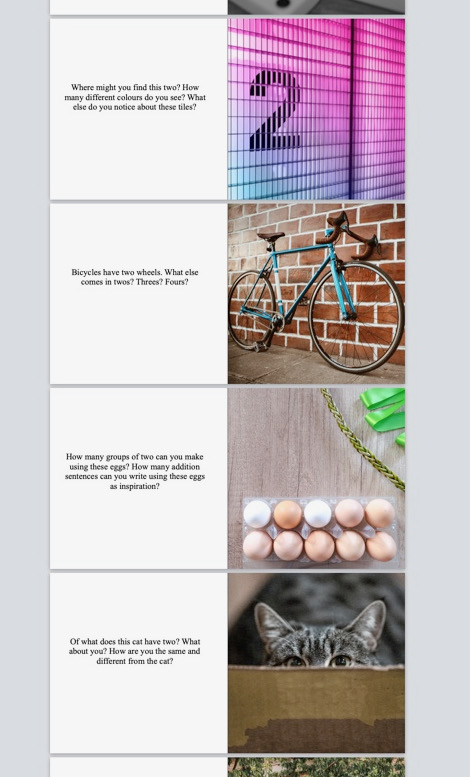
To help support educators who are interested in starting daily math talks with children, I have published a book called Calendar Math: Daily Prompts for Math Explorations with Children. 

To help give an idea of what this book is about, and to help educators create their own math prompts, here are the first few pages of the book!


Thursday, April 28, 2022

The Wonder of Trees

"Between every two pines is 

a doorway to a new world."

John Muir
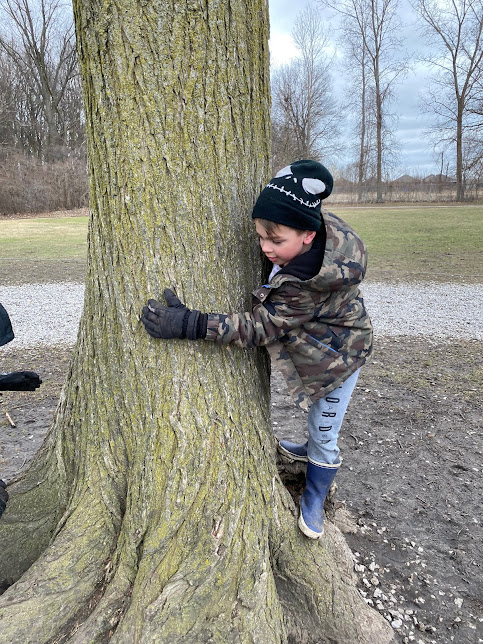
 

"Look at me!" Kyle called as he stood on his tiptoes.  "I can reach so high. If I jump I can reach even higher!"

"That's nothing. I bet I can reach higher," Asher responded.

"Ok, let's see you do it!" Kyle laughed. "I can reach this high." He jumped and slapped a spot on the tree.

Asher copied the movements, jumping and tapping the tree in a different place.

"Who was higher?" they called to me.

"I'm not sure," I answered. "It's hard to tell where you each touched and compare the spots. You'll have to think of a way to mark and measure to be accurate."

Harper had been standing next to me watching the boys. 

"I know," she said. "What if you each hold a piece of chalk in your hand. When you jump you can touch the tree and leave a mark."

"Oh good idea!" I answered. "And we can check our wonder wagon to see if we have any tools that measure."

"Like a measuring stick!" Harper answered.

Spending time outside in nature each day is important for children's growth and development. There is a misconception that a robust outdoor program needs numerous tools and materials in order to be successful. However in my practice I have found that often the best inquiries spark from examining and exploring natural elements in our play yard. One of the most intriguing artifacts that children love to explore is a tree. Trees are usually easy to find, diverse, and offer endless possibilities for child-centred inquiry. Responding to children's observations and wonderings about trees can inspire rich math, literacy and science work. 

Interested in exploring the trees in your surroundings with children? Here are some ideas for getting started. 

Tell stories about the interesting markings you find on trees.  Children love to hypothesize about unique things. Ask children to imagine how a spot ended upon a tree, or look for the math within the markings (here the knot on the tree appears to be made from concentric circles).

Explore the different textures you feel on trees. Many children are sensory learners who enjoy exploring their surroundings through touch. Encourage children to feel different parts of a tree (e.g., bark, leaves, blossoms) and describe what they feel. Sensations can be categorized and sorted (e.g., making a pile of smooth leaves).

Research the different objects that grow on trees. The life cycle of trees often results in the creation of flowers and fruit. This growth pattern can be observed and tracked over time.

Inquire about what living things make their homes in trees. Each area is unique with specific animals and insects using trees as shelters. Nests can be observed and described (e.g., a robin's nest is perfectly circular). Children can be encouraged to draw pictures detailing what they see.

Hypothesize the age of a tree using different clues. The rings on a stump can help determine the age of a tree as well as its type and size. Look for stumps and ask children to count as many of the concentric circles as they can see. They can estimate the age of the tree. If a tree is still standing children can estimate how tall or old it might be.

Build gross motor skills and perseverance by climbing trees. Building resiliency, grit and perseverance helps children in all aspects of their learning. Climbing trees encourages these skills as well as being a great physical experience that many children enjoy.

Investigate how trees change over time by exploring decomposition. Logs left over time provide a wonderful opportunity for children to become curious about how it has transitioned from tree to rotting wood. Many insects make their homes in and under logs. Ask children to tell stories about what they think might have happened to fell the tree, or investigate who has been using it as shelter.

Search for clues on the tree to guess who might have visited before you. Holes in the bark can tell stories of what animals have been searching for food in the bark, or using the tree as shelter. Children can observe bark for changes over time and conduct research.

Ponder why some trees stay green all year while others lose their leaves. Coniferous trees do not usually drop their needles. Ask children to describe and categorize the trees in the yard or neighbourhood, and observe them over the course of several weeks or months.

Use materials gathered from the tree as loose parts for imaginative play. Pinecones, twigs, leaves, needles and acorns are great manipulatives for math or creative work outdoors. These can be collected from the yard or donated by families, adding variety and interest to process-based play.
Measure, record and compare the sizes and shapes of different trees. Find the largest or smallest tree in your area and challenge children to find different ways to measure the trunk's circumference. Keep track of the measurements by recording them in a nature notebook or chart paper.
These suggestions are just a starting point for using trees as the basis for rich inquiry during outdoor learning. Listening to the observations and wonderings of children can spark amazing projects. Children often have the best ideas!

Monday, January 10, 2022

Stand Up Sit Down

Due to the great feedback I've received I have turned the 'Stand Up Sit Down' slides into a video that educators can use in their physical or virtual classrooms. This fun activity can be an icebreaker for a new group of students, a minds-on activity before a main lesson, or used during transition times.  


Check it out on YouTube: Stand Up Sit Down


See, Think, and Wonder Math Routine Using Videos

Math is all around us! As an educator I love helping children discover the authentic ways we use math in our everyday lives! As children recognize the integrated, meaningful ways math helps our world work, their interest and confidence in the subject will grow. Exploring the authentic math that exists in our surroundings may help nurture children’s interest and confidence, building a strong foundation for subsequent experiences. 

The ‘see, think, and wonder’ routine is a specific sequence of steps that guides children’s thinking regarding a specific observation. Children first describe what they see, focusing on their power of observation. Next, they interpret these observations and articulate connections to what they have seen. Finally, they share a question or wondering about the object in order to guide their future thinking work.

The 'Winter Day - See, Think and Wonder' video can be used in physical or virtual learning spaces to help facilitate math conversations. At first children can be invited to carefully observe each photo and share what they see. Ask children to use rich description as they articulate their observations. Next, ask children to make personal connections to the information presented in the text and photos. They can articulate what they think about the question prompts in the text, or make inferences about the information shared in the photos. Finally, ask children to share what they wonder about the text and photos. Educators can pause the video at any point to give children more time to engage in math conversation about their observations and wonderings.

As children engage in conversation, reflect upon their ideas. What are children curious about? What do they notice in the foreground, and background of each photo? What connections can they make to the video? What experiences do they have that relate to the objects or situations being presented? Is there something they are interested in learning further? How might they go about conducting mathematical research if they have access to these objects or scenarios in real life? What knowledge do they need to have in order to research their question? What tools and supports might help them in their quest? How can they share their findings with others?

After the children have explored the video, consider asking them to co-create their own version of the media in the form of a 'See, Think, and Wonder' class book. Children can illustrate pictures and write their own narratives. Invite children to look around their homes and communities for other seasonal situations to explore. Perhaps children can digitally document what they find and add these to their own Winter Day book. Images can also be gathered and shared in a video form. The possibilities are as endless as the questions children ask.


YouTube link is Here: Winter Day - See, Think and Wonder

Saturday, January 8, 2022

Math-ercise Videos

Interactive videos can be a great way to engage children in virtual learning spaces, or can be used in the physical classroom as warm ups to lessons, during transition times, or even during lunch times when children are finished eating (especially during Covid when only half the children can be eating at once and the other half of the class requires something to work on).

I have created some simple math-ercise videos that educators and families can use to help engage children in exploring math concepts. These ask children to look at a math equation and complete the exercise that corresponds to the answer they feel is correct. Children complete the exercise for 20 seconds and then get 5 seconds of rest as the correct answer is displayed. I feel that the physical nature of the videos will be engaging for children and add a kinesthetic feature to math learning. Videos can be paused and mini number talks can occur if educators wish.

The first video explores adding to 10.

 Math-ercise Workout - Adding up to 10

The second video explores adding to 20.

 
The third video explores subtracting from 10.
 
The third video explores subtracting from 20.
 

I will continue to create videos and add them to this blog post over time. I am hoping to explore subtraction, multiplication and division facts.

Educators may wish to create their own videos/presentations to explore other math concepts (e.g., number patterns, doubles). 

Get a copy of the files here to use at your own pace in your physical or virtual classroom. This gives you the option to pause the power point and explore each slide or personalize it to best meet the needs of your students. Music and transition times are embedded within the presentation so all educators need to do is change the equations and answers on each slide. Playing the presentation should run it without the need to manually forward each slide. 

This version is not animated: PDF Math-ercise File

Get a copy of the Power Point file here: PPTX Math-ercise File.

Get a copy of the Google Slides file here: Google Slides Math-ercise File 

Feel free to share with others! Feedback in the comments always appreciated!

Wednesday, January 5, 2022

Stand Up Sit Down

Here is a fun activity to get children moving as they respond to a prompt. Look at the photo and respond to the 'stand up if you..." prompt accordingly. Children can then create their own statements for their peers to consider. Providing time for children to reflect upon and discuss their ideas regarding the stand up/sit down prompts can encourage rich oral language as children consider the photos and verbal prompts and make connections to their own lives and experience.


Get a copy of the slides to use in your classroom here: Stand Up Sit Down

Thursday, November 11, 2021

Using End Pages to Inspire Math Conversations


"I think all of these have four wheels."
"No, the truck in the middle has 8. You just can't see the other four because they are on the other side."
"I like the red car best. It goes faster than the others."
"The red car has a number 5 on it. That's because it came in fifth place."
"No, the number five is because there are five cars on these pages. The other ones just don't have numbers on them."
 
* * * * * * * * * *
 
Have you ever taken time to appreciate the beautiful art that exists on the end pages of books? This year my goal has been to really slow down and enjoy books together with the children. Sometimes my literacy appetite is so great that I just can't wait to read all these wonderful books in my collection - we rush through book after book each day, gorging ourselves without slowing down to appreciate their intricacies. It's hard not to - there are so many amazing children's books in the world and I'm eager to share as many of them with my class as possible. However the educator in me knows it's important to take our time so we really get as much out of each book as possible. Appreciating the book's design, the illustrations, text, even choice of font, can all help empower children as well rounded readers. There is so much to be discovered within books when we appreciate each text.

Kassia Wedekind, co-author of Hands Down, Speak Out: Listening and Talking Across Literacy and Math, challenges us to think about "how we can mathematize end pages of books". She gives the example from the book Creepy Pair of Underwear by Aaron Reynolds. The end pages feature an array of mini underwear pictures (always a perfectly humorous topic for any elementary school student!). Kassia suggests that children can examine the array and use different strategies for calculating the total number of objects. Children can then be challenged to write different equations to show a deeper understanding of their thinking.

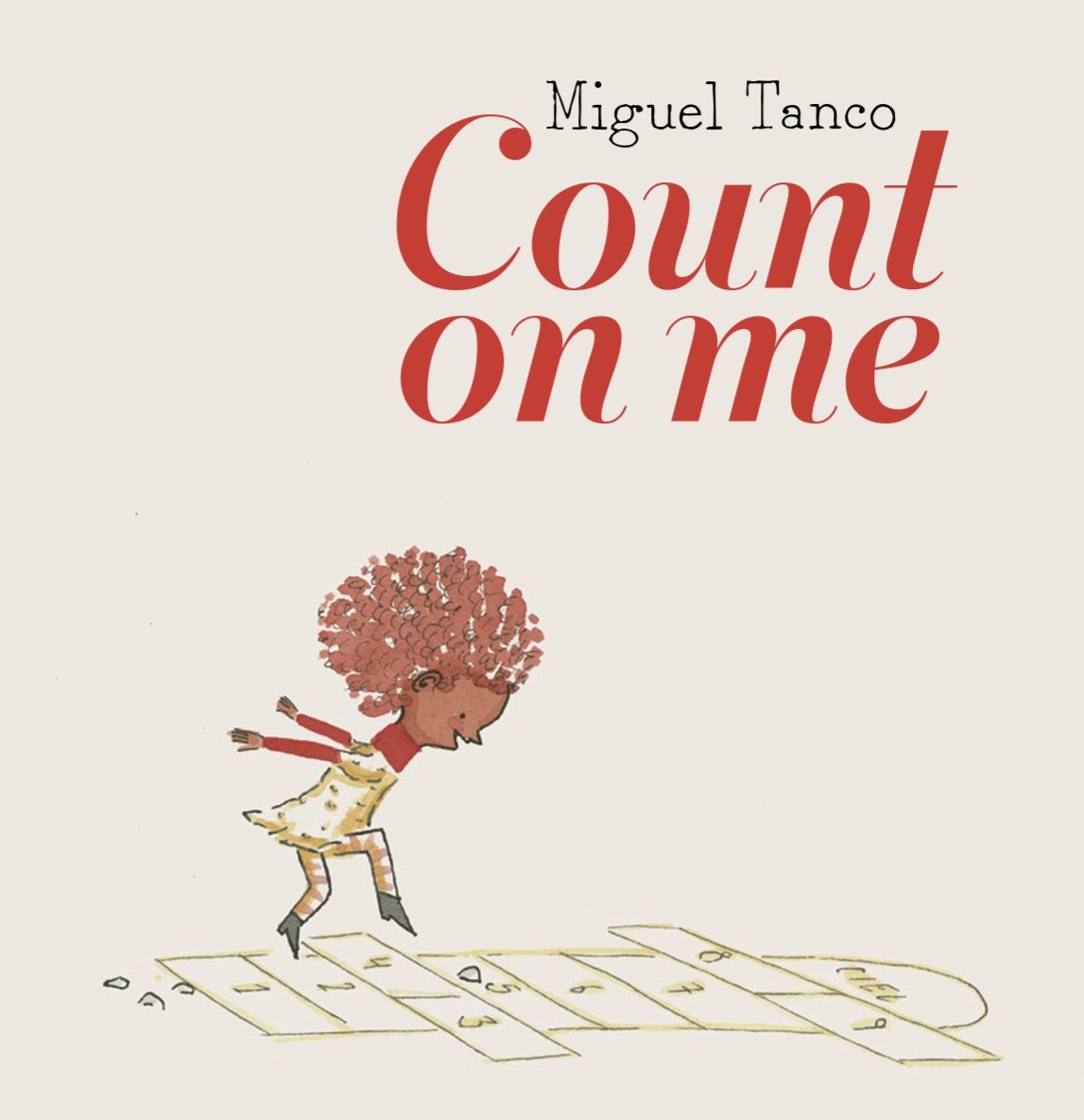
Looking to extend this idea we read Count on Me by Miguel Tanco. This book helps readers uncover the beautiful math that exists in the world around us (e.g., geometric shapes on playgrounds, sharing during dinner time). After reading the book for pleasure, I reintroduced it again to children and asked them to take notice of the cover and end pages specifically. They immediately noticed the vibrant pattern on the inside cover, and made the connection that a small portion of the pattern was also visible on the spine.
 
Count on Me | San Francisco Book Review

 
Participating in their discussion while honouring their ideas by including them in an idea web is always challenging for me. It's hard to listen attentively, talk, and record what is being said at the same time. I tried my best to capture some of their thinking on a large chart paper. Most children were eager to discuss the intricate crisscross pattern and curious about what other objects in our yard had this same design (e.g., many noted the fence also looked like this). Towards the end of our conversation the idea of quantity arose, and children wondered if the estimate of 30 diamonds was correct. Many felt this number was too small and thought counting by rows would be an easier way to find out. A next step for us might be to place the book along with different loose parts (e.g., gems, buttons), chart paper and a hundreds chart and challenge children to see how many diamonds they can count in the pattern. I also wonder if helping children to calculate a large quantity by creating groups of counters using a friendly number such as 5 or 10 might work. It's okay if we don't arrive at an answer to this question - the process of working towards it is just as important in my opinion. 

Interested in exploring end pages with children in order to provoke deeper math thinking and exploration? After you find a book that is meaningful for children and has beautiful end page art, consider using some of these question prompts: 
  • What do you see?
  • What do you think about ____?
  • What does this remind you of?
  • What do you like/dislike about these pages?
  • Why did the author/illustrator choose this design for the inside of the book?
  • What meaning does this end page have now that we've read the story? 
  • What connections to this design can you make?
  • What math do you see?
  • What math questions do you have?
  • How might we find an answer to your question?
  • If you were the author/illustrator how would you have designed the end pages?
  • How would you improve this design?
  • How would you change this design to emphasize patterning/quantity/shape/colour/etc. more prominently? 
  • Can you draw your own unique end page for a book you've written?
  • What would you ask the author/illustrator personally about this piece?
Connecting math and literacy is a wonderful way to help children appreciate how connected the world is and find authentic problems to explore in their lives!

Thursday, November 4, 2021

10 Math Concepts that Children Learn from Puddle Play

"Childhood is that state which ends the moment a puddle is first viewed as an obstacle instead of an opportunity."

K. Williams


Puddle play is an incredibly rich learning activity that many children enjoy. Spending time outdoors exploring many natural elements helps children recognize that there is no such thing as bad weather. There is beauty and wonder to be found in every aspect of nature. Sometimes in early childhood education we need to help our families and school community understand the authentic learning that can happen when children play with sensory materials like puddle water outdoors. Demonstrating the meaningful math connections that emerge in this type of play can build support for outdoor exploration and learning. Sharing this through regular communication including documentation can be incredibly helpful in cultivating positive partnerships and support for messy play outdoors.

Here are ten math ideas that can be introduced and strengthened when children play in the puddles:

1. Patterning

When rain drops fall into water their impact disturbs the surface tension of the water. The ripples spread outward from this impact point. This reaction forms concentric circles which are two or more circles that have the same center point. Each subsequent circle is larger than the last, creating a growing geometric pattern for children to explore.

2. Opposites (Float and Sink)

Children love to place objects in water and experiment with what happens to them. A favourite outdoor activity for our children is to place many different objects in water and see if they float or sink. An object's density determines whether it stays above or below the water. The object will float in the puddle if it is less dense than the water. If it sinks, it is more dense than the water. 

 3. Temperature

The temperature of puddles can vary depending on the ground and air temperature. Children enjoy feeling the water with their hands and describing how hot or cold it seems. An engaging activity is to provide kid-friendly thermometers to children and challenge them to read the temperature of the different puddles in the yard. Are the larger ones a different temperature than the smaller ones? Does the temperature of a single puddle change over the course of the day? Ask children to generate theories about why this is happening.

4. Measurement

Sensory experiences are vital for children's growth and development. Most children love to play in mud using cooking items and utensils. A favourite activity for us is to use the puddles for water play. Not only do we not have to worry about a wet floor indoors, children are captivated using cups, spoons, funnels and bowls to collect the water. Challenge children to measure how much water they can collect. Ask them to see if they can empty a puddle and calculate how much water it had altogether. 
 
5. Cause and Effect
Cause and effect activities help children realize that every action they take has a reaction. When children jump in puddles, the water splashes. Experimenting with cause and effect helps children play with variables that can control the reactions in different ways. For example, and bigger jump in the puddle usually results in a larger splash of water. Children can change their actions (e.g., increasing movement, decreasing movement, modifying direction) and observe the results.

6. Comparison
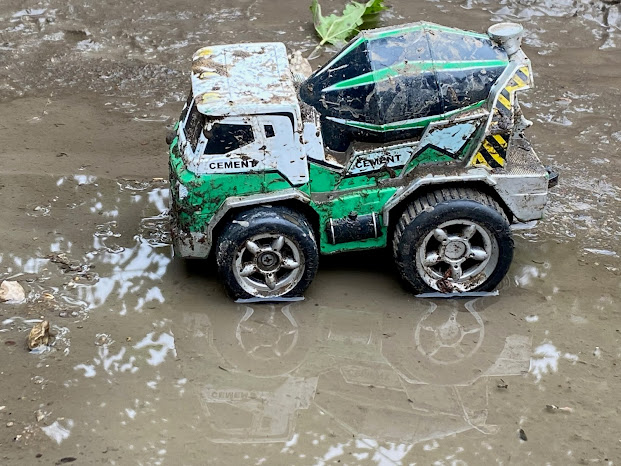
Puddle water can look many different ways. Some puddles are clear while others are muddy and filled with debris. Children can travel the yard and observe/describe what they see as they compare puddles to one another. They can also experiment with the different materials and observe the reactions that occur. For example when water is added to soil, the soil appears a darker colour. This occurs because wetter soil has less oxygen compares to drier soil. Some puddles are so saturated with dirt that there is a layer of mud that settles on the bottom and a layer of water that has risen to the top. As children explore different puddles they can notice and name what they see, and compare the properties of each to one another.

7. STEAM (science, technology, art, engineering, art, math)

STEAM challenges are highly motivating for children. Puddles offer many opportunities for educators to ask children to design and build an object to be used with the puddles. A favourite in our classroom is to ask children to create a puddle boat from loose parts (e.g., wooden craft sticks, cardboard, foam, aluminum foil) that floats. Another highly motivating construction activity is for children to build a bridge over the puddle for the mini cars to use to cross the puddle. 

8. Counting

In our yard we often have very large puddles when the rain falls due to the slope and drainage of the playground pavement. A fun activity is for children to crowd in and count how many can fit in the area of the puddle. Great math questions emerge in this activity - can the same number of children fit in the different sized puddles in the yard? How many boots altogether are in the puddle? Can we count the boots by 2s?

9. Reflection

 
Water is a reflective surface. When the water in a puddle is still, the surface is flat and can easily reflect light. If the wind is blowing and ripples appear, the reflection can become distorted. The harder the wind is blowing the more distorted the reflection appears. This type of reflection also offers an exploration of symmetry as children can identify the line of symmetry and see how each side appears. This symmetry is often curious for children who notice that the reflected side appears lighter/faded than the real object. Children can experiment with reflective symmetry by placing and moving different materials into the puddle and seeing the result.

10. Area and Perimeter

The size and shape of a puddle can often inspire conversation about its area and perimeter as children wonder about how big or small it might be. Sometimes we will use loose parts to help us measure (e.g., How many rocks fit around the outside of the puddle?  How many leaves can float on top of the puddle?). The distance across a puddle is also interesting to measure as children leap across the puddle and measure how far they've jumped, or build bridges to help the mini cars cross the puddle.
 
What other math have you explored in the puddles? Tweet me and share your awesome ideas and experiences! @McLennan1977

Looking for a resource to read with kids to support authentic math play in the puddles? Check out my new book Puddle Math: See, Think and Wonder! 


Related Posts Plugin for WordPress, Blogger...