Friday, September 1, 2023

A Classroom Tour for September


For many years now I have been greatly inspired by the Reggio Emilia approach to early childhood education and have sought any source of information that I could get my hands on! When FDK was first introduced in Ontario I was thrilled to see that many of Reggio's beliefs were interwoven in the document and honouring children's interests through play, inquiry and documentation were highlighted. As educators who follow a standardized curriculum we have great flexibility in our interpretation and implementation of the expectations and this makes our role exciting and dynamic.

I believe in having a fluid, evolved space that continues to change to better reflect the needs of the children and support heightened understandings of explorations and inquiries as well as enhanced abilities in the various domains of learning. We want to support the whole child in developmentally appropriate experiences and integrate learning materials from centres in diverse and unconventional ways.  

Some of the Reggio principles that have guided my work include:
  • children are capable of constructing their own learning
  • children form an understanding of themselves and their place in the world through their interactions with others
  • children are communicators
  • the environment is the third teacher
  • the adults in the room are mentors and guides
  • there is an emphasis and importance on documenting children's thoughts and experiences
  • there are hundreds of languages of children and these are used to explore and communicate ideas and experiences
This is the door leading to our classroom. I post information around the door to assure visitors to the space that I believe in an inclusive environment where all children are respected. Building relationships with families and helping them learn about and support growth mindset is a big part of creating a safe and supportive space for learning. Something about which I've had a lot of positive feedback is our 'wish wreath'. Each September we ask families to write their hopes, wishes, dreams, etc. for their children's kindergarten experiences on paper ribbons. We weave each of these onto a grapevine wreath and display it on our door. We want it to be a symbol of our partnership and collaboration with families for the year ahead. We also include a photo of our teaching team and visitors to the room can access our class blog by scanning the QR code on the door.


Above each child's cubby is a recent photo and painted self-portrait. These change a few times each year (usually a new photo and self-portrait per term) to help show their growth. We like including a real photo to celebrate each child and love how the children use the language of art to represent their perception of self. 
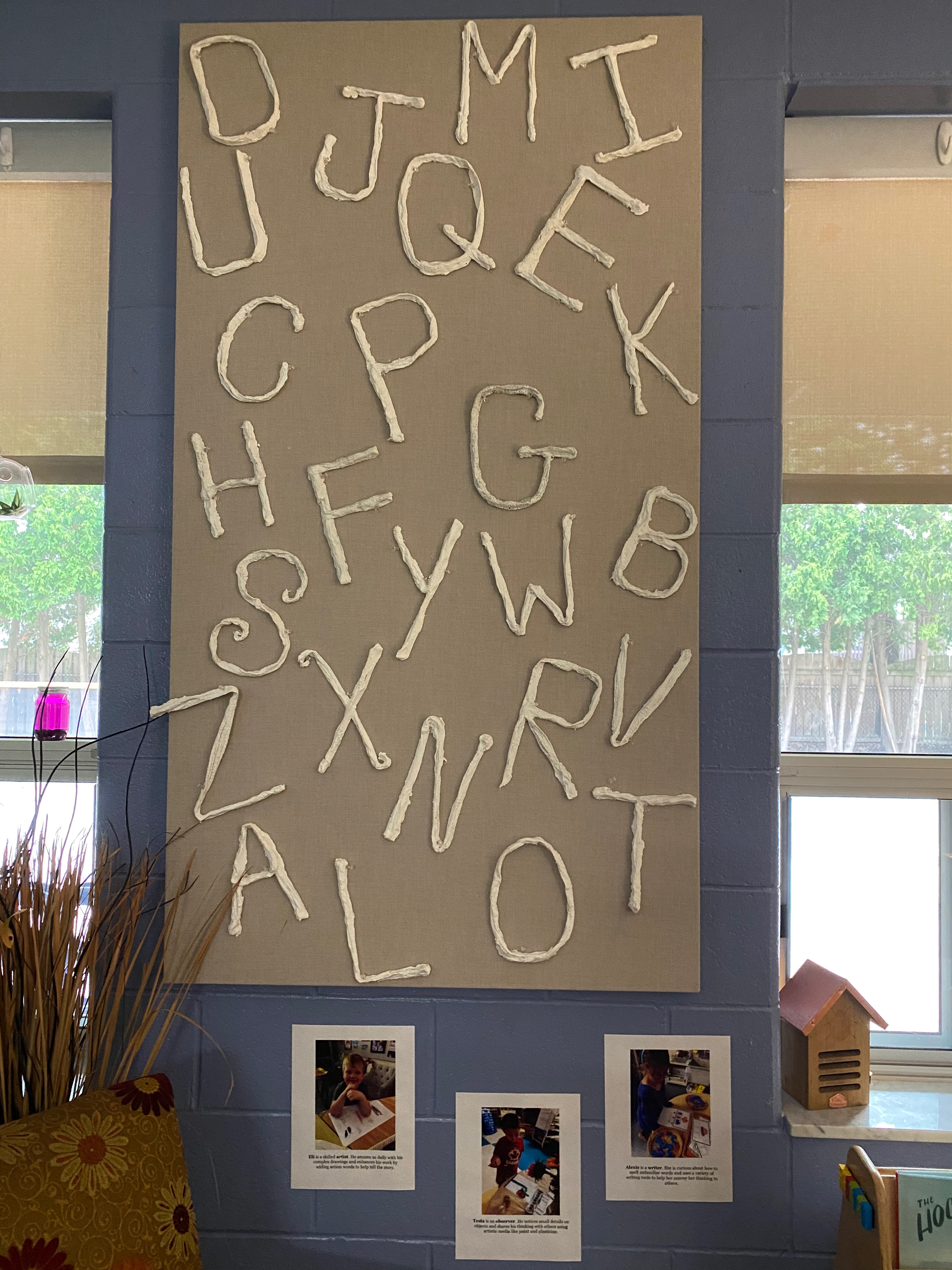
Our quiet literacy area has a collection of books and writing materials to explore. It's a comfortable area for children who want a quiet space to read or draw and the sofa and chairs are a great way to calm oneself if a child is tired or needs a break. The whimsical light invites children to stay for a while and read a book or chat with a friend. We ask families to send in photos that are hung by the sofa as a sign of connection and comfort. The light table and weaving wall encourage creativity and fine motor development which will help children with writing readiness. An upcycled photo display holds seasonal vocabulary cards that can be manipulated by children. The wooden shelf holds diverse and inclusive books so all children can see themselves reflected in classroom resources.


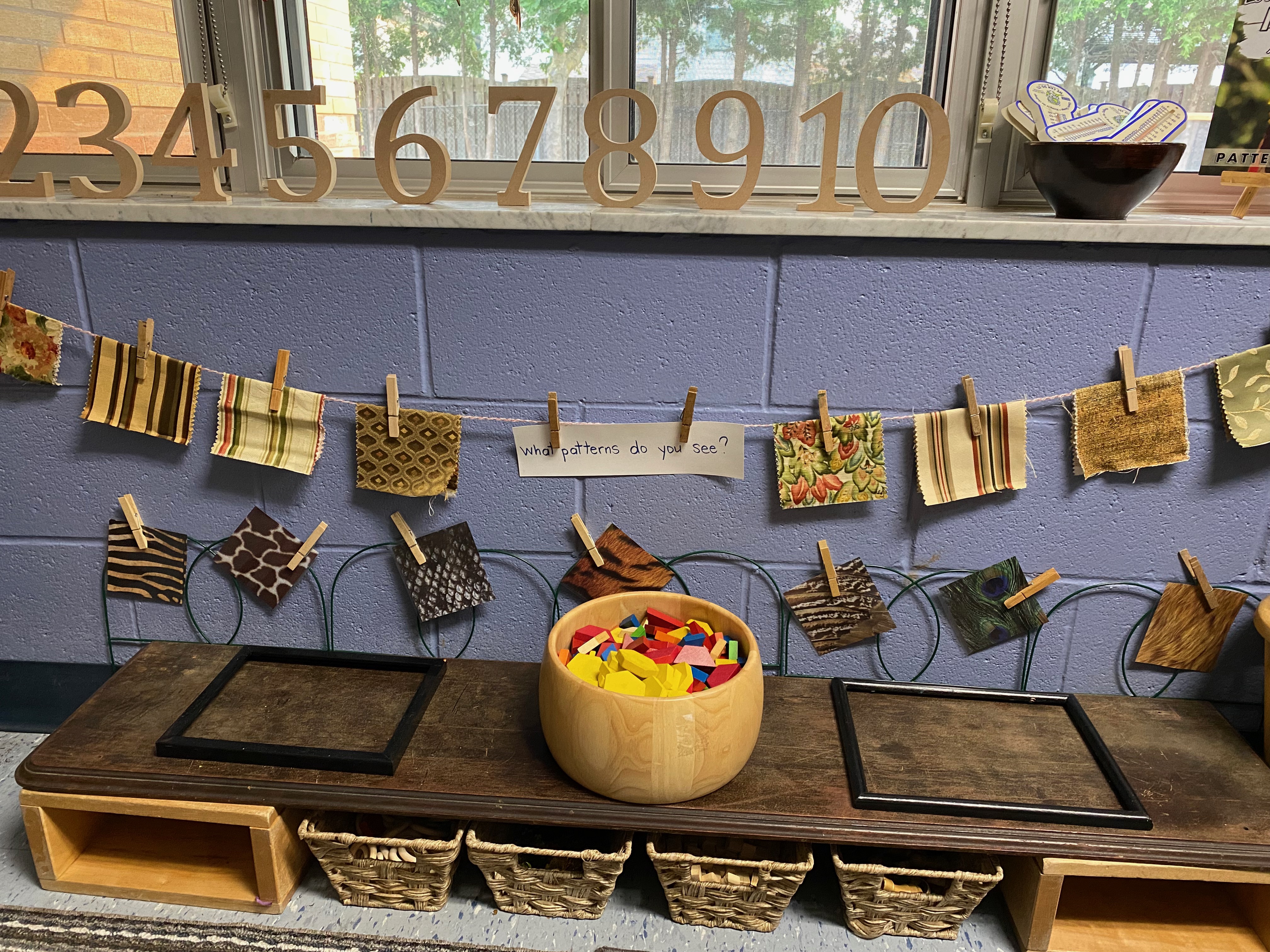
Our math area has many things available for children. We include mentor texts, learning props, and documentation to showcase and support our program.




Our drama centre changes based on the interests and requests of the children. At the beginning of the year it is set up as a little 'house' to provide comfort and familiarity to children.  We include many real objects for the children to use in their imaginative play; real objects communicate the message to children that they are capable of using these tools and make the context for the imaginary play very real and meaningful. Donations from families and the local community also helps represent the diversity of our population and encourages children to see themselves and their peers reflected in the space. Literacy is interwoven throughout as children can talk on the phone, write on the chalk boards, or follow a recipe when cooking. A variety of scarves encourages children to dress up and create their own costumes and clothing. A large basket of fabric flowers can be turned into different arrangements for the table or inspire other dramatic play (e.g., a flower shop, a farmer's market).


Our building area is the heart of our room and the most popular place to be. Children integrate materials from all around the classroom into their play here. We love the big body play the wooden blocks encourage. Small loose parts (e.g., tile squares, corks, wooden spools) are also included in this area for children to combine with wooden blocks. Pillow are available for incorporation in the creations and photos of local structures are displayed for inspiration.


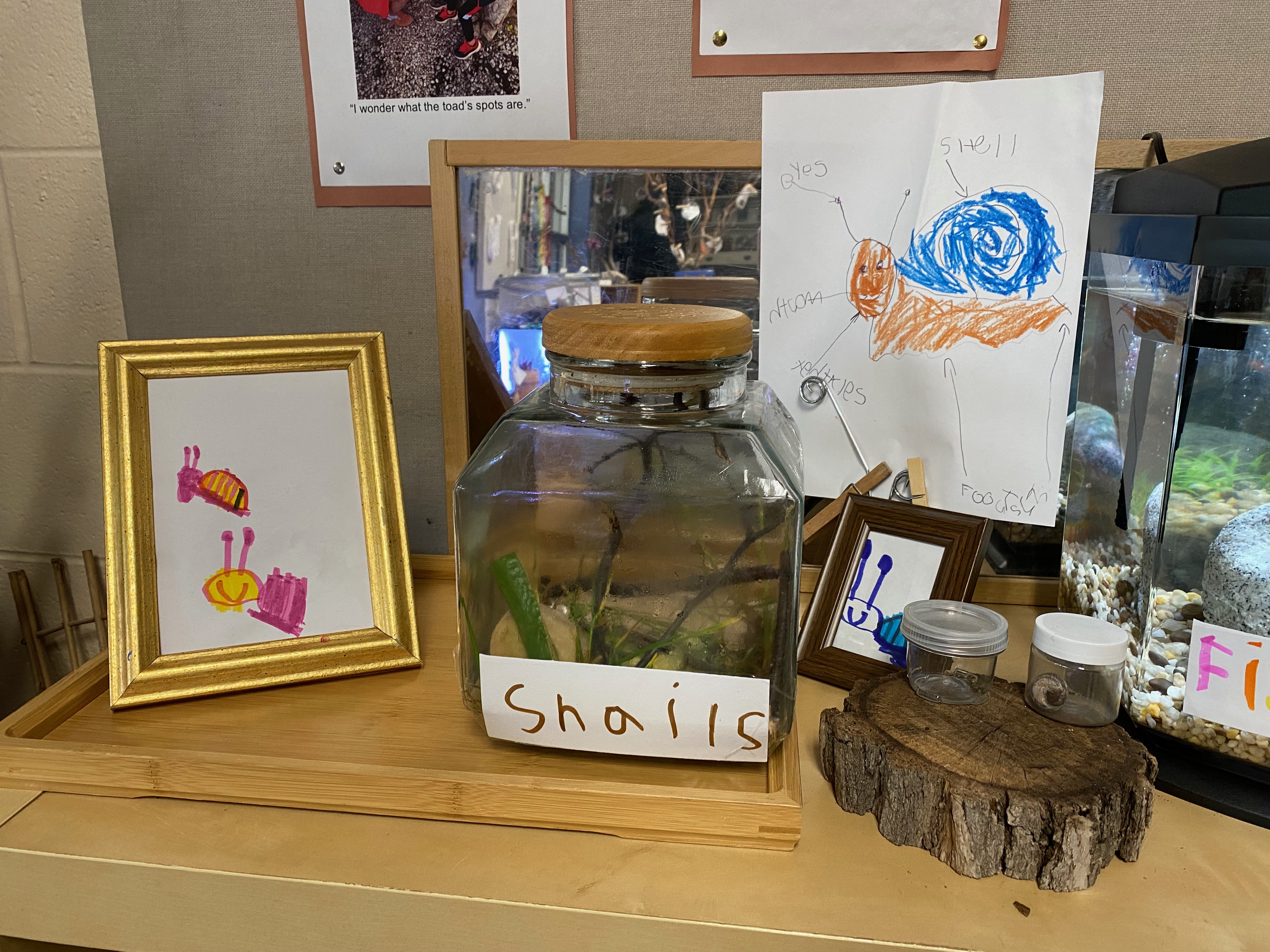
My favourite center in the classroom is the science area. We are fortunate to have a very large wall of windows on one side of the space. The shelf near the window houses materials that are specific to ongoing inquiries. Loose parts play are a big part of our program as we embrace all things STEAM and love our makerspace. We use many natural and found materials here and always welcome donations from our families. The science area also houses many building materials and the children can freely use these around the room in any area to support their play. Often treasures found outdoors (e.g., pinecones, feathers) and the changing of the seasons inspire inquiries. Invitations for further exploration are sometimes set up on the table in this area. A sensory table integrates imaginative play regarding current interests, here insects and their natural habitat. Children can swap out materials for other small world play (e.g., dinosaurs, fabric flowers).


The art studio is located in a sunny area of the classroom. You can see that colours and colour mixing are ongoing interests and there is much art that supports this. The materials are aesthetically arranged to be accessible for children and also decorate the space. Materials are organized by colour for ease of accessibility and also to embed math and sorting into the centre.


We are often asked by other educators about how we encourage the children to engage in regular reading and writing in a child-driven space. On the back of our bookshelf are writing clipboards, one per child. We ask children to self-select a piece of writing that they are proud of and display it on their clipboard. These are then brought to a sharing circle where children can discuss their work with others. It's a quick and easy way for us to see which children have (and haven't) engaged in regular writing so we know how to better support their needs. This clipboards can also be brought on nature walks in the yard or community as needed.
Thank you for visiting us! We love feedback and to learn about your classroom and program. Please share in the comment section below or connect with us on Twitter @McLennan1977.

Monday, August 28, 2023

Vintage Treasures in the Classroom

"The objects surrounding the child should look solid and attractive to him, and the house of the child should be lovely and pleasant in its particulars; for beauty in the school invites activity and work."

Maria Montessori
One of my favourite ways to spend a relaxing Sunday is to visit a local antique store in my town. They refresh their wares on a regular basis and it's inspiring to wander the store and see the new arrivals. I love to find unique objects and imagine how they might be used by children during free play. Sometimes objects are a vintage model of what we already have - I'd much rather offer a solid metal scale for measuring than a flimsy plastic one. Other times unfamiliar objects become invitations for exploration and play as children have not had previous experience with the new resource. Providing something interesting and unique in the learning centers for them to discover has led to some amazing questions and explorations. Children attempt to discover what a new object might be and for what other purposes they can use it.
     
Visitors to our space are surprised to see the delicate materials being used by children. I'm often asked how fragile objects are not damaged, and if children take care of the resources properly. I believe that because children consider themselves equal members in a democratic space they value their beautiful learning environment and strive to care for all materials. Do things sometimes get broken? Absolutely! But this is a rare occurrence and when it does happen it provides an excellent moment for reflection and learning so that children take care to ensure materials are safely cared for.
 
Visitors to our space also ask how I am able to acquire such interesting materials without spending a lot of personal money to do so. As a scavenger I am always on the look out for vintage items; I love to spend rainy Sundays in second hand shops looking for things that can be easily fixed up and used in the classroom. Families are also quick to donate items from their homes and yards, especially after an open house when they see just how children incorporate materials into their play. Sometimes colleagues, my own extended family and other community members will offer things they no longer need. Sending letters home to families and posting for specific items I am hoping for on social media has also resulted in some amazing items being added to our space. Because I have taught for 20+ years I have acquired quite the interesting collection! It takes time and patience to build a complex space.

Offering antiques and vintage items in the classroom not only beautifies the space, it offers many other learning opportunities for children:
  • children learn about how materials and lifestyles have evolved throughout the years (e.g., learning how rotary phones evolved to dial and eventually to wireless smart devices)
  • children appreciate how materials can be recycled, reused and even upcycled in place of always purchasing something new
  • the classroom begins to take on an interesting eclectic flavour that can represent the spirit and history of the local community
  • statement pieces can spark in depth inquiries or creative explorations (e.g., researching the purpose of an unknown object, writing about the history of an object)
  • children can also explore cultural and historical significance of pieces and use them to learn more about the past
  • children can emotionally connect with the aesthetics of a piece and hold wonder and curiosity for their environment
  • sharing the theories children have for vintage items beyond the walls of the classroom (e.g., social media, newsletters, documentation) helps showcase young children as capable and creative and might inspire further donations
     

Over the years I have replaced plastic, commercial toys in our classroom with found and recycled objects. It's taken years to curate a classroom filled with wonder and excitement and I'm eager to continue this journey with the children in the upcoming school year. What unique objects are valued in your classroom? Share your ideas in the comments below or share on social media tagging @McLennan1977!

Wednesday, August 23, 2023

ETFO PLEY Chat - A Classroom that Fosters Mathematical Thinking

As an educator helping children develop a love of and appreciation for math is one of my greatest professional interests. I strive each day to engage children in authentic math learning through play and inquiry. I was super honoured and excited this past spring to welcome ETFO into our kindergarten classroom and record a number of chats regarding how children explore math in our classroom. 

All videos are now available here: A Classroom that Fosters Mathematical Thinking

The Beliefs that Drive Practice

Moving the Learning Forward

 Math is Relevant and All Around Us

Understanding how Children Develop Mathematical Understanding

Math Happens Everywhere

 Thinking Through a Mathematical Lens

Documenting and Communicating the Learning


Related Posts Plugin for WordPress, Blogger...