Friday, March 29, 2024

20 Free Alphabet Activities to Use with Children

I have spent time reviewing many of the resources and materials I have created over the years. Over the next few weeks I would like to share some on this blog.

Learning the names and sounds of upper- and lower-case alphabet letters take time, patience and practice.

Many families are eager for 'take home' activities to help their children practice literacy skills at home. Educators are also looking for easy to gather and implement small group work for children to use at school. In this file I have shared 20 alphabet activities that can be printed and shared with families or used with children during the day. Print all, or take what you think will be a best fit for your little ones!

You can access the file here: 20 Instant Alphabet Activities

Thursday, March 28, 2024

Five Free Printables to Use with Tree Math

 "Trees are poems that the earth writes upon the sky."

-Khalil Gibran

During outdoor play children are drawn to the trees in the school yard. They love to feel bark with their hands and wrap their arms around the trunk. They collect artifacts for exploration including sticks and leaves and search for insects in the bark's crevices. Trees offer so many rich opportunities for wonder and discovery as children notice how they change with the weather and seasons.


To help supplement my book Tree Math (available from Amazon and Indigo) here are five easy, free printables that can be used to support children's work in nature!

1. My Favourite Tree

Encourage children to spend time in nature and observe the tree they like best. Ask them to consider what it is they appreciate about this tree? Children can then sketch the tree on this page and compare their tree with others.

2. My Tree and the Four Seasons

Over time children can observe the same tree and draw what they notice changing during the four seasons. This page can be kept over time and added to as the months change. Children can also draw on it at one sitting and hypothesize what the tree might look like in each season, especially after conducting research about how trees adapt to the weather.

3. Tree Circumference

Children can use a variety of materials to measure how big around a tree's trunk is (e.g., measuring tape, hand spans, links) and record it on this tracking page. Drawing a picture can help explain their math thinking.

4. Tree Bark Patterns

Exploring the texture of bark appeals to many children who enjoy sensory experiences. Children can use magnifying glasses to examine the patterns in bark up close, or place a paper on top of the bark and use crayons to create a rubbing. Children can then describe what they see and compare their rubbings to others. 

5. A Tree is a Home

Encourage children to explore many trees in the school yard and neighbourhood. Ask children to observe what living things they observe on and in the trees (e.g., birds, insects, mould) and record their observations on the tracking paper. They can hypothesize how the tree might be a home for many living things at the same time.

Tuesday, March 5, 2024

Easy St. Patrick's Day Math Ideas

St. Patrick's Day is a fun holiday that helps jump start the spring season! Here are a few easy to plan math activities for children!

1. Shamrock Subitizing- Write different numerals in the center of each shamrock and encourage children to place dominoes with the corresponding number of pips in each leaf.

 
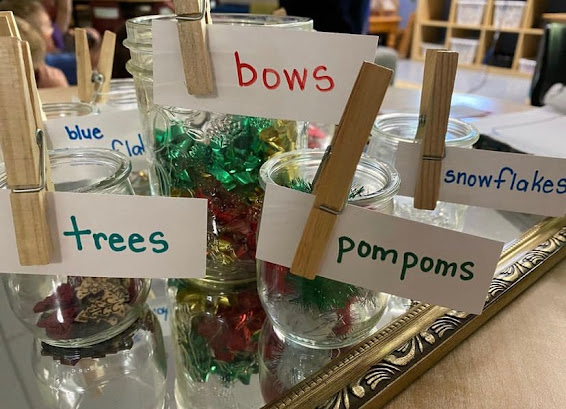
2. Estimation/Counting Jars - Fill jars with a variety of different seasonal loose parts. Encourage children to estimate how many objects are in each jar. They can then use a variety of math tools (e.g., number grid, ten frame, hundreds chart) to count the total objects. These can then be recorded on a paper for comparison.

3. Rainbow Numbers - Provide children with a variety of numbers and encourage them to explore these in different ways (e.g., sorting by colour, ordering, create number combinations).
4. Colour and Coin Sorting - Recycled marker caps can become 'pieces' of the rainbow. Add fun play coins and seasonal pots to the tray and encourage children to sort, count, and pattern with the loose parts.
5. Roll and Record - Here is a fun template that can be used by children to support many math explorations! Children can roll and subitize a die and colour in the corresponding number of shamrocks. Two children can each roll and colour in shamrocks using their own colour and try to get 4 in a row. Children can colour the shamrocks in using different colours to create patterns. The possibilities for this template are endless!

Get the free printable here: Shamrock Printable

 
6. Which One Doesn't Belong? -  Show children pictures of different shamrocks and ask them to articulate which picture does not belong. 
Get the free printable here: WODB Shamrocks
7. Gold Coin Count - Add dice, coins, number lines and writing materials to this game board and encourage children to create and play their own treasure games!
Get the free printable here: Gold Coin Count
8. Find the Gold Coding - Draw the path needed to get from home to the pot of gold! Use arrows to display direction of movement.
Get the free printable here: Gold Coding Mat 


Sunday, March 3, 2024

Alphabet Mats for Letter Recognition

Recently we have been working with different fonts to help children recognize that the same letter can look many ways. These letter templates are easy to use in matching games. Get a copy here!

Alphabet Mats 


Tuesday, December 12, 2023

Holiday Sweaters

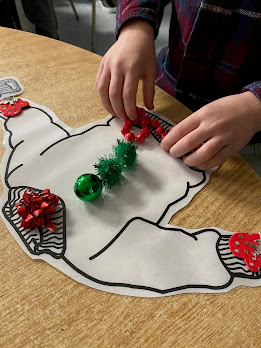
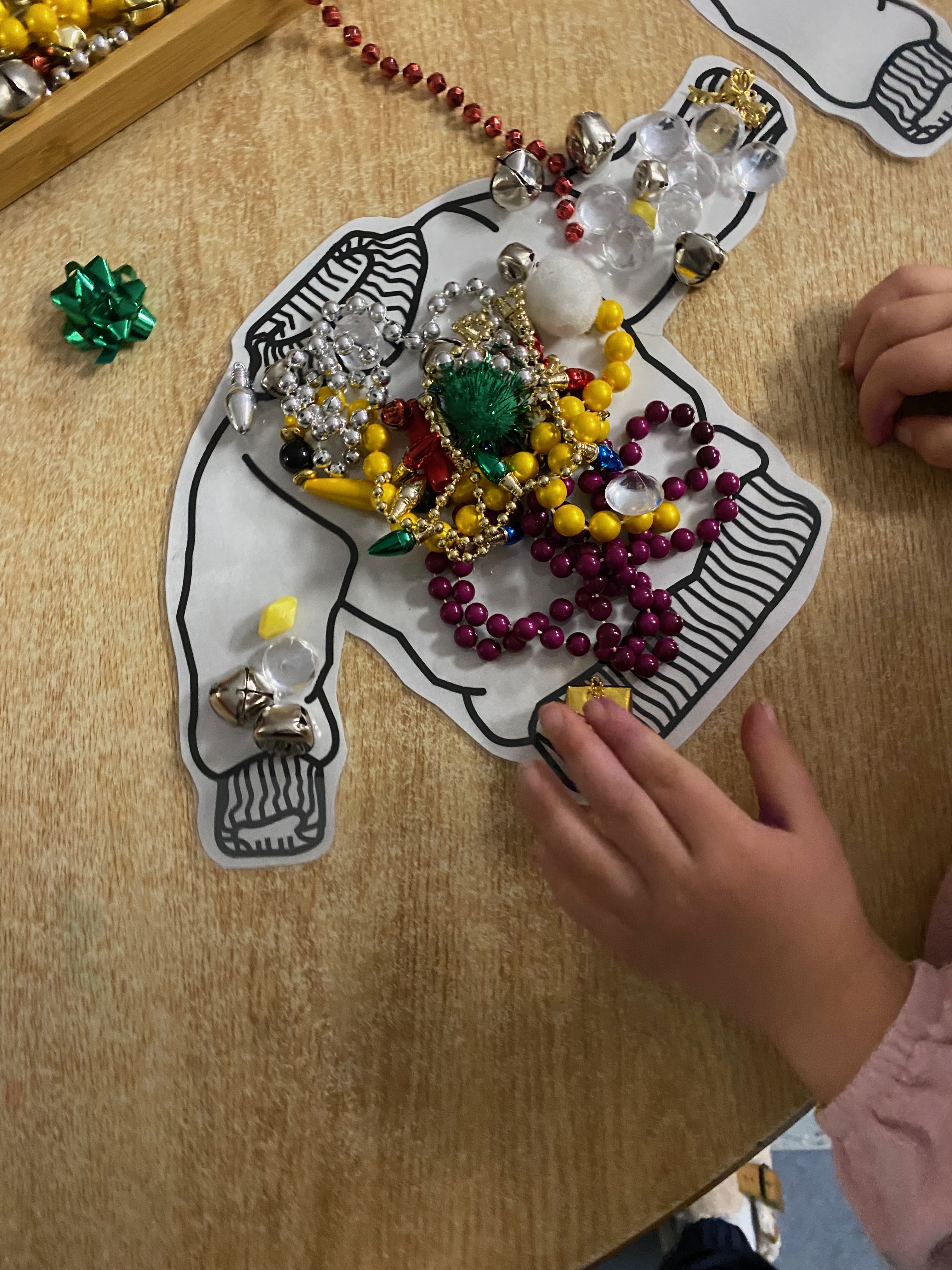
A fun activity this time of year is to decorate ugly holiday sweaters with a variety of loose parts! This activity promotes math as children create patterns on the sweaters. An interesting discussion of the differences between area and perimeter usually emerges as children use strings of beads to outline the sweater while filling it in with seasonal trinkets.


Click here for a copy of the free printable sweater page.


Sunday, December 3, 2023

Ten Easy Holiday Math Activities

The holidays are such a lovely time of year to spend with children! However the last few weeks before the winter break can be hectic. Here are ten easy to assemble activities that can infuse playtime with math by capturing the magic of the season! Many of the seasonal loose parts included in these photos were found at the local dollar store. Enjoy!

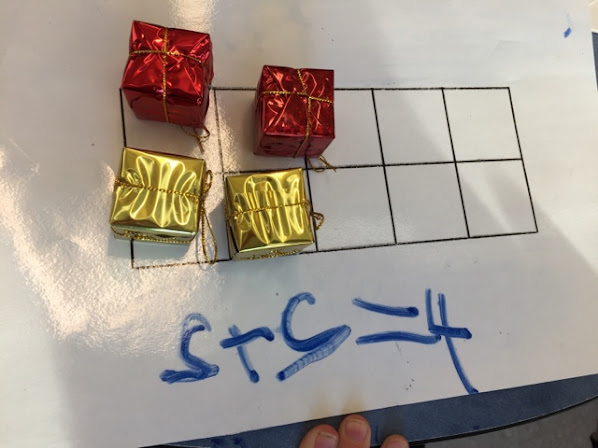
1. Count the Presents - offer children mini presents (or other seasonal trinkets including bells or ornaments) and number cards. Encourage children to match the corresponding number of objects to the cards. Children can also place presents on a laminated ten frame and write a corresponding addition or subtraction sentence using a dry erase marker.


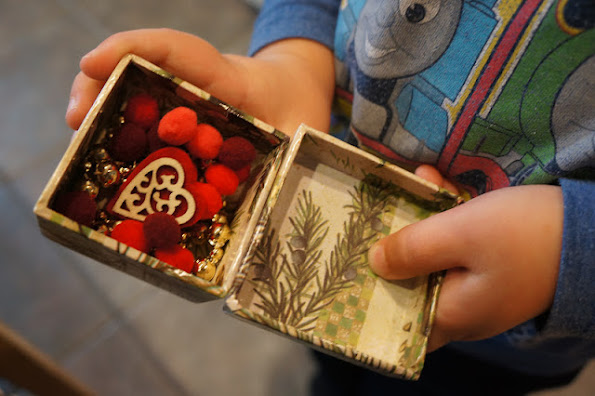
2.  Holiday Sensory Bin with Mini Boxes - fill a sensory bin with seasonal trinkets and treasures. Add mini present boxes and encourage children to fill the boxes with different objects. Children can then use a hundreds grid to count how many objects fit in each box!


3. Catapult the Gingerbread Man to Safety - help mini Gingerbread Men land to safety over the river by firing them using catapults made from clothespins attached to blocks using elastics. This activity works fine motor muscles too!


4. Cookie Cutter Bell Count - display a collection of bells in a tray with a variety of seasonal cookie cutters. Challenge children to fill one cutter with bells and use a hundreds grid to count how many it holds. Which cutter holds the most? Least?


5. What's Inside the Presents? - fill different holiday boxes with loose parts. Encourage children to shake one at a time and estimate how many objects might be inside. They can then open the box and spill the objects out. Each object can be placed on a number grid and counted.

6. Fill a Tree with Trinkets - children can explore the concepts of area and perimeter by filling or outlining wooden trees (or other seasonal place mats or shapes) with a variety of bead strings, ribbons or small objects.

7. String a Pattern - secure a number of green pipe cleaners to a sturdy cardstock or cardboard base in the form of a tree. Encourage children to string beads to 'decorate' the tree using different patterns. Children can also count how many beads they use for each section.
 

8. How Many Elastics? - children can wrap a number of elastics around cookie cutters until they are filled. Encourage children to count how many times they wrap each elastic. For an added fine motor challenge have children remove the elastics one at a time.


9. Gingerbread House STEM Challenge - provide children with magnet shapes and challenge them to build an intricate gingerbread house. Ask them to search the room for various loose parts that will attach to the magnets and 'decorate' the house (e.g., here the staples in mini bows attract to the magnets).

10. Holiday Guessing Jars - fill glass jars with seasonal loose parts. Encourage children to estimate how many objects are in each jar. The objects can then be shaken out and counted using math tools such as number grids and ten frames.


Looking for a book to support holiday math learning? Check out my book Holiday Math


Thursday, November 30, 2023

Virtual Bird Count

“There is an unreasonable joy to be had from the observation of small birds going about their bright, oblivious business.”
 Grant Hutchison

 
Colder weather and light snow this week have inspired new observations during outdoor play and exploration. The children have noticed birds hiding in the trees. It's been fun to watch them flit from branch to branch, observe their tracks in the snow and identify their different calls. I hoped to continue with these observations indoors. I introduced Cornell's live bird cam and invited children to spend time observing the animals that visited the different feeders. The children were enthralled with the quick, happy little birds as they flew in and out of the frame and gobbled up the seed.

The next day I asked children to predict which birds they thought might be at the feeders. We spent time drawing our guesses on a graphic organizer. I wanted to capitalize on the children's interest in the birds and integrate math and literacy into the experience. I also displayed posters from our library that had illustrations of common North American birds to be used as reference.


As the children observed the feeders they tracked what they saw on their charts. After ten minutes of watching we calculated and shared our results. Blue jays appeared the most!


This is an easy to implement activity that brings the outdoors inside! Click here for a free printable Bird Count tracking sheet children can use to record birds.

Friday, November 24, 2023

Subitizing Game Printable

Subitizing is the ability to instantly recognize the number of objects without actually counting them.


This week we practised subitizing using a number cube and this subitizing grid. Children rolled the number cube and dabbed a corresponding square on the grid. There are so many possibilities for how else children can extend this game. It's perfect for small group math work, a math center or independent practice during whole group time. Visit the link to download a copy of the grid. Enjoy!

Tuesday, November 7, 2023

Creating a More Inclusive Math Environment

I grabbed a coffee from a drive through this past weekend. While there I chatted with the employee working at the window. I asked him how his day was going.

"It was great until about five minutes ago," he said. "I just saw my former math teacher. I haven't seen him in years. Nice guy but I dreaded his class. I just never really felt like I belonged. I hated the math. Just couldn't relate. Seeing him brought up all those old feelings for me again."

As someone who loves math I was devastated to hear this story. As a kindergarten educator I try my best to cultivate a safe and supportive space where children feel like they are equal members of a democratic learning environment. I want kids to love math and see themselves as authentic mathematicians. Inclusive learning environments are ones in which children feel fully supported, and that their contributions and perspectives are equally valued and respected regardless of their identities or learning preferences. There is a sense of belonging for everyone.

Every child has the right to learn and reach his or her highest potential. This is especially important in mathematics, where growth mindset and differentiated learning and assessment approaches can make all the difference in how children interact within, and enjoy classroom explorations.

Inclusive math education ensures access to quality learning experiences for all children by meeting their diverse needs in a way that is responsive, accepting, respectful and supportive. Educators should work to diminish and remove barriers that may lead to children's disengagement and exclusion. 

There are many ways we can creative inclusive learning environments. Here are a few suggestions:

Critically Examine your Math Questions and Prompts

Consider the types of questions you ask children. Can they relate to what they are being asked? Are the questions relevant to their age, interests, strengths and needs? Is inclusive language used? I recall feeling troubled reading a question in my daughter's math work about the number of marriages that could be possible in a group of people when X number of men and women paired together. "What about gay couples?" she asked me when we reviewed her homework that evening.

Honour Student Voice in the Learning Process

Consider asking children to create the parameters for math work together in class. As an educator reflect upon the math work you ask children to complete - do they have a voice in the explorations and activities? Does math work ebb and flow around natural learning situations in the classroom or does it exist in isolation from children's lives? In our classroom we often explore new math tools together and play with how they might be used before I suggest a more formal or structured approach. I try to include children's ideas as much as possible.

Encourage Unconventional Ways of Representing Math

Consider the ways in which you ask children to explore math ideas and showcase their understanding. Do you tend to default to paper and pencil activities? Do children work only from worksheets or textbooks? Are you able to encourage children to use their hundreds of languages (e.g., painting, drawing, building) to explore math problems and share their findings with others? In the photo this child is exploring multiplication by creating an array with sticky notes. In our classroom we try to represent math thinking using innovative, non-traditional ways of knowing and being that are self-selected by children whenever possible.

Invite Family Knowledge into Math Experiences

Consider how you can welcome families into your math activities in order to enhance children experiences. Do family members have interesting jobs and hobbies that can be shared to help supplement children's understanding of math concepts or how math is used authentically in the world? How do families feel about math learning? What is it they value as part of the math learning process? Are their feelings about math limiting their children's potential? What role can families play in supporting children's emerging confidence when learning new concepts (e.g., take home math games, reading math books together)? Share information about math learning with families to help them deconstruct tasks and engage more authentically with math explorations.

Use Diverse Learning Materials

Consider the types of materials that are offered to children. Are they diverse and meet the children's interests, strengths and needs? Do they offer multiple ways of engaging with math? Are they inclusive so all children feel a connection in some way to the experience? Offering math materials throughout the classroom and not just in a 'math area' helps children see the connection that math has to the world around them and their own lives. Invite children to co-construct math materials and visuals that are used throughout the learning space.

Examine your Assumptions and Biases

Sometimes educators default to teaching about math the way they were taught. When something is new or uncomfortable it might seem natural to revert back to familiar ways of knowing and being. Many educators do not enjoy math and subconsciously communicate this to children. Consider how you talk about math with others. Do you present a growth mindset when problems occur that you are unsure of how to solve? Do you approach new and interesting mathematical situations with a stance of curiosity and willingness to learn? Math is a beautiful and engaging discipline and talking about it as such will help learners experience positive associations with math learning. 

Hold High Expectations for all Students

Children are natural mathematicians. They are curious about the world around them and want to understand how it works and make connections to others. Offering low floor, high ceiling tasks encourage all children to enter into math explorations and helps differentiate tasks for their individual needs. Activities that relate immediately to a child's world and experiences will be more meaningful for them mathematically. Communicate your belief to children that they are capable of participating fully in rich math learning and hold them to high expectations. Provide as much time, space and support as needed to ensure children experience success.

Use a Community Approach to Learning

Math is a communal experience. Too often children have been asked to complete math tasks in quiet isolation while working at desks. Rethink how you invite children into math exploration and encourage noise, mess, and social exploration. Ask children to work together to solve math problems and share their thinking with others. Resist the urge to default to thinking that math should look and sound like it might have in your childhood. Share with families and the greater community that math learning is rich and layered when we all work together.  

Create Unconventional Learning Spaces 

Math can happen anywhere, anytime. Help children see the authentic and meaningful ways math connects to our world by looking for it beyond the classroom. Be open to math moments that arise in outdoor play and exploration, and be intentional about the whole and small group math experiences you encourage in areas like the gym, library and music room. Embrace the questions children ask that are mathematical in nature, especially those related to risky play (e.g., "How fast/far/high can I run/jump/climb?").


Related Posts Plugin for WordPress, Blogger...